Periods can happen at the same time, but that is not the same as proving that they sync because people live together. Menstrual synchrony is the proposed biological process in which close contact makes people's cycle start dates align. The evidence has not established it as a reliable effect you can use to explain or predict your period.
If you and a friend, partner, sister or housemate have bled during the same week, the observation can be completely real. The question is what caused the overlap. Cycles have different lengths, those lengths can change, and bleeding lasts more than one day. That creates many opportunities for dates to meet temporarily without a coordinating signal.
This guide looks at the original claim, later research including a newer positive study, and a worked example showing how independent cycles can appear to converge. It also explains what to record if your own timing changes. You do not have to dismiss a shared experience, but you should not use it to overlook pregnancy possibility or symptoms that need care.
What does period syncing actually mean?
In everyday conversation, being in sync may mean bleeding on the same day, during the same week, or once during a holiday. Those descriptions are not equivalent. Two people can share a bleeding day while starting their periods several days apart. They can also start together once and have very different dates in the next cycle.
For a biological synchrony claim, researchers need more than one overlap. They need a clear definition, repeated observations and a comparison with the alignment expected when cycles operate independently. The proposed effect should be distinguishable from ordinary variation, selective reporting and the way start dates are paired for analysis.
Menstrual overlap is an observation; menstrual synchrony is an explanation that needs evidence. Neither same-week bleeding nor an app displaying similar predictions shows that one person's hormones have adjusted to another's. The distinction does not deny what you noticed. It simply prevents the calendar from being treated as proof of a mechanism it cannot measure.
What does the research show, including newer studies?
The idea became widely known after Martha McClintock's 1971 Nature paper reported synchrony among students living in a dormitory. Later work did not produce a consistently reproducible result. Wilson's 1992 critical review identified analytical and selection problems that could make synchrony appear more likely, including how initial differences and missing cycles were handled.
A 2006 study by Yang and Schank followed 186 Chinese students living in dormitories for more than a year and found no group synchronization. A separate 2006 Polish dormitory study also did not find synchrony. These studies do not forbid individual overlaps; they question whether close living produces alignment beyond what independent cycles can generate.
The literature is not uniformly negative. A 2023 observational study followed 62 medical students in shared rooms for 13 months and reported synchrony in some pairs. Its authors acknowledged a small, narrowly selected population and missing information about friendship. The result warrants discussion, not a claim that everybody's periods synchronize or that the study identified a cycle-altering chemical.
The practical conclusion is about the whole evidence base, not a vote between papers. Statistical assumptions, independent replication and a convincing mechanism matter. A March 2026 explanation by reproductive-health researchers likewise concludes that the popular period-syncing claim is not scientifically supported. It is more accurate to say not reliably established than to insist that no study has ever reported it.
| Research | Reported finding | How to interpret it |
|---|---|---|
| ResearchMcClintock, 1971 | Reported findingDormitory observations suggested closer timing. | How to interpret itAn influential starting point, not proof that all close contacts synchronize. |
| ResearchWilson, 1992 | Reported findingCritical review identified methodological errors. | How to interpret itAnalysis and exclusions can change whether apparent alignment is called synchrony. |
| ResearchYang and Schank, 2006 | Reported findingNo synchrony in 186 students followed for over a year. | How to interpret itConvergence and later divergence can arise from cycle variability. |
| ResearchZiomkiewicz, 2006 | Reported findingNo synchrony in a separate dormitory sample. | How to interpret itLiving together and social interaction did not establish a shared cycle. |
| ResearchStern and McClintock, 1998 | Reported findingAn underarm-extract experiment reported cycle-timing effects. | How to interpret itLaboratory claims and their critiques are separate from proof of natural household synchrony. |
| ResearchMedical-student study, 2023 | Reported findingA small observational study reported synchrony in some roommate pairs. | How to interpret itA positive result with limitations does not establish a reliable effect or a practical fertility method. |
A calendar example: dates can meet without a syncing mechanism
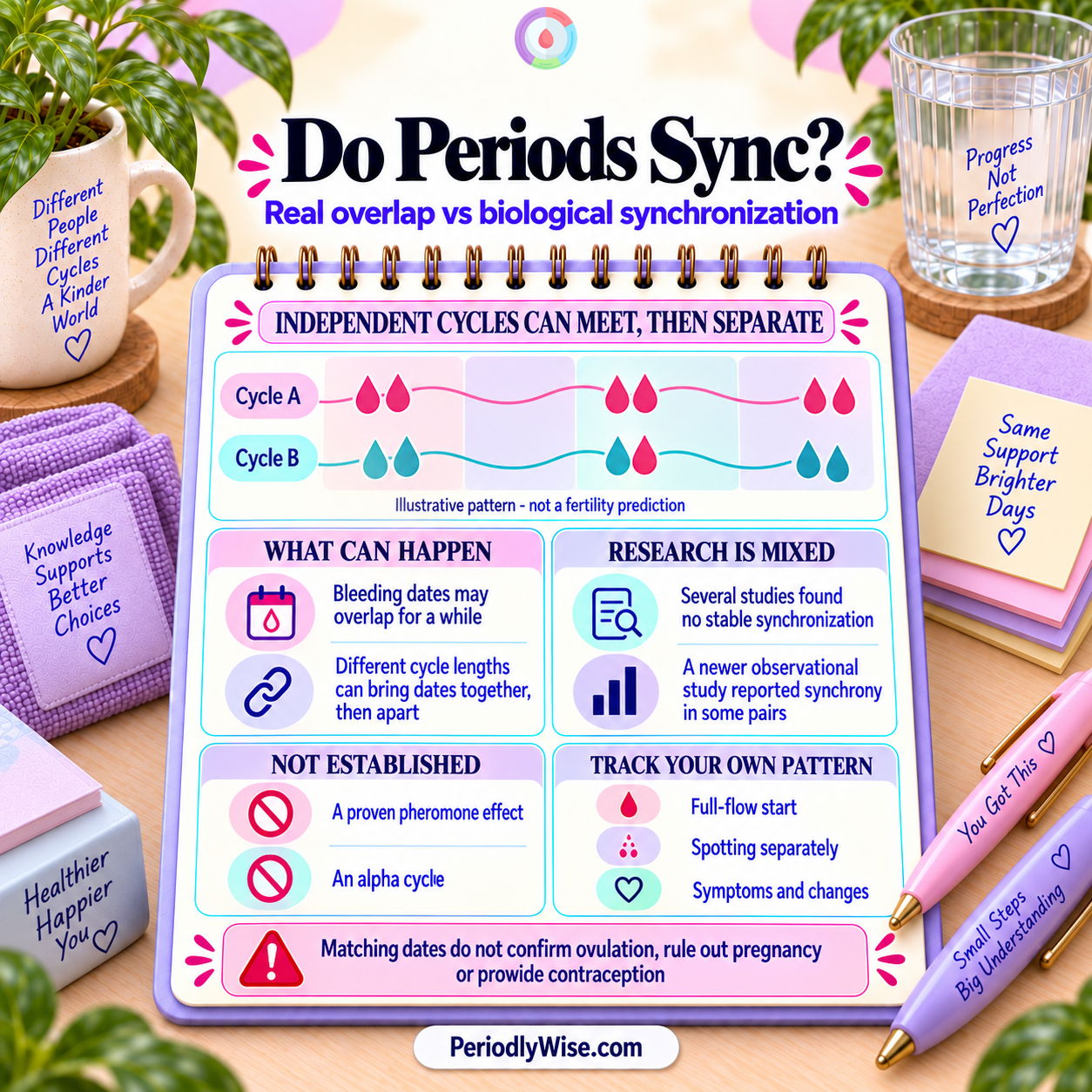
Imagine two independent cycles. Person A starts every 28 days and Person B every 26 days. In the illustration, A first starts on calendar day 1 and B on calendar day 7. B's shorter interval reduces the gap by two days at each subsequent start, until the dates meet. After that, the dates separate again because neither interval has changed.
The day numbers below belong to one shared imaginary calendar, not to either person's individual cycle-day count. These are constructed numbers to explain the arithmetic, not patient data, predictions or a claim that every cycle follows a fixed schedule. Real cycles can vary, which adds more possible patterns.
If both people bleed for five days, some periods also overlap before their starts match exactly. A four-day start difference can still create one shared bleeding day. Saying we were both on our periods is therefore a much broader observation than saying our bodies changed their timing to align.
| A: start on shared calendar | B: start on shared calendar | Start-date gap |
|---|---|---|
| A: start on shared calendarDay 1 | B: start on shared calendarDay 7 | Start-date gap6 days |
| A: start on shared calendarDay 29 | B: start on shared calendarDay 33 | Start-date gap4 days |
| A: start on shared calendarDay 57 | B: start on shared calendarDay 59 | Start-date gap2 days |
| A: start on shared calendarDay 85 | B: start on shared calendarDay 85 | Start-date gap0 days: one exact match |
| A: start on shared calendarDay 113 | B: start on shared calendarDay 111 | Start-date gap2 days: dates separate |
| A: start on shared calendarDay 141 | B: start on shared calendarDay 137 | Start-date gap4 days: separation continues |
Why does overlap feel so convincing?
A shared experience is easier to remember when you talk about it. Borrowing a pad, noticing cramps on the same evening or joking about a household period week makes the overlap visible. Months when one person menstruates quietly and nobody compares dates are less likely to become part of the story.
That is one form of confirmation bias: a memorable match gets more attention than ordinary non-matches. It is not a criticism of anyone's honesty. We all notice patterns, particularly when they carry social meaning. In a larger household or friendship group, there are also more pairs to compare and more opportunities to find a close match somewhere.
Changing the definition after seeing the dates adds another problem. Starting within a day, within a week and sharing any bleeding day give different results. If the rule expands whenever the dates do not fit, the observation becomes difficult to evaluate. Consistent records are more informative than a collection of the most striking coincidences.
- Duration: a period spans several days, creating an overlap window.
- Different intervals: shorter and longer cycles can move closer and then apart.
- More comparisons: a group offers more possible pairs than one household story suggests.
- Selective memory: record the non-matching dates as well as the memorable matching ones.
Do pheromones, smell or an alpha cycle make periods sync?
Pheromones are proposed chemical signals between members of a species. Animal findings are not automatic evidence for a human menstrual effect. A 1998 experiment by Stern and McClintock reported that underarm compounds collected at different cycle stages altered timing in recipients. That claim is part of the scientific history, not a proven household method.
Richard Doty's scientific discussion of human pheromones describes major criticisms of the experiments and the absence of an identified, validated cycle-synchronizing signal in that evidence. Neither that literature nor the newer roommate study establishes a reliable chemical mechanism for everyday period syncing.
There is no established alpha period that dominates a group. Who bleeds first does not measure hormonal strength, leadership, attractiveness or closeness. You do not need to avoid a friend's scent, change deodorant, separate bedrooms or buy a pheromone product to manage your cycle. No such recommendation follows from the evidence discussed here, and trying to force matching dates can distract from your own health needs.
Could a shared routine affect each person's cycle separately?
Living together may also mean shared exams, a move, demanding training or disrupted routines. A common circumstance is different from one person's cycle controlling another's. NHS guidance on irregular periods lists stress, major weight changes, excessive exercise, life stage and hormonal contraception among relevant contexts. It does not establish that those influences make housemates synchronize.
Responses can differ even when the environment is similar. One person's cycle may change while another's does not, or the changes may occur at different times. Recording a stressful month is useful context, but it does not diagnose why a particular period was late. Avoid turning a plausible shared factor into a certain explanation.
Puberty, breastfeeding, perimenopause, contraception changes and health conditions can also alter patterns. Family members may share some circumstances without being in the same reproductive stage. If your dates change after moving in with someone, compare them with your own previous pattern and consider pregnancy possibility or symptoms rather than assuming you absorbed another person's cycle.
Same bleeding dates do not mean the same ovulation or fertility
The NHS explanation of the menstrual cycle separates bleeding, ovarian activity and fertility. Bleeding start dates alone cannot confirm the exact day of ovulation. Two people starting a period together may have different cycle lengths and different timing later in that cycle.
Hormonal contraception adds another distinction. A scheduled bleed during a hormone-free interval is not the same evidence as an unmedicated ovulatory cycle, and some methods produce irregular spotting or no bleeding. Similar prescribed schedules can explain similar bleeding dates without demonstrating biological synchronization. Do not stop, start or rearrange prescribed hormones just to match someone else.
Never use a friend's period to decide whether sex is safe from pregnancy. It cannot supply your fertile window, rule out pregnancy, or replace a contraceptive method. Likewise, an estimate in a calendar app is not confirmation of ovulation. If trying to conceive or managing irregular cycles, get guidance appropriate to your own history instead of borrowing someone else's dates.
How to track your own pattern without chasing synchrony
Use the same recording convention each time. For general menstrual tracking, note the first day of actual period flow and label separate light spotting separately; follow your clinic's convention if receiving fertility care. Record actual events rather than copying a predicted date. A period that starts later than an app guessed is not automatically an abnormal cycle.
Count a cycle from the first day of one period to the first day of the next. Several records help describe your usual range, but you do not need to collect months of evidence before asking about a symptom. ACOG's bleeding diary illustrates the value of documenting the pattern for a clinical conversation.
If you compare dates with someone, obtain their agreement and keep their record separate. Do not place their information in your own health history or assume access to a shared phone is consent. Sharing a story does not require sharing a full calendar, sexual history, pregnancy concern or account password. Stop comparing if it increases anxiety or pressure.
| Record | Useful example | What it can tell you |
|---|---|---|
| RecordActual flow and spotting | Useful exampleLight spotting Friday; usual flow began Saturday. | What it can tell youKeeps different bleeding events distinct. |
| RecordStart-to-start interval | Useful exampleThe latest interval was 30 days; earlier ones were 27 and 29. | What it can tell youDescribes your own variation, not a friend's influence. |
| RecordSymptoms and daily impact | Useful examplePain interrupted work; dizziness accompanied heavier flow. | What it can tell youGives care-relevant information beyond calendar dates. |
| RecordContext | Useful exampleChanged contraception or had a demanding training period. | What it can tell youAdds context without establishing the cause. |
| RecordPrediction versus observation | Useful exampleApp estimated Tuesday; actual flow began Thursday. | What it can tell youPrevents a forecast from replacing the real record. |
- Record your actual start: note full-flow onset and separate spotting, using a consistent definition.
- Calculate your own intervals: count start-to-start days rather than the difference from a housemate.
- Add useful symptoms: flow, pain, fatigue, dizziness and impact on school, work or daily activity.
- Note relevant changes: contraception, medicines, pregnancy possibility, illness, stress, food or training changes.
- Keep predictions distinct: an estimated date is a planning aid, not an observed event or safety check.
- Review the whole pattern: include non-matches if comparing voluntarily, and seek care for concerning changes.
When not to explain a late or unusual period as syncing
If pregnancy is possible, a missed period should prompt testing at an appropriate time, not a comparison with a roommate. NHS guidance advises testing from the first missed-period day, or at least 21 days after the last unprotected sex if you do not know when the period is due. If a negative test was early or suspicion remains, repeat after a few days; seek advice if a second negative is followed by continued absence.
Arrange clinical advice for a persistent new pattern, repeatedly irregular cycles, bleeding between periods or after sex, or pain or heavy flow that affects daily life. NHS missed-period guidance also recommends assessment after three missed periods in a row. That is not a reason to wait through severe symptoms, pregnancy concerns or a worrying change.
ACOG's abnormal-bleeding advice highlights very heavy flow and symptoms such as dizziness, shortness of breath or chest pain. Seek emergency help for severe bleeding with faintness or serious illness, or severe sudden abdominal pain. With possible pregnancy, unusual bleeding and abdominal pain need urgent assessment; shoulder-tip pain, collapse or severe one-sided pain can indicate an ectopic pregnancy emergency, even without a positive home test.
You can share support without needing matching cycles
Period conversations can make practical support easier: keeping products available, respecting a request for rest or helping someone get medical advice. Those benefits do not require biological synchrony. Your experience is not less valid if you bleed alone, and a friend's different schedule is not evidence that you are less close.
Avoid ranking cycles as strong, weak, normal enough or more feminine. Women, trans men and nonbinary people may menstruate, and not everyone wants to discuss it. Respect a person's words, identity and privacy. Do not infer pregnancy, sexual activity or illness because someone did not join the household period week.
If someone says our periods always sync, a useful response is that the overlap may be real while the cause remains uncertain. You can keep the shared joke or supportive ritual without turning it into a medical claim. The most useful question remains: is my own pattern familiar, comfortable enough for daily life, or changing in a way I should discuss with a clinician?
Frequently asked questions
Do periods sync when you live with someone?
Periods may overlap, but a reliable biological synchronization effect from living together has not been established. Different intervals, bleeding duration and ordinary variation can produce temporary matches. Some positive studies exist, but their findings do not make household syncing a proven explanation.
Why do my friend and I get our periods in the same week?
A period lasts several days, so starts need not match for bleeding to overlap. Independent cycles can approach and separate, and matching weeks are often more memorable than non-matches. The observation does not identify its cause or prove that your hormones adjusted to each other.
Do sisters, mothers and daughters, or partners synchronize?
A family relationship or intimate partnership does not establish a synchronization mechanism. Shared circumstances can matter to each person's health, but life stage, contraception and cycle history can differ substantially. Use your own record rather than treating a relative's or partner's dates as a prediction.
Is there an alpha period or a dominant cycle?
No established evidence shows that the first person to bleed sets a group's cycle. Period timing does not measure dominance, hormone strength or closeness. You do not need to avoid someone's smell or buy a syncing product.
Does one positive research study prove period syncing is real?
No. It should be considered alongside methods, limitations, chance comparisons and independent replication. The 2023 shared-room study reported positive findings in a small selected population; it did not establish a universal effect, identify a proven pheromone or validate a fertility-planning method.
If our periods match, do we ovulate together?
You cannot infer that from bleeding dates. Ovulation timing and cycle length differ, and contraceptive-related bleeding may not reflect an unmedicated cycle. Another person's calendar is never a contraceptive method or a way to rule out pregnancy.
Can a period tracker prove that we are synchronized?
A tracker can record actual dates and show overlap. It cannot by itself distinguish a biological influence from independent variation, shared circumstances or how comparisons were selected. Predictions are not observed periods. Keep records separate and share only with consent.
Should I worry if my period no longer matches my friend's?
Not because the dates differ. Assess your own pattern and symptoms. Test appropriately if pregnancy is possible, discuss persistent changes or bothersome flow or pain, and seek urgent or emergency help for concerning symptoms rather than waiting for another person's cycle.
Use your actual period start and your own recent cycle history for an educational estimate. PeriodlyWise can support planning, but its dates do not diagnose a change, confirm ovulation or provide contraception. Keep symptoms and pregnancy-test decisions separate from the forecast.
Open the Period TrackerThe takeaway
Overlapping periods are real; a reliable biological mechanism that makes housemates' cycles synchronize is not established. Research has mixed findings and important methodological questions. Share support freely, track your own observed pattern, and never use matching dates to overlook a missed period, possible pregnancy or symptoms that need medical attention.