Period tracker privacy concerns can sound abstract until you picture the actual notes people save: late periods, fertile-window estimates, sex timing, pregnancy worries, symptoms, mood, medication changes, miscarriage history, contraception changes, and appointment questions.
Cycle data is not just a calendar entry when it is connected to your identity, device, account, location, advertising profile, or cloud backup. It can become sensitive personal context, even when the app looks soft, friendly, and routine.
This guide is a practical checklist. It explains what to ask before using a period tracker, what privacy laws may not cover, and how to keep tracking useful without giving away more than you intended.
What period data can reveal
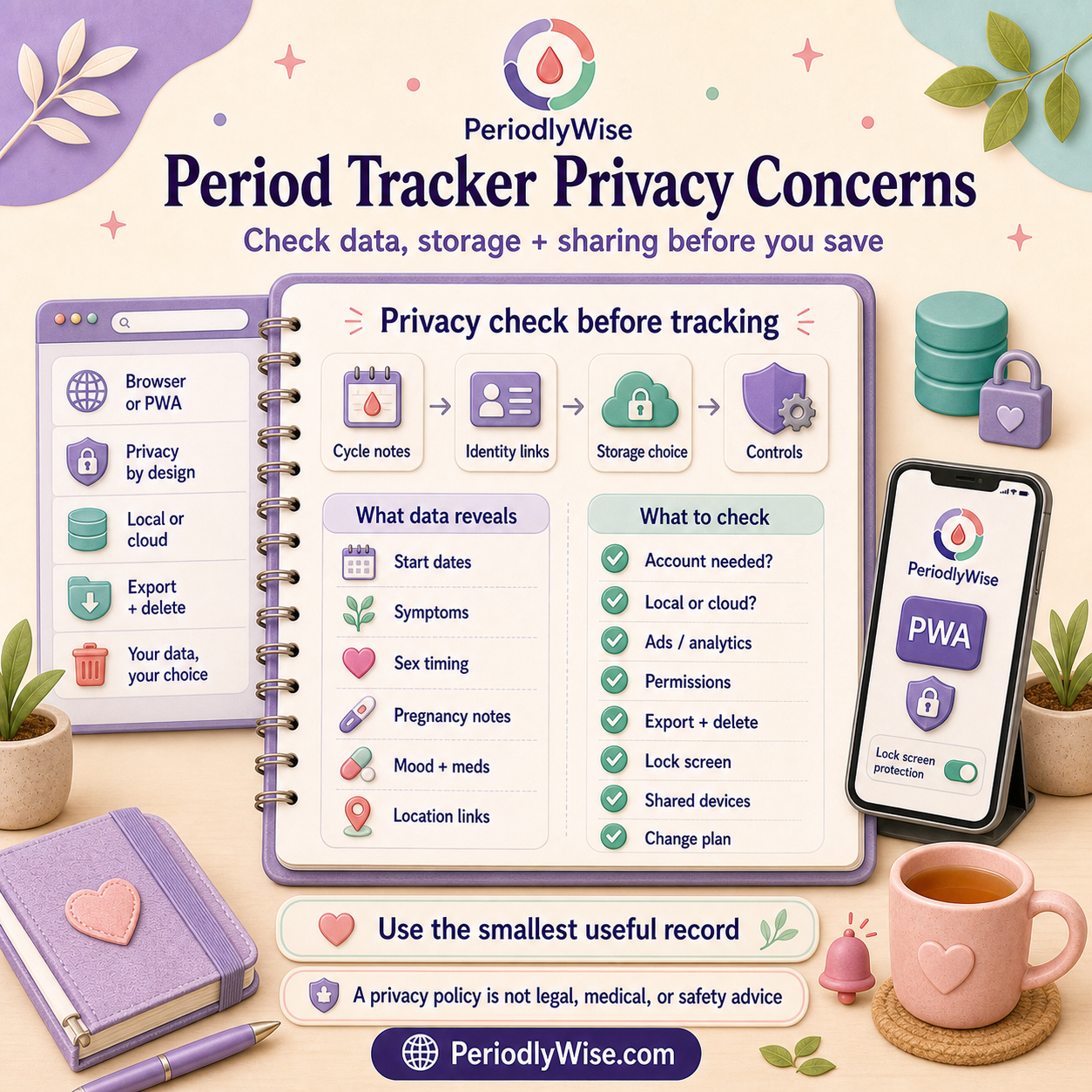
A simple period start date can be useful and low-friction. The sensitivity rises when entries show repeated cycle changes, possible pregnancy, ovulation goals, contraception timing, sexual activity, pain, discharge, mood, mental health, medication, location, or clinician notes.
Account data can add another layer. An email address, phone number, device identifier, IP address, payment history, location signal, or advertising identifier can connect cycle notes to a person rather than leaving them as private reminders.
The FTC has treated health app privacy promises seriously, including enforcement involving a fertility app that allegedly shared users' health information after promising privacy. That history is why it is reasonable to read beyond the home page and ask what happens after you tap save.
Period tracker privacy checks
| Question | Why it matters | Lower-risk habit |
|---|---|---|
| Can I use it without an account? | No account can reduce identity links, but may limit saved history or device syncing. | Use account-free mode for quick estimates if you do not need long history. |
| Where is data stored? | Browser storage, phone storage, cloud storage, and backups create different exposure paths. | Choose the least storage needed for your goal and understand sync before enabling it. |
| Does it share data for ads or analytics? | Analytics and advertising tools can move sensitive context outside the app's core service. | Prefer tools with plain explanations, minimal sharing, and opt-out controls. |
| Can I delete and export? | Deletion and export controls matter when you change tools, share devices, or reduce detail. | Test settings before entering highly sensitive notes. |
| What permissions are requested? | Contacts, precise location, photos, microphone, and unrelated device access can be unnecessary. | Decline permissions that do not clearly support cycle tracking. |
What privacy laws do and do not solve
Health privacy rules can be narrower than people expect. HHS materials explain that HIPAA applies to covered entities and business associates, not automatically to every consumer app that stores health-related information. A period tracker outside that covered relationship may be governed by other consumer privacy, health breach, advertising, contract, state, or country-specific rules.
The FTC's mobile health app guidance tells developers to consider laws such as the FTC Act and the Health Breach Notification Rule. The updated rule also focuses on many health apps and similar technologies not covered by HIPAA. That does not mean every situation is protected in the way a user imagines; it means data practices and promises matter.
Legal rights vary by place, age, data type, provider relationship, and the exact service. This article cannot tell you your legal risk. For immigration, abortion, fertility treatment, intimate partner safety, school, employment, custody, insurance, or law-enforcement concerns, treat legal advice as separate from app advice.
Questions to ask before using a period tracker
You do not need a perfect privacy audit. A few clear questions catch most of the practical issues.
- Purpose: What do I need the tracker to do: estimate dates, remember symptoms, support fertility timing, or prepare for appointments?
- Data amount: Can I track only start dates instead of detailed sexual, pregnancy, or mood notes?
- Account choice: Is sign-in required, and what identity information is attached to the account?
- Storage: Is data kept on my device, in browser storage, in a cloud account, or across several backups?
- Sharing: Does the privacy policy explain service providers, analytics, ads, affiliates, or research uses in plain language?
- Permissions: Does the app ask for location, contacts, photos, microphone, notifications, or health platform access?
- Controls: Can I correct, export, download, delete, or close my account without emailing support?
- Security: Are HTTPS, authentication options, app lock, password hygiene, and breach notices addressed?
- Household safety: Could someone else see the app, email, notifications, device backups, browser history, or shared account?
- Change plan: What will I do if my privacy needs change: delete details, export records, switch tools, or pause tracking?
A calmer privacy routine
Use tracking in a way that matches your real risk level, not a generic privacy promise.
- Start with the smallest useful entry. A start date and flow level may answer everyday planning questions without storing intimate details.
- Separate sensitive notes. If a detail would feel risky in an account, keep it offline, use neutral wording, or bring it directly to a clinician instead.
- Review settings before history builds. Check sync, analytics choices, notifications, lock screen previews, exports, and deletion while the stakes are low.
- Protect the device. Use a strong device passcode, private browser habits, account hygiene, and notification settings that fit your household context.
- Revisit after life changes. Pregnancy concerns, legal climate, relationship safety, travel, shared devices, or new health goals can change the right level of tracking.
When to be extra cautious
Be more cautious if someone else can access your phone, browser, email, cloud backup, shared tablet, family account, notification previews, or app purchase history. Privacy is not only about the app company; it is also about the spaces where your data appears.
Be more cautious when entries involve pregnancy, abortion, fertility treatment, miscarriage, sexual activity, medication, gender identity, mental health, immigration, custody, school, employment, or relationship safety. Those notes may deserve less detail, a different storage place, or professional guidance.
Do not rely on a tracker as a legal shield. If you face a concrete legal or safety concern, ask a qualified legal, health, or advocacy professional in your location. A privacy policy cannot replace that support.
Use PeriodlyWise for privacy-aware cycle estimates, clear limits, and lighter tracking choices that do not require turning every body note into a permanent diary.
Open PeriodlyWiseFAQ
Are period tracker apps safe to use?
Some tools may be reasonable for basic tracking, but safety depends on storage, sharing, security, deletion controls, permissions, your device, and your personal risk. Read the policy before saving sensitive details.
Does HIPAA protect my period tracker data?
Not automatically. HIPAA generally applies to covered healthcare entities and business associates. A consumer period app may fall outside HIPAA unless it is connected to a covered relationship.
Should I delete my period tracker?
It depends on your risk and goals. You might keep a lighter record, delete sensitive notes, use account-free tracking, export needed history, or pause tracking if the data creates safety concerns.
What period data is most sensitive?
Pregnancy concerns, sex timing, fertility goals, abortion or miscarriage notes, medications, location-linked entries, mental health notes, and data tied to your identity can be especially sensitive.
Is browser-based tracking more private than an app?
Not automatically. Browser-based tracking can reduce app-store friction, but the important questions are still storage, account use, cookies, analytics, sharing, deletion, export, and device access.
Final thoughts
Period tracking can be useful without being invasive. The key is choosing the smallest useful record and understanding where that record goes.
Privacy is not one setting. It is storage, identity, sharing, device safety, legal context, and your ability to change your mind later.