Is a period tracker accurate? It can be accurate enough to help you prepare for a likely period window, especially when your cycles are fairly consistent and you enter the correct start dates. But that does not mean every highlighted day has the same reliability. Recording a period that already happened is different from predicting the next one, and predicting a period is different again from estimating ovulation or fertile days.
The most honest answer is therefore not a percentage. Accuracy depends on what the tracker is predicting, what data it receives, how much your cycles vary, and how the result is presented. A tracker that shows a realistic range and explains uncertainty may be more trustworthy than one that confidently names a single day.
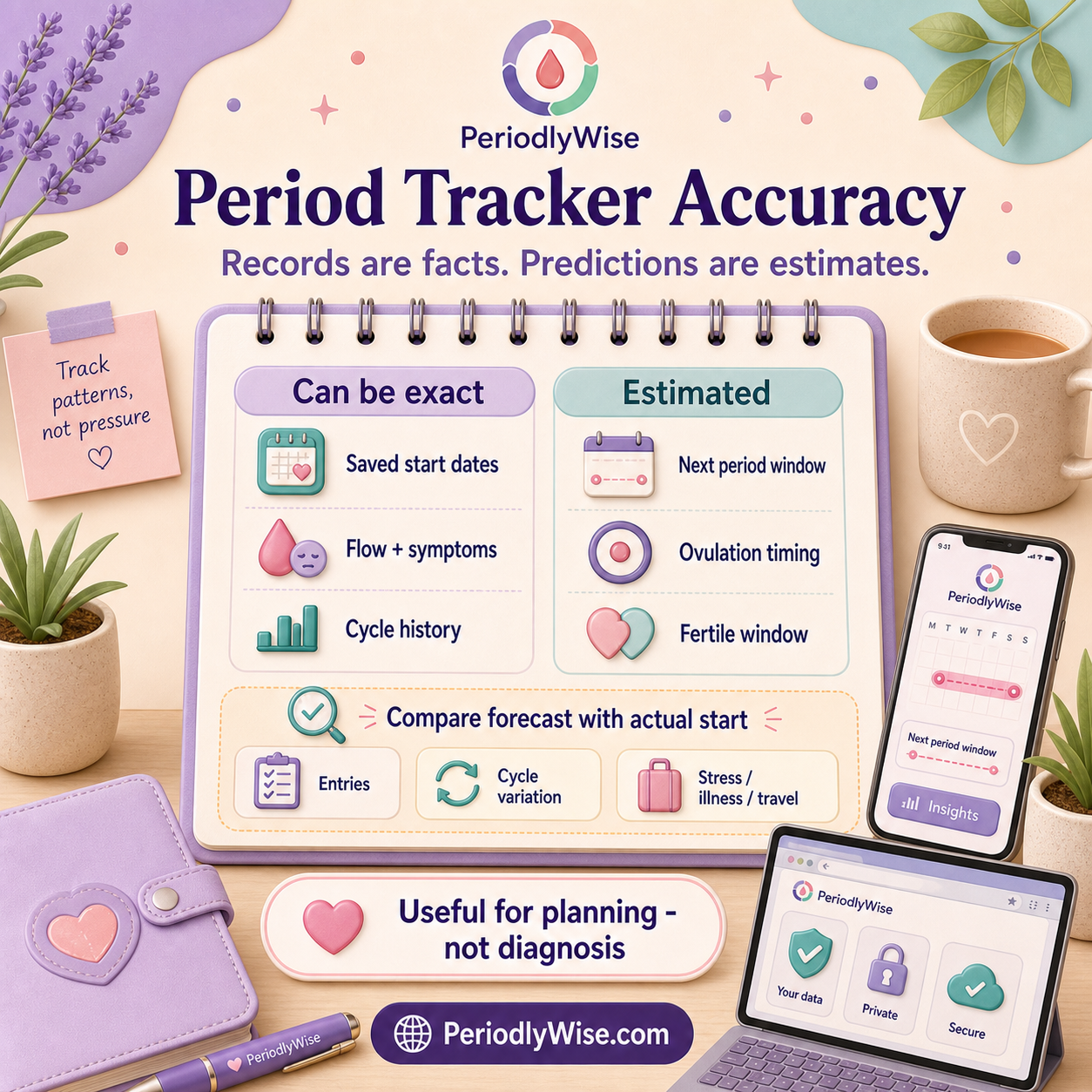
First, separate four meanings of "accurate"
1. Did it record what you entered?
If you correctly enter that full flow began on August 3, the tracker can store August 3 accurately. Errors here usually come from choosing spotting instead of full flow, forgetting a cycle, entering the final bleeding day, changing time zones, or accidentally editing a record.
2. Did it summarize your history correctly?
A tracker can calculate cycle length from one start date to the next and summarize averages or ranges. The calculation may be exact while the data is incomplete. A missed entry can make one apparent cycle look twice as long, which is a tracking artifact rather than a body pattern.
3. Did it predict the next period closely?
This is a forecast. It may be close when recent cycles are stable, but it can be early or late when the current cycle differs from the past. The Office on Women's Health notes that menstrual cycle length can vary from month to month, including for people whose periods are generally regular.
4. Did it identify ovulation or fertile days?
This is the most easily overinterpreted claim. A calendar model infers ovulation from dates; it does not observe egg release. A study using luteinizing hormone measurements found substantial variation in ovulation day for the same cycle length and concluded that cycle-length information alone cannot accurately predict the ovulation day for every cycle.
Why period-date estimates can be more useful than ovulation estimates
The next period estimate asks a relatively direct historical question: based on previous gaps between start dates, when might the next start occur? If your last several cycles were 28, 29, 28, and 30 days, a prediction near that range can be useful for planning.
Ovulation is different. The tracker is estimating an internal event from external calendar dates. Even if the next period eventually arrives when expected, the precise day of ovulation may not have been the highlighted day. Research comparing apps has also found that different tools can give different cycle, ovulation, and fertile-window results from the same hypothetical profiles.
That is why PeriodlyWise labels these dates as estimates and uses ranges. Read How Calculations Work and Signs of Ovulation to understand what calendar timing and observed signs can each contribute.
What makes a period prediction closer or farther away?
- Correct start dates: day 1 should be the first day of full menstrual flow, with uncertain spotting kept separate.
- Enough recent cycles: one cycle gives little information about personal variation. Several complete cycles show more context.
- Cycle consistency: a narrow recent range supports a narrower estimate; irregular timing needs a wider one.
- Complete tracking: missed periods in the log can create falsely long cycles and distort averages.
- Life and health changes: illness, stress, sleep disruption, travel, weight or exercise changes, postpartum recovery, breastfeeding, perimenopause, PCOS, thyroid conditions, and other factors may shift timing.
- Contraception and medication: starting, stopping, missing, or changing hormonal contraception can change bleeding and ovulation patterns. Some methods suppress ovulation.
- Model transparency: a range with an explanation is easier to judge than a single date produced by an undisclosed method.
If cycle length itself is unclear, begin with Cycle Length Meaning. If your dates recently moved, read Why Period Dates Change.
A simple way to measure your tracker's period prediction
You do not need a technical score to learn whether a tracker is useful for your own planning. For three to six cycles, write down the predicted start date before the period begins, then compare it with the actual first day of full flow.
Save the central predicted date and the full predicted window. Do not change the record after seeing the outcome.
Record the true first day of full flow. Note uncertain spotting separately.
If the prediction was August 10 and flow began August 12, the central prediction error was 2 days late.
Ask whether the actual start fell inside the displayed range. A useful range can succeed even when the central date differs.
Repeated small errors may still support planning. Increasing or erratic errors may signal changing cycles, incomplete data, or a model that does not fit your pattern.
This is not a medical test of your cycle. It is a practical audit of whether the prediction helps you prepare. Avoid comparing your result with another person's app: different cycle patterns, inputs, and algorithms make that comparison weak.
Green flags in a responsible period tracker
- It calls future dates estimates. Language such as "likely," "possible," or "window" reflects biological uncertainty.
- It uses your own history. It does not quietly force every person into a 28-day cycle.
- It shows variation. Shortest, longest, recent average, or a visible range can be more informative than one number.
- It separates period, ovulation, and fertile timing. These outputs should not be presented as interchangeable.
- It explains limits. It does not claim to diagnose conditions, confirm pregnancy, or replace contraception.
- It lets you correct data. A wrong or missing start date should be editable without hiding what changed.
- It respects sensitive information. Storage, account use, deletion, export, permissions, and sharing should be understandable.
For browser use and privacy questions, read Period Tracker Online and Privacy-First Cycle Tracking.
Red flags in accuracy claims
Be cautious if a tracker promises an exact future period every time, treats day 14 as universal ovulation, claims that period dates alone confirm fertile or infertile days, uses a single "accuracy percentage" without explaining what was measured, or implies that a missed prediction diagnoses a condition.
Also be cautious when an app changes an old prediction after the actual period is entered and then presents the revised date as if it had always predicted correctly. A fair accuracy check preserves the forecast that existed before the outcome.
Can a period tracker be accurate with irregular cycles?
It can record irregular cycles accurately, but forecasting them is harder. A record of start dates, flow, symptoms, and context may be extremely useful even when the next date cannot be predicted closely. In that situation, the tracker's value shifts from exact forecasting toward pattern description and clearer medical conversations.
Use a broad range based on several real cycles rather than one average. The Irregular Period Tracker and tracking irregular periods without guessing guide are designed around that distinction.
Accuracy is not the same as contraception or fertility diagnosis
A tracker can help organize information when trying to understand a cycle, but a basic calendar prediction cannot assess egg quality, sperm, fallopian tubes, implantation, hormonal conditions, or other factors involved in fertility. It cannot confirm pregnancy or infertility.
Do not use a general period prediction or calendar-only fertile window as your only method of avoiding pregnancy. Fertility-awareness-based contraceptive methods require specific rules, appropriate instruction, consistent observations, and a plan for fertile days. Discuss suitable contraception with a qualified healthcare professional.
When the accuracy question is really a health question
Sometimes a tracker seems "wrong" because the cycle itself changed. Seek medical guidance when periods become repeatedly much shorter or longer than your usual pattern, stop unexpectedly, become very heavy, occur between periods or after sex, or come with severe or worsening pain. Seek prompt care for possible pregnancy with pain or bleeding, fainting, severe weakness, shoulder pain, fever, shortness of breath, or other worrying symptoms.
The tracker can help by preserving dates and symptoms for the conversation. It cannot explain the cause on its own.
Period tracker accuracy FAQ
How many cycles does a period tracker need?
Several complete cycles provide more personal context than one. There is no universal number that guarantees accuracy, and sudden changes can still make a future cycle differ from the history.
Why was my tracker accurate for months and then wrong?
The current cycle may have shifted because of ordinary variation or changes in health, stress, sleep, travel, medication, contraception, life stage, or other factors. One missed prediction does not diagnose the reason.
Are period predictions more accurate than ovulation predictions?
They can be more useful for planning because they are based directly on previous period intervals. Ovulation day varies within cycles of the same length, so calendar-only ovulation estimates carry greater uncertainty.
Can a period tracker tell me if I am pregnant?
No. A late period may be a reason to take a pregnancy test when pregnancy is possible, but a tracker cannot confirm or rule out pregnancy.
Track real start dates, view ranges, and compare predictions with outcomes over time. Let the record support planning without asking it to predict biology perfectly.
Open the Period Tracker