Ovulation can feel invisible if you are only looking at a calendar. Some cycles give obvious clues. Others are quiet. Some people notice changes in discharge, mood, energy, libido, or pelvic sensation. Some notice nothing at all. All of those experiences can be valid.
The signs of ovulation are best understood as clues, not guarantees. They can help you understand your fertile window, compare cycle patterns, and notice when timing shifts. But they cannot confirm ovulation with absolute certainty for every person, and they should not be treated as a stand-alone birth control method.
PeriodlyWise can help you organize ovulation clues next to period dates, cycle length, symptoms, and life context so your cycle feels less random without turning tracking into pressure.
Ovulation basics: what is happening?
Ovulation is when an ovary releases an egg. In many cycles, ovulation happens before the next period, and ACOG explains that it often occurs about 14 days before a period starts, though timing can vary. That is why counting backward from the next period often explains the pattern better than assuming everyone ovulates on cycle day 14.
The fertile window is broader than the ovulation day. The days leading up to ovulation matter because sperm can live in the reproductive tract for several days, while the egg has a shorter window after release. For more detail, read Ovulation Window vs Fertile Window.
The main signs of ovulation to notice
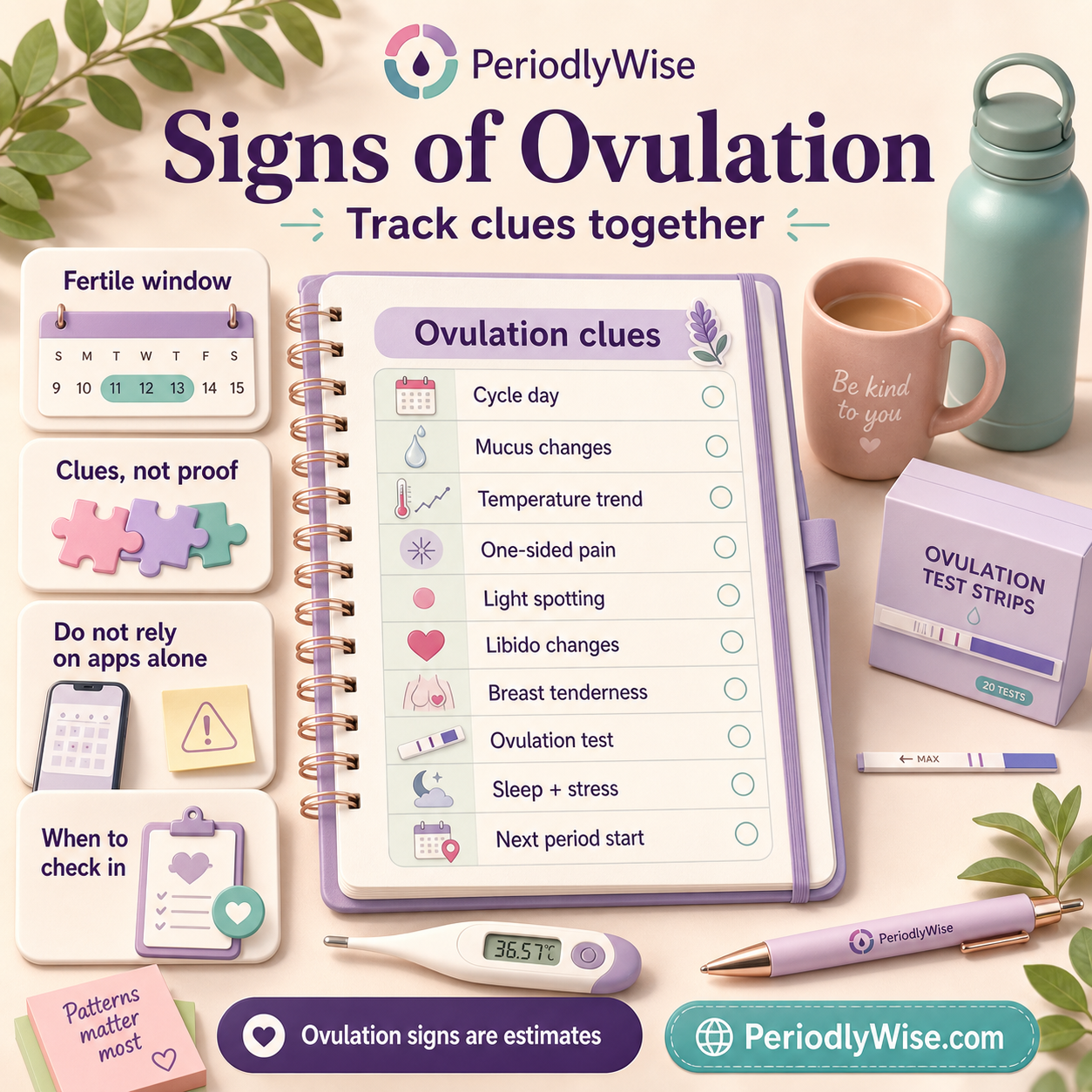
No single sign appears for everyone. Think of these as possible clues.
| Possible sign | What it may feel or look like | Tracking note |
|---|---|---|
| Cervical mucus change | Discharge may become clearer, wetter, slippery, or stretchy around fertile days. | Note texture, color, stretch, and cycle day. |
| Basal body temperature rise | Temperature may rise slightly after ovulation, not before it. | Track every morning before getting up and look for a trend. |
| Mild one-sided pelvic pain | Some people feel a twinge, ache, or cramp on one side. | Note side, pain level, duration, and whether it repeats. |
| Light spotting | A small amount of spotting can happen for some people. | Track amount, color, pain, and whether it is unusual. |
| Libido changes | Some people notice increased sexual desire near fertile days. | Useful only as a soft clue, not a medical test. |
| Breast tenderness or bloating | Hormone shifts may bring mild body changes. | Compare timing across several cycles. |
| Positive ovulation test | LH tests can detect a hormone surge before ovulation. | Record test date and time, but remember tests are still not a full diagnosis. |
Cervical mucus: the sign many people miss
Cervical mucus often changes through the cycle. Around fertile days, it may become more slippery, wet, clear, or stretchy. ACOG's fertility-awareness guidance includes cervical mucus monitoring as one of the ways people estimate fertile days.
Track what you actually see rather than forcing labels. "Dry," "sticky," "creamy," "watery," and "stretchy" can be enough. If discharge has a strong odor, itching, burning, pelvic pain, fever, or a color that worries you, treat that as a medical symptom rather than an ovulation sign.
Basal body temperature: useful but easy to misread
Basal body temperature can rise slightly after ovulation due to progesterone. The key phrase is after ovulation. Temperature tracking is better at confirming a pattern afterward than predicting the exact fertile day in advance.
It also needs consistency. Poor sleep, alcohol, fever, illness, travel, different wake times, and missed readings can make the chart harder to interpret. If temperature tracking makes you anxious, it is okay to skip it and use gentler cycle notes.
Ovulation pain versus period cramps
Some people feel mild one-sided pelvic pain around ovulation, sometimes called mittelschmerz. It may last minutes to a day or two. Period cramps usually happen closer to bleeding and often feel more central or lower in the pelvis, though bodies vary.
Severe pain is not something to normalize as ovulation. Seek medical care for severe, sudden, one-sided, worsening, or persistent pain, especially with fever, vomiting, dizziness, shoulder pain, heavy bleeding, pregnancy possibility, or unusual discharge. For a deeper comparison, read Ovulation Pain vs Period Cramps.
What to track in PeriodlyWise
The clearest ovulation picture comes from combining signs with dates.
- Cycle day: where the sign appeared in the cycle.
- Cervical mucus: dry, sticky, creamy, watery, clear, slippery, or stretchy.
- Pelvic sensation: side, pain level, duration, and whether it affected activity.
- Spotting: amount, color, timing, and whether it is new for you.
- Temperature trend: only if you track consistently and calmly.
- Ovulation test: date, time, and result if you use one.
- Sex timing: helpful for trying-to-conceive notes or pregnancy possibility.
- Sleep, illness, travel, stress: these can shift timing or make signs harder to read.
- Next period start date: confirms the cycle length and helps estimate when ovulation likely occurred.
If you are trying to conceive
Ovulation signs can help you understand your likely fertile window. ACOG notes that the days leading up to ovulation are important for timing sex when trying to get pregnant. Ovulation tests, cervical mucus tracking, and cycle history can all be useful tools.
If you are under 35 and have been trying for 12 months, or 35 or older and have been trying for 6 months, many clinicians recommend seeking fertility guidance. Seek support sooner if you have very irregular cycles, absent periods, known reproductive conditions, repeated pregnancy loss, or other concerns.
If you are avoiding pregnancy
Do not rely on an app prediction, calendar estimate, or one body sign as your only method of pregnancy prevention. Fertility-awareness methods require careful education, consistent tracking, and backup planning. If pregnancy prevention matters, speak with a healthcare professional about reliable contraception options that fit your health and preferences.
How PeriodlyWise helps you keep ovulation tracking grounded
Use the Ovulation Tracker for estimated ovulation and fertile windows. Use the Fertility Window Tracker if you want a broader view of fertile timing. If your cycle length shifts, read Cycle Length Meaning and Why Period Dates Change.
The goal is not to make every sensation meaningful. The goal is to notice repeatable patterns gently enough that tracking supports you instead of consuming your attention.
FAQ
What are the most reliable signs of ovulation?
Cervical mucus changes, basal body temperature trends, and ovulation tests are commonly used. Each has limits. They are most useful when interpreted with cycle dates and repeated patterns.
Can I ovulate without noticing symptoms?
Yes. Some people do not notice clear ovulation symptoms. Lack of symptoms does not automatically mean ovulation did not happen.
Does ovulation always happen on day 14?
No. Day 14 is a simplified example, not a rule for everyone. Ovulation timing depends on cycle length and can shift from cycle to cycle.
Is ovulation spotting normal?
Light spotting can happen for some people, but new, heavy, painful, repeated, or post-sex bleeding should be discussed with a healthcare professional.
Use PeriodlyWise to compare mucus, pain, spotting, temperature, test results, and cycle dates in one calm place.
Open the Ovulation Tracker