Pain around your cycle can be confusing. A twinge in the lower belly might make you wonder whether it is ovulation pain, early period cramps, digestion, stress, or something else entirely.
Timing can give useful clues. Ovulation pain usually happens around the middle of the cycle, often about two weeks before the next period. Period cramps usually happen just before bleeding starts or during the first days of the period. But real bodies do not always follow a perfect calendar, especially if cycles are irregular.
This guide explains the practical differences between ovulation pain and period cramps, what to track, and when pain deserves medical advice.
What is ovulation pain?
Ovulation pain is pain that happens around the time an ovary releases an egg. It is sometimes called mittelschmerz, which means middle pain.
Ovulation pain may feel like a sharp twinge on one side, a dull ache low in the belly, a cramp-like feeling without period bleeding, or pain that switches sides between cycles. Some people also notice light spotting or clear, stretchy discharge around the same time.
The NHS notes that ovulation pain often happens about 14 days before a period, affects one side of the tummy, and may last from minutes to 1 or 2 days.
What are period cramps?
Period cramps are pain linked with menstrual bleeding. They happen when the uterus contracts to help shed its lining.
They may feel like lower belly cramping, a dull heavy ache, throbbing pain, pelvic pressure, or pain spreading to the lower back, hips, or thighs. Cramps can begin shortly before bleeding or on day 1 of the period.
Mayo Clinic describes menstrual cramps as throbbing or cramping pains in the lower abdomen that can start before the period, peak around the start of bleeding, and improve over the next few days.
Ovulation pain vs period cramps: key differences
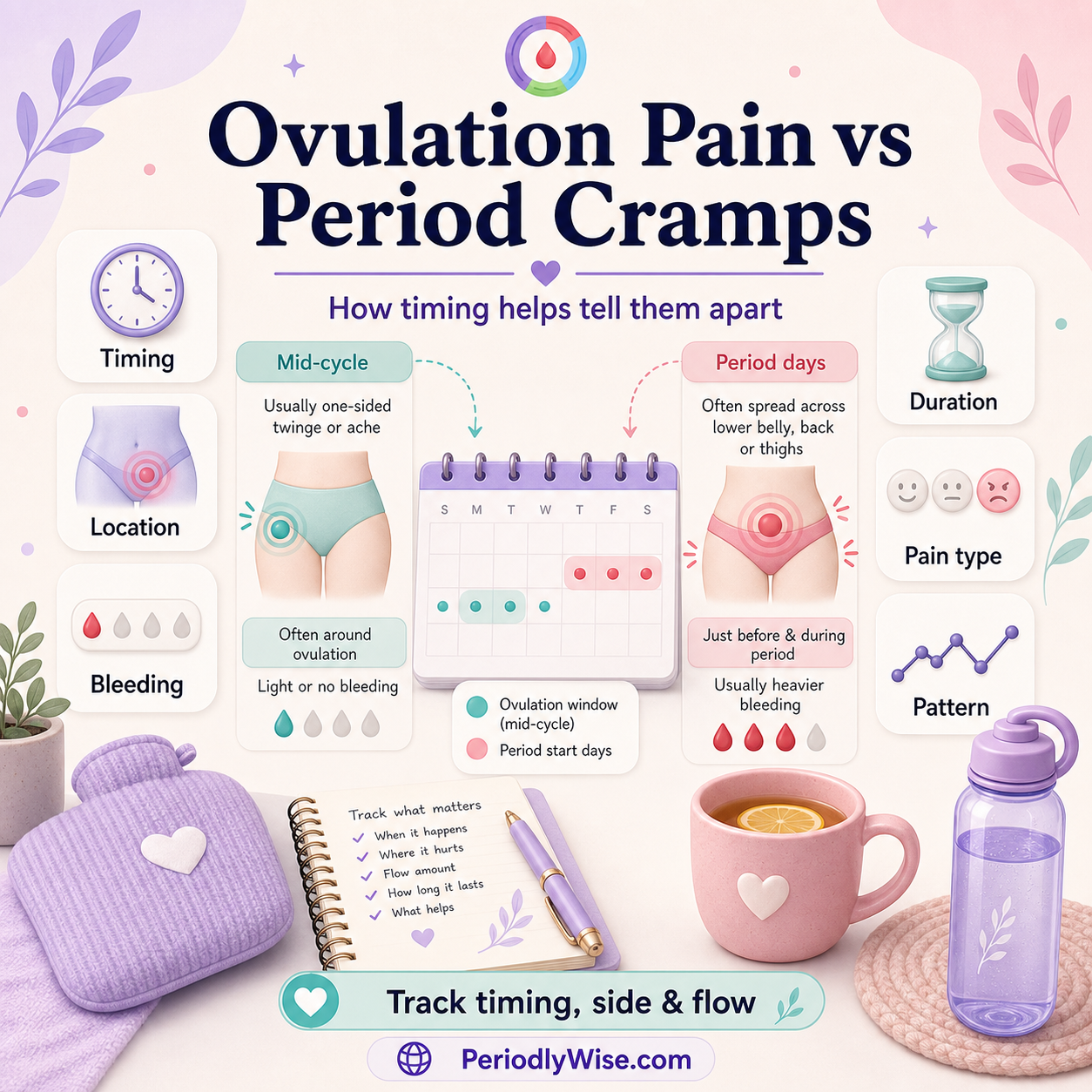
| Feature | Ovulation pain | Period cramps |
|---|---|---|
| Timing | Around mid-cycle, often about 14 days before the next period. | Just before bleeding or during the first days of the period. |
| Location | Often one side of the lower belly. | Lower abdomen, sometimes spreading to the back or thighs. |
| Bleeding | Usually no period flow, though light spotting can happen. | Usually comes with menstrual bleeding. |
| Duration | Minutes to 1 or 2 days. | Often up to a few days. |
| Feeling | Sharp twinge, dull ache, or one-sided cramp. | Cramping, throbbing, dull ache, or pressure. |
| Pattern | May switch sides from cycle to cycle. | Often repeats around period start. |
Why timing matters more than the calendar day
Many people are told ovulation happens on day 14. That can be true for some 28-day cycles, but it is not a universal rule.
A better clue is this: ovulation pain usually happens before the next period, not necessarily on the same numbered cycle day every month. If your cycles are 24 days, 32 days, or irregular, ovulation timing may shift.
That is why tracking several cycles is more useful than judging one pain episode by one calendar day. Compare the first day of bleeding, estimated ovulation window, pain timing, pain location, flow level, and whether the pattern repeats.
Can ovulation pain feel like period cramps?
Yes. Ovulation pain can feel cramp-like, which is why it can be confusing.
The difference is usually the context. If the pain happens around the middle of your cycle, affects one side, does not come with period flow, and goes away within a short time, ovulation pain may be more likely.
If pain happens when bleeding starts, comes with heavier flow, and spreads through the lower abdomen or back, period cramps may be more likely. Tracking cannot diagnose the cause, but it can help you describe the pattern more clearly.
Can period cramps start before bleeding?
Yes. Period cramps can begin before bleeding starts. Some people feel pelvic heaviness, lower belly cramps, back pain, or thigh aches a day or two before the period arrives.
That can make late-cycle cramps look like something else. A useful question is: did bleeding start soon after the pain? If yes, it may fit a pre-period cramp pattern. If pain happens much earlier and bleeding does not follow for about two weeks, it may be closer to ovulation timing.
What to track
Track the details that separate timing, location, and pattern.
- Cycle day: what day of your cycle the pain happened.
- Days before next period: how far pain was from the next bleed.
- Location: left side, right side, center, lower back, hips, or thighs.
- Type of pain: sharp, dull, cramping, throbbing, pressure, or stabbing.
- Duration: minutes, hours, one day, or several days.
- Bleeding: no bleeding, spotting, light flow, or normal period flow.
- Discharge: clear, stretchy, watery, unusual, or none.
- Pain level: mild, moderate, severe, worsening, or different from usual.
- Other symptoms: nausea, loose stools, headache, dizziness, fatigue, fever, or unusual discharge.
- What helped: heat, rest, fluids, gentle movement, medicine, sleep, or time.
A simple note might look like: "Cycle day 15, sharp right-sided twinge, no bleeding, lasted 4 hours, mild discharge, improved with heat."
Another note might be: "Day before period, lower belly cramps and back pain, bleeding started next morning, cramps strongest on day 1."
When pain may be less worrying
Pain may be less concerning when it is mild, familiar, short-lived, follows a repeat pattern, and does not stop normal activities.
Examples include a brief one-sided twinge around mid-cycle, mild cramps that come with your usual period, pain that improves with rest or heat, and symptoms that feel similar to your normal pattern.
Still, normal for you matters. If your usual pattern changes, tracking that change is important.
When to get medical advice
Get medical advice if pain is new, severe, worsening, persistent, or different from your usual cycle pattern.
It is especially important to seek help if pain comes with fever, vomiting, fainting, severe one-sided pelvic pain, pain that does not go away, heavy bleeding, bleeding between periods, possible pregnancy, unusual discharge, pain during sex, pain when peeing or having a bowel movement, or pain that disrupts school, work, sleep, or daily life.
Ovulation pain and period cramps are common, but not every pelvic pain is cycle pain. Ovarian cysts, endometriosis, pelvic inflammatory disease, fibroids, ectopic pregnancy, digestive problems, urinary issues, or infections can sometimes cause similar pain. Tracking is helpful, but it is not a diagnosis.
Gentle comfort ideas
If the pain is mild and familiar, comfort steps may help. You might try a warm bath or shower, a heat pad over the lower belly or back, rest in a comfortable position, gentle walking or stretching if it feels good, fluids, simple meals, or writing down the episode instead of guessing from memory.
Use pain relief only if it is safe for you and appropriate for your health situation. If you are unsure, ask a healthcare professional.
How PeriodlyWise can help
PeriodlyWise cannot diagnose ovulation pain, period cramps, or pelvic conditions. But it can help you organize the pattern.
Use the Period Tracker to compare pain with your expected period window. Use the Ovulation Tracker or Fertility Window Tracker to see whether one-sided pain falls near the estimated ovulation window. If your cycles vary, the Irregular Period Tracker can help you avoid relying on one perfect cycle length.
The goal is not to label every pain immediately. The goal is to notice whether the timing repeats.
Use PeriodlyWise to estimate your period window, ovulation timing, and cycle pattern so pain notes are easier to interpret.
Open the Ovulation TrackerFAQ
Is ovulation pain the same as period cramps?
No. Ovulation pain happens around ovulation, often mid-cycle or about 14 days before the next period. Period cramps happen just before or during menstrual bleeding. They can feel similar, but the timing and bleeding pattern are different.
Can ovulation pain happen on both sides?
Ovulation pain is often felt on one side, depending on which ovary releases an egg. It may switch sides between cycles. If pain is severe, persistent, or unusual, do not assume it is ovulation pain.
Can ovulation pain mean I am fertile?
Ovulation pain can happen around the fertile window, but it is not a reliable way to confirm ovulation or prevent pregnancy. Cycle estimates, cervical mucus, ovulation tests, and medical guidance may give more context depending on your goal.
Why do period cramps spread to the back or thighs?
Period cramps can radiate beyond the lower belly. Track where pain spreads and whether that is usual for you, especially if the pain becomes stronger or different.
How many cycles should I track?
Try tracking for at least two or three cycles if symptoms are mild and familiar. If pain is severe, new, worsening, or worrying, do not wait several cycles to get medical advice.
Final thoughts
Ovulation pain and period cramps can overlap in how they feel, but timing often tells the clearest story.
Ovulation pain is more likely when pain is one-sided, brief, mid-cycle, and not linked with period flow. Period cramps are more likely when pain happens just before or during bleeding, feels crampy or throbbing, and may spread to the back or thighs.
Track the pattern, not just the pain. If pain is severe, new, persistent, or affecting daily life, it deserves medical attention.