Feeling dizzy, faint, weak, or lightheaded around your period can be unsettling. It may happen before bleeding starts, during heavier flow days, after standing up, during strong cramps, after poor sleep, or when you have not eaten or had enough fluids.
Sometimes the reason is simple and temporary, such as dehydration, low food intake, standing too quickly, or a difficult pain day. But dizziness can also be a sign that your period is too heavy, your iron level may be low, you may be anemic, or something unrelated to your cycle needs attention.
The safest approach is not panic and not dismissal. Track the pattern, notice what happens around it, and seek medical help when symptoms feel severe, unusual, or unsafe.
What does period dizziness feel like?
People use the word dizzy in different ways. That matters because different sensations can point to different patterns.
- Lightheaded, like you might faint.
- Weak, shaky, or unsteady.
- Foggy or hard to focus.
- Suddenly hot, sweaty, or nauseated.
- Like your vision is dimming or narrowing.
- Like your heart is racing.
- Worse when standing up.
- Better when lying down.
- Spinning, like the room is moving.
Lightheadedness is more like feeling faint. Vertigo is more like spinning or movement. If you feel true spinning, balance trouble, hearing changes, or dizziness that is not clearly connected with your period, it is worth discussing with a healthcare professional.
Why can dizziness happen before or during your period?
There is not one single reason. Period-related dizziness is usually about the full pattern: bleeding, pain, hydration, food, sleep, stress, medicines, and your baseline health.
1. Heavy bleeding
Heavy bleeding is one of the most important patterns to notice. If your period is very heavy, lasts longer than usual, includes large clots, or makes you feel weak and lightheaded, it should not be ignored.
Heavy menstrual bleeding can contribute to iron deficiency or anemia in some people. Anemia means your blood may not carry oxygen as effectively as it should, which can cause tiredness, weakness, shortness of breath, headaches, dizziness, or lightheadedness.
Track dizziness carefully if it happens with:
- Bleeding through pads or tampons every 1 to 2 hours.
- Needing double protection.
- Waking at night to change protection.
- Bleeding longer than 7 to 8 days.
- Large or frequent clots.
- Weakness, fatigue, shortness of breath, chest discomfort, or feeling faint.
If clots are part of the picture, the guide on period clots can help you decide what details to write down.
2. Possible iron deficiency or anemia
Iron is needed to make hemoglobin, the part of red blood cells that carries oxygen. When the body loses more iron than it replaces, iron deficiency can develop. Heavy periods are one possible reason.
Possible signs to track include:
- Dizziness or lightheadedness.
- Extreme tiredness.
- Weakness.
- Shortness of breath.
- Fast heartbeat.
- Headaches.
- Pale skin.
- Cold hands or feet.
- Feeling worse during or after heavy flow days.
Do not start high-dose iron supplements without medical guidance. Too much iron can be harmful, and dizziness can have many causes. A clinician can decide whether blood tests are needed.
Is dizziness before your period normal?
Mild occasional lightheadedness can happen for simple reasons, especially if you are tired, dehydrated, stressed, or have not eaten enough. But common does not always mean safe to ignore.
Dizziness before your period is worth tracking if it repeats each cycle, appears with PMS symptoms, happens with cramps or nausea, or improves once bleeding begins. It is worth checking sooner if it is new, strong, worsening, or affects daily life.
Is dizziness during your period more concerning?
Dizziness during your period deserves extra attention when it happens on heavy bleeding days. This is especially true if you also feel unusually weak, short of breath, faint, or unable to function normally.
A useful question is: does dizziness match my heaviest flow day? If yes, track flow level, product changes, clots, pain, energy, and how long bleeding lasts.
| Pattern | What it may suggest | What to do |
|---|---|---|
| Lightheaded after standing quickly | May relate to posture, hydration, food intake, or blood pressure changes. | Sit or lie down, hydrate, eat if needed, and track if it repeats. |
| Dizzy on heavy flow days | May be connected with heavy bleeding or possible anemia. | Track flow and symptoms; seek medical advice if repeated or strong. |
| Dizzy with severe cramps | Pain, nausea, stress, or body response to pain may contribute. | Track pain level and what helps; get care if pain is severe or unusual. |
| Dizzy with chest pain, shortness of breath, fainting, weakness, or neurological symptoms | Could be urgent or unrelated to the period. | Seek urgent medical help. |
What else can make dizziness worse around your period?
Dehydration
Bleeding itself is not the same as dehydration, but dehydration can make lightheadedness worse. Vomiting, diarrhea, fever, not drinking enough, sweating, or drinking more caffeine than usual can all contribute.
Low food intake
Some people eat less when cramps, nausea, bloating, or appetite changes are present. Going too long without food may make shakiness or lightheadedness worse.
Strong cramps or pain
Strong pain can make some people feel faint, nauseated, sweaty, or weak. If cramps are severe, worsening, or stopping daily activities, they deserve medical attention rather than being treated as normal.
Poor sleep
Poor sleep can make the body feel less steady. If dizziness appears with period fatigue, mood changes, headaches, or stress, track sleep quality too.
Medicines or supplements
Some medicines can affect dizziness, bleeding, blood pressure, nausea, or hydration. If dizziness started after a new medicine, supplement, contraception change, or dose change, mention that to a clinician.
Pregnancy possibility
If pregnancy is possible, bleeding with dizziness should be taken seriously. Seek medical guidance, especially if there is heavy bleeding, one-sided pelvic pain, shoulder pain, fainting, or severe weakness.
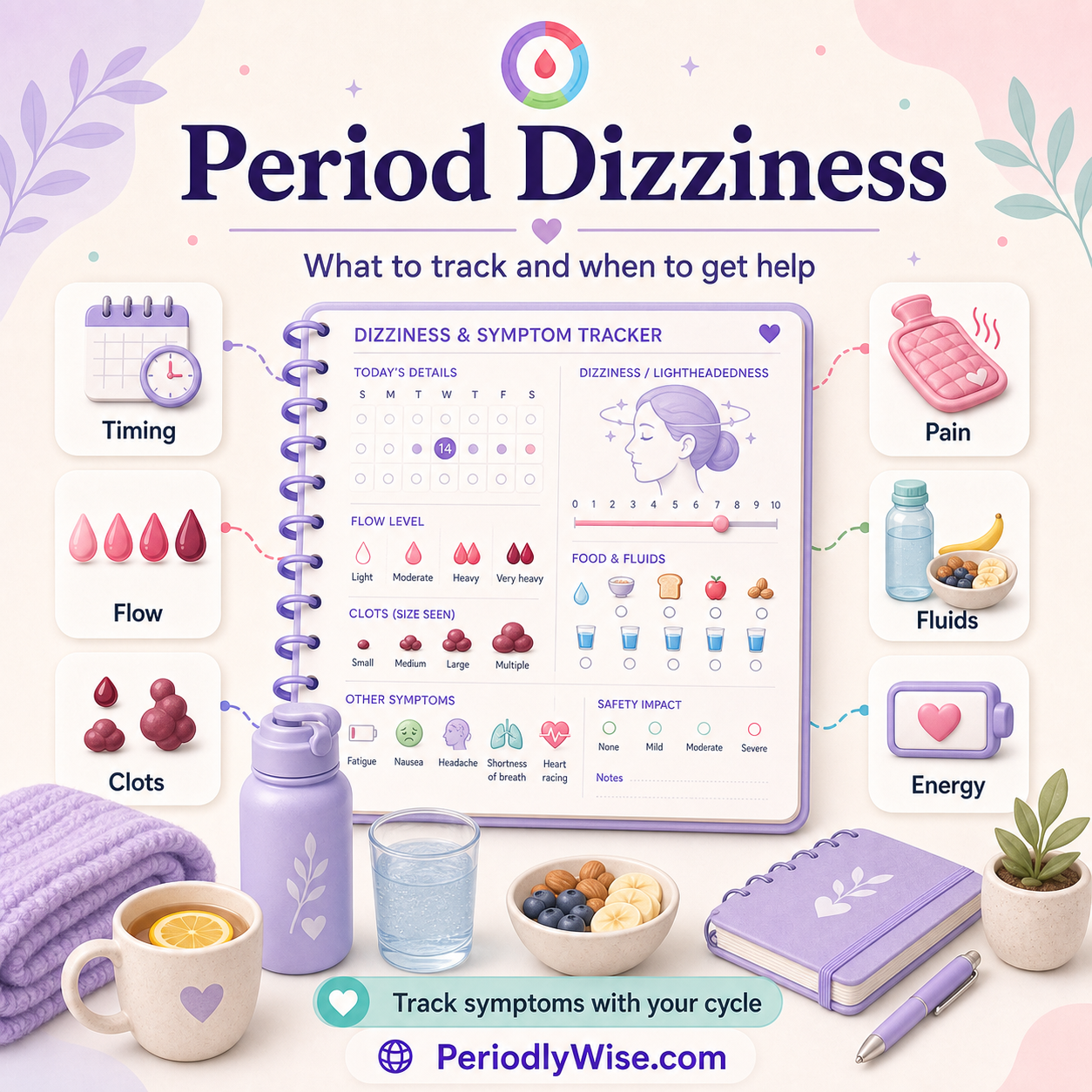
What should you track?
Tracking helps you see whether dizziness is a one-time event, a repeating premenstrual pattern, a heavy-flow signal, or something that needs care.
- Timing: before period, day 1, day 2, after bleeding, or outside your period.
- What it feels like: lightheaded, faint, spinning, weak, shaky, foggy, or unsteady.
- Position: lying down, sitting, standing, after standing quickly, after showering, or after exercise.
- Flow level: spotting, light, moderate, heavy, or very heavy.
- Product changes: how often you change pads, tampons, cups, or period underwear.
- Clots: size, frequency, and whether clots are new for you.
- Pain: cramps, back pain, pelvic pain, one-sided pain, headache, or nausea.
- Energy: fatigue, weakness, shortness of breath, fast heartbeat, or chest symptoms.
- Food and fluids: skipped meals, low appetite, vomiting, diarrhea, caffeine, alcohol, or hydration.
- Sleep and stress: poor sleep, high stress, travel, deadlines, or illness.
- Medicines: pain relief, blood pressure medicine, hormonal contraception, supplements, or blood thinners.
- Safety impact: whether you had to sit down, lie down, stop driving, miss work or school, or nearly fainted.
A helpful note might look like: day 2 of period, heavy flow, changed pad every 2 hours, felt lightheaded when standing, also tired and short of breath walking upstairs.
That kind of note is much more useful than simply writing dizzy.
What may help in the moment?
If dizziness feels mild and you are not having emergency symptoms:
- Sit or lie down.
- Avoid driving or standing in unsafe places.
- Drink water or an electrolyte drink.
- Eat something simple if you have not eaten.
- Stand up slowly.
- Keep something stable nearby when walking.
- Rest in a cool, calm place.
- Track what happened before the episode.
- Seek help if symptoms do not improve or keep returning.
If you feel like you might faint, lie down if possible and raise your legs slightly. If you actually faint, feel confused, have chest pain, shortness of breath, one-sided weakness, severe headache, heavy bleeding, or possible pregnancy complications, get urgent help.
When should you get medical advice?
Consider medical advice if:
- Dizziness is new for you.
- Dizziness repeats across cycles.
- Dizziness happens with heavy bleeding.
- Your period lasts longer than 7 to 8 days.
- You bleed through protection every 1 to 2 hours.
- You pass large or frequent clots.
- You feel weak, exhausted, or short of breath.
- You have chest pain or a fast or irregular heartbeat.
- You faint or nearly faint.
- Dizziness happens outside your period too.
- Dizziness started after a new medicine or contraception change.
- You may be pregnant.
- Symptoms interfere with work, school, driving, caregiving, or daily life.
Seek urgent medical help if dizziness comes with chest pain, shortness of breath, fainting, severe weakness, trouble speaking, vision changes, inability to move an arm or leg, severe headache, heavy bleeding, severe one-sided pelvic pain, or feeling unsafe.
How can you prepare for a medical visit?
You do not need perfect records. A simple pattern is enough.
- The date your last few periods started.
- How long bleeding lasted.
- Which days were heaviest.
- How often you changed menstrual products.
- Whether you passed clots.
- When dizziness happened.
- Whether you fainted.
- Pain level and location.
- Fatigue, shortness of breath, chest symptoms, headaches, or weakness.
- Food, fluid, sleep, and stress context.
- Pregnancy possibility.
- Medicines, supplements, contraception, and medical history.
A clinician may ask about bleeding, symptoms, blood pressure, medications, pregnancy possibility, and whether blood tests are needed. If heavy bleeding is part of the pattern, they may check for iron deficiency anemia or other causes.
How PeriodlyWise can help
PeriodlyWise can help you connect dizziness with cycle timing. Instead of trying to remember everything later, you can track period dates, flow, symptoms, and notes across cycles.
You may notice dizziness happens only on your heaviest day, starts before bleeding, appears after poor sleep, happens with cramps, or repeats with fatigue and shortness of breath. Those patterns can help you plan more safely and explain symptoms more clearly if you speak with a healthcare professional.
Use PeriodlyWise to estimate your period window, save notes, and compare dizziness, flow, pain, fatigue, and other symptoms across cycles.
Open the Period TrackerFAQ
Is it normal to feel dizzy during your period?
Some people feel lightheaded during their period, especially with heavy flow, cramps, poor sleep, dehydration, or not eating enough. But repeated, strong, new, or heavy-bleeding-related dizziness should be discussed with a healthcare professional.
Can heavy periods cause dizziness?
Heavy periods can be connected with dizziness or lightheadedness, especially if blood loss contributes to iron deficiency or anemia. Track flow, product changes, clots, fatigue, weakness, and shortness of breath.
Can low iron make you dizzy during your period?
Low iron or iron deficiency anemia can cause symptoms such as tiredness, weakness, shortness of breath, headaches, dizziness, or lightheadedness. A healthcare professional can confirm this with appropriate testing.
Why do I feel like fainting on the first day of my period?
The first day can bring stronger cramps, heavier bleeding, nausea, poor appetite, or dehydration for some people. If feeling faint is severe, repeated, or linked with heavy bleeding or other concerning symptoms, seek medical advice.
Should I take iron if I feel dizzy during my period?
Do not assume dizziness means you need iron. Heavy periods can increase the risk of iron deficiency, but dizziness has many causes. Speak with a healthcare professional before starting iron supplements, especially high-dose supplements.
When is period dizziness urgent?
Get urgent help if dizziness comes with fainting, chest pain, shortness of breath, severe weakness, severe headache, trouble speaking, vision changes, one-sided weakness, heavy bleeding, possible pregnancy complications, or symptoms that feel unsafe.
Final thoughts
Dizziness around your period is worth taking seriously without immediately assuming the worst. Sometimes it reflects hydration, food, sleep, stress, cramps, or standing up too quickly. Other times it may point to heavy bleeding, possible iron deficiency, anemia, pregnancy-related bleeding, or another issue that needs care.
Track the pattern, especially flow level, dizziness timing, fatigue, shortness of breath, pain, clots, and whether symptoms repeat. If dizziness is strong, new, worsening, or connected with heavy bleeding or fainting, get medical advice.