Learning your cycle can be reassuring. It can help you know when your period may arrive, why your energy changes before bleeding, which days tend to bring cramps or heavy flow, and what kind of support helps you feel more prepared. But cycle tracking should not become another source of pressure.
There is a real difference between awareness and obsession. Awareness says, "I am noticing a pattern, and this can help me care for myself." Obsession says, "I must check again, predict perfectly, explain every feeling, and get every date right." PeriodlyWise is built for the first one: calm, practical cycle awareness that respects the body without turning it into a project to constantly manage.
Your period is natural. Your cycle can shift. Your notes can be useful without being perfect. This guide is about learning enough to support yourself while still letting your life be bigger than your tracker.
What healthy cycle awareness feels like
Healthy cycle awareness usually feels clarifying. It helps you understand why certain days are heavier, why your mood may feel more sensitive before your period, why sleep can change, or why your plans need more flexibility around day 1 or day 2. It gives you language for your body without making your body feel like a problem.
It does not require perfect notes. It does not require logging every sensation. It does not require you to open your tracker every time your stomach feels different or your mood shifts. A menstrual cycle is a pattern, not a test. The goal is to know yourself better, not to monitor yourself harshly.
If tracking has started to feel emotionally heavy, the solution may not be to stop learning. It may be to make the learning lighter.
The enough-data rule
A helpful rule is this: track enough to make tomorrow easier, not so much that today becomes smaller.
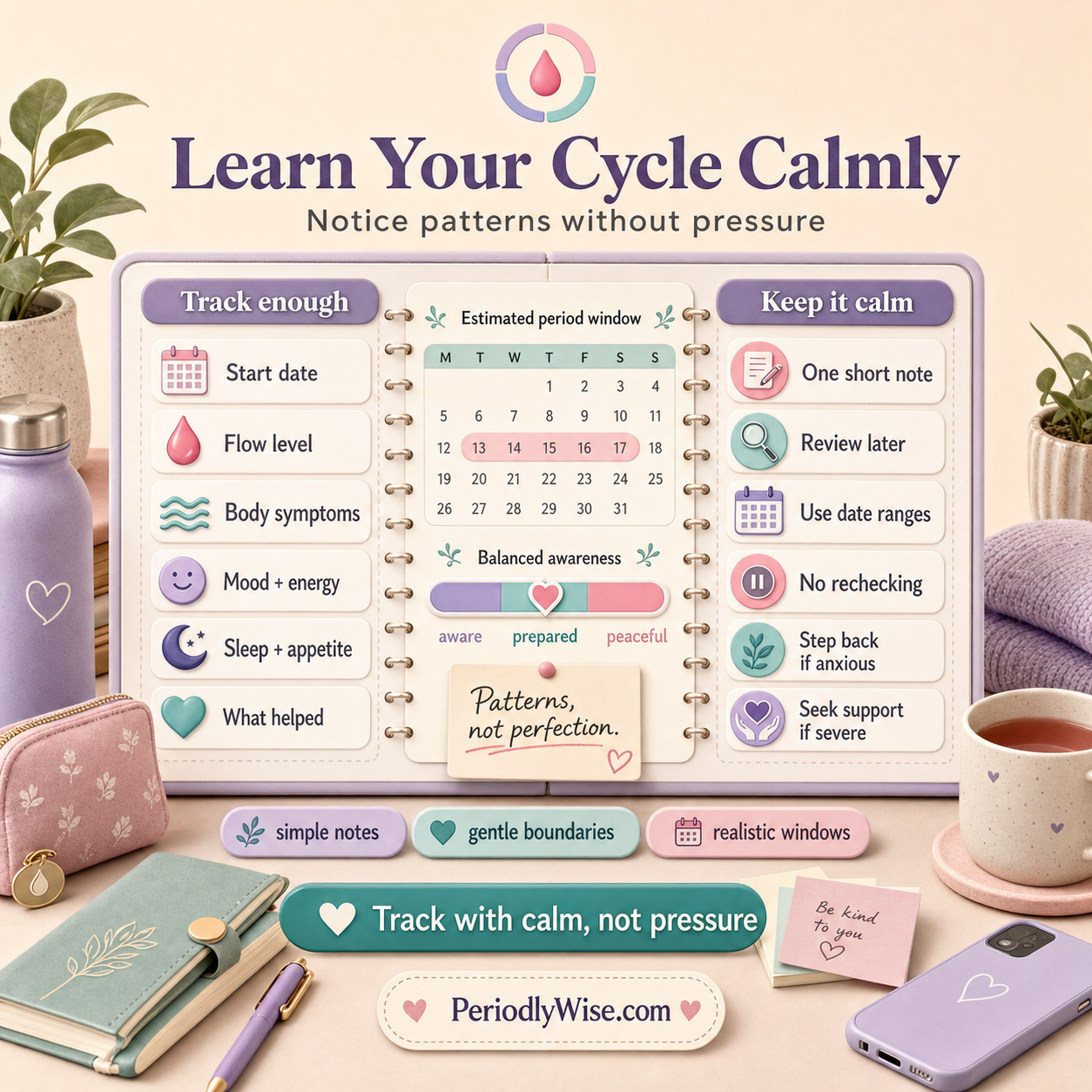
For many people, enough data includes the first day of bleeding, how long bleeding lasts, flow level, cramps or pain, symptoms that affect daily life, mood or energy changes, sleep, appetite, and what helped. You do not need a perfect record of every hour. You need a record that answers useful questions later.
| Useful question | Simple note to save | Why it helps |
|---|---|---|
| When does my period usually start? | First day of real bleeding | Builds a clearer cycle history and future period window. |
| Which days need more support? | Flow level, cramps, fatigue, and mood | Helps you prepare products, rest, food, clothing, and schedule space. |
| What is repeating? | One short note on timing and context | Turns vague worry into a pattern you can review calmly. |
| What actually helped? | Heat, fluids, sleep, medication if safe, food, movement, quiet, or support | Creates a personal care list for future cycles. |
| Should I ask for medical help? | Severity, sudden changes, heavy bleeding, dizziness, severe pain, or daily-life impact | Gives you clearer details to discuss with a healthcare professional. |
This is why period tracking can feel like self-care. The point is not to prove that your body is predictable. The point is to notice what your body has been asking for.
Signs tracking is becoming too much
Sometimes a tool that begins as support can start creating stress. That does not mean you did anything wrong. It simply means the relationship with tracking needs a softer boundary.
- You check your expected period date repeatedly even when nothing has changed.
- You feel anxious if you miss a day of notes.
- You treat every mood, appetite, or body change as something that must be explained immediately.
- You feel disappointed in yourself when your cycle is early, late, heavier, lighter, or different.
- You use tracking to judge your body instead of support it.
- You avoid normal plans because the tracker estimate feels uncertain.
- You feel more worried after tracking than you felt before opening the tracker.
If anxiety is part of the pattern, read Period Anxiety Before Your Period. If the worry feels severe, persistent, or hard to interrupt, professional support can help. Tracking should not become a private pressure system.
Three boundaries that keep tracking calm
Boundaries make tracking more sustainable. They protect the purpose of the habit: useful awareness without constant mental noise.
1. One note is enough
On most days, one short note is enough. "Day 2, heavy flow, cramps, low energy, heat helped" is a complete note. It gives useful information without forcing you into a long body report.
2. Review, do not recheck
Repeated checking often increases anxiety because it asks the same question without giving new information. A calmer rhythm is to log once, then review once a week or after your period ends. Patterns become clearer when you step back.
3. Use ranges over certainty
No calendar can promise an exact period date. Cycles can vary because ovulation timing can shift, and everyday factors such as stress, sleep, illness, travel, medication changes, and life stage can affect timing. A date range is often more honest than one fixed day. For more context, read Why Period Dates Change From Month to Month.
A green, yellow, red way to track
You can also think of tracking in three levels of attention. This keeps ordinary cycle awareness separate from symptoms that need more care.
| Level | What it means | How to respond |
|---|---|---|
| Green | Normal-for-you symptoms, expected timing, manageable flow, familiar mood or energy changes | Log lightly, use usual comfort steps, and avoid overchecking. |
| Yellow | A pattern is repeating or becoming inconvenient: worse PMS, more cramps, late periods, heavier flow, poor sleep, or plan changes | Track for a few cycles, note what helps, and consider whether support or routine changes are needed. |
| Red | Severe pain, very heavy bleeding, fainting, shortness of breath, large or frequent clots, bleeding between periods, unsafe mood symptoms, or sudden major changes | Seek medical advice or urgent care when symptoms feel unsafe or severe. |
This structure helps you avoid treating every change like an emergency while still taking important symptoms seriously.
What to track without overtracking
If you want a practical baseline, keep it simple for two or three cycles. You can always add detail later if you need it.
- Dates: first day of bleeding, last day of bleeding, and any spotting.
- Flow: light, medium, heavy, very heavy, leaks, clots, or product changes.
- Body comfort: cramps, headache, back pain, bloating, breast tenderness, nausea, digestion, dizziness, or fatigue.
- Mood and mind: anxious, sensitive, irritable, low, foggy, calm, steady, or overwhelmed.
- Daily impact: sleep changes, plan changes, work or school difficulty, social withdrawal, or needing more rest.
- What helped: heat, fluids, food, rest, movement, pain relief if safe for you, quiet, support, or a lighter schedule.
If cycles are irregular, tracking irregular periods without guessing can help you use real start dates and wider windows. If mood symptoms feel intense before bleeding, PMS vs PMDD: What to Track explains when the pattern may deserve extra support.
How PeriodlyWise supports a lighter habit
Use PeriodlyWise as a place to keep context, not as a place to chase certainty. Enter your period start dates, review your estimated window, and add notes only when they help you understand comfort, planning, or care. If a day feels ordinary, it is okay for the note to be ordinary too.
A balanced note might say, "Expected period in 3 days, more sensitive, slept poorly, early night helped." Another might say, "Day 1, cramps and heavy flow, worked from home, heat helped." These notes are useful because they connect timing, symptoms, and support. They do not need to explain your entire body.
PeriodlyWise stands with everyone moving through this natural journey. The tracker is meant to give you more self-trust, not more self-surveillance.
When to step away from tracking for a while
It is okay to pause. If tracking makes you spiral, compare yourself harshly, or feel afraid of normal body variation, take a lighter approach. You can track only period start dates for a while. You can stop symptom notes unless something affects daily life. You can review once after your period instead of during every change.
Also consider support from a healthcare professional or mental health professional if cycle worries are interfering with daily life, sleep, eating, relationships, work, school, or your ability to feel safe in your body. If you feel unlike yourself before your period, Not Feeling Like Yourself Before Your Period may help you name that experience without turning it into blame.
When cycle patterns need medical advice
Learning your cycle is helpful, but it is not a substitute for care. Seek medical advice if periods become suddenly irregular, stop unexpectedly, become much heavier or more painful, last longer than usual, or include bleeding between periods or after sex. Also get support for severe pain, fainting, dizziness, shortness of breath, very heavy bleeding, large or frequent clots, fever, or symptoms that feel new or worrying.
If mood symptoms are severe, frightening, unsafe, or disrupt relationships and daily life, do not treat them as something you simply need to track better. Tracking can organize the timeline, but support and treatment may still be needed.
FAQ
How often should I track my cycle?
For many people, logging period start dates and adding one short daily note during symptomatic days is enough. If tracking increases anxiety, reduce the detail and review patterns less often.
Can cycle tracking make anxiety worse?
It can for some people, especially if checking becomes repeated, urgent, or fear-based. A tracker should help you feel informed. If it makes you feel trapped in constant checking, set boundaries or seek support.
What is the minimum useful cycle data?
The first day of bleeding, period length, general flow, major symptoms, and what helped are a strong starting point. You can add details later if a pattern needs more attention.
Should I worry if my period does not match the predicted date?
Not automatically. Period dates can shift. If your period is much later than usual, pregnancy is possible, cycles become persistently irregular, or symptoms are concerning, seek appropriate testing or medical advice.
Can I use period tracking as contraception?
Period tracking alone should not be treated as reliable contraception. Calendar estimates cannot confirm ovulation or guarantee fertile and non-fertile days. Speak with a healthcare professional about contraception if pregnancy prevention matters.
Use PeriodlyWise to save useful cycle context, notice patterns, and prepare gently without turning every body signal into homework.
Open the Period Tracker