There are days before a period when the change is hard to explain. You may still be doing your normal tasks, answering messages, going to work or school, caring for others, and moving through the day. But inside, something feels different. You may feel more sensitive, more irritable, less patient, more tired, more anxious, more tearful, or simply not quite like yourself.
That experience can feel lonely, especially when it arrives before bleeding begins. Because there is no visible sign yet, it can be tempting to blame your personality, your discipline, your relationships, or your ability to cope. But pre-period emotional and physical changes can be real, patterned, and worth understanding with kindness.
This article is not here to make your cycle feel like a problem. Your period is not shameful, and your pre-period days are not a personal failure. PeriodlyWise stands with everyone in this natural journey. The goal is to help you notice patterns, name what is happening, and support yourself without fear, shame, or harsh self-judgment.
What "not feeling like yourself" can mean
Not feeling like yourself is a personal phrase. It can mean something slightly different for each person. For one person, it may mean crying easily. For another, it may mean feeling impatient with people they love. For someone else, it may mean feeling foggy, disconnected, low, restless, or unable to enjoy things that usually feel good.
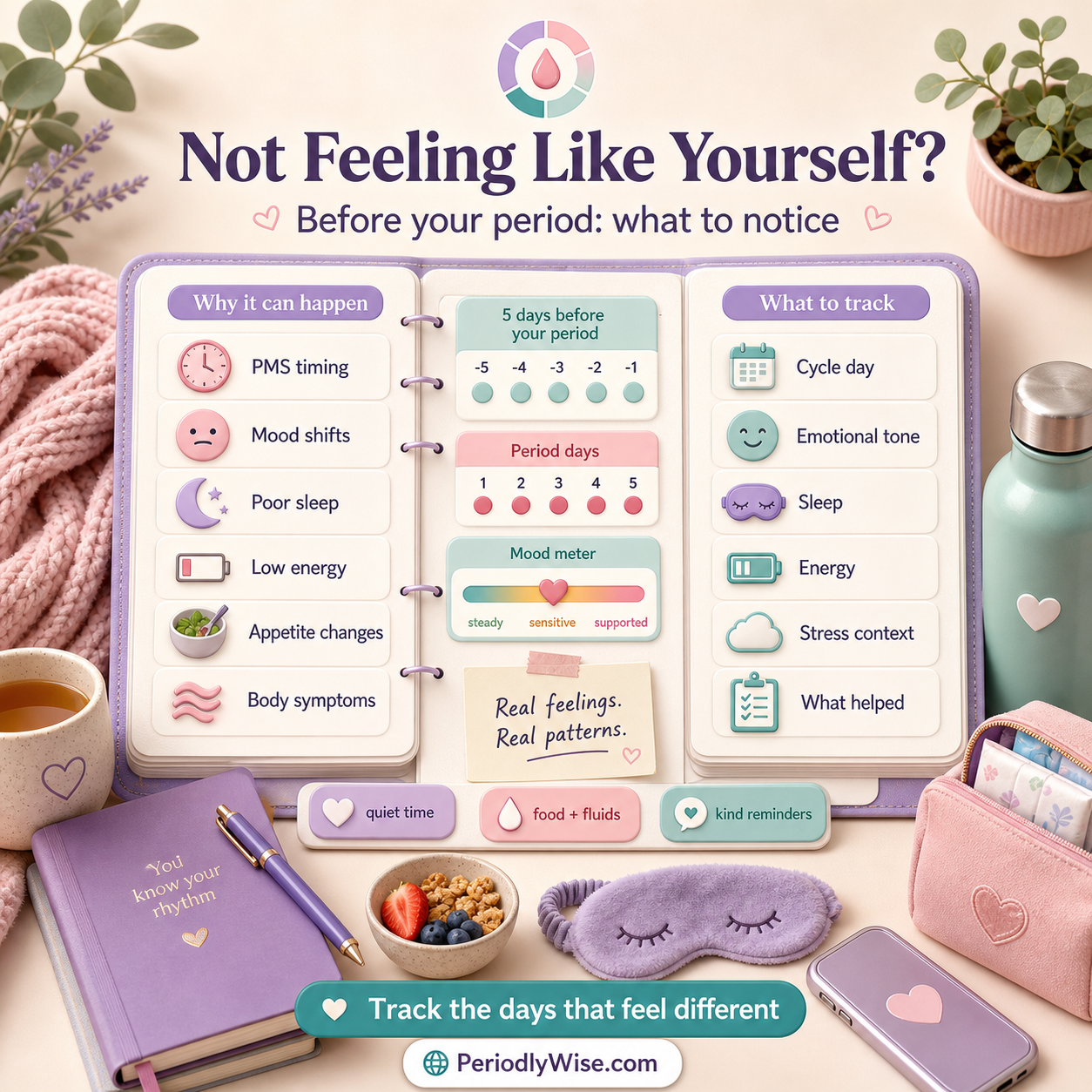
The phrase matters because it captures the emotional side of cycle tracking. You may not always have one neat symptom. Sometimes the pattern is a cluster: lighter sleep, more worry, more cravings, lower patience, tender breasts, bloating, cramps, and a mind that feels full. Together, those changes can make you feel unfamiliar to yourself.
ACOG describes PMS as physical or mood changes that happen before menstruation and affect normal life when they repeat month after month. The Office on Women's Health notes that PMS symptoms can include tiredness, sleep problems, appetite changes, trouble with concentration or memory, tension, anxiety, sadness, crying spells, and mood swings. In other words, feeling emotionally different before your period is not rare, and it is not something you need to dismiss.
Why it can happen before bleeding starts
The pre-period window can be emotionally intense because the body is already moving through cycle changes before bleeding appears. Hormonal shifts after ovulation may play a role for some people, but the lived experience is usually more than hormones alone. Sleep, stress, pain, appetite, digestion, workload, relationship pressure, and life context can all shape how that week feels.
If you slept poorly for several nights, have cramps building in the background, feel bloated, and are trying to manage a demanding day, your emotional threshold may naturally feel lower. That does not mean you are "too sensitive." It means your mind and body are carrying more input than usual.
For some people, pre-period symptoms are mild. For others, they can affect work, school, relationships, confidence, or daily life. If the emotional shift is intense, repeats often, or feels out of proportion to what is happening around you, tracking can help you decide whether to seek support for PMS, PMDD, anxiety, depression, or another overlapping concern.
Common ways this feeling can show up
Feeling unlike yourself before your period may appear as mood, body, focus, relationship, or self-image changes. These signs are not a diagnosis. They are tracking prompts that can help you understand your pattern.
- Emotionally tender: crying more easily, feeling hurt quickly, or needing more reassurance.
- Irritable or reactive: feeling annoyed faster, snapping, or needing more space.
- Anxious or tense: worrying more, replaying conversations, or feeling restless.
- Low or flat: feeling less motivated, less interested, or less connected to usual joy.
- Foggy: struggling with focus, memory, decisions, or words.
- Body-aware: noticing bloating, breast tenderness, skin changes, cramps, headaches, or fatigue more strongly.
- Socially withdrawn: wanting quiet, avoiding messages, or feeling easily overwhelmed.
- Self-critical: judging your body, your mood, your productivity, or your needs more harshly.
If focus is the strongest change, read Period Brain Fog. If worry and tension lead the pattern, Period Anxiety Before Your Period may be more useful. If irritability or emotional swings are the main concern, start with Period Mood Swings and Irritability.
Is it PMS, PMDD, or just a hard week?
Sometimes a hard pre-period week is partly cycle-related and partly life-related. A stressful deadline, conflict, poor sleep, grief, illness, travel, or caregiving load can make PMS feel stronger. The question is not whether your feelings are "real" or "just hormones." They are real either way. The useful question is whether they follow a cycle pattern.
PMS is more likely when symptoms appear in the days before your period, repeat across cycles, improve after your period starts, and affect your normal life. ACOG notes that PMS diagnosis usually depends on a pattern, including symptoms in the 5 days before a period for at least three cycles, ending within a few days after the period starts, and interfering with some normal activities.
PMDD is more severe than PMS. The Office on Women's Health describes PMDD as severe irritability, depression, or anxiety in the week or two before your period, usually improving after your period starts, and sometimes needing treatment. If your symptoms feel extreme, impair daily life, damage relationships, or include hopelessness or thoughts of self-harm, do not wait quietly. Reach out to a qualified healthcare professional or urgent local support.
| Pattern | What it may suggest | What to do |
|---|---|---|
| Shows up before your period and eases after bleeding starts | Possible PMS pattern | Track for several cycles and plan gentle support. |
| Severe mood symptoms that disrupt life or relationships | Possible PMDD or another concern | Seek medical or mental health support. |
| Present most of the month | May not be only cycle-related | Discuss with a healthcare professional. |
| New, sudden, or much worse than usual | Needs attention | Track details and get professional advice. |
| Linked with poor sleep, heavy flow, pain, or stress | Overlapping triggers may be adding load | Track the full context, not mood alone. |
What to track when you do not feel like yourself
Tracking should not become another thing to judge yourself for. Keep it simple. The goal is to see whether a pattern exists and what helps you feel steadier.
- Cycle day: when the feeling starts, peaks, and improves.
- Emotional tone: sensitive, irritable, anxious, low, numb, restless, overwhelmed, or tearful.
- Intensity: mild, moderate, strong, or hard to manage.
- Sleep: bedtime, wake-ups, insomnia, oversleeping, or waking tired.
- Energy: normal, tired, drained, wired, or unable to focus.
- Appetite: cravings, low appetite, skipped meals, nausea, or food feeling harder.
- Body symptoms: cramps, bloating, breast tenderness, headache, acne, back pain, digestion changes, or dizziness.
- Stress context: deadlines, arguments, travel, illness, caregiving, or major life events.
- Relationship impact: needing space, feeling misunderstood, snapping, withdrawing, or wanting support.
- What helped: sleep, food, water, movement, quiet time, journaling, heat, boundaries, medication if safe for you, or talking with someone trusted.
A helpful note does not need to be long. Something like "5 days before period, anxious and not myself, slept badly, skipped lunch, walk and early dinner helped" is enough. Over time, the pattern may become clearer.
How PeriodlyWise can help you name the pattern
PeriodlyWise can help you estimate your next period window and connect emotional notes with cycle timing. That matters because the same feeling can look different once you see where it sits in your cycle.
If you notice the feeling often arrives before your period, you can prepare with more compassion: fewer unnecessary commitments, clearer reminders, easier meals, a calmer evening routine, or a message to yourself that says, "This is a known pre-period window. I do not have to turn every feeling into a verdict about my life."
For a softer approach to this kind of awareness, read When Period Tracking Feels Like Self-Care. If you feel physically separate from your body during this time, the guide on Feeling Disconnected From Your Body may help you name that experience without shame.
Gentle support for the pre-period version of you
You do not need to become a different person to get through pre-period days. Often, support means reducing the friction around the version of you who is more sensitive, tired, or easily overwhelmed.
- Use reminders instead of expecting perfect memory.
- Eat something steady before difficult conversations if hunger worsens your mood.
- Protect sleep when you notice the pre-period window starting.
- Move gently if it helps, but do not punish your body with exercise.
- Delay big self-judgments until the hardest days pass.
- Tell a trusted person, "I am in my pre-period window and feeling more sensitive. I may need a little patience."
- Prepare comfort basics, such as heat, water, simple food, products, and quiet time.
If appetite gets difficult, see Low Appetite During Your Period. If sleep is the trigger that changes everything, the guide on sleep, stress, and the menstrual cycle can give you more context.
When to seek support
It is okay to ask for help before symptoms become unbearable. Consider speaking with a healthcare professional if you feel unlike yourself before most periods, if symptoms interfere with work, school, relationships, parenting, sleep, eating, or daily life, or if they feel intense enough to scare you.
Seek urgent support if you have thoughts of self-harm, feel unsafe, feel out of control, or cannot trust yourself to stay safe. Also get medical advice if mood changes come with severe pain, very heavy bleeding, fainting, shortness of breath, sudden confusion, or symptoms that are new or rapidly worsening.
Support is not shame. It is care. PeriodlyWise can help you organize the timeline, but it cannot diagnose PMS, PMDD, depression, anxiety, anemia, thyroid conditions, or any medical condition.
FAQ
Is it normal to not feel like myself before my period?
Many people notice emotional, mental, and physical changes before a period. It can be common, especially if it follows a repeating PMS pattern. Severe, unsafe, or disruptive symptoms still deserve professional support.
How do I know if this is PMS?
Track timing for a few cycles. PMS is more likely when symptoms appear before your period, repeat across cycles, improve after bleeding starts, and affect normal life.
Can PMS make anxiety or depression worse?
Yes, PMS can overlap with anxiety and depression, and existing symptoms may worsen before or during a period for some people. If symptoms are present most of the month, speak with a healthcare professional.
What should I do on days when I feel emotionally different?
Use practical support: eat steadily, drink fluids, protect sleep, use reminders, reduce unnecessary pressure, move gently if it helps, and avoid making permanent judgments from a temporary cycle window.
When could it be PMDD?
PMDD is possible when pre-period mood symptoms are severe, disruptive, and repeat in a clear cycle pattern. A healthcare professional can help evaluate and treat it.
Use PeriodlyWise to connect mood, sleep, energy, appetite, pain, stress, and what helped with your period window.
Open the Period Tracker