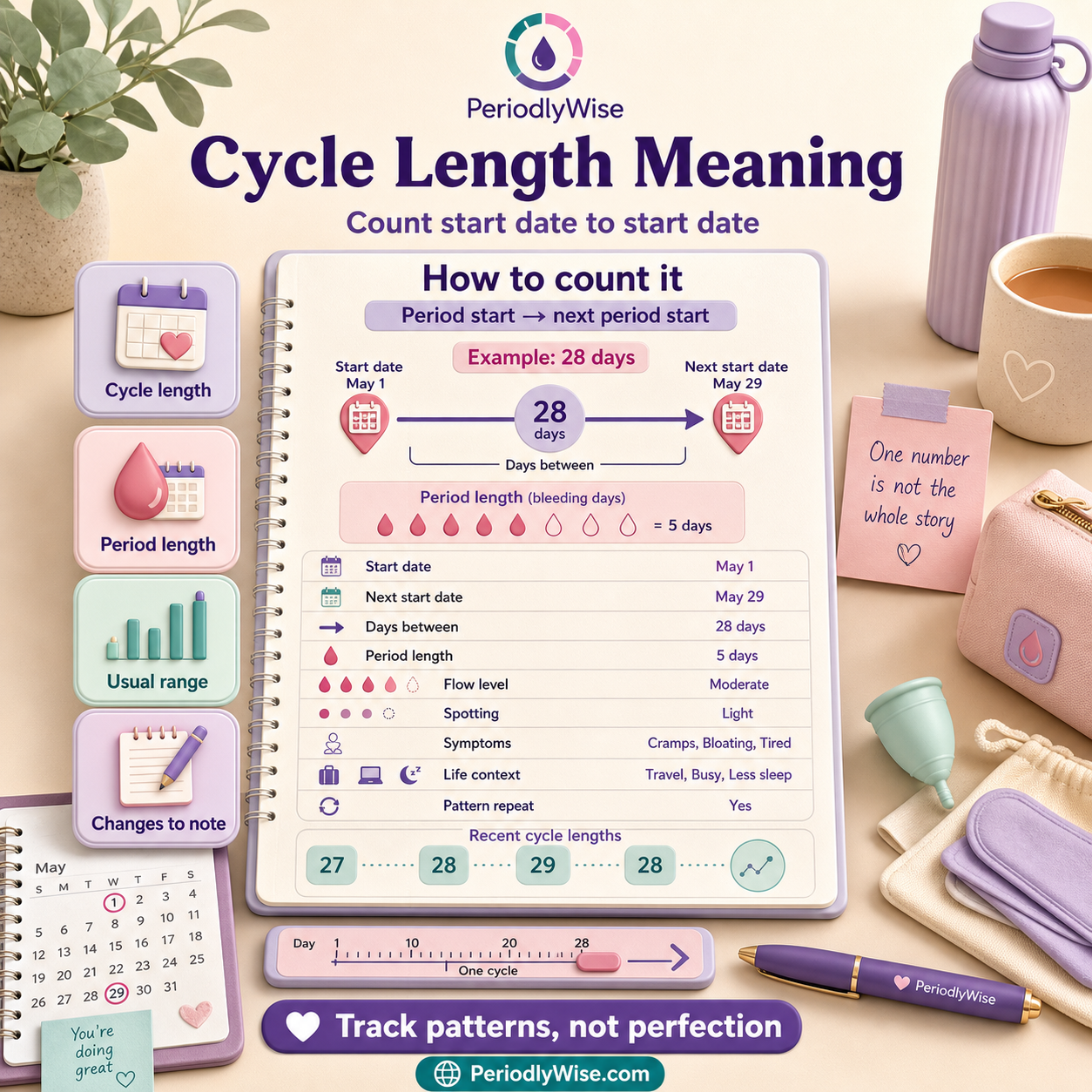
Cycle length is one of the simplest menstrual tracking terms, but it is also one of the easiest to misunderstand. Many people think it means how many days they bleed. It does not. Cycle length means the number of days from the first day of one period to the first day of the next period.
That number can help you estimate your next period window, notice early or late patterns, understand why two periods can land in one calendar month, and explain cycle changes more clearly if you ever need medical support. But cycle length is not a grade, a diagnosis, or a promise that your body must repeat the same number forever.
This guide explains cycle length meaning in a practical, calm way: how to count it, what it is not, what short and long cycles can suggest, and how PeriodlyWise can help you track the pattern without obsessing over every single day.
Cycle length meaning in one sentence
Your menstrual cycle length is the number of days between period start dates.
Day 1 is the first day of real period bleeding. The cycle ends the day before your next period starts. When the next period starts, a new cycle begins.
For example, if your period starts on June 4 and the next period starts on July 2, count June 4 as day 1. July 2 begins the next cycle. The cycle length is 28 days.
Cycle length is not period length
This difference matters because two people can both have a 28-day cycle while bleeding for different numbers of days. One person may bleed for 3 days. Another may bleed for 7 days. The cycle length is the same, but the period length is different.
| Term | What it means | Example |
|---|---|---|
| Cycle length | Days from one period start date to the next period start date | 28 days |
| Period length | How many days bleeding lasts | 5 bleeding days |
| Flow level | How light, moderate, or heavy bleeding is each day | Heavy day 2, light day 5 |
| Regularity | How much cycle length changes from cycle to cycle | 26, 28, 27, 29 days |
If your bleeding days changed, read Short Periods vs Long Periods. If the question is when your next period may come, read How to Calculate Your Next Period Date.
What cycle length range is considered typical?
Different medical resources describe typical cycle ranges slightly differently. The Office on Women's Health says periods are still regular if they usually come every 24 to 38 days. ACOG describes a normal menstrual cycle as typically between 21 and 35 days and lists cycles shorter than 21 days or longer than 35 days as one type of abnormal uterine bleeding pattern.
That may sound confusing, but the practical message is simple: your usual pattern matters, and repeated cycles far outside your normal range deserve attention. A one-time 23-day or 39-day cycle may have a different meaning from a repeated pattern, especially if stress, illness, travel, contraception changes, pregnancy possibility, heavy bleeding, pain, or missed periods are part of the story.
The three numbers that matter more than one average
An average cycle length can be useful, but it can hide important details. PeriodlyWise works better when you think in three numbers:
- Your shortest recent cycle: the smallest start-to-start count from the last few cycles.
- Your longest recent cycle: the largest start-to-start count from the last few cycles.
- Your most common pattern: the range where your cycle usually lands.
For example, cycles of 27, 28, 29, and 28 days tell a steady story. Cycles of 24, 36, 27, and 41 days tell a more variable story. Both deserve accurate tracking, but they call for different expectations.
What cycle length can help you understand
Cycle length cannot diagnose you. It can, however, give useful context.
| Pattern | What it may help explain | What to track with it |
|---|---|---|
| Cycles usually around the same length | Your next period window may be easier to estimate. | Start dates, period length, flow, and PMS timing. |
| Cycles sometimes shorter | Your period may land twice in one calendar month. | Start-to-start count, spotting, flow, and stress context. |
| Cycles sometimes longer | Ovulation may have happened later, or timing may have shifted. | Pregnancy possibility, illness, travel, sleep, stress, medication changes. |
| Cycles vary widely | Predictions need a wider window and the pattern may deserve medical discussion. | Shortest and longest cycles, missed periods, acne, hair changes, weight changes, symptoms. |
| Cycle length changes suddenly | A recent body or life change may be relevant. | New medications, contraception, illness, stress, weight change, exercise, pain, bleeding amount. |
What can a shorter cycle mean?
A shorter cycle means the next period starts sooner than expected. Sometimes this is simply your normal pattern. Sometimes it follows stress, illness, travel, sleep disruption, hormonal contraception changes, emergency contraception, perimenopause, or another timing shift. Sometimes bleeding that seems like a short cycle is actually spotting or bleeding between periods.
If you often have bleeding less than three weeks apart, if bleeding is heavy, if it happens between expected periods, or if it repeats, it is worth discussing with a healthcare professional. ACOG includes cycles shorter than 21 days and bleeding between periods among abnormal uterine bleeding patterns.
If this is your main question today, read Period Twice in One Month.
What can a longer cycle mean?
A longer cycle means your next period starts later than expected. This can happen when ovulation is delayed or when the body is responding to stress, illness, travel, sleep changes, weight changes, intense exercise, hormonal contraception, breastfeeding, perimenopause, thyroid conditions, PCOS, or other factors.
If pregnancy is possible, a late period deserves pregnancy consideration. If periods stop for several months, become very unpredictable, or come with symptoms that worry you, seek medical advice. For timing shifts, read Why Period Dates Change From Month to Month.
Regular does not mean identical
A regular cycle does not have to be the exact same number every month. A cycle that moves between 27 and 30 days may still be predictably regular for that person. A cycle that jumps from 24 to 46 to 25 days is a different kind of pattern.
This is why a period tracker should not make you feel like your body failed because one date moved. The goal is to learn your range. A realistic range is more useful than a perfect-looking average.
What to track with cycle length
Cycle length becomes more meaningful when it is paired with symptoms and life context. A 35-day cycle after international travel and poor sleep tells a different story from a 35-day cycle with repeated missed periods, new acne, or pregnancy possibility.
- Period start date: the first day of real bleeding.
- Period end date: when bleeding stopped.
- Flow level: light, moderate, heavy, or heavier than usual.
- Spotting: before, after, or between periods.
- Pain and symptoms: cramps, pelvic pain, headache, nausea, dizziness, fatigue, mood, sleep, appetite.
- Pregnancy possibility: especially with late, light, painful, or unusual bleeding.
- Contraception or medication changes: start, stop, missed doses, emergency contraception.
- Life context: stress, illness, travel, weight change, intense exercise, sleep disruption.
- Daily impact: missed work, school, exercise, sleep, intimacy, or plans.
How PeriodlyWise uses cycle length
PeriodlyWise uses start dates and cycle length to estimate your next period window. If your cycles are steady, the window can be narrower. If your cycles vary, the window should be wider. This is not weakness in the tool. It is honest tracking.
Use PeriodlyWise to notice patterns like: "My cycle is usually 27 to 29 days," "Travel makes my cycle longer," "My period sometimes arrives twice in long months," or "My bleeding between periods is not the same as a true period." These notes can help you plan products, clothing, travel, rest, and conversations with a clinician if needed.
If you want tracking to stay gentle, read Learning Your Cycle Without Obsessing Over It.
When cycle length deserves medical support
Speak with a healthcare professional if cycles are repeatedly much shorter or longer than your usual pattern, if bleeding happens between periods or after sex, if periods stop for several months, if bleeding is very heavy or lasts more than 7 days, if pain is severe, if pregnancy is possible, or if symptoms such as dizziness, fainting, shortness of breath, fever, unusual discharge, or extreme fatigue appear.
Tracking is helpful because it gives you clearer language. It does not replace medical evaluation.
FAQ
How do I calculate my cycle length?
Count from the first day of one period to the first day of the next period. The first day of bleeding is day 1.
Is cycle length the same as period length?
No. Cycle length is the number of days between period start dates. Period length is how many days you bleed.
Why does my cycle length change?
Cycle length can change because ovulation timing shifts. Stress, illness, travel, sleep, weight changes, exercise, contraception changes, breastfeeding, perimenopause, thyroid conditions, PCOS, pregnancy, and other factors can contribute.
Does a longer cycle mean pregnancy?
Not always. A longer cycle can happen for many reasons, but if pregnancy is possible and your period is late, take a pregnancy test at the appropriate time and seek medical advice if you are unsure.
Can cycle length predict ovulation?
Cycle length can help estimate ovulation timing, but it cannot confirm ovulation. ACOG notes that ovulation often happens about 14 days before the next period, but individual patterns can vary.
Use PeriodlyWise to track period start dates, cycle length, flow, symptoms, and life context so your period window feels less random.
Open the Period Tracker