Seeing bleeding twice in one month can make your brain jump straight to worry. You may wonder whether your period came back, whether your cycle is suddenly irregular, whether it was spotting, or whether something more serious is happening.
The most helpful first step is not panic. It is sorting the pattern carefully. A period twice in one month can sometimes be normal calendar timing. It can also be a sign of a shorter cycle, bleeding between periods, spotting, a contraception change, pregnancy-related bleeding, stress, illness, perimenopause, or another health issue that deserves attention.
PeriodlyWise is built for this kind of moment: not to diagnose you, and not to make your body feel like a problem, but to help you keep clear notes so the pattern is easier to understand.
First question: is this a calendar issue or a cycle issue?
A calendar month is not the same thing as a menstrual cycle. A calendar month has about 28 to 31 days. Your menstrual cycle is counted from the first day of one period to the first day of the next period. The Office on Women's Health explains that a menstrual cycle starts on the first day of your period and starts again when the next period begins.
This means two periods can fit into one calendar month without your body doing anything unusual. For example, if your period starts on August 1 and your usual cycle is 26 days, your next period may start around August 27. That is two periods in August, but the cycle length itself may still be normal for you.
| What happened | Possible meaning | What to check next |
|---|---|---|
| Period on day 1 and again near day 27 | May be normal calendar timing for a shorter cycle | Count days between start dates. |
| Bleeding appears between two expected periods | May be spotting or intermenstrual bleeding | Track amount, color, pain, discharge, sex, and contraception. |
| Bleeding is much heavier than usual | May need medical advice, especially if soaking protection quickly | Record product changes, clots, dizziness, fatigue, and daily impact. |
| Bleeding follows a late period or pregnancy possibility | Pregnancy-related bleeding is one possibility | Consider a pregnancy test at the right time and seek medical guidance. |
How to count it without guessing
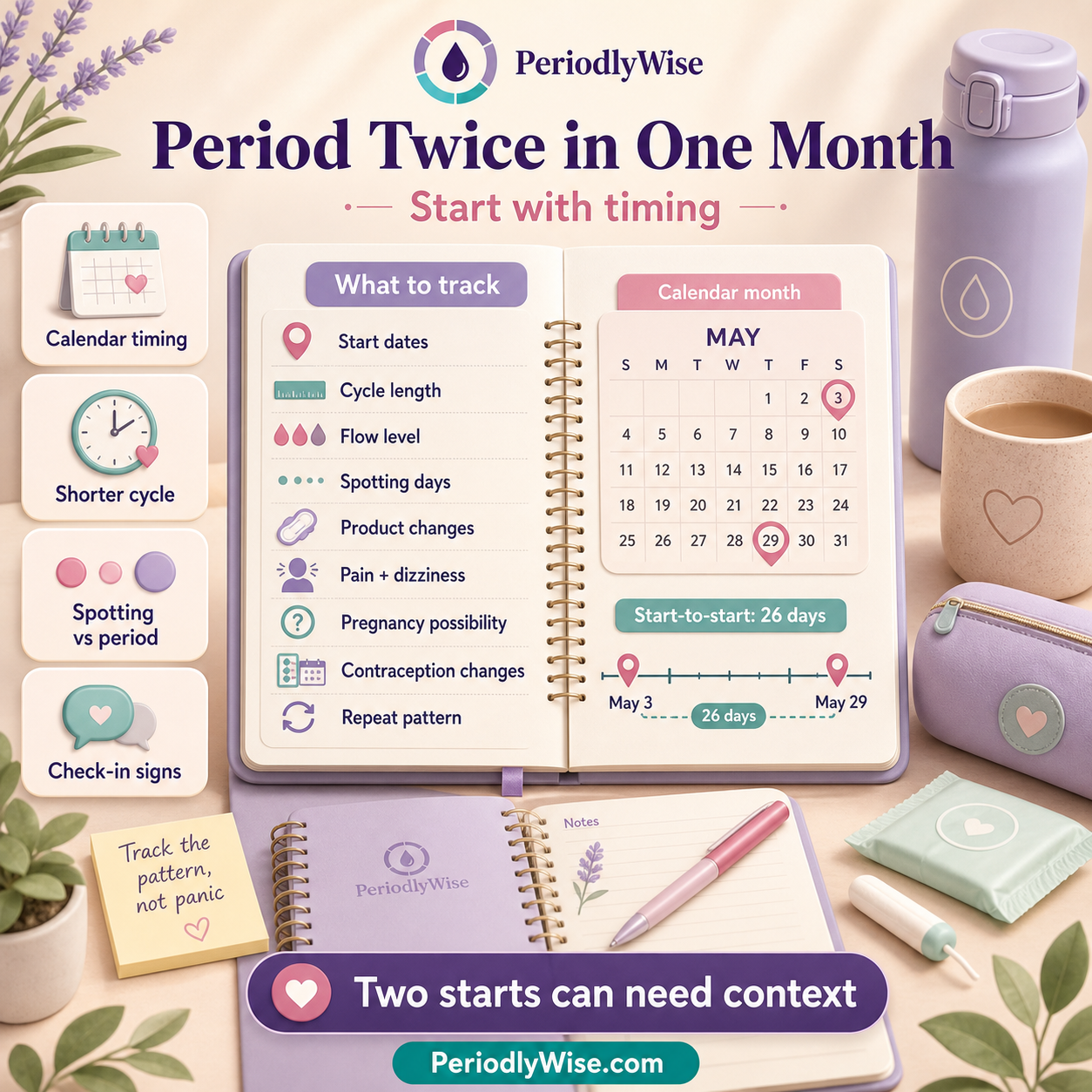
Write down the first day of real bleeding for each episode. Do not count from the last day of bleeding. Do not count from the heaviest day. Cycle day 1 is the first day your period starts.
Then count from the first start date to the next start date. If the first period started on July 3 and the next started on July 29, that cycle was 26 days. If the first started on July 3 and bleeding appeared again on July 14, that is more likely bleeding between periods or spotting rather than a full new cycle.
If this counting part feels confusing, read Cycle Length Meaning. If your dates move often, Tracking Irregular Periods Without Guessing can help you use ranges instead of one fixed date.
Common reasons bleeding may happen twice in one month
There is no single explanation that fits everyone. The most useful approach is to put the bleeding into one of several practical buckets.
1. A shorter cycle that still fits your pattern
The Office on Women's Health says periods can still be regular if they usually come every 24 to 38 days. ACOG describes a normal menstrual cycle as typically between 21 and 35 days. These ranges are not meant to make you self-diagnose from one number. They show why your own pattern matters.
If your cycles are often around 24, 25, or 26 days, two starts in one calendar month can happen naturally. The key is whether the start-to-start count matches your usual cycle length.
2. Spotting before, after, or between periods
Spotting is lighter than a typical period and may show as marks, wiping, or light bleeding that does not build into your usual flow. It can happen around hormonal changes, contraception changes, ovulation, stress, or for many other reasons. Bleeding between periods should be tracked carefully, especially if it is new, repeated, painful, or happens after sex.
For a closer guide, read Spotting Before Your Period.
3. Hormonal contraception or medication changes
Starting, stopping, missing, or changing hormonal birth control can change bleeding patterns. Emergency contraception can also affect timing for some people. If the bleeding began after a medication or contraception change, record the date of the change, missed pills if relevant, bleeding amount, and any pain or pregnancy concern.
4. Puberty, postpartum changes, breastfeeding, or perimenopause
Cycles can be less predictable in the first years after periods begin, after pregnancy, during breastfeeding, and during the years leading toward menopause. ACOG notes that some irregularity can be common at certain life stages, but abnormal bleeding should still be discussed with a healthcare professional.
5. Health conditions or body stress
Stress, illness, weight change, intense exercise changes, sleep disruption, thyroid conditions, PCOS, fibroids, polyps, infection, and other causes can affect timing or bleeding. This does not mean you should assume the most serious cause. It means repeated, heavy, painful, or unusual bleeding is worth bringing to a clinician with clear notes.
What to track in PeriodlyWise
When bleeding happens twice in one month, the best notes are simple but specific. The goal is to answer: did this behave like a true period, or did it behave like unusual bleeding?
| Track this | Why it matters | Example note |
|---|---|---|
| Start date of each bleeding episode | Shows the real cycle length. | "Bleeding started Aug 1 and Aug 27." |
| Flow level by day | Separates spotting from period flow. | "Day 1 light, day 2 moderate, day 3 light." |
| Bleeding days versus spotting days | Prevents overcounting a period. | "4 flow days plus 2 spotting days." |
| Product changes | Helps estimate heaviness and daily impact. | "Changed pad every 3 hours, no leaks." |
| Clots | Size, frequency, and change from usual can matter. | "Small clots day 2 only." |
| Pain, dizziness, fatigue, shortness of breath | Can signal that bleeding is affecting your body more strongly. | "Dizzy when standing, heavy flow." |
| Pregnancy possibility | Important with late, light, unusual, or painful bleeding. | "Pregnancy possible, test planned." |
| Contraception or medication changes | Can explain sudden bleeding shifts. | "Missed two pills last week." |
| Sex, discharge, odor, fever, pelvic pain | Can help a clinician assess infection, cervix, or other causes. | "Bleeding after sex, pelvic pain." |
| Repeat pattern | One cycle and repeated cycles are different stories. | "Second month this happened." |
When to seek medical advice
ACOG lists several bleeding patterns as abnormal uterine bleeding, including bleeding or spotting between periods, bleeding after sex, heavy bleeding, bleeding that lasts more than 7 days, cycles longer than 35 days or shorter than 21 days, and bleeding after menopause. MedlinePlus also recommends evaluation for unusual bleeding, especially bleeding between periods or after menopause.
Seek urgent care if bleeding is very heavy and you feel faint, dizzy, short of breath, weak, confused, or have chest pain. ACOG advises emergency care when someone is changing pads or tampons every hour for more than 2 hours in a row and also has symptoms such as chest pain, shortness of breath, lightheadedness, or dizziness.
Also contact a healthcare professional if pregnancy is possible and bleeding is unusual, if pain is severe or one-sided, if bleeding happens after sex, if there is fever or unusual discharge, if bleeding repeats, or if the pattern is worrying you.
How PeriodlyWise can help you explain the pattern
PeriodlyWise can help you save the date story, the flow story, and the symptom story together. That matters because "I had my period twice in one month" can mean many different things. "My periods started 26 days apart and both were normal for me" is different from "I had moderate bleeding 12 days after my period ended with pelvic pain."
Use the Period Tracker for start dates and expected windows. Use the Irregular Period Tracker if timing varies. If the bleeding length changed, read Short Periods vs Long Periods. If the color or flow looked unusual, read Period Blood Colors and Flow Changes.
FAQ
Can it be normal to have two periods in one month?
Yes, it can be normal if your cycle is shorter and the two start dates fall within the same calendar month. Count from the first day of one period to the first day of the next period to see the real cycle length.
Is bleeding two weeks after my period a second period?
Bleeding two weeks after a period is more likely to be spotting or bleeding between periods than a full new cycle, but the cause can vary. Track the amount, pain, pregnancy possibility, contraception changes, sex, discharge, and whether it repeats.
Should I take a pregnancy test?
If pregnancy is possible and bleeding is late, unusual, very light, painful, or different from your usual period, a pregnancy test at the appropriate time can be helpful. Seek medical advice if you are unsure or have pain, dizziness, or heavy bleeding.
When is a period twice in one month concerning?
It is more concerning when bleeding is very heavy, repeated, painful, between periods, after sex, after menopause, linked with pregnancy possibility, or comes with dizziness, fainting, shortness of breath, fever, unusual discharge, or severe fatigue.
Use PeriodlyWise to record start dates, flow, spotting, symptoms, and what changed so unusual bleeding is easier to explain clearly.
Open the Period Tracker