A period that suddenly feels shorter or longer than usual can be confusing. Maybe your bleeding ended after one or two days. Maybe it stretched past a week. Maybe the number of bleeding days changed, but the flow was lighter. Or maybe the period lasted longer because spotting continued after the heavy days ended.
One unusual period does not always mean something is wrong. Menstrual bleeding can vary with stress, sleep, travel, illness, age, contraception, cycle regularity, and normal month-to-month body changes. But changes in bleeding days are worth tracking because they can show whether this was a one-time shift or a pattern that deserves medical attention.
The goal is not to diagnose yourself from the calendar. The goal is to record the right details clearly.
First, separate cycle length from bleeding days
These two details are easy to mix up. Cycle length means the number of days from the first day of one period to the first day of the next period. Bleeding days means how many days you bleed during that period. Spotting days are light marks or very light bleeding before or after the main flow.
| Term | What it means | Example |
|---|---|---|
| Cycle length | First day of one period to first day of the next period. | 29 days |
| Bleeding days | How many days you bleed during that period. | 5 days |
| Spotting days | Light marks or very light bleeding before or after the main flow. | 2 days |
| Flow level | How heavy bleeding is on each day. | Light, moderate, heavy |
A short cycle is not the same as a short period. A long cycle is not the same as a long period. For example, you might have a 31-day cycle with only 2 bleeding days, or a 25-day cycle with 8 bleeding days. Tracking both helps you avoid guessing.
What counts as a short period?
A short period usually means your bleeding days are fewer than usual for you. For some people, a 3-day period is normal. For someone who usually bleeds for 6 days, a sudden 1- or 2-day period may feel unusual.
A short period may look like bleeding that stops after 1 to 2 days, flow that is much lighter than usual, bleeding that looks more like spotting than a normal period, or a period that arrives on time but does not build into your usual flow.
The key question is: short compared with what is normal for you?
What can make a period shorter?
A shorter period can happen for several reasons, and not all are alarming. Possible contributors include stress, illness, travel, weight change, increased exercise, poor sleep, hormonal contraception, emergency contraception, perimenopause, postpartum changes, breastfeeding, or cycle variation.
Sometimes, what seems like a short period may actually be spotting. This matters if pregnancy is possible, if bleeding happens between periods, or if the bleeding pattern is new.
- Was this period on time, early, or late?
- Was there real flow or only spotting?
- Did bleeding require period products?
- Was pregnancy possible this cycle?
- Did you recently start, stop, or change birth control?
- Did you have unusual stress, illness, travel, or sleep disruption?
- Did this happen once or repeat?
If bleeding was very light and pregnancy is possible, consider taking a pregnancy test at the appropriate time and seeking medical advice if you are unsure.
What counts as a long period?
A long period usually means bleeding lasts longer than usual for you. Medical sources often flag bleeding that lasts more than 7 to 8 days as something worth paying attention to, especially if it is heavy or affects daily life.
A long period may look like bleeding that continues past a week, heavy flow that lasts more days than usual, spotting that continues after the main period, bleeding that stops and starts again, or bleeding that comes with fatigue, dizziness, weakness, or shortness of breath.
A long period is more concerning when it is also heavy, painful, new, repeated, or affecting daily life.
Long period vs spotting after a period
Not all longer bleeding patterns are the same. Some people have 3 to 5 days of true flow followed by 1 or 2 days of brown spotting. Others have 8 or 9 days of active bleeding. Those patterns are different.
- Flow days: days when bleeding needs a pad, tampon, cup, disc, period underwear, or frequent protection.
- Spotting days: days with light marks, wiping only, or very minimal bleeding.
- Heavy days: days when protection fills quickly, leaks happen, or you need double protection.
This helps you explain the pattern clearly. "My period lasted 9 days" is useful, but "5 flow days plus 4 spotting days" is even clearer.
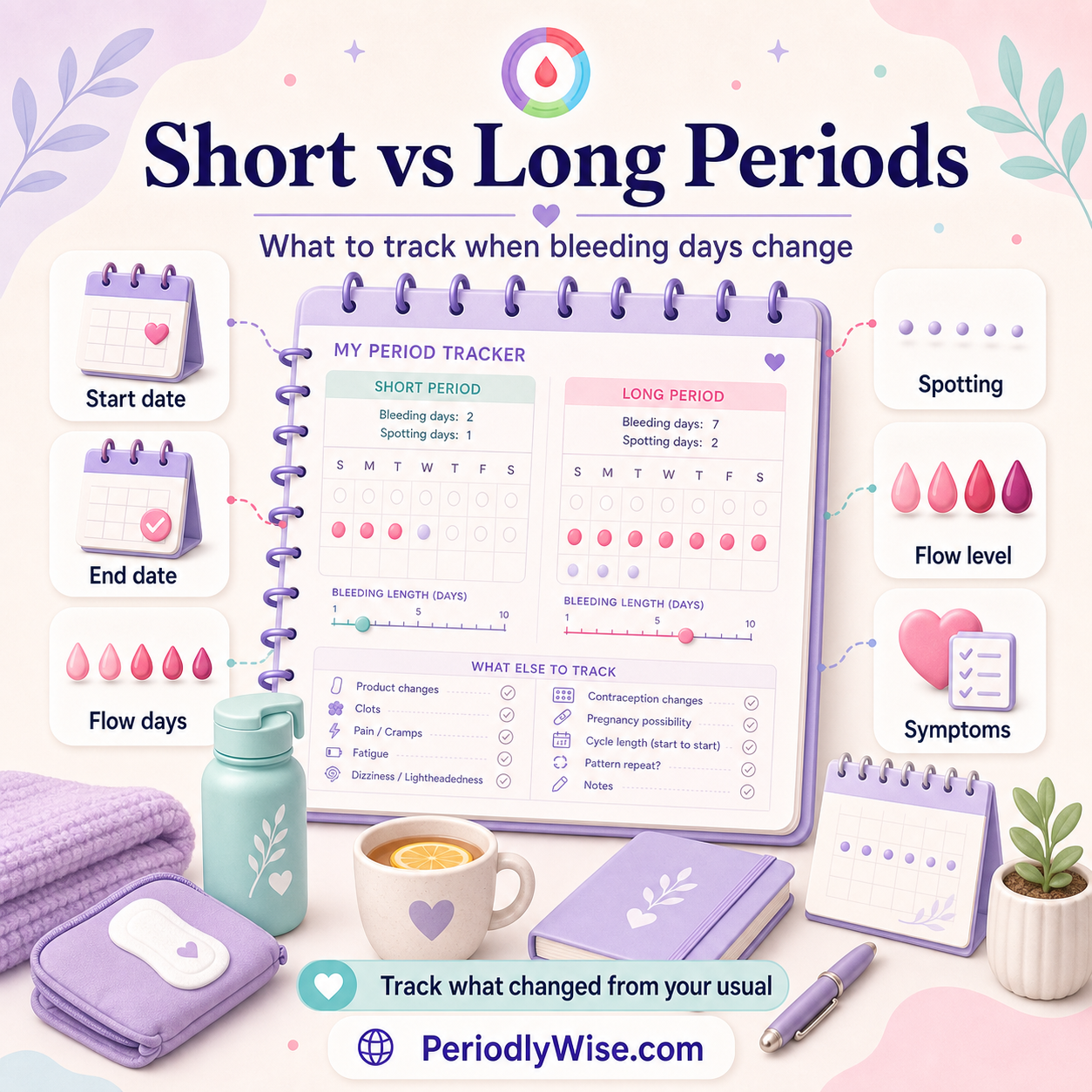
What to track when bleeding days change
Use simple notes for two or three cycles. You do not need perfect detail.
| What to track | Why it helps |
|---|---|
| Period start date | Confirms cycle day 1. |
| Period end date | Shows total bleeding length. |
| Flow days vs spotting days | Separates true period flow from light spotting. |
| Heaviest day | Shows whether the period was short but intense or long but light. |
| Product changes | Helps estimate whether bleeding is heavier than usual. |
| Clots | Size, frequency, and whether they are new. |
| Pain | Cramps, back pain, pelvic pain, or one-sided pain. |
| Fatigue or dizziness | Can matter if bleeding is heavy or prolonged. |
| Pregnancy possibility | Important with late, light, unusual, or irregular bleeding. |
| Birth control or medication changes | Can affect bleeding patterns. |
| Stress, illness, travel, sleep | Helps explain one-off changes. |
| Daily impact | Shows whether bleeding affected work, school, exercise, sleep, or normal plans. |
PeriodlyWise can help you track the start date and compare bleeding patterns over time. Use the Period Tracker for regular cycles, or the Irregular Period Tracker if your timing varies.
When short periods deserve attention
A shorter period may be worth discussing with a healthcare professional if bleeding lasts less than 2 days repeatedly, your usual period suddenly becomes much shorter, periods become very light and irregular, you miss periods, pregnancy is possible, bleeding is more like spotting than a period, or you have pelvic pain, dizziness, unusual discharge, or symptoms that worry you.
A short period is not automatically a problem. But if it is new, repeated, or confusing, tracking gives you a better starting point.
When long periods deserve attention
A longer period deserves more attention if bleeding lasts more than 7 to 8 days, you need to change pads or tampons every 1 to 2 hours, you need double protection, you bleed through clothes or bedding, you pass large clots, or you feel dizzy, weak, unusually tired, lightheaded, or short of breath.
It is also worth seeking advice if pain is severe or different from usual, bleeding happens between periods, bleeding happens after sex, bleeding happens after menopause, or the long bleeding pattern repeats.
The NHS notes that heavy periods may include periods lasting more than 7 days, frequent product changes, clots, bleeding through clothes or bedding, or avoiding daily activities because of bleeding. The Office on Women's Health also advises medical attention for bleeding that lasts longer than eight days or comes with symptoms such as dizziness, weakness, tiredness, chest pain, or trouble breathing.
What can make bleeding days change?
Bleeding-day changes can happen for many reasons. Some are temporary. Some need evaluation.
- Stress or major routine changes.
- Illness, travel, or sleep disruption.
- Weight changes or intense exercise changes.
- Hormonal contraception or emergency contraception.
- Missed or late ovulation.
- Perimenopause or the first few years after periods begin.
- Pregnancy-related bleeding.
- Thyroid conditions or PCOS.
- Fibroids, polyps, endometriosis, or adenomyosis.
- Bleeding disorders or some medications.
This does not mean you should assume the most serious cause. It means repeated or disruptive changes should not be ignored.
A simple tracking note example
Instead of writing "long period," try: "Cycle day 1 started June 29. Moderate flow days 1 to 3. Light flow days 4 to 6. Brown spotting days 7 to 9. Mild cramps day 1. No large clots. More tired than usual."
Or: "Period was only 2 days. Usually 5 days. Flow was light, no cramps, period was 4 days late. Pregnancy possible."
These notes are short, but they tell a much clearer story.
How PeriodlyWise can help
PeriodlyWise can help you compare bleeding days from one cycle to another. Over time, you may notice your period is usually 4 to 5 days, one month was shorter after travel or illness, spotting happens before your true period starts, long periods happen during irregular cycles, or fatigue appears when bleeding lasts longer.
You can also read Period Blood Colors and Flow Changes, Spotting Before Your Period, Period Clots, and Why Period Dates Change From Month to Month.
Use PeriodlyWise to estimate your next period window and compare flow days, spotting, symptoms, and notes across cycles.
Open the Period TrackerFAQ
Is a 2-day period normal?
A 2-day period can be normal for some people, especially if that has always been their pattern. It is more worth tracking if your period is usually longer, if bleeding is unusually light, if pregnancy is possible, or if short periods repeat.
Is an 8-day period normal?
Some people occasionally bleed longer than usual, but bleeding that lasts more than 7 to 8 days is worth tracking carefully. If it is heavy, repeated, painful, or comes with fatigue, dizziness, weakness, or shortness of breath, seek medical advice.
Does spotting count as a period day?
It is usually clearer to separate spotting from true flow. Mark the first day of real bleeding as period day 1, then note spotting days separately before or after the main flow.
Why did my period suddenly get shorter?
A sudden shorter period can happen with stress, illness, travel, hormonal changes, contraception changes, or cycle variation. It can also be confused with spotting. If pregnancy is possible or the pattern repeats, consider testing and/or medical advice.
Why is my period lasting longer than usual?
A longer period can happen with hormonal shifts, irregular ovulation, contraception changes, perimenopause, fibroids, polyps, heavy bleeding, or other causes. Track flow, clots, pain, fatigue, dizziness, and whether it repeats.
When should I worry about bleeding-day changes?
Seek medical advice if bleeding lasts more than 7 to 8 days, is very heavy, happens between periods or after sex, happens after menopause, comes with severe pain, or causes dizziness, weakness, tiredness, chest pain, or trouble breathing.
Final thoughts
Shorter or longer bleeding can happen for many reasons. One unusual cycle may simply be a one-off shift, but repeated changes are easier to understand when you track the details.
Focus on what is different from your usual pattern: start date, end date, true flow days, spotting days, heaviest day, product changes, clots, pain, fatigue, dizziness, pregnancy possibility, and whether the change repeats.