A period calculator can turn a few cycle details into a practical planning window. Enter the first day of your last period, your usual cycle length, and how long bleeding normally lasts, and the calculator can estimate when your next period may begin. A fuller tool may also show a possible period range, estimated ovulation timing, and a fertile window.
The helpful word is estimate. A calculator works with dates you provide; it cannot see hormone levels, confirm ovulation, detect pregnancy, or know that illness, stress, contraception, postpartum changes, perimenopause, or ordinary variation will shift this particular cycle. The result becomes more useful when you understand what each date means and where uncertainty belongs.
Before you calculate: choose the right cycle details
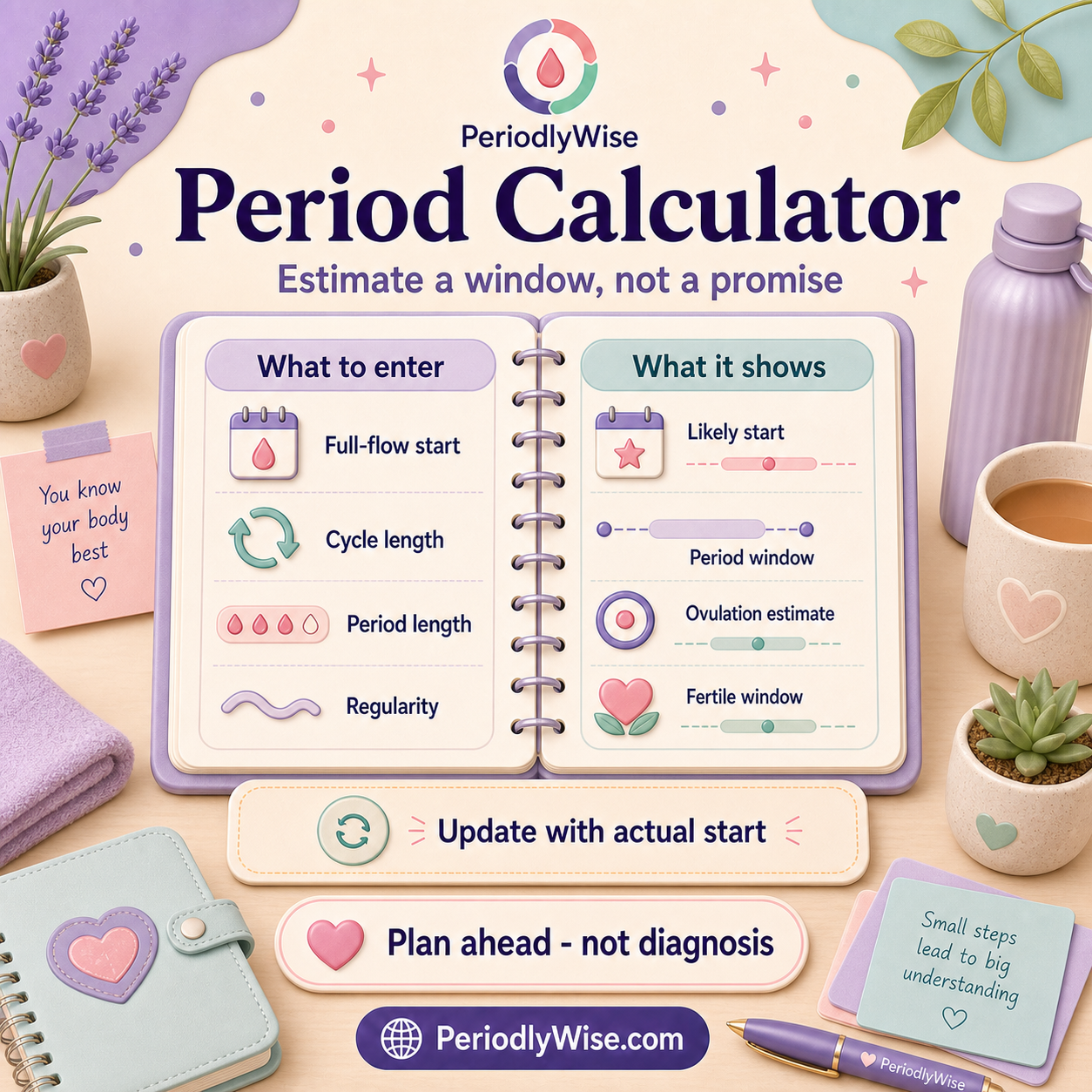
Most incorrect results begin with an input that means something different from what the calculator expects. Take a moment to identify these four details:
Use the first day of full menstrual flow as cycle day 1. Do not use the final bleeding day. If you only noticed uncertain spotting, record it separately rather than automatically calling it day 1.
Count from day 1 of one period to day 1 of the next. If your recent cycles were 27, 29, and 28 days, the average is 28 days. Your own history is more relevant than a default.
Count the days you usually bleed. This helps display the likely bleeding span, but it is different from cycle length and does not determine the next start date by itself.
A cycle that moves by a day or two can support a narrower planning range. Wider variation calls for a wider window and less confidence in one central date.
If cycle length and period length still sound interchangeable, read Cycle Length Meaning. If you want the arithmetic alone, the separate guide on how to calculate your next period date walks through the manual formula.
What the PeriodlyWise period calculator calculates
PeriodlyWise begins with a calendar model. The central next-period estimate comes from adding average cycle length to the last period start date. It then places a period window around that date based on the regularity information entered. Period length helps extend the display across the likely bleeding days.
The tool also estimates ovulation in relation to the expected next period and creates a broader fertile window around that central ovulation estimate. These additional dates are less directly predictable from period dates alone. Research using hormone measurements has shown that ovulation timing varies even among cycles of the same length, so calendar-based ovulation dates should be read especially cautiously.
You can review the model and its limitations on How Calculations Work. For a focused explanation of the ovulation output, see the Ovulation Calculator guide.
A worked walkthrough: from one date to a planning window
Imagine that the first day of your last period was August 3. Your recent cycles were 28, 29, and 30 days, your bleeding usually lasts 5 days, and your timing is usually regular with a little variation.
- Find the average. The three cycle lengths average 29 days.
- Add 29 days to August 3. That places the central next-period estimate around September 1.
- Allow for real variation. Because the recorded cycles differ by a couple of days, planning for a short range around September 1 is more realistic than expecting one guaranteed date.
- Add the bleeding span. A usual 5-day period helps you picture the likely days of flow after the start, while recognizing that duration can also change.
- Read fertility dates separately. Estimated ovulation and fertile days are calendar hypotheses. They are not confirmation of egg release and are not contraception guidance.
If the period begins on August 31 or September 2, the calculator has not necessarily "failed." A central estimate and its window are designed to represent uncertainty. Save the actual start date so the next calculation reflects the new history.
Read each result for the question it answers
Most likely start date
This is the central calendar estimate based on the values entered. It is useful for reminders and preparation, but it is not an appointment your body has agreed to keep.
Possible period window
This is the more practical planning range. It acknowledges that cycle length can differ from month to month. Pack supplies or plan comfort around the window rather than waiting for one highlighted day.
Estimated ovulation timing
This is inferred from the expected next period. It cannot confirm that ovulation occurred or identify the exact day. Hormonal contraception may suppress ovulation, and natural cycles can shift for many reasons.
Estimated fertile window
This broader range reflects that sperm may survive for several days while the egg has a shorter viable time after ovulation. It may support general awareness, but a simple period calculator is not a contraceptive method and cannot guarantee conception.
Five ways to make the result more useful over time
Replace predictions with the dates bleeding truly began. Several real cycles reveal your personal range.
A pre-period spot should not automatically shorten the calculated cycle. Note ambiguity when you are unsure.
Flow, pain, fatigue, mood, sleep, headaches, and daily disruption can be more medically useful than a prediction alone.
Illness, travel, stress, medication, contraception changes, postpartum recovery, breastfeeding, and perimenopause may help explain a shift.
Ask whether the result was close enough to help you prepare, and whether the error is changing over several cycles.
The Office on Women's Health recommends tracking when bleeding begins, how heavy it is, symptoms, and how long it lasts. A calculator becomes a better awareness tool when the date sits beside that real-life context.
When a period calculator is less dependable
Expect wider uncertainty when cycles are new after the first period, repeatedly irregular, postpartum, affected by breastfeeding, approaching menopause, or changing after starting, stopping, missing, or switching hormonal contraception. Acute illness, intense stress, major sleep disruption, significant changes in weight or exercise, PCOS, thyroid conditions, and other health factors can also shift timing.
When your cycle lengths vary substantially, one average can hide the pattern. Use the Irregular Period Tracker and the Irregular Period Calculator guide for a range-based approach. Read Why Period Dates Change when a previously steady rhythm moves.
What a period calculator cannot tell you
- It cannot confirm or rule out pregnancy.
- It cannot confirm whether or when ovulation happened.
- It cannot diagnose PCOS, endometriosis, fibroids, thyroid disease, anemia, infection, infertility, miscarriage, or any other condition.
- It cannot determine the cause of bleeding, spotting, pain, discharge, dizziness, or a missed period.
- It cannot identify days on which unprotected sex is guaranteed not to result in pregnancy.
If a period is late and pregnancy is possible, use an appropriately timed pregnancy test and follow its instructions. Seek prompt medical help for possible pregnancy with significant pain, heavy bleeding, fainting, weakness, or shoulder pain.
When the pattern deserves medical care
Contact a qualified healthcare professional if periods repeatedly fall outside your usual pattern, stop unexpectedly, become much heavier or longer, occur between periods or after sex, or come with severe or worsening pain. Seek timely care for dizziness, fainting, shortness of breath, unusual weakness, fever, concerning discharge, or bleeding after menopause. A calculator can organize dates for the appointment, but it should never delay assessment.
Period calculator FAQ
Can a period calculator predict the exact day?
No calculator can guarantee the exact day. A central estimate may be useful when cycles are steady, but a range is more honest because cycle timing can change.
What if I do not know my average cycle length?
Record the first day of full flow for several cycles and count the days between starts. Until then, any default value is only a rough starting assumption.
Should spotting count as day 1?
Cycle day 1 is generally the first day of full menstrual flow. If spotting is unusual, persistent, occurs between periods, or may be pregnancy-related, discuss it with a healthcare professional.
Does a period calculator work with irregular cycles?
It can provide a broad planning range, but accuracy is lower when cycle lengths vary. Use several real start dates and avoid relying on one average.
Enter your last period start, average cycle length, usual period length, and regularity to view your next-period estimate with related cycle context.
Open the Period Calculator