An ovulation calculator can turn a few cycle dates into a useful planning window. It can help you estimate when ovulation may happen, understand why fertile days appear before that estimate, and compare timing from one cycle to the next. What it cannot do is observe an ovary releasing an egg.
That distinction matters. A calculator produces a calendar-based estimate. It is most useful when you know what information drives the result, how much uncertainty belongs around it, and which body signs or tests can add context.
What the ovulation calculator asks you to enter
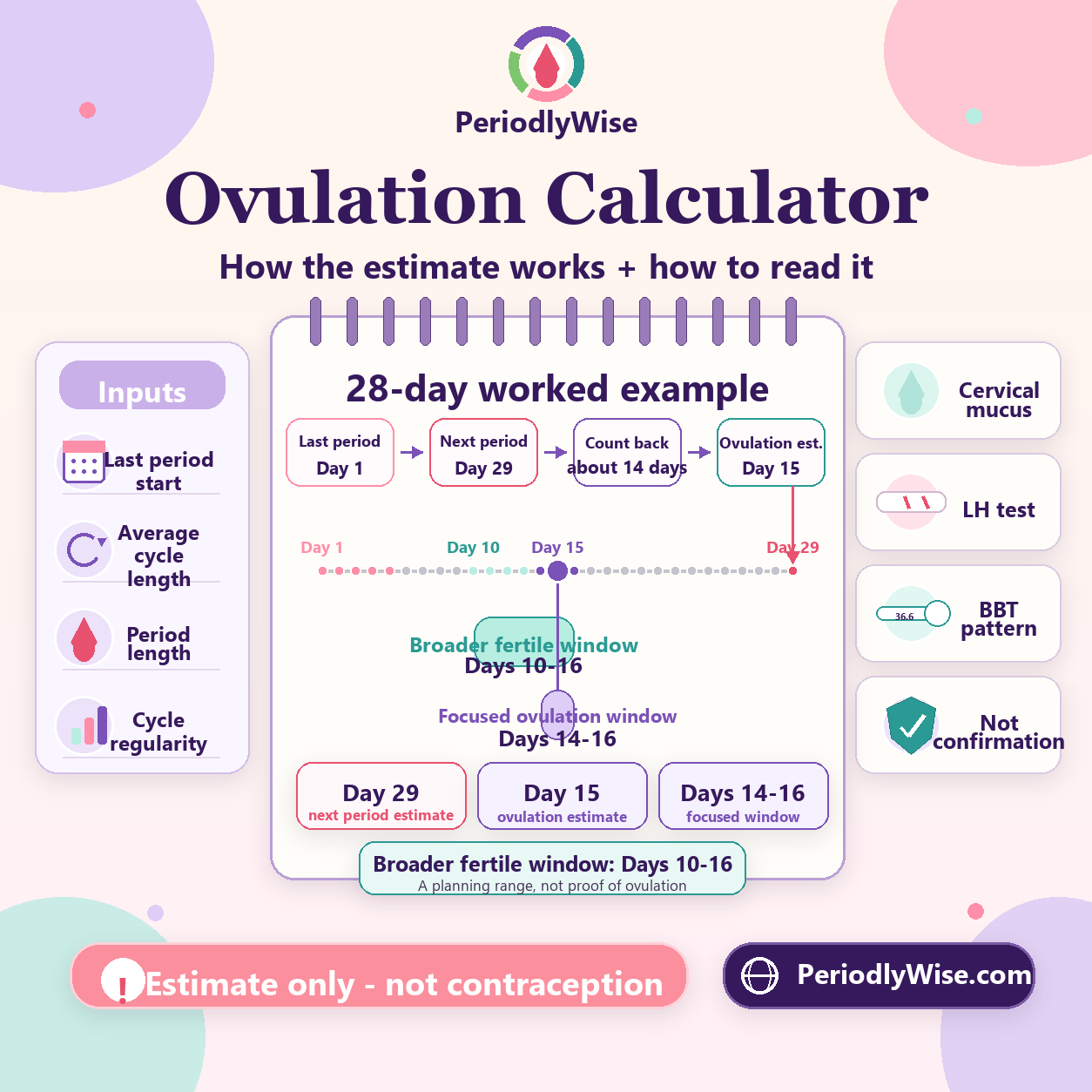
The quality of a calendar estimate begins with the inputs. PeriodlyWise asks for four pieces of information:
Use the first day of full menstrual flow, not the final bleeding day. If you only had uncertain spotting, note that separately.
Count from day 1 of one period to day 1 of the next. Your own recent average is more useful than automatically choosing 28 days.
This helps the tool show the likely end of the next period. It is not the main driver of the ovulation estimate.
This tells PeriodlyWise how cautious to be about the overall cycle estimate and how widely to present possible period timing.
If you are unsure about the difference between cycle length and bleeding length, read Cycle Length Meaning before calculating.
How PeriodlyWise calculates the estimate
The calculation happens in stages. First, the tool adds your average cycle length to the last period start date to estimate the next period start. It then counts backward about 14 days to create the central ovulation estimate. Finally, it displays a focused ovulation range around that central day and a broader fertile window around ovulation.
This backward-counting model is more realistic than assuming everyone ovulates on cycle day 14. A person with a 24-day cycle and a person with a 34-day cycle should not receive the same central estimate.
ACOG explains that ovulation often occurs about 14 days before the next period in an average cycle, while also emphasizing that individual timing varies. PeriodlyWise therefore presents the result as a planning range rather than a confirmed biological event. The site explains the model in more detail on How Calculations Work.
Three worked examples
If day 1 is August 1, the next period is centrally estimated around August 29. Counting back 14 days places the central ovulation estimate around August 15.
If day 1 is August 1, the next period is centrally estimated around August 25. Ovulation is estimated earlier, around August 11.
If day 1 is August 1, the next period is centrally estimated around September 4. Ovulation is estimated later, around August 21.
These examples illustrate the arithmetic, not a promise about what the ovaries did. If the next period arrives earlier or later than the average predicts, the likely ovulation timing also shifts. Read Why Period Dates Change for common reasons cycles move.
How to read your result without overreading it
The result contains several related dates. The central ovulation estimate is the calculator's best single calendar estimate. The ovulation window gives a short range around it because one exact day would suggest more certainty than a calendar can provide. The fertile window is broader because sperm may survive for several days and the egg remains viable for a shorter time after release.
These dates answer different questions. The ovulation estimate concerns likely egg release. The fertile window concerns days when intercourse may be biologically relevant to conception. See Ovulation Window vs Fertile Window for the distinction.
What can shift ovulation timing?
Ovulation does not have to occur on the same cycle day every month. Timing may shift with normal cycle variation, stress, acute illness, sleep disruption, travel, significant weight or exercise changes, postpartum or breastfeeding changes, perimenopause, stopping or changing hormonal contraception, PCOS, thyroid conditions, and other health factors.
Some hormonal contraceptives suppress ovulation. In that situation, a natural-cycle ovulation estimate may not describe what the medication is designed to do. Read the product information and speak with a healthcare professional about your method rather than using a general calculator to infer ovulation.
If your cycles vary widely, build a real start-date history and use the guide to tracking irregular periods. A wider historical range is more honest than forcing several different cycles into one confident date.
Add body signs without turning them into proof
Calendar dates become more informative when you compare them with signs you actually observe. Possible clues include cervical mucus becoming clearer, wetter, slippery, or stretchy; a positive luteinizing hormone ovulation test; a small basal body temperature rise after ovulation; and mild one-sided pelvic discomfort for some people.
- Cervical mucus can help identify approaching fertile conditions, but infections, medications, intercourse, lubricants, and other factors can change its appearance.
- Ovulation predictor tests detect an LH surge. They can suggest that ovulation may be approaching, but they do not guarantee egg release.
- Basal body temperature is generally more useful for recognizing a pattern after ovulation than predicting the day in advance.
- Pelvic pain or spotting is nonspecific. Severe, persistent, new, or worrying symptoms need medical assessment.
For a fuller tracking guide, read Signs of Ovulation.
Use the estimate differently for different goals
For cycle awareness
Compare the estimated window with discharge, energy, libido, spotting, pelvic sensations, and the actual date of the next period. Look for repeated patterns rather than trying to assign meaning to every symptom.
When trying to conceive
The estimate can help identify days worth considering, especially when combined with cervical mucus or ovulation tests. ACOG notes that intercourse during the fertile days, often every day or every other day, may support conception attempts. A calculator cannot assess egg quality, sperm, fallopian tubes, implantation, or other factors involved in fertility.
When avoiding pregnancy
Do not use this calculator, an app prediction, or a single body sign as your only contraception. Calendar estimates can be wrong when ovulation shifts, and pregnancy can occur from intercourse before the estimated ovulation day. Fertility-awareness methods require specific education and consistent rules; discuss reliable contraceptive options with a qualified professional.
When a calendar estimate is not enough
Consider medical guidance if periods are repeatedly absent or highly irregular, if you have concerns about ovulation or fertility, or if you are trying to conceive and want advice tailored to your age, cycle pattern, health history, and time trying. Seek prompt care for severe or sudden pelvic pain, pain with fainting or shoulder pain, fever, heavy bleeding, or pain and bleeding when pregnancy is possible.
An ovulation calculator should make the limits clearer, not hide them. The useful result is a starting hypothesis you can compare with your cycle, not a diagnosis.
FAQ
How accurate is an ovulation calculator?
It can provide a useful calendar estimate when cycles are regular and the average cycle length is accurate. It cannot confirm ovulation, and accuracy falls when ovulation or cycle length shifts.
Do all people ovulate on day 14?
No. Day 14 is a familiar example for a 28-day cycle, not a universal rule. Ovulation is often estimated by counting backward from the next period.
Can I calculate ovulation with irregular periods?
You can view a broad planning estimate, but one average may hide substantial variation. Use several real period starts, body signs, and professional guidance when needed.
Can an ovulation calculator tell me if I am pregnant?
No. It cannot confirm pregnancy. Use an appropriately timed pregnancy test and medical guidance for pregnancy questions or concerning symptoms.
Enter your last period start, average cycle length, period length, and cycle regularity to see the estimated ovulation, fertile, and next-period windows together.
Open the Ovulation Calculator