Should you track your period? The honest answer is: only if it helps you. Period tracking can be practical, reassuring, and medically useful, but it is not a moral test. You are not careless if you do not track every symptom. You are not "doing health wrong" if you prefer a simple note on the calendar. Your cycle belongs to you, and the amount of attention it receives should fit your body, your privacy needs, and your peace of mind.
For many people, tracking brings quiet relief: fewer surprises, better preparation, clearer symptom patterns, and less guessing when a clinician asks about dates. For others, especially people who feel anxious, pressured, dysphoric, overwhelmed, or watched by their own data, tracking may need to stay very light or be paused. Both responses are valid.
You do not have to track to respect your body
Periods are normal, but that does not mean everyone must document them in the same way. Some people enjoy charts and patterns. Some only want a reminder before their period. Some have a medical reason to track carefully for a while. Some would rather avoid daily entries because it makes them feel anxious or disconnected from their body.
A healthy tracking routine should reduce confusion, not add pressure. If tracking turns into perfectionism, constant prediction checking, fear of every variation, or shame about symptoms, the routine is too heavy for the job. Read Learning Your Cycle Without Obsessing Over It for a softer approach.
Why people choose to track
A likely period window helps you carry supplies, plan clothing, pack pain relief, or keep a backup layer nearby.
Start dates can show whether cycles are usually steady, occasionally variable, or changing over time.
Brief notes can reveal whether cramps, headaches, fatigue, sleep changes, mood shifts, or digestive symptoms cluster around the same cycle days.
Dates, flow, pain, spotting, and daily impact can make appointments more concrete than trying to remember everything under pressure.
Tracking can also support practical self-care. See When Period Tracking Feels Like Self-Care and Period Confidence: Small Ways to Feel Prepared Anywhere.
Three levels of tracking, from simple to detailed
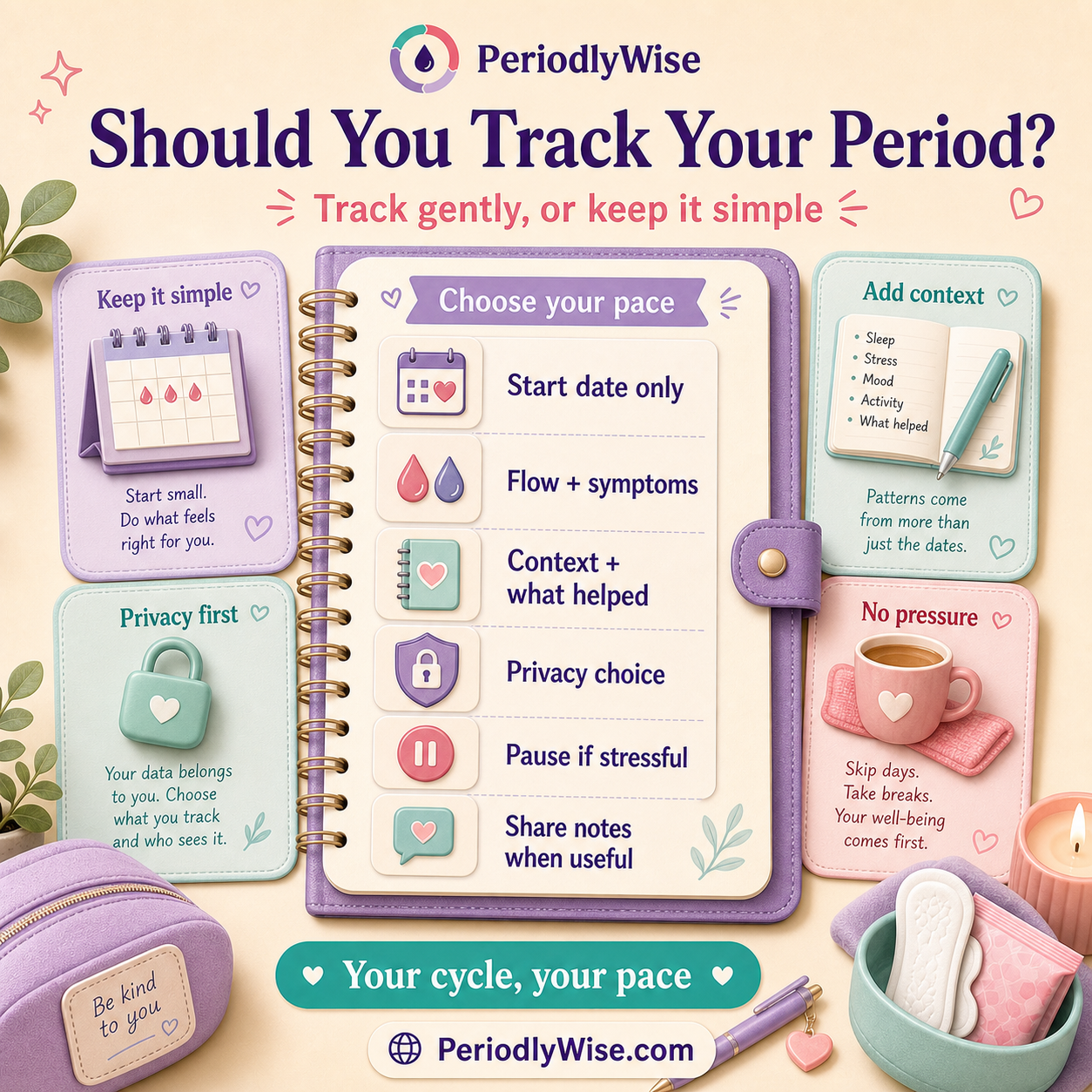
You do not need to begin with a full symptom diary. Choose the smallest level that answers your current question.
Mark the first day of full flow. This is enough for basic cycle length, next-period estimates, and recognizing early or late timing.
Add bleeding level, pain, spotting, mood, sleep, digestion, headaches, or fatigue when those affect your day.
Add stress, illness, travel, contraception changes, medication, postpartum changes, perimenopause, what helped, and what disrupted daily life.
If you are unsure where to start, use Level 1 for two cycles. If questions remain, add one or two recurring details. A tracker should adapt to the question, not collect everything forever.
What tracking can show over time
The Office on Women's Health notes that cycle length can vary. ACOG also emphasizes that period patterns, bleeding, pain, and symptoms can provide useful health information. A record can show whether a change happened once or is becoming a pattern.
- Timing: periods arriving earlier, later, twice in a month, or after a long gap.
- Flow: light, moderate, heavy, flooding, clots, or a change in bleeding days.
- Pain: familiar cramps, new pain, one-sided pain, pain that affects work or school, or pain that continues outside the period.
- Mood and sleep: repeated premenstrual anxiety, irritability, sadness, insomnia, or feeling unlike yourself.
- Life context: stress, travel, illness, sleep disruption, medication, contraception, or major routine shifts.
- What helped: care strategies worth repeating and symptoms that still need professional support.
For the emotional side of cycle awareness, read Not Feeling Like Yourself Before Your Period.
When tracking may be especially useful
Tracking is often useful when periods are new, becoming irregular, unusually heavy, unusually painful, or changing after a medication or contraception change. It can help during postpartum transitions, breastfeeding, perimenopause, fertility planning, conversations about PMS or PMDD, or when a clinician asks about bleeding frequency and symptom timing.
If pregnancy is possible, tracking can help you notice a late period, but it cannot confirm pregnancy. Use a properly timed test and seek medical guidance for pain, unusual bleeding, fainting, shoulder pain, or symptoms that worry you.
When to keep tracking light or pause
Tracking is not helpful if it makes you feel trapped in constant analysis. Keep it simpler, take a break, or seek support if tracking increases anxiety, body checking, shame, distress about fertility, fear of every late day, eating concerns, gender dysphoria, trauma responses, or relationship conflict around private data.
A gentle compromise is to mark only the start date and ignore daily symptoms unless something truly affects your life. You can also track only for two or three cycles before an appointment, then stop when the question is answered.
Symptoms worth tracking and discussing promptly
A tracker can organize the story, but it should not delay care. Seek professional guidance for bleeding that is very heavy or lasts longer than usual, periods that stop unexpectedly, repeated cycles much shorter or longer than your usual range, bleeding between periods, bleeding after sex, bleeding after menopause, severe or worsening pain, pain with fever or unusual discharge, fainting, dizziness, shortness of breath, or possible pregnancy with pain or bleeding.
Also seek mental health support if mood symptoms before a period are severe, unsafe, disruptive, or include thoughts of self-harm. PMS and PMDD symptoms deserve care; they are not character flaws.
How PeriodlyWise can help without making tracking heavy
PeriodlyWise lets you start with the basics: last period start date, average cycle length, period length, and cycle regularity. From there, you can view estimated period, ovulation, and fertile-window timing. If your cycles vary, saved records and the Irregular Period Tracker can help you understand ranges rather than forcing one exact date.
You can use PeriodlyWise in the browser, and on supported devices you can install it as a progressive web app. Read Period Tracker Online for the browser-based workflow and Privacy-First Cycle Tracking for the privacy approach.
A gentle template for one cycle
- Day 1: first day of full flow.
- Bleeding days: light, medium, heavy, or unusual.
- One body note: cramps, headache, fatigue, digestion, breast tenderness, or sleep.
- One mood note: steady, sensitive, anxious, low, irritable, calm, or supported.
- One context note: stress, travel, illness, medication, contraception, or big life event.
- One care note: what helped, what did not, and whether support is needed.
That is enough. Tracking should make your cycle easier to explain, not harder to live through.
FAQ
Should everyone track their period?
No. Tracking is optional. It can be useful for planning, awareness, and medical conversations, but it should fit your needs and emotional safety.
What is the minimum useful period tracking?
The first day of full flow is the most useful minimum entry. It supports cycle length and next-period estimates.
Can tracking make period anxiety worse?
Yes, for some people. If tracking leads to constant checking, fear, shame, or distress, simplify it, pause it, or seek support.
Can tracking diagnose why my period changed?
No. It can show patterns and support medical conversations, but a qualified healthcare professional is needed for diagnosis and treatment.
Use PeriodlyWise for a simple start-date estimate, or add more context only when it answers a real question.
Open the Period Tracker