Some days feel random until you look at them beside your cycle. The tired morning that arrives again before bleeding. The sensitive mood that appears around the same few days. The appetite change that makes lunch feel unappealing. The heavy-flow day that quietly changes your clothing, commute, sleep, bathroom plans, and patience.
Cycle awareness does not make the body perfectly predictable. It also does not mean every feeling must be explained by hormones. But it can help you see that many "out of nowhere" moments are not really out of nowhere. They may be part of a repeating rhythm, a stress pattern, a sleep pattern, a flow pattern, or a care need your body has shown before.
That matters emotionally. When life feels less random, you can respond with less shame and more steadiness. PeriodlyWise is built around that idea: menstruation is natural, your body is not a problem to hide, and tracking should support everyday confidence instead of making you feel monitored.
What cycle awareness really means
Cycle awareness is the habit of noticing your menstrual cycle as one part of daily life. It is not the same as obsessing over dates. It is not a demand to control your body. It is a softer skill: paying attention to timing, symptoms, comfort, mood, energy, and daily impact so your body does not have to keep surprising you in the same ways.
The Office on Women's Health explains that hormone changes across the menstrual cycle can affect emotional, mental, and physical health. Some people notice changes in energy, memory, pain tolerance, appetite, mood, sleep, and symptoms of existing conditions at different points in the cycle. That does not mean every day has a fixed script. It means patterns are possible, and patterns can be useful.
Healthy cycle awareness sounds like: "I usually need more rest before my period," "day 1 tends to be heavier," "my sleep is worse the week before bleeding," or "I feel more sensitive when cramps and poor sleep happen together." These are not complaints. They are practical observations.
If you want a gentler foundation for this habit, read Learning Your Cycle Without Obsessing Over It. If tracking has started to feel like care instead of pressure, When Period Tracking Feels Like Self-Care expands that approach.
The random-feeling list: what cycle awareness can explain
Many cycle-related changes are not dramatic enough to feel like a medical problem, but they are still strong enough to affect the day. They can make you wonder why normal tasks feel harder than usual. A cycle note can help you connect the moment to a larger pattern.
| What can feel random | What cycle awareness may reveal | What to track |
|---|---|---|
| Low energy | Fatigue may repeat before bleeding, during heavy flow, after poor sleep, or during high-stress weeks. | Cycle day, sleep, flow, fatigue level, dizziness, food, and what helped. |
| Mood sensitivity | Emotional tone may shift before the period or when pain, poor sleep, and stress overlap. | Mood, stress context, sleep, pain, support, and whether symptoms interfere with life. |
| Low appetite or cravings | Food can feel harder, or cravings can become stronger, around PMS days or period days. | Appetite level, nausea, meals, fluids, cravings, bloating, and energy. |
| Poor sleep | Bedtime worry, cramps, leaks, night sweats, discomfort, or PMS can affect sleep timing and quality. | Bedtime, wake-ups, anxiety, cramps, flow, product use, and morning energy. |
| Plan changes | Dates, flow, pain, bathroom access, fatigue, or leaks may repeatedly affect certain plans. | Plan type, symptom load, product needs, leak worry, and what adjustment helped. |
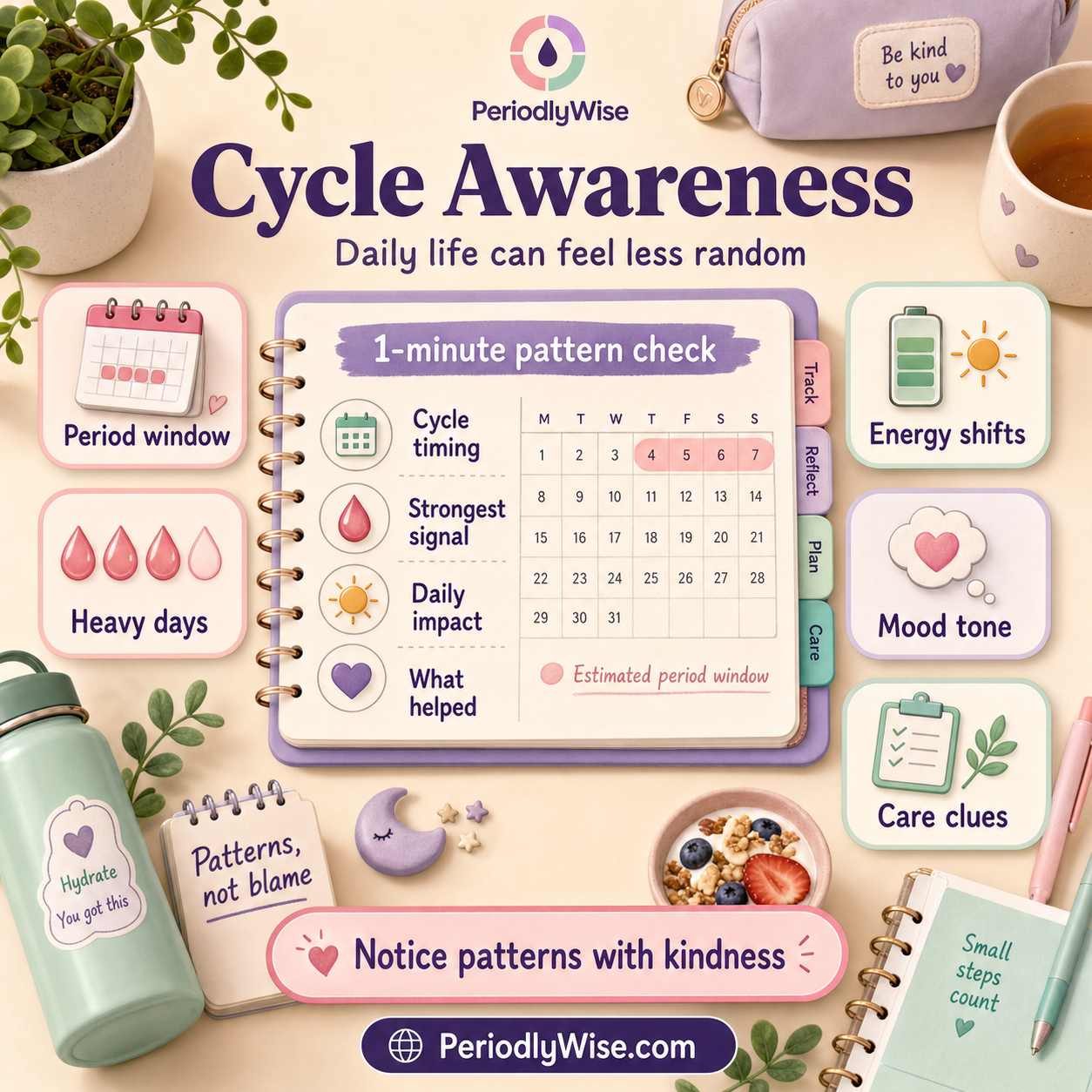
A one-minute pattern check
You do not need a long journal entry to build awareness. Start with a one-minute pattern check on days that feel different. The point is to record enough context to help future you, not to write a full report.
- Mark the timing: period day, pre-period day, late period, spotting day, or expected start window.
- Name the strongest signal: energy, mood, cramps, flow, sleep, appetite, headache, nausea, bloating, skin comfort, or focus.
- Notice the daily impact: work, school, errands, social plans, exercise, clothing, food, sleep, or emotional bandwidth.
- Save one care clue: what helped, what made things harder, or what you would prepare next time.
A useful note might be: "3 days before period, poor sleep, emotional, low focus, quieter evening helped." Another might be: "Day 2, heavy flow, tired, changed product every 2 hours, packed backup next time." Short notes like these can be enough.
Why this can feel emotionally relieving
When symptoms feel random, it is easy to turn them into self-criticism. "Why am I like this today?" "Why can I not keep up?" "Why did this bother me so much?" Cycle awareness gives you another possibility: maybe your body is not failing. Maybe the day has more context than you realized.
This is especially important for people who feel unlike themselves before their period. The Office on Women's Health notes that PMS can include emotional and physical symptoms such as irritability, anxiety, poor concentration, sleep problems, appetite changes, bloating, headache, fatigue, and digestive changes. For PMS, clinicians look for a repeated timing pattern that affects normal life. That is why a record of symptoms and period dates can be useful when symptoms are more than mild.
For everyday self-understanding, the same idea can be gentler. You may not need a diagnosis to notice, "I am more sensitive before bleeding," or "my body needs a lighter plan on day 1." If this experience feels familiar, read Not Feeling Like Yourself Before Your Period.
Cycle awareness without false certainty
A good tracker should not pretend your body is a machine. Cycles can vary. The Office on Women's Health notes that a typical cycle is often described as 28 days, but people differ, and cycles can vary from month to month. The NHS also notes that irregular periods are common in some life stages and that tracking can help you see whether your periods are irregular.
That is why PeriodlyWise works best as a context tool. It can estimate your period window, help you save start dates, and connect symptoms with timing. It should not make you feel as if an estimate is a command or a missed date is your fault.
If your period timing is the part that makes life feel random, read Why Period Dates Change From Month to Month. If your plans change because your cycle shifts or symptoms arrive unexpectedly, read Why Your Period Can Change Your Plans Without Warning.
Five patterns worth knowing about yourself
If you want daily life to feel less random, focus on patterns that actually help you plan. You do not need to track every sensation. These five areas usually give the most practical value.
1. Your period window
Knowing the most likely start window can reduce last-minute stress. It can help you pack products, choose clothing, plan travel, adjust workouts, or avoid scheduling everything tightly around the days that usually need more flexibility.
2. Your heavy days
Flow is not always the same across the period. Some people have heavier bleeding on day 1 or day 2. Others have a heavier start after spotting. Knowing your pattern can help with product choice, bathroom planning, sleep setup, and when to carry backup.
3. Your energy shifts
Energy can change because of sleep, pain, bleeding, appetite, stress, and PMS. If you often feel lower energy before or during bleeding, planning a gentler first task, simpler meals, or a slower morning can be a realistic form of care.
4. Your emotional tone
Some people feel more sensitive, reflective, irritated, anxious, or socially tired before their period. Tracking emotional tone without judgment can help you protect your relationships and your self-talk.
5. What actually helps
This is the most powerful pattern. Heat, rest, water, food, pain relief if safe for you, quiet, movement, looser clothing, a backup product, or support from someone trusted may help in different ways. Save what works so you do not have to rediscover it every cycle.
How to use PeriodlyWise for less random days
Use PeriodlyWise as a calm cycle memory. Enter period start dates, review your estimated period window, and add short notes when something affects daily life. The notes do not have to be perfect. They only need to be useful.
For example, if you wake up tired and disconnected three days before your period, save that with sleep and mood context. If cramps appear before a meeting, save the cycle day, pain level, and what helped. If appetite drops on day 1, save food and fluids that felt manageable. Over time, these small notes can become a practical guide to your own rhythm.
This can make daily life feel less random because you begin to recognize the difference between a one-off hard day and a pattern that deserves preparation. You can plan slower mornings, keep products ready, choose meals that feel easier, protect sleep, and speak to yourself with more compassion.
When awareness should lead to care
Cycle awareness is supportive, but it should not become a way to normalize severe symptoms. Seek medical advice if your periods become suddenly irregular, much heavier, much more painful, or disruptive to everyday life. Also get help for bleeding between periods, periods lasting longer than usual, severe pelvic pain, faintness, dizziness, shortness of breath, very heavy bleeding, large or frequent clots, fever, possible pregnancy concerns, or mood symptoms that feel unsafe.
If symptoms interfere with normal activities before your period for several cycles, a clinician may want a record of symptoms and dates. Tracking can help you explain the pattern clearly, but it does not replace professional assessment.
FAQ
Can cycle awareness really change daily life?
It can. Cycle awareness does not remove symptoms, but it can reduce surprise. When you know which days often need more rest, products, food, sleep, or emotional space, you can plan with more context.
What is the simplest thing to track?
Start with period start dates, flow level, the strongest symptom, daily impact, and what helped. This gives useful pattern information without making tracking feel heavy.
Does every mood change mean PMS?
No. Mood changes can have many causes, including stress, sleep, relationships, mental health, illness, and life events. PMS is more likely when symptoms follow a repeated pre-period timing pattern and affect normal life.
Should I worry if my cycle is not perfectly regular?
Not automatically. Cycles can vary. But if your normal pattern changes, periods are persistently irregular, bleeding is heavy or painful, or symptoms worry you, seek medical advice.
Can tracking become too much?
Yes. If tracking increases anxiety, reduce the detail, log less often, and review patterns only occasionally. Read Learning Your Cycle Without Obsessing Over It for a calmer approach.
Use PeriodlyWise to save period dates, estimate your next window, and connect everyday changes with gentle, useful cycle context.
Open the Period Tracker