Waiting for the next period after miscarriage can feel like waiting for proof that your body is recovering. It can also bring complicated feelings: relief, grief, anxiety, impatience, fear of bleeding again, or pressure about whether to try for another pregnancy.
Most timelines are ranges, not promises. Some people have a period around 4 to 6 weeks after miscarriage, NHS says it can take up to 8 weeks, and Tommy's notes that it may take several cycles to settle back into a regular rhythm.
This guide explains when the next period may return, why it may be delayed, how ovulation can happen first, and what signs deserve medical advice.
When does the next period usually come?
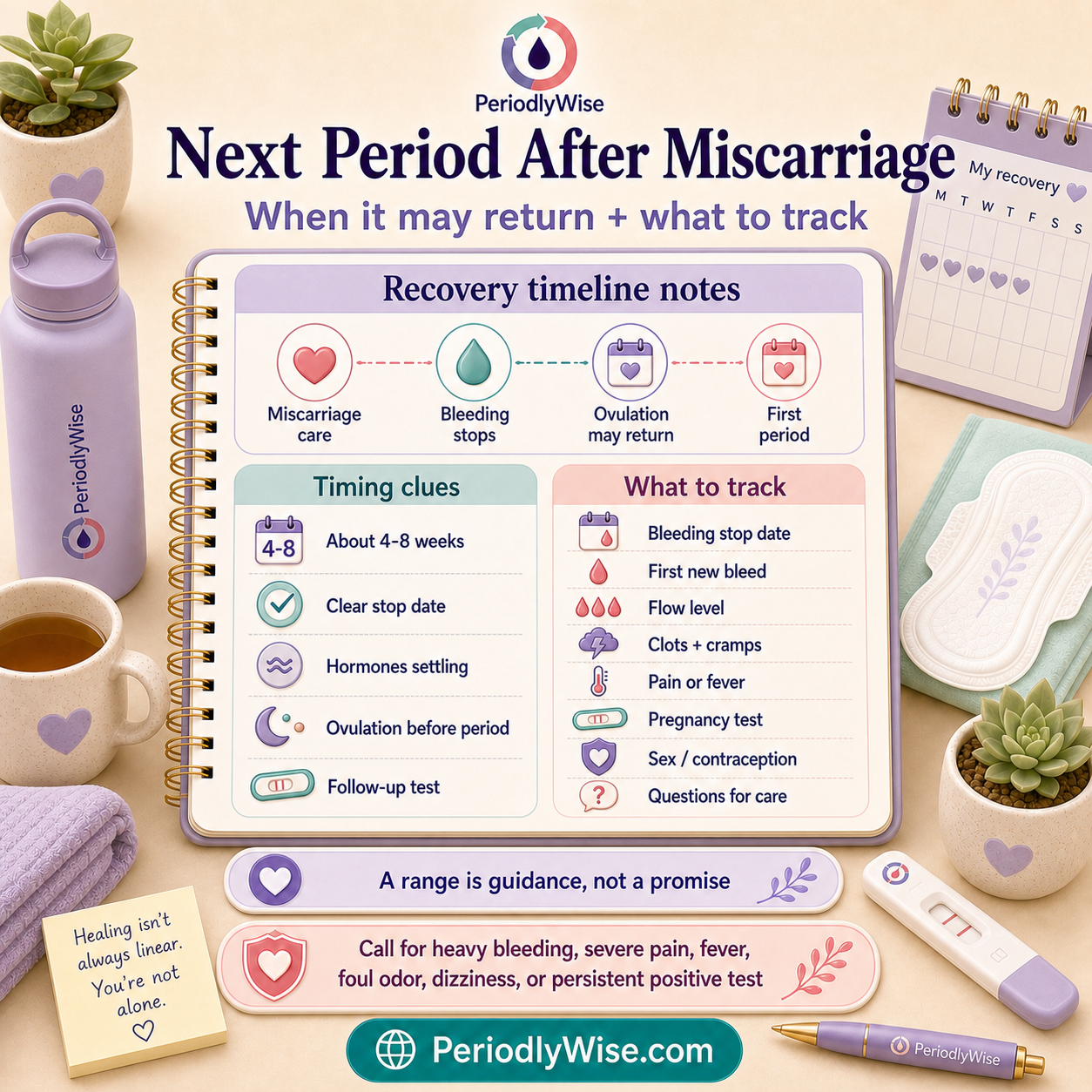
Different medical sources use slightly different reference points. The Royal Women's Hospital says the next period usually comes in 4 to 6 weeks after miscarriage. Tommy's says 4 to 6 weeks if periods were normally regular, while another Tommy's guide notes 4 to 8 weeks and that cycles can take months to settle. NHS says it can take up to 8 weeks before a period returns.
Mayo Clinic frames the timing another way: many people get their period about two weeks after any light bleeding or spotting stops. That is a useful reminder that the countdown often starts from the end of miscarriage bleeding, not from the first day of the loss.
If your miscarriage happened later in pregnancy, if bleeding continued longer, if you had medication or a procedure, or if your cycles were irregular before pregnancy, your timeline may be different.
Next period timing: what each stage can mean
| Timing or clue | What it may mean | What to track |
|---|---|---|
| Bleeding has not fully stopped | This is likely still miscarriage bleeding or recovery bleeding. | Bleeding amount, clots, pain, fever, odor, and care instructions. |
| Bleeding stopped, then period-like bleeding returns 4 to 8 weeks later | This may be the first period after miscarriage. | Start date, flow, clots, cramps, mood, and duration. |
| No period yet, but ovulation signs or sex happened | Ovulation can happen before the first period. | Sex timing, contraception, ovulation signs, and pregnancy-test timing. |
| Positive pregnancy test weeks after the loss | This may be normal hormone decline, a new pregnancy, or a sign you need follow-up depending on timing. | Follow your care team's testing plan and call if the test stays positive when they told you it should be negative. |
Ovulation can happen before the first period
This point surprises many people. Tommy's says you may ovulate before you have a period, so you may be fertile in the first month after miscarriage. Mayo Clinic also says pregnancy can happen as soon as two weeks after miscarriage.
That does not mean you need to decide immediately whether to try again. Mayo Clinic emphasizes being physically and emotionally ready and asking your healthcare professional for guidance. Tommy's also notes that if there is no medical reason to wait, the decision can be individual, and some clinicians suggest waiting for one period mainly to make dating a new pregnancy easier.
If you do not want to become pregnant right away, talk about contraception. If you do want to try again, ask your care team whether you should wait for symptoms to stop, a negative pregnancy test, a period, or any follow-up testing in your specific situation.
What to track before the next period
A simple record can reduce guessing and make follow-up conversations clearer.
- Miscarriage date: when bleeding started, tissue passed, medication was used, or a procedure happened.
- Bleeding stopped date: when bleeding or spotting fully stopped.
- Pregnancy test plan: whether you were told to test at 2 or 3 weeks and what the result was.
- Symptoms: pain, cramps, fever, chills, discharge, odor, dizziness, fatigue, or feeling unwell.
- Sex timing: whether sex happened after symptoms stopped and whether contraception was used.
- Ovulation clues: cervical mucus, ovulation tests, one-sided pain, or basal temperature if you track it.
- First new bleed: start date, flow level, clots, pain, and whether it feels like a period.
- Emotional context: grief, anxiety, relief, dread, or symptoms that make the first period difficult.
- Care instructions: follow-up appointment, Rh immune globulin, restrictions, medication, or testing.
- Questions: when to call, when to try again, contraception options, and what counts as abnormal bleeding for you.
A calm timeline to use
Use this as a tracking framework, not as a rule that every body must follow.
- Mark the loss and care date. Note expectant management, medication, aspiration, D&C, or hospital care.
- Mark the day bleeding stops. This is often more useful than the day bleeding began when estimating the next period.
- Follow the test instructions you were given. Some services ask for a pregnancy test after 2 or 3 weeks, especially if they want to confirm hormones are falling.
- Watch for ovulation before the period. Use contraception if you are not ready for pregnancy, because the first ovulation can come before the first period.
- Call if the pattern does not fit your instructions. No period by the advised window, worsening bleeding, fever, bad odor, severe pain, or persistent positive test should be discussed.
When to contact a healthcare professional
Contact your care team urgently if you have heavy bleeding, severe pain, shoulder pain, fever, chills, foul-smelling discharge, dizziness, fainting, chest pain, shortness of breath, or a positive pregnancy test when your care team expected it to be negative.
Make a non-urgent appointment if your period has not returned by the timeframe you were given, if cycles remain very irregular for several months, if you feel unsure whether a bleed is a period or continued miscarriage bleeding, or if grief or anxiety is affecting daily life.
Ask sooner if you had a later loss, recurrent miscarriages, ectopic pregnancy, molar pregnancy, or specific medical instructions. Those situations can need different follow-up.
Use PeriodlyWise to save bleeding stop date, first new bleed, symptoms, ovulation clues, and questions for follow-up.
Open the Period TrackerFAQ
When should I get my next period after miscarriage?
Many people get a period around 4 to 8 weeks after miscarriage, but timing varies. Some sources use 4 to 6 weeks, while NHS says it can take up to 8 weeks.
Can I ovulate before my first period after miscarriage?
Yes. Ovulation can happen before the first period, so pregnancy is possible before you see bleeding again. Use contraception if you are not ready to become pregnant.
Why is my period late after miscarriage?
Timing can vary because pregnancy hormones need to fall, bleeding may continue, ovulation may restart later, and your usual cycle may take time to settle. Call your care team if the delay goes beyond their advice.
Should I wait for one period before trying again?
Some clinicians suggest waiting for one period to make pregnancy dating easier, but if there is no medical reason to wait, timing can be individual. Ask your healthcare professional for guidance.
Can the first period be heavier?
It can be heavier, lighter, or different from usual. Seek care if bleeding soaks pads quickly, comes with severe pain, fever, dizziness, foul odor, or does not fit your recovery instructions.
Final thoughts
The next period after miscarriage is not only a calendar event. It can carry grief, relief, worry, and questions about fertility. A range is normal, but your own recovery instructions matter most.
Track when bleeding stops, when a new bleed starts, whether a test turns negative, and whether symptoms feel safe. That gives you a calmer way to understand your body and a clearer record if you need care.