A heavy period after miscarriage can feel physically alarming and emotionally loaded. It can also be hard to tell whether you are having your first period after the loss or whether miscarriage bleeding is still continuing.
Some heavier bleeding can happen during miscarriage recovery, but there are clear limits where you should seek care rather than watch and wait. The safest answer depends on timing, how fast you are soaking pads, whether bleeding had stopped, whether clots or tissue are passing, and whether pain, fever, dizziness, or odor are present.
This guide explains what can be expected, what is not safe to ignore, and what to track so you can describe the bleeding clearly.
First: is it a period or miscarriage bleeding?
After miscarriage, bleeding or spotting can last days to weeks. NHS guidance says bleeding or spotting may last up to 2 weeks after miscarriage, while Mayo Clinic notes that light bleeding or spotting can continue and that many people get a period after the light bleeding stops. The Royal Women's Hospital says pain and bleeding after miscarriage usually feel similar to a period and usually stop within two weeks.
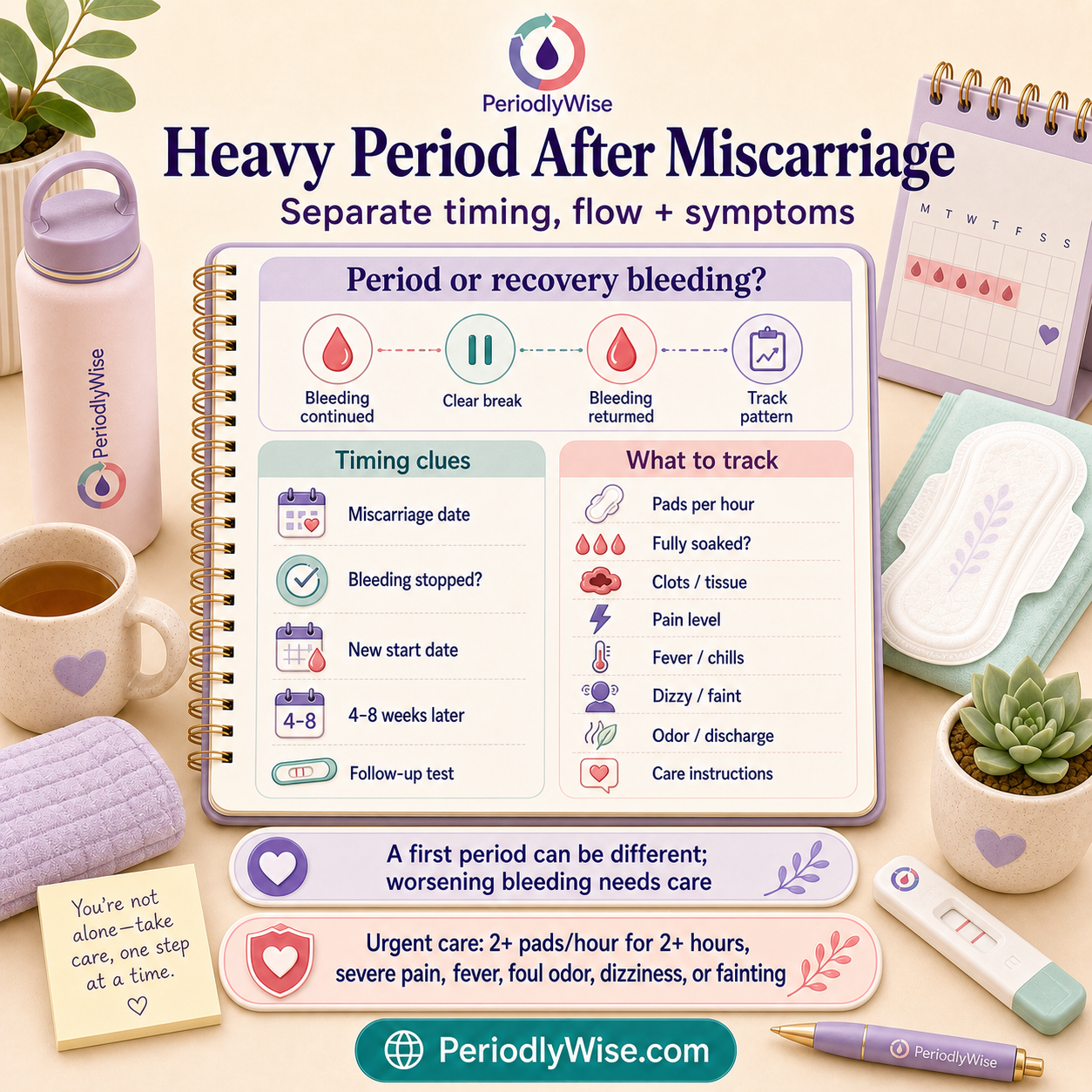
That means timing matters. If bleeding has not fully stopped since the miscarriage, it may still be recovery bleeding rather than a new period. If bleeding stopped, you had a clear break, and then bleeding returned weeks later, it is more likely to be your first period.
The distinction matters because ongoing heavy bleeding can sometimes mean retained pregnancy tissue, infection, or the need for more care. Tracking cannot diagnose that, but it can show whether bleeding is following the expected pattern of easing over time.
Heavy bleeding after miscarriage: how to read the timing
| Pattern | What it may mean | What to do |
|---|---|---|
| Bleeding has continued since the miscarriage and is still heavy | This may be miscarriage recovery bleeding, not a new period. | Contact your pregnancy unit, OB-GYN, GP, or urgent care if it is heavy, prolonged, or worsening. |
| Bleeding stopped, then a period-like bleed returned 4 to 8 weeks later | This may be the first period after miscarriage. | Track flow, clots, pain, and duration; seek care if it crosses heavy bleeding thresholds. |
| Bleeding soaks pads quickly or comes with large clots | This can be too heavy to monitor alone. | Use your local urgent threshold; Mayo Clinic cites more than two pads an hour for more than two hours. |
| Bleeding comes with fever, chills, foul odor, severe pain, dizziness, or fainting | These may signal infection, retained tissue, or unsafe blood loss. | Seek urgent medical care. |
Why the first period can be different
Pregnancy hormones fall after miscarriage, and they do not settle at the same speed for everyone. Tommy's notes that pregnancy hormones begin to fall after miscarriage and that periods may take several weeks to return. A first period may therefore feel different from your usual pattern.
A heavier first period can happen because the uterine lining and cycle timing are resetting. It may also feel heavier emotionally because bleeding can bring back memories of the miscarriage itself. That emotional reaction is real, not a failure to cope.
Still, a heavy period after miscarriage should not be used to explain away bleeding that is extreme. The important question is not simply whether heavy bleeding is possible. The question is whether the amount, pain, smell, fever, dizziness, or duration suggest you need medical support.
What to track
Use short, concrete notes. They are more useful than trying to remember the whole episode later.
- Miscarriage date: the date bleeding started, tissue passed, medication was used, or a procedure happened.
- Bleeding stopped date: the first full day with no bleeding or spotting.
- New bleeding start date: when the heavy bleeding began again.
- Pad changes: how many pads per hour and whether pads are fully soaked.
- Clots or tissue: size, number, color, and whether anything looks unusual for you.
- Pain: cramps, one-sided pain, shoulder pain, back pain, or pain stronger than a usual period.
- Symptoms: dizziness, fainting, weakness, fever, chills, nausea, or feeling unwell.
- Discharge or odor: bad smell, green or yellow discharge, or new irritation.
- Pregnancy test: whether you were advised to test and whether it is negative.
- Care instructions: medication, D&C or aspiration, Rh immune globulin, follow-up appointment, or emergency instructions.
What to do if bleeding is heavy
Use a calm sequence, but do not delay urgent care if symptoms are severe.
- Measure the flow for one hour. Count fully soaked pads and note clots, dizziness, and pain.
- Compare with urgent thresholds. Mayo Clinic advises calling for more than two menstrual pads an hour for more than two hours; other services use similarly urgent heavy-bleeding cutoffs.
- Check for infection signs. Fever, chills, foul-smelling discharge, flu-like symptoms, or worsening pain deserve prompt care.
- Do not put anything in the vagina while bleeding. Many miscarriage aftercare instructions advise pads instead of tampons or cups until bleeding has stopped, to reduce infection risk.
- Ask for follow-up if bleeding is confusing. A clinician may consider pregnancy testing, ultrasound, blood tests, or evaluation for retained tissue depending on your situation.
When to seek urgent care
Seek urgent medical care if you are soaking pads quickly, passing very large clots, feeling faint or dizzy, having severe pain, shoulder pain, fever, chills, foul-smelling discharge, chest pain, shortness of breath, or bleeding that feels unsafe.
Contact your healthcare professional if bleeding gets heavier after it had been getting lighter, if bleeding lasts longer than you were told to expect, if pain is stronger than period pain, or if a pregnancy test remains positive when your care team expected it to be negative.
If you are unsure, call. Miscarriage recovery is not a time to prove you can tolerate heavy bleeding. A phone call can help decide whether home monitoring, clinic review, or emergency care is safest.
Use PeriodlyWise to record bleeding dates, pad changes, clots, pain, symptoms, and when bleeding fully stops.
Open the Period TrackerFAQ
Is the first period after miscarriage usually heavy?
It can be heavier than usual for some people, but it can also be lighter or irregular. The key is whether bleeding had stopped before it returned and whether the amount crosses urgent bleeding thresholds.
How do I know if this is my period or still miscarriage bleeding?
If bleeding never fully stopped, it may still be miscarriage recovery bleeding. If bleeding stopped for a clear stretch and then returned weeks later, it may be a period. When in doubt, ask your care team.
Are clots normal after miscarriage?
Clots can happen during miscarriage bleeding and heavy periods, but large, frequent, or new clots with heavy bleeding, pain, dizziness, or fever should be checked.
Can I use tampons for a heavy period after miscarriage?
Many miscarriage aftercare instructions advise using pads and avoiding tampons, cups, sex, or anything inside the vagina until bleeding has stopped, because of infection risk. Follow your own clinician's instructions.
When is heavy bleeding an emergency?
Seek urgent help if bleeding soaks pads quickly, especially more than two pads an hour for more than two hours, or if you have fainting, severe dizziness, severe pain, fever, chills, foul odor, or feel unsafe.
Final thoughts
A heavy bleed after miscarriage can be part of recovery or the first period, but it should never be brushed off automatically. The safest approach is to separate timing, amount, symptoms, and follow-up instructions.
Track what is happening, use pads while bleeding unless your clinician says otherwise, and seek care quickly if the bleeding is very heavy, worsening, painful, feverish, smelly, or makes you feel faint.