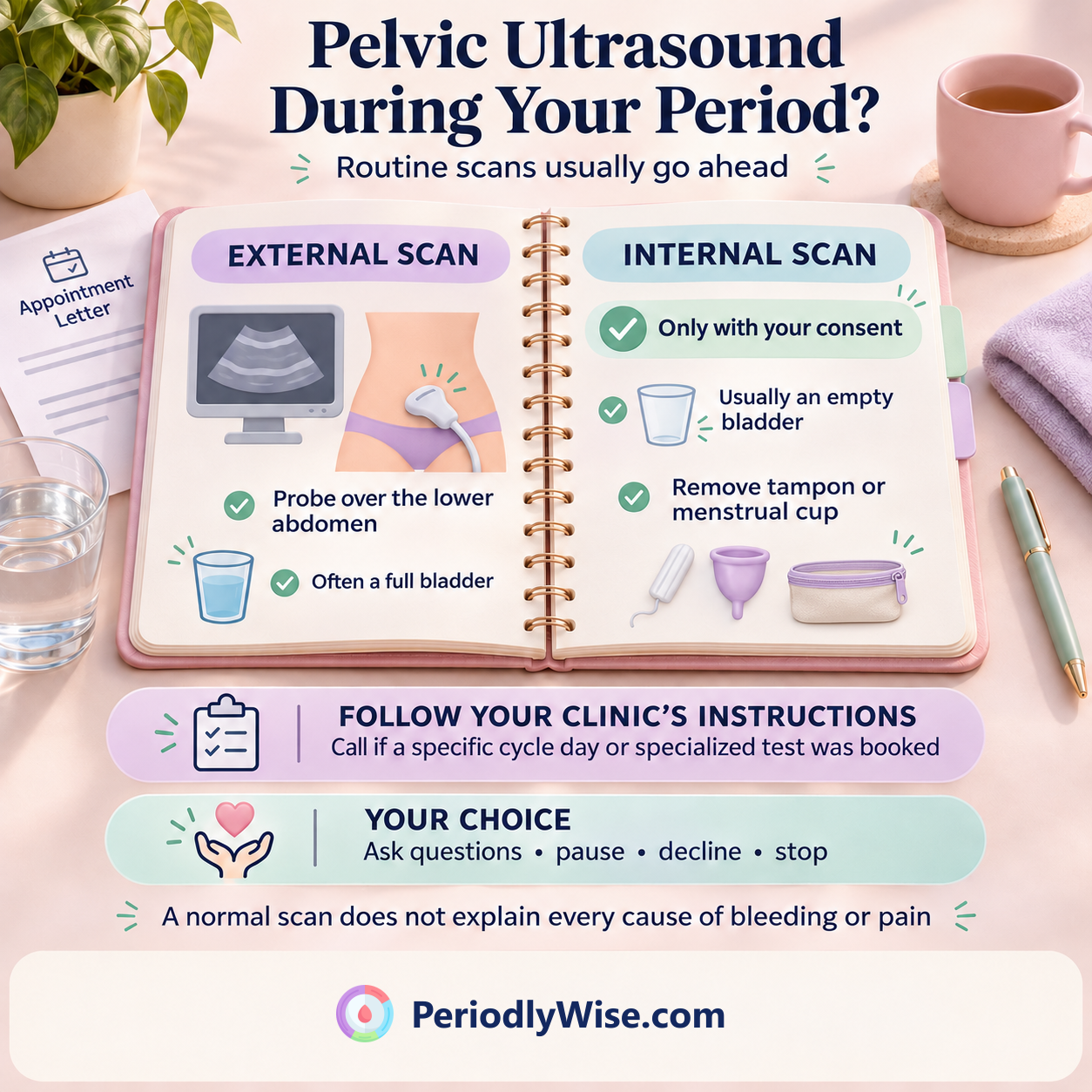
Yes, you can usually have a pelvic ultrasound on your period. This applies to a routine scan over your lower abdomen and, if offered and you agree, a transvaginal scan. If your appointment letter gives no cycle-day requirement and the bleeding is your usual period, there is generally no need to cancel.
Check the appointment name before changing your plans. A standard pelvic ultrasound, a fertility monitoring visit, and a saline ultrasound of the uterus answer different questions. Your clinic can tell you whether the date matters and whether you need to arrive with a full bladder.
What kind of scan are you having?
| Scan | What happens | Usual preparation |
|---|---|---|
| ScanTransabdominal (external) | What happensA probe moves over gel on your lower abdomen. | Usual preparationOften a full bladder. Follow the amount and timing in your clinic’s instructions. |
| ScanTransvaginal (internal) | What happensWith your consent, a covered, lubricated probe is inserted into the vagina. | Usual preparationUsually an empty bladder. Remove a tampon or menstrual cup before the internal scan. |
| ScanBoth at one visit | What happensThe external scan often comes first. Staff may then offer internal images for more detail. | Usual preparationIf told to arrive with a full bladder, wait until staff tell you when to empty it. |
The Cambridge University Hospitals guide describes this two-step approach and confirms that an internal scan can be done during a period. If your letter says only “pelvic ultrasound” and the bladder instructions are unclear, call before drinking a large amount of water. Tell the clinic if you have a fluid restriction or find holding your bladder difficult.
Will bleeding affect the images?
Having a period generally does not stop the sonographer from examining the uterus and ovaries. A routine pelvic scan uses sound waves, with no ionizing radiation. For a transvaginal scan, the probe sits closer to the pelvic organs, which can give more detailed images. RadiologyInfo explains what each approach can show.
The appearance of the uterine lining changes across the cycle. Tell the sonographer when bleeding started and whether it seems like your usual period, spotting, or something unexpected. The timing helps the clinician interpret the findings. If the question is specifically about the lining or a finding needs another look, the clinician may recommend a repeat scan at a particular time.
When is it worth calling before you go?
| Situation | What to do |
|---|---|
| SituationUsual period and a routine pelvic scan | What to doKeep the appointment and follow its preparation instructions. |
| SituationThe letter specifies a cycle day | What to doCall the booking team if your dates changed. Ask how they define day 1 if you only have spotting. |
| SituationFertility baseline or follicle monitoring | What to doContact your fertility clinic as instructed. Some baseline scans are planned early in the cycle, when you may still be bleeding. Later scans may be timed differently. |
| SituationSaline infusion sonography | What to doConfirm the date with the clinic. This uses fluid in the uterus and is often scheduled soon after menstruation. |
| SituationBleeding is unusual or pregnancy is possible | What to doTell the referring team. Get urgent assessment if pain, bleeding or other symptoms warrant it. |
A fertility clinic’s baseline scan can be part of a treatment schedule, so do not move it yourself based on a general article. Saline infusion sonography is a separate procedure with different timing and pregnancy checks.
How to prepare on a bleeding day
- Read the appointment letter for the scan type, bladder instructions, and any timing or medication directions. If they conflict with general advice online, contact the clinic.
- Pack a spare pad or other preferred protection and comfortable clothing. If you wear a tampon or cup, you can ask when and where to remove it before the internal scan.
- Tell the team your last period start if you know it, whether bleeding differs from usual, where you feel pain, and whether pregnancy is possible.
- Ask who will explain your result, when you should receive it, and whom to contact if symptoms change first.
There is no need to apologize for bleeding. If you worry about leaking during the exam, ask the team for a pad or a sheet and time to use the restroom. If your appointment is external first, ask before emptying your bladder.
You can choose whether to have an internal scan
The clinician should explain the exam and ask for consent. You can decline, ask for a pause, or ask to stop at any point. You can also ask about a chaperone, accessibility arrangements, or how the examiner can make the visit more comfortable. Mention pelvic pain, previous difficult exams, or a latex allergy if relevant. You do not have to share more personal detail than you want.
If you prefer an external scan, ask what information it can provide and what might be harder to see. A different approach or another appointment may be useful, depending on why you were referred. If an exam hurts, tell the person doing it. You do not need to tolerate pain to finish the scan.
When to seek care instead of waiting
If there is a chance of pregnancy and you have unusual bleeding with pelvic pain, seek urgent advice even if you have not had a positive test. Bleeding that looks like a period can have another cause. Follow the advice of the team assessing you, even if you already have an ultrasound booked.
Get emergency help for severe or worsening pelvic pain, feeling faint or passing out, shoulder-tip pain, or very heavy bleeding with pain or dizziness. These can be signs of a serious problem, including an ectopic pregnancy when pregnancy is possible. Do not wait for the appointment or for bleeding to stop. The NHS pelvic pain guide explains which symptoms need urgent or emergency assessment.
What a normal result means
A normal scan is useful information, but it does not explain every cause of bleeding or pain. It does not rule out endometriosis, for example. If symptoms continue, ask the clinician who referred you what the scan did and did not answer and what the next step should be. See NICE’s endometriosis guidance.
Frequently asked questions
Do I need to reschedule if my period starts that morning?
Usually no for a routine pelvic ultrasound. Call if the appointment has a required cycle day, is for a specialized procedure, or if your symptoms have changed.
Can I wear a tampon or menstrual cup to the appointment?
You can usually arrive wearing one. Remove it when the team prepares you for an internal scan. Bring a spare pad or your preferred protection for afterward.
Do I need a full bladder if my scan is internal?
Usually no. If both scans are planned, the external scan may need a full bladder first. Wait for the team’s instructions.
Can I have just the external scan?
You can decline an internal scan. Ask whether external images will answer the question or whether another option would be more useful.
Will a scan on my period rule out endometriosis?
No. A normal scan does not exclude endometriosis. Follow up about persistent or recurring symptoms.
Record the start of your usual flow and note spotting separately so you can describe the timing at your visit.
Use the Period Tracker