Yes, you can take a pregnancy test while you are bleeding. You do not have to wait for the bleeding to stop. A home urine test looks for the pregnancy hormone human chorionic gonadotropin, or hCG. Bleeding does not switch off that hormone or make a test unnecessary when pregnancy is possible.
The more useful question is whether you are testing at the right time. A bleed that arrives when you expected your period may be reassuring, especially if it matches your usual pattern, but appearance alone cannot confirm its cause. Pregnancy-related bleeding can sometimes be mistaken for a period.
This guide separates three decisions: whether a test can work while you bleed, when its result is informative, and when symptoms require care instead of another home test. You can make those decisions without trying to diagnose yourself from blood colour, cramps or a calendar prediction.
Does period blood affect a pregnancy test?
A urine pregnancy test detects hCG rather than oestrogen, progesterone or blood. The test manufacturer Clearblue explains that menstrual hormones and period blood do not prevent hCG detection. This answers the practical question about testing during bleeding; it does not identify why the bleeding is happening.
Use urine in exactly the way your particular kit describes. Do not put vaginal blood on the testing tip, use fluid from a pad or tampon, or add water to the sample. If a collected sample looks heavily contaminated or you cannot read the result clearly, use a fresh test and follow the manufacturer's advice rather than treating an unclear result as negative.
When should you test while bleeding?
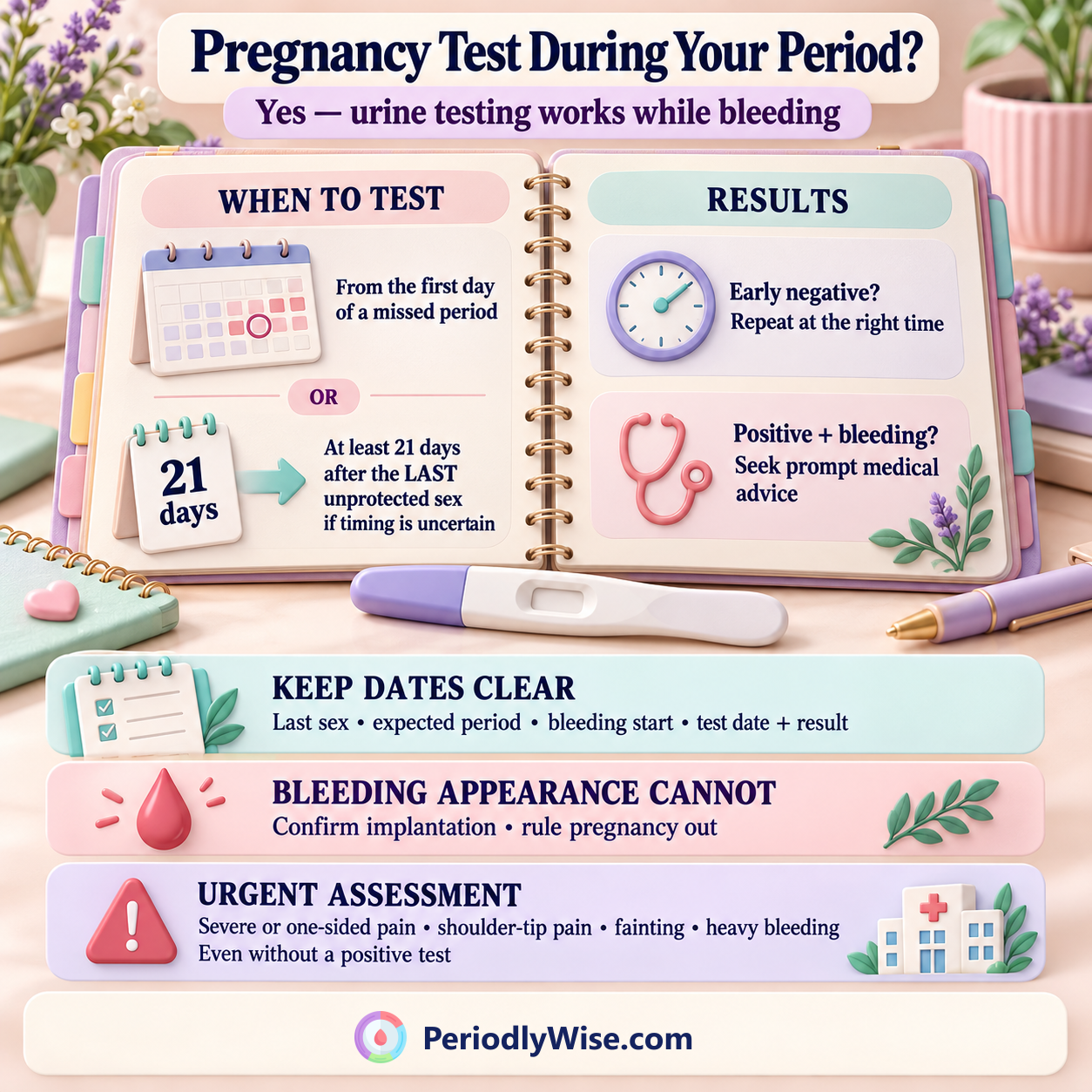
The NHS recommends testing from the first day of a missed period, or at least 21 days after the last unprotected sex when the due date is unknown. A condom break or another contraceptive failure also gives you a relevant date to discuss with a pharmacist or clinician.
A tracker estimates dates; it cannot confirm when you ovulated. This matters with irregular cycles, a recent illness, breastfeeding or changes in contraception. If you have had further unprotected sex since the date you first counted from, a test may address the earlier occasion while still being too early for the later one.
| Your situation | Testing plan | What to remember |
|---|---|---|
| Your situationYour period was due and bleeding is unusual | Testing planTake a test now, following the kit instructions. | What to rememberThe amount or colour of bleeding cannot establish the cause. |
| Your situationYou cannot predict your period | Testing planTest at least 21 days after the last unprotected sex. | What to rememberCount from the actual encounter, not an app's fertile window. |
| Your situationSex was only a few days ago | Testing planA test now cannot exclude pregnancy from that encounter. | What to rememberAsk promptly about emergency contraception if pregnancy is not wanted. |
| Your situationYou tested before the expected period | Testing planRepeat at the appropriate time if the result is negative. | What to rememberAn early-detection label does not make every early negative conclusive. |
| Your situationYou have severe pain, faintness or heavy bleeding | Testing planSeek urgent care now. | What to rememberDo not postpone assessment to reach a testing date. |
For example, a negative test on day 10 after an encounter does not become a 21-day result simply because bleeding starts that evening. Keep the exposure date and the bleeding date as separate entries.
A true period and bleeding in pregnancy are different
A true menstrual period is the shedding of the uterine lining in a cycle without an ongoing pregnancy. You do not have a true menstrual period during pregnancy, but you can have vaginal bleeding. The NHS describes several possible causes of bleeding in pregnancy and advises medical assessment.
Light spotting, a short bleed, brown discharge and cramps are not reliable home methods for distinguishing menstruation from pregnancy-related bleeding. Nor can a photograph confirm 'implantation bleeding'. There is overlap between how different causes look and feel, so use testing and clinical advice rather than a colour chart.
A bleed that is typical for you makes pregnancy less likely, but an unusual bleed deserves context. Consider whether contraception failed, whether a test was early and whether symptoms differ from your usual period. You do not need to panic about every change; you do need a clear next step if pregnancy remains possible.
How to take the test while you are bleeding
Read the leaflet before opening the test. Different products have different sample methods, timings and result windows. The MedlinePlus pregnancy-test guide explains why preparation and correct interpretation matter. The packet instructions take priority over a generic online demonstration.
You can usually test at any time of day once the appropriate testing date has arrived. If testing early or repeating an uncertain negative, first-morning urine can help because it is often more concentrated. Avoid drinking a large amount just to produce a sample, since dilution can make low hCG harder to detect.
- Check the expiry date, sealed wrapper and instructions; use an undamaged test.
- Wash your hands and prepare a clean, dry container if the kit uses a collected sample.
- Collect urine or hold the absorbent tip in the stream for the exact time described.
- Set the test down as directed and start a timer; do not estimate the waiting time.
- Check that the control indicator appears and read the result within the stated window.
- Record the date and result, then decide whether to repeat, seek advice or arrange care.
You do not need to insert a tampon to make a test work. Use your usual comfortable period protection. If the test errors or the control indicator is absent, it has not supplied a usable pregnancy result.
What does a negative test during bleeding mean?
A negative result means that this test did not detect enough hCG in that sample at that time. It is more informative when taken at the recommended time and used correctly. Testing too soon is a common reason for a false negative. The FDA explains that an early negative may need repeating after several days.
If you tested early, schedule the repeat for when your period is due or for at least 21 days after the last unprotected sex if your cycle is uncertain. If the result remains negative but your usual period does not arrive, or the bleeding stays unusual, contact a healthcare professional rather than repeating indefinitely.
A negative home test does not explain persistent pain or abnormal bleeding. It also cannot exclude a pregnancy from sex that happened very recently. Symptoms and timing still matter; a result should support a care decision, not override warning signs.
Use the result to choose the next step
A test result, the timing of sex and your symptoms belong in the same decision. The table below is a practical plan rather than a diagnosis. If your situation fits more than one row, follow the more urgent advice.
Keep the original test instructions available if you call for help. Saying 'negative, 12 days after a condom break, with new one-sided pain' is much more useful than saying only 'my period came'. You do not need exact medical terminology to describe what changed.
| Result or concern | What it can mean | Next action |
|---|---|---|
| Result or concernNegative before the recommended date | What it can meanThere may not be enough hCG to detect yet. | Next actionRepeat at the appropriate time; do not call it definitive. |
| Result or concernNegative at an appropriate time, symptoms settle | What it can meanPregnancy is less likely. | Next actionMonitor; seek advice if your usual period remains absent or concerns continue. |
| Result or concernPositive with any bleeding | What it can meanPregnancy is likely; the cause and location are not established. | Next actionContact a clinician or early-pregnancy service promptly. |
| Result or concernFaint line within the valid reading window | What it can meanIt may be a positive result if the control and instructions are satisfied. | Next actionTreat it as potentially positive and arrange appropriate advice. |
| Result or concernNo control indicator or an error | What it can meanThe test is invalid. | Next actionUse a new test; do not interpret this as negative. |
| Result or concernSevere pain, shoulder-tip pain, fainting or heavy bleeding | What it can meanA serious cause needs urgent exclusion. | Next actionSeek emergency assessment regardless of a home-test result. |
What if the test is positive and you are bleeding?
A positive test with bleeding should not be dismissed as 'just a period'. Bleeding can occur in an ongoing pregnancy, a miscarriage or an ectopic pregnancy, among other situations. A home test cannot tell you which explanation applies, whether a pregnancy is developing normally or where it is located.
Contact a healthcare professional promptly, even if the bleeding is light. They may ask about pain, dates, previous pregnancies and contraception, and may use blood tests or ultrasound depending on the circumstances. A scan very early in pregnancy may not yet show its location, so follow-up can be necessary.
Do not use changes in line darkness to decide that the pregnancy is safe or that a loss is complete. Different urine concentrations, products and reading conditions can change the appearance. If you receive a follow-up plan, keep it even if the bleeding stops or a later home test looks different.
Faint lines, late lines and invalid results
Read a line test only in the manufacturer's time window. A faint coloured test line within that window, with the required control, may indicate pregnancy. A mark noticed much later is not a reliable new result. Digital tests can also give an error; their wording does not remove the need for correct timing.
No control indicator means no valid result. Use a new kit rather than trying to repair, re-dip or reuse the old one. If bleeding makes the sample or display difficult to assess, ask the manufacturer or a clinician about repeating with a fresh sample.
When results conflict, note which products you used and when. Bring that information to an appointment. Taking many tests over a few hours often adds anxiety without resolving the question of pregnancy location or the reason for bleeding.
Birth control and emergency contraception do not replace testing
Contraceptive hormones do not prevent a pregnancy test from detecting hCG. A withdrawal bleed on the pill or irregular spotting with an implant or hormonal IUD can make calendar interpretation difficult, but the testing timeline can still be based on the date of a possible contraceptive failure.
Emergency contraception may change the next bleed. Devon Sexual Health advises a pregnancy test three weeks after unprotected sex following emergency contraception. Follow your own service's instructions, including any advice about restarting contraception and additional protection.
If unprotected sex was within the last five days and pregnancy is not wanted, seek advice promptly rather than waiting for a test. The CDC highlights the limits of testing after recent sex and the option of timely emergency contraception. The available methods and appropriate timing depend on your circumstances.
Recent pregnancy and some medicines change interpretation
hCG can remain detectable for a time after a birth, miscarriage or abortion. A positive result in that setting may need a specific follow-up plan rather than the usual assumption about a new pregnancy. Tell the clinician when the pregnancy ended and whether you were given a particular test or testing date.
Some fertility treatments contain hCG and can affect results. Do not stop prescribed medicine because of a home-test result; ask your treatment team when to test and how to interpret it. Most everyday medicines do not create pregnancy hormone, but the kit leaflet and your pharmacist can address a particular medicine.
These situations are another reason to keep the result in context. Neither ongoing bleeding nor a positive home test alone can confirm that a recent pregnancy has fully resolved. Follow the aftercare advice you received and seek care sooner for worsening symptoms.
What to record without turning tracking into a diagnosis
A short record can make a consultation easier. Keep facts separate from guesses: 'spotting started Tuesday' is clearer than 'implantation happened Tuesday'. You can use paper, a calendar or a tracker, whichever feels manageable and private.
Record what is different for you rather than trying to match someone else's flow. If you need period protection, note how often it becomes soaked. Mention whether pain is one-sided, worsening or interfering with normal activities. You do not have to finish a diary before asking for medical help.
- Dates of unprotected sex or a possible contraceptive failure, including any later encounters.
- Your expected period date, if known, and the first day of the current bleeding.
- Flow, duration, clots and how the pattern compares with your usual period.
- Test brand, expiry, testing date, valid reading time and result.
- Pain location, dizziness, shoulder pain, fever or other new symptoms.
- Contraception, emergency contraception, fertility treatment and any recent pregnancy.
When bleeding needs urgent medical attention
An ectopic pregnancy develops outside the uterus and can cause dangerous internal bleeding. The NHS advises assessment for suggestive symptoms even without a positive pregnancy test. You cannot safely rule this out by assuming the bleeding is your period.
Seek prompt medical advice for new one-sided lower-abdominal pain, persistent unusual bleeding or a positive result with bleeding. If symptoms are severe or you feel acutely unwell, use emergency care. Let the service know pregnancy is possible and describe your test timing, rather than delaying because an earlier test was negative.
Frequently asked questions
Can I take a pregnancy test on the first day of my period?
Yes, you can test while bleeding. The useful timing depends on when your period was due or when unprotected sex occurred. If you test too soon after sex, a negative result may need repeating even if bleeding has started.
Can period blood cause a false positive?
Menstrual blood does not create hCG. Read the kit correctly and within its stated time window. A positive result with bleeding needs medical advice; recent pregnancy or hCG-containing fertility treatment can change interpretation.
Should I wait until the bleeding stops?
No. You can test on the appropriate date while bleeding. Waiting is especially inappropriate if you have severe pain, shoulder-tip pain, faintness or heavy bleeding; those symptoms need urgent assessment.
Can I test at night?
Usually yes, when testing at the recommended time. First-morning urine can help when hCG may still be low, especially after an early negative. Follow the kit instructions and avoid excessive fluids before testing.
Does a negative test prove the bleeding is a period?
No. It says hCG was not detected at that time; it does not diagnose the bleeding. Repeat an early test at the appropriate time and seek advice for persistent unusual bleeding or pain.
Is light pink or brown bleeding implantation bleeding?
Colour, flow and cramps cannot confirm implantation. Several causes can look similar. Use the recommended pregnancy-testing timeline and seek medical advice when bleeding is unusual or pregnancy is confirmed.
Can I be pregnant if I had sex during my period?
Pregnancy is possible after sex during bleeding, because ovulation timing varies and bleeding is not always a true period. A test immediately after sex cannot answer that question; count from the encounter and seek timely contraception advice if needed.
What if I have an IUD and a positive test?
Contact a clinician promptly, especially if you have pain or bleeding, so the pregnancy's location can be assessed. Do not try to remove the IUD yourself. Severe symptoms need emergency care.
Record your bleeding dates and cycle context so you can explain changes. Predictions support planning; they cannot confirm pregnancy, rule out an ectopic pregnancy or replace a clinician's assessment.
Open the period trackerA clear plan is more useful than guessing from bleeding
You can take a pregnancy test while bleeding. Choose the testing date using your expected period or the last unprotected sex, follow the instructions and repeat an early negative when appropriate. A period-like bleed does not make an early test definitive.
If the result is positive, seek advice about the bleeding. If you have urgent warning signs, get care regardless of the result. You do not need a perfect cycle record, a darker test line or proof from an app before asking for help.