Yes, you can get pregnant from sex during your period. It is often less likely than sex during the fertile window, but menstrual bleeding is not contraception and there is no universally safe period day. The answer depends on when you ovulate, how long sperm remain alive, the length and regularity of your cycle, and whether the bleeding is actually a menstrual period.
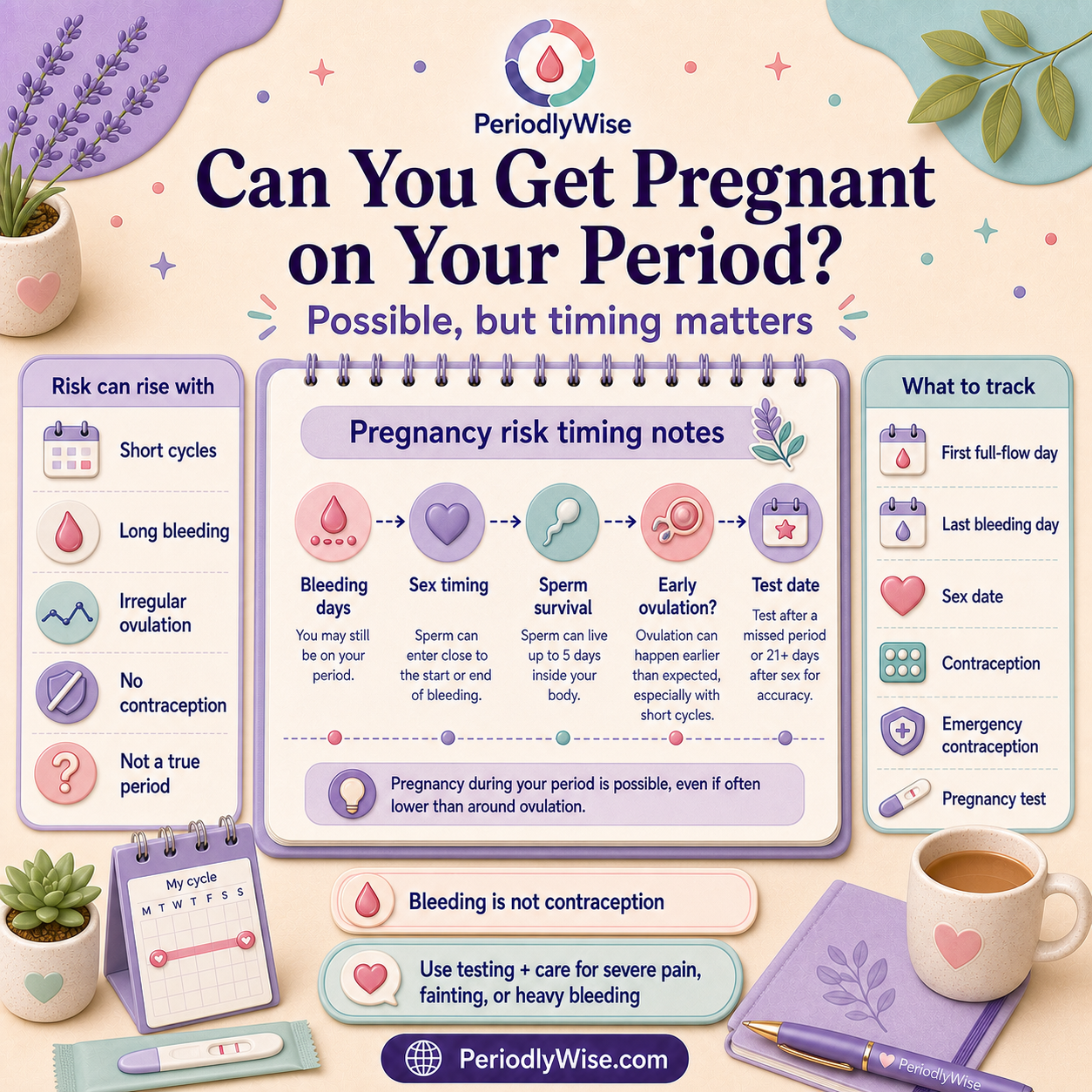
A menstrual cycle starts on the first day of period bleeding. Ovulation does not always happen on day 14. ACOG explains that ovulation generally occurs about 14 days before the next period, while sperm may survive for about 3 days and sometimes up to 5 days. If you have sex late in a period and ovulate early, living sperm may still be present when an egg is released.
Use your tracker as a record, not a guarantee. Save the first day of full flow, the last day of bleeding, recent cycle lengths, contraception, sex dates, ovulation signs, emergency contraception, and pregnancy-test dates. That timeline is more useful than a calendar label that says only period day.
How period sex can lead to pregnancy
Pregnancy requires sperm to meet an egg. The egg is available for only a short time after ovulation, but sperm can survive in the reproductive tract for several days. That longer sperm lifespan is the reason sex before ovulation can result in pregnancy. Bleeding does not wash sperm away or stop fertilization.
Imagine a 21-day cycle with ovulation near day 7. Sex on day 5, while bleeding is ending, could leave sperm present when ovulation happens. The exact day cannot be calculated perfectly from cycle length alone, and illness, stress, travel, breastfeeding, perimenopause, or recent hormonal changes can move ovulation.
The bleeding itself may also be misleading. Spotting from hormonal contraception, ovulation, cervical irritation, infection, or early pregnancy can be mistaken for a light period. If the bleed was unusual for you, do not use its color or timing as proof that pregnancy is impossible.
Timing examples
| Situation | Why pregnancy may be possible | Practical response |
|---|---|---|
| Sex early in a usual period | Often farther from ovulation, but timing can still vary. | Use contraception if pregnancy is not wanted. |
| Sex near the end of a long period | Sperm survival may overlap with early ovulation. | Do not assume the last bleeding day is safe. |
| Cycles around 21 to 24 days | Ovulation may happen relatively early. | Treat calendar estimates cautiously. |
| Irregular or changing cycles | The fertile window is harder to predict. | Use a reliable contraceptive method, not dates alone. |
| Bleeding was lighter or different | It may have been spotting rather than a true period. | Use pregnancy-test timing and seek advice if symptoms concern you. |
What can make the timing less predictable?
No single item proves pregnancy will happen, but these details make a period-day estimate less reassuring:
- Short cycles: less time may separate the first bleeding day from ovulation.
- Long bleeding: sex toward the end of a 6- or 7-day period can be closer to ovulation.
- Irregular cycles: calendar predictions are less dependable when cycle length changes.
- Recent hormone changes: starting, stopping, missing, or changing birth control can alter bleeding and ovulation.
- Postpartum, breastfeeding, or perimenopause: ovulation may return or occur unpredictably.
- Bleeding that was not a period: spotting cannot be used to reset the cycle with confidence.
What a tracker can and cannot tell you
| A tracker can help you | A tracker cannot prove |
|---|---|
| Compare period start dates and cycle-length ranges. | The exact day ovulation happened in a past cycle. |
| Record cervical mucus, test-strip results, and temperature. | That a bleeding day is automatically nonfertile. |
| Show when unprotected sex and contraception changes occurred. | That pregnancy is impossible without a test. |
| Prepare a clear timeline for a clinician or pharmacist. | That fertility-awareness estimates replace contraception. |
What to do after unprotected sex during a period
If pregnancy is not wanted, act from the date of sex rather than waiting to see what the next period does.
- Write down the date and time. Also note where you were in the bleed and whether a condom broke, slipped, or was not used.
- Ask about emergency contraception as soon as possible. CDC guidance says emergency contraceptive pills should be taken as soon as possible within 5 days, and a copper IUD may be placed within 5 days in appropriate circumstances.
- Check instructions for ongoing contraception. What you do next can differ after levonorgestrel or ulipristal, so use the product directions or ask a pharmacist or clinician.
- Plan a pregnancy test. Test from the first day of a missed period. If you do not know when it is due, the NHS advises testing at least 21 days after the last unprotected sex.
- Consider STI testing. Emergency contraception does not prevent sexually transmitted infections, and period timing does not change that risk.
When to test or seek medical care
Take a test if your next period is late, much lighter than usual, or absent, or if you develop pregnancy symptoms. A negative result taken too early may need repeating according to the test instructions. If a test is positive, arrange appropriate pregnancy care.
Seek urgent medical help if pregnancy is possible and you have severe or one-sided pelvic pain, shoulder-tip pain, fainting, marked dizziness, or heavy bleeding. Those symptoms can occur with an ectopic pregnancy or another urgent problem and should not be managed by tracking alone.
Contact a clinician if bleeding during or after sex keeps happening, cycles have become newly irregular, or you are unsure whether the bleed was a period. A pregnancy test, contraception review, STI testing, or evaluation of abnormal bleeding may be appropriate.
Record period flow, cycle range, sex dates, contraception, ovulation signs, and test dates in one timeline. Use the estimate for planning, and use reliable contraception when pregnancy prevention matters.
Open the fertility window trackerFrequently asked questions
Can you get pregnant on the first day of your period?
It may be less likely in a predictable cycle, but it is not impossible. Early ovulation, short cycles, and bleeding that is not a true period can change the timing.
Can sperm survive until after the period?
Yes. Sperm can survive for several days, sometimes up to about 5 days, so sex late in a period can overlap with an early ovulation.
Can you be pregnant and still have a period?
A true menstrual period does not continue during pregnancy, but spotting or bleeding can occur and may be mistaken for a period. Test if pregnancy is possible or the bleeding is unusual.
Does period tracking prevent pregnancy?
No. A tracker estimates timing and records patterns; it does not confirm ovulation or guarantee safe days. Use a reliable contraceptive method if you do not want pregnancy.
Should I take emergency contraception after sex on my period?
If sex was unprotected or contraception failed and pregnancy is not wanted, ask a pharmacist or clinician promptly. Emergency options are time-sensitive and can be used after sex during period bleeding.
The bottom line
Pregnancy during period bleeding is possible because sperm can outlast the bleeding and ovulation can occur earlier than a calendar predicts. The risk is not identical on every day, but a period is not a contraceptive method.
If unprotected sex already happened, focus on time-sensitive emergency contraception, accurate pregnancy-test timing, and urgent symptoms. For future cycles, track your pattern while using contraception that matches how strongly you want to avoid pregnancy.