A late period after taking Plan B can be normal, but it deserves a careful timeline. Plan B One-Step and other levonorgestrel morning-after pills work mainly before ovulation by stopping or delaying the release of an egg. Because the timing of ovulation helps set the timing of a period, a medication that shifts ovulation can also shift the next bleed. That is why your next period may show up a few days early, a few days late, heavier, lighter, or more spotty than usual.
The important thing is to separate common cycle disruption from signs that you need a pregnancy test or medical care. Emergency contraception reduces the chance of pregnancy after unprotected sex or a contraception problem, but it is not perfect. It also does not protect against sexually transmitted infections, and it will not end or affect an existing pregnancy. If your period is late, the question is not only, did Plan B delay my period? It is also, when was sex, when was Plan B taken, when was my period expected, and when is a pregnancy test likely to be useful?
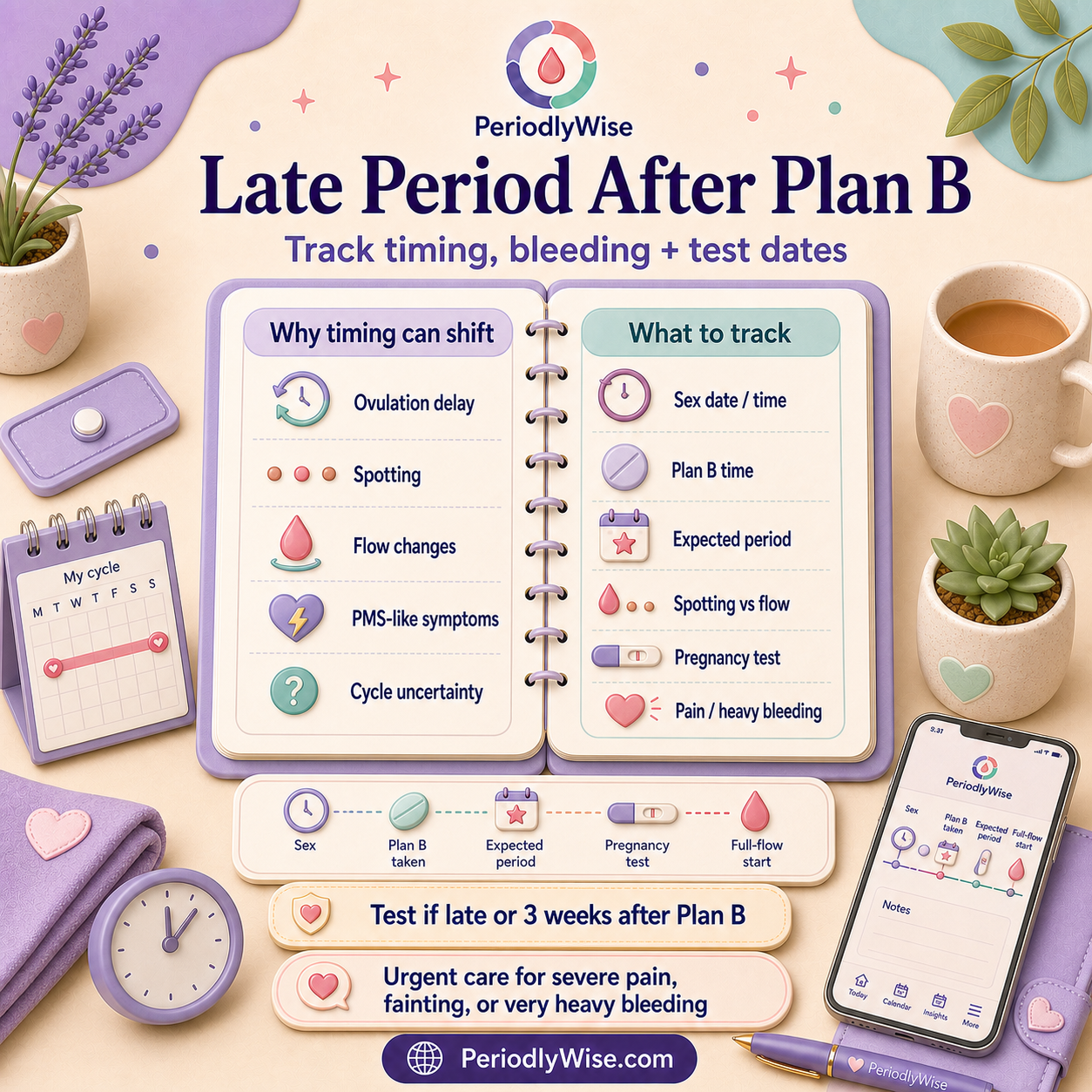
PeriodlyWise can help by turning the worry into a clean record. Log the date and time of sex, the date and time you took Plan B, your expected period date, any spotting, symptoms, pregnancy test dates, and the first day of true menstrual flow. A clear record is more useful than trying to guess from one symptom.
Why Plan B can delay a period
Plan B contains levonorgestrel, a progestin. The FDA explains that Plan B works before the egg is released from the ovary, so it usually stops or delays ovulation. If ovulation was delayed, the period that follows may also be delayed. If ovulation had already happened, Plan B may be less effective, which is why pregnancy testing matters when a period does not arrive.
Timing also matters. Levonorgestrel emergency contraception works best the sooner it is taken after sex, and product directions generally emphasize taking it as soon as possible within 72 hours. Some morning-after pills may be used up to 5 days after sex, but they work better earlier. A delayed period does not prove the pill worked, and an on-time period does not prove there was never pregnancy risk. It is one piece of the whole timeline.
It is also common to notice bleeding that does not behave like a typical period. You may have spotting in the days after taking Plan B, then a later true period. You may have a bleed that starts near the expected date but is lighter or heavier than usual. If you track all bleeding as the same thing, your calendar can become confusing. Labeling spotting separately from full flow makes future cycle estimates more realistic.
How late is too late after Plan B?
ACOG says that with emergency contraception, the period usually comes within 1 week of the expected time, which can mean up to a week before or after the expected date. ACOG also advises pregnancy testing if you have not had a period within a week of when you expected it. Planned Parenthood gives another practical anchor: take a pregnancy test if you have not gotten your period within 3 weeks after taking the morning-after pill.
Those two timelines can work together. If you know when your period was due, test once it is more than a week late. If your cycles are irregular, if you do not know when your period was expected, or if you are not sure whether the bleeding you had counted as a period, use 3 weeks after sex or after taking Plan B as a clearer testing point. Pregnancy tests work best after a missed period, and Planned Parenthood notes that for very irregular cycles, testing 3 weeks after sex is a useful way to improve accuracy.
If the test is negative but your period still does not come, repeat the test in a few days or check in with a clinician. A false negative can happen if you test too early, use diluted urine, misread the timing window, or ovulate later than expected. If the test is positive, contact a healthcare professional to discuss next steps and watch for pain or heavy bleeding.
What symptoms can happen after Plan B?
Short-term side effects can include nausea, breast tenderness, headache, dizziness, fatigue, abdominal discomfort, spotting, and period changes. Some people have no symptoms at all. Symptoms are not a reliable way to confirm whether Plan B worked or whether pregnancy happened, because early pregnancy, PMS, stress, and medication side effects can overlap.
Pay special attention to the amount of bleeding and the character of pain. A heavier-than-usual period can happen after Plan B, but bleeding that soaks a pad or tampon every 1 to 2 hours, bleeding with fainting or severe dizziness, or bleeding that feels unmanageable should be checked urgently. Severe lower abdominal or pelvic pain, especially with a positive pregnancy test or pain that does not improve with over-the-counter pain relief, needs prompt medical advice because ectopic pregnancy must be ruled out.
Also consider STI risk. Plan B helps reduce pregnancy risk after sex, but it does not prevent chlamydia, gonorrhea, HIV, or other infections. If sex was unprotected, if a condom broke, if you have pelvic pain, unusual discharge, fever, pain with urination, or bleeding after sex, STI testing may be part of the right follow-up.
What to track after taking Plan B
Start with dates. Record the date and time of sex, the date and time Plan B was taken, and whether vomiting happened within 2 hours of the dose. If vomiting did happen, contact a pharmacist or clinician because the dose may not have absorbed properly. Record the expected period date, the first day of spotting, the first day of full flow, and whether the flow was light, medium, heavy, or clotty.
Add context that may affect the result. Note whether you were near your usual fertile window, whether you use any ongoing birth control, whether pills were missed, whether a condom broke, and whether you have taken emergency contraception more than once in the same cycle. Also note medicines or herbal products that may reduce effectiveness, such as some seizure medicines, rifampin-like antibiotics, certain HIV medicines, and St. John's wort. A clinician or pharmacist can check your exact medication list.
Then track symptoms without overreading them. Tender breasts, cramps, nausea, fatigue, mood changes, and headaches can happen for many reasons. A simple severity score and start date are enough. The pattern matters more than one isolated symptom.
When to get medical care
Get medical care quickly if you have severe lower abdominal pain, shoulder-tip pain, fainting, severe dizziness, a positive pregnancy test with pain or bleeding, or heavy bleeding that requires changing a pad or tampon every 1 to 2 hours. You should also seek care if you have fever, unusual or foul-smelling discharge, pain during sex, or symptoms that make you feel unsafe at home.
Make a non-urgent appointment if your period is more than a week late and tests are unclear, if you still have no period 3 weeks after taking Plan B, if bleeding keeps repeating between periods, or if emergency contraception is becoming your main pregnancy-prevention method. Plan B can be used when needed, but a regular method such as condoms, pills, an implant, an IUD, a ring, a patch, or another option may fit better if pregnancy prevention is an ongoing need.
For tracking, treat this cycle as a special cycle. A late or strange period after Plan B can temporarily throw off predictions, so future estimates should use the next confirmed period as a cleaner starting point. Use the Period Tracker for period dates, the Ovulation Tracker for estimated fertile timing, and the missed period and negative test guide if your testing timeline is unclear.