A late period can feel stressful, especially when your cycle is usually predictable. For many people, the first thought is pregnancy, and if pregnancy is possible, taking a pregnancy test is a sensible first step. But pregnancy is not the only reason a period can arrive later than expected.
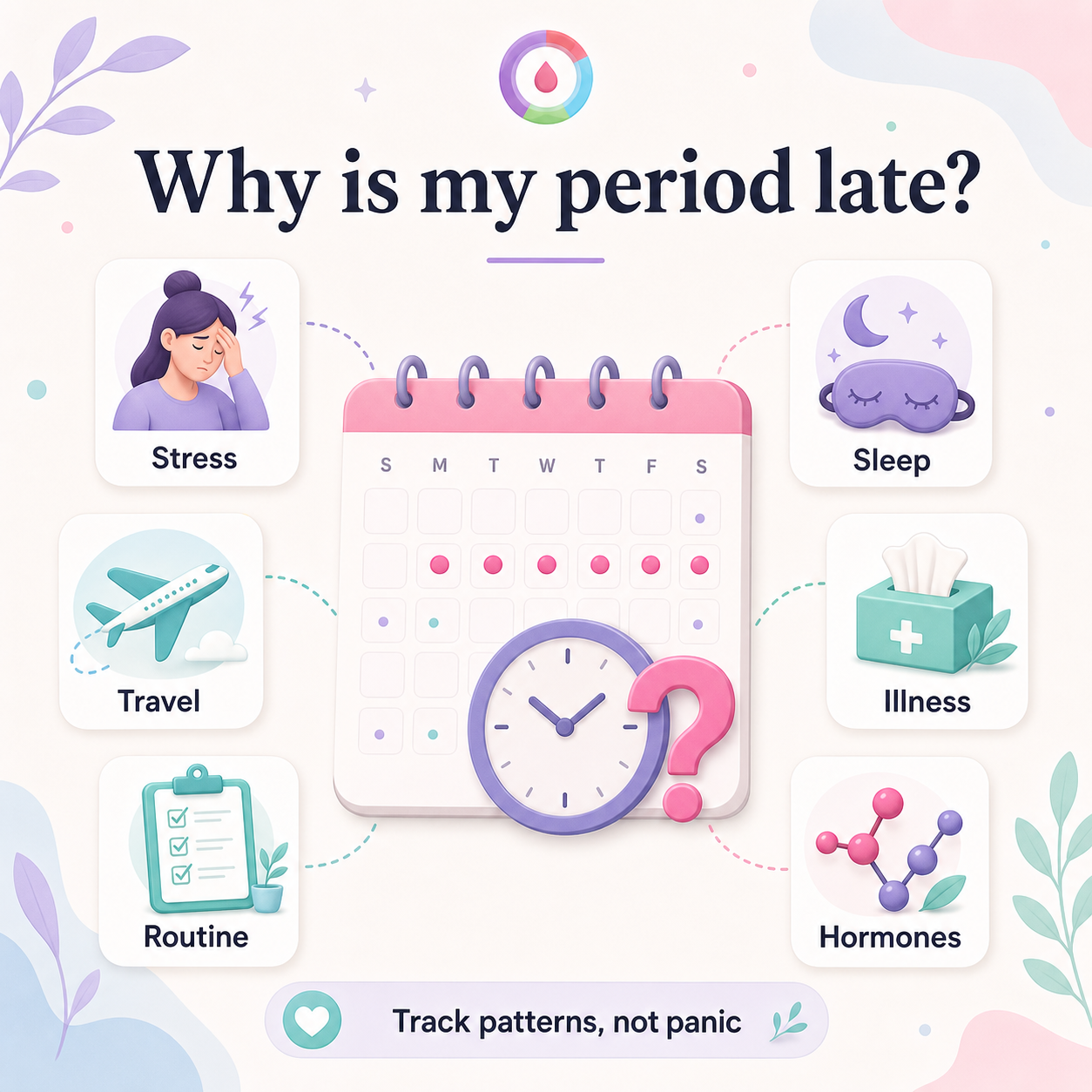
Menstrual cycles are influenced by hormones, ovulation timing, stress, sleep, illness, medication, weight changes, exercise, and underlying health conditions. A period often arrives after ovulation. If ovulation happens later than usual, the period may also come later. That is why one delayed period does not always mean something is seriously wrong.
Still, tracking the pattern matters. A single late period after a stressful month is different from repeated missed periods, very irregular cycles, heavy bleeding, severe pain, or symptoms that feel new for your body. This guide explains common reasons for a late period besides pregnancy, what to track, and when to speak with a healthcare professional.
What counts as a late period?
A menstrual cycle is counted from the first day of one period to the first day of the next period. The Office on Women's Health notes that cycles can naturally vary, and a typical adult cycle often falls within a range rather than one fixed number. The NHS describes periods as irregular when the gap between periods is less than 21 days or more than 35 days.
This means a "late period" depends on what is normal for you. If your cycle is usually 28 days and your period arrives on day 32, that may feel late, but it can still fall within a common range. If your period is more than a week later than expected, or if your cycles are repeatedly outside your usual pattern, it is worth paying closer attention.
Using a period tracker or cycle history can help you compare this cycle with previous ones instead of relying on memory.
1. Pregnancy
Pregnancy is one of the most common reasons for a missed period. If you had sex where pregnancy is possible, take a home pregnancy test. Testing is especially important if your period is late and you also notice symptoms such as breast tenderness, nausea, fatigue, or unusual spotting.
If the test is negative but your period still does not arrive, repeat the test after a few days or follow the test instructions. If you are unsure, speak with a healthcare professional.
2. Stress and emotional pressure
Stress can affect the hormonal signals that help regulate ovulation and menstruation. Mayo Clinic explains that mental stress can affect the hypothalamus, a part of the brain involved in hormonal control of the menstrual cycle. When ovulation is delayed or temporarily disrupted, your period may come late or skip.
Stress does not have to be dramatic to affect the body. Exams, deadlines, family pressure, grief, financial worry, relationship stress, burnout, or chronic anxiety can all add up.
- Did the stressful period happen before ovulation or before the expected period?
- Was this a one-time stressful month or a repeated pattern?
- Did your sleep, appetite, exercise, or routine change too?
3. Poor sleep or routine changes
Sleep affects many hormone-related systems in the body. While one late night is unlikely to change your entire cycle, repeated poor sleep, shift work, travel, jet lag, or major changes in daily routine may contribute to irregular timing.
If your period is late after travel, night shifts, intense work weeks, or a disrupted schedule, note it in your cycle record. Over time, you may notice whether your cycle responds to routine changes.
4. Illness or physical stress
Your body may treat illness as a physical stressor. Fever, infections, major inflammation, surgery, recovery from illness, or intense physical strain can affect ovulation timing. If ovulation happens later, the period may also be delayed.
This does not mean every cold will delay your period. But if you were sick around the middle of your cycle, or your body was recovering from something significant, it may be part of the picture.
5. Weight changes or not eating enough
Significant weight loss, weight gain, restrictive eating, or not eating enough for your activity level can affect menstrual cycles. Mayo Clinic lists low body weight and eating disorders as possible contributors to missed periods because they can interrupt hormonal functions involved in ovulation.
This is not about appearance or blame. The body needs enough energy to support normal hormonal patterns. If your period becomes late, irregular, or stops after major diet changes, intense calorie restriction, or rapid weight changes, it is worth seeking medical support.
6. Intense exercise or training changes
Exercise is healthy, but sudden or intense training changes can affect periods, especially if the body is not getting enough rest or nutrition. Mayo Clinic notes that rigorous athletic training can increase the risk of missed periods.
This may happen with endurance training, heavy workouts, dance, sports preparation, or a sharp increase in exercise load. Track both exercise and food/rest patterns, because the issue is often the combination of high output and low recovery.
7. Birth control or stopping birth control
Hormonal contraception can change bleeding patterns. Some people have lighter periods, irregular bleeding, no bleeding, or delayed return of regular cycles after stopping certain methods. Mayo Clinic notes that oral contraceptives, injections, implants, and some IUDs can affect menstruation.
If you recently started, stopped, changed, or missed hormonal birth control, that may explain a late or unusual period. If you are worried about pregnancy risk after missed pills or contraception changes, follow your contraceptive instructions or speak with a healthcare professional.
8. Breastfeeding, postpartum changes, and perimenopause
Periods can be delayed or absent during breastfeeding. They may also be irregular after giving birth as the body transitions.
Perimenopause can also make periods less predictable. The Office on Women's Health notes that cycles may become irregular during the transition to menopause, often beginning in the 40s. Periods may become shorter, longer, lighter, heavier, skipped, or closer together.
9. PCOS, thyroid conditions, and other health issues
Sometimes late or irregular periods are linked to an underlying condition. The NHS lists PCOS and an underactive thyroid as possible causes of irregular periods. The Office on Women's Health also lists PCOS, thyroid problems, eating disorders, high prolactin, pelvic inflammatory disease, uncontrolled diabetes, and other causes under period problems.
Possible signs to pay attention to include repeated long or unpredictable cycles, acne or increased facial hair, unexplained weight changes, fatigue, feeling cold, hair changes, pelvic pain, trouble getting pregnant, bleeding between periods, or very heavy bleeding. These symptoms do not prove you have a condition, but they are useful to discuss with a clinician.
What should you track when your period is late?
A late period is easier to understand when you track context, not just dates. In PeriodlyWise, you can track your period start date, cycle length, period length, and cycle regularity. You can also save records and review your cycle history over time.
| What to track | Why it helps |
|---|---|
| Expected and actual period date | Shows how late the period was compared with your usual pattern. |
| Cycle length and bleeding length | Helps separate one unusual cycle from a repeating pattern. |
| Stress, sleep, travel, illness, and exercise changes | Gives context for delayed ovulation or routine disruption. |
| Flow, spotting, pain, bloating, mood, and fatigue | Helps you notice symptoms that repeat or need medical attention. |
| Birth control changes and pregnancy test results | Important context when pregnancy or hormone changes are possible. |
When should you see a doctor?
Seek medical advice if you have gone three months without a period and are not pregnant or breastfeeding, your periods suddenly become irregular after previously regular cycles, your cycles are repeatedly very short or very long, your period lasts longer than seven or eight days, or you bleed through pads or tampons every one to two hours.
You should also seek help if you pass clots larger than a quarter, have severe pain, dizziness, fainting, chest pain, shortness of breath, bleeding after sex, bleeding between periods, bleeding after menopause, or if you are trying to get pregnant and cycles are very irregular.
The Office on Women's Health recommends medical attention for missed periods lasting three months, heavy bleeding, unusual bleeding, and symptoms that interfere with daily life. The NHS also advises speaking with a GP if periods are irregular or your normal pattern changes.
FAQ
Can stress make my period late?
Yes. Stress can contribute to a late or missed period by affecting hormonal signals involved in ovulation and menstruation. If stress delays ovulation, your period may also arrive later.
How many days late can a period be before worrying?
It depends on your usual cycle. A few days of variation can be normal. If pregnancy is possible, take a test. If periods are repeatedly irregular, absent for three months, very heavy, very painful, or unusual for you, speak with a healthcare professional.
Can poor sleep delay a period?
Poor sleep alone may not always delay a period, but repeated sleep disruption, travel, shift work, stress, and routine changes can affect the body's hormonal rhythm and may contribute to cycle changes.
Can exercise make your period late?
Moderate exercise is generally healthy. But sudden intense training, heavy exercise, low energy intake, or poor recovery can contribute to late or missed periods in some people.
Can PeriodlyWise tell me exactly why my period is late?
No. PeriodlyWise can help estimate your period and show patterns in your cycle history, but it cannot diagnose the cause of a late period. Use it as an educational tracking tool, and speak with a healthcare professional for medical concerns.
Final thoughts
A late period can happen for many reasons besides pregnancy. Stress, sleep changes, illness, travel, weight changes, intense exercise, birth control, breastfeeding, perimenopause, PCOS, thyroid issues, and other health factors can all influence cycle timing.
The most useful next step is not panic. It is pattern tracking. Record what changed, when your period arrives, how heavy it is, and whether the delay repeats. If the change is persistent, severe, or worrying, seek medical advice.
You can use the PeriodlyWise period tracker, irregular period tracker, and cycle history to understand your cycle patterns more clearly.
Use PeriodlyWise to estimate your next period, compare cycle history, and understand whether one late period is becoming a pattern.
Open the Period Tracker