Tracking ovulation with irregular periods can feel like trying to plan around a moving target. One cycle may be 31 days, the next 44, and a calendar app may still point to a neat middle date that does not match your body.
The better strategy is to track a window, not a single day. Irregular cycles often mean ovulation is delayed, earlier than expected, or sometimes not happening in a predictable pattern. A wider window gives you something useful without pretending the date is certain.
This guide explains how to combine cycle history, cervical mucus, ovulation tests, basal body temperature, and symptoms in a practical routine, plus when irregular cycles should be discussed with a clinician.
Why irregular cycles make ovulation harder to predict
The fertile window is commonly described as the days leading up to and including ovulation, but ovulation does not always land on cycle day 14. NHS guidance notes that ovulation is usually about 10 to 16 days before the next period, which means you often recognize the timing more clearly after the cycle ends.
ASRM guidance warns that calendar-based apps may not accurately predict ovulation day, especially when they assume a fixed ovulation pattern. Irregular cycles make that assumption weaker because the first half of the cycle can vary a lot.
A late period after a long cycle often means ovulation happened later than usual, not necessarily that the period itself randomly moved. That is why tracking ovulation with irregular periods works best when you combine multiple signs.
Ovulation tracking methods for irregular periods
| Method | What it can show | Main limitation |
|---|---|---|
| Cycle range | Your likely early and late fertile-window boundaries from recent history. | It estimates a window, not a confirmed ovulation day. |
| Cervical mucus | Wet, slippery, stretchy, egg-white mucus can suggest rising fertility. | Mucus can be affected by infections, arousal, semen, medications, or hydration. |
| LH ovulation tests | A positive test can show an LH surge before possible ovulation. | PCOS, long cycles, testing too late, or multiple surges can confuse results. |
| Basal body temperature | A sustained rise can confirm ovulation likely happened. | It confirms after the fact and needs consistent morning measurement. |
| Symptoms and spotting | Mittelschmerz, breast changes, libido, or light spotting may add context. | Symptoms are not reliable enough alone. |
Build a window instead of chasing one day
Start with your recent cycle range. If your shortest recent cycle was 30 days and your longest was 45 days, your fertile tracking window needs to start earlier and last longer than a standard 28-day estimate. This does not mean every day is equally fertile; it means you are giving your body enough room to show signs.
Cervical mucus is often the first real-time clue. ReproductiveFacts and ASRM describe fertile mucus as increasing before ovulation and becoming more slippery and stretchy as fertility rises. For irregular cycles, mucus can tell you that your body may be moving toward ovulation even when the calendar is uncertain.
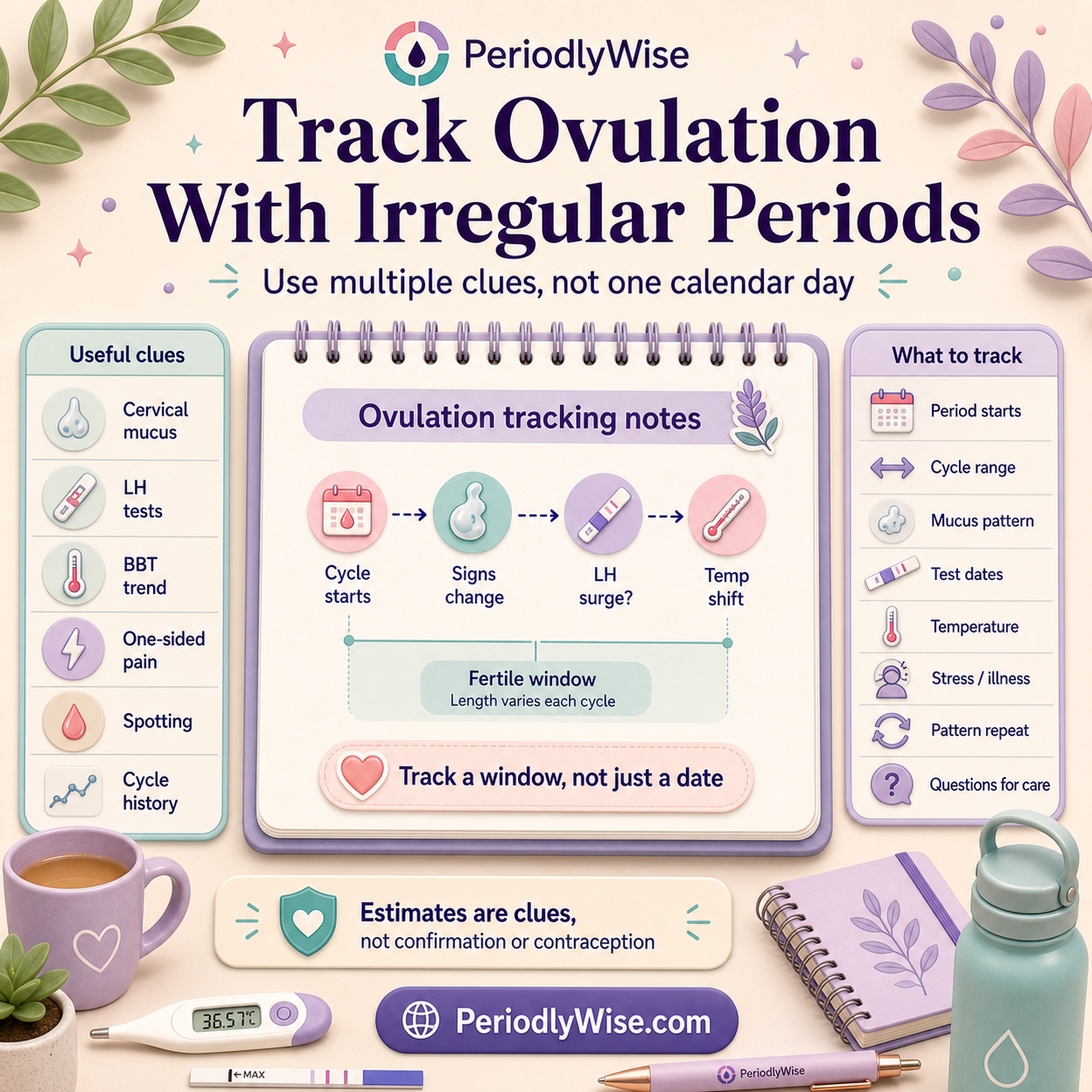
LH tests can help narrow the window, and BBT can help confirm whether the pattern likely completed. Together they answer different questions: mucus says fertility may be rising, LH says ovulation may be approaching, and BBT says ovulation may have already occurred.
What to track
Keep the notes short and repeatable. Consistency matters more than a perfect chart.
- Period start date: the first day of full flow, not spotting.
- Cycle length: count from one full-flow start date to the next.
- Shortest and longest cycles: use the last 6 to 12 cycles if you have them.
- Cervical mucus: dry, sticky, creamy, wet, slippery, stretchy, egg-white, or unclear.
- LH test results: negative, rising, positive, peak, test brand, and time of day.
- Basal temperature: morning temperature before getting up, if this routine is realistic.
- Sex timing: if trying to conceive, note timing without turning it into pressure.
- Symptoms: one-sided pain, breast tenderness, bloating, libido, spotting, headaches, or mood.
- Context: illness, travel, stress, sleep disruption, medication, breastfeeding, weight change, or intense exercise.
- Care clues: cycles over 90 days, no periods, very heavy bleeding, severe pain, acne or hair growth changes, or thyroid-like symptoms.
Step-by-step routine
Use this as a flexible routine, then simplify anything that makes tracking stressful.
- Mark periods first. Build a clean start-date history before trusting any ovulation estimate.
- Estimate a broad window. Use your shortest and longest cycles to decide when to start watching signs.
- Watch mucus daily in the window. Notice the shift toward wet, slippery, stretchy mucus rather than searching all month.
- Add LH tests strategically. Start earlier than a regular-cycle app suggests and keep testing through delayed signs when cycles run long.
- Use BBT for confirmation. Look for a sustained rise after suspected ovulation, not for same-day timing.
When irregular ovulation tracking needs medical support
Ask a clinician about irregular cycles if periods are frequently more than 35 days apart, absent for three months, suddenly very different, extremely heavy, very painful, or paired with symptoms such as new acne, excess hair growth, milk discharge, hot flashes, weight changes, or thyroid-like symptoms.
PCOS is one common reason cycles can be irregular and ovulation can be inconsistent, but it is not the only reason. Stress, eating changes, major exercise, thyroid conditions, high prolactin, postpartum changes, breastfeeding, perimenopause, and medications can also affect timing.
If you are trying to get pregnant, do not wait forever with confusing charts. Medical advice is often reasonable after 12 months of trying if under 35, after 6 months if 35 or older, or sooner with very irregular cycles or known reproductive-health concerns.
Use PeriodlyWise to organize period starts, cycle range, fertile-window estimates, mucus notes, ovulation-test timing, symptoms, and patterns you can share if needed.
Open the Period TrackerFAQ
Can I ovulate with irregular periods?
Yes, many people with irregular periods still ovulate, but ovulation may happen later, earlier, less often, or less predictably. Tracking several signs gives more context than a calendar alone.
When should I start ovulation tests with irregular cycles?
Start earlier than a standard app would suggest, based on your shortest recent cycle, and continue longer when signs are delayed. If tests are confusing for several cycles, ask a clinician.
Is cervical mucus reliable with irregular cycles?
Cervical mucus can be useful because it changes in real time, but it is not perfect. Infection, semen, arousal fluid, medications, and hydration can make interpretation harder.
Does a positive LH test mean I definitely ovulated?
No. A positive LH test suggests a surge that often comes before ovulation, but it does not prove the egg released. BBT or clinical testing can help confirm patterns.
Can I use ovulation tracking to avoid pregnancy if my cycles are irregular?
Do not rely on calendar predictions alone. If avoiding pregnancy matters, use a reliable contraceptive method or learn a formal fertility-awareness method from a qualified instructor.
Final thoughts
Irregular periods make ovulation tracking more nuanced, not impossible. The goal is to collect enough clues to see a pattern without forcing your body into a 28-day template.
Use a wide window, real-time signs, and medical support when cycles are very unpredictable or fertility goals are time-sensitive.