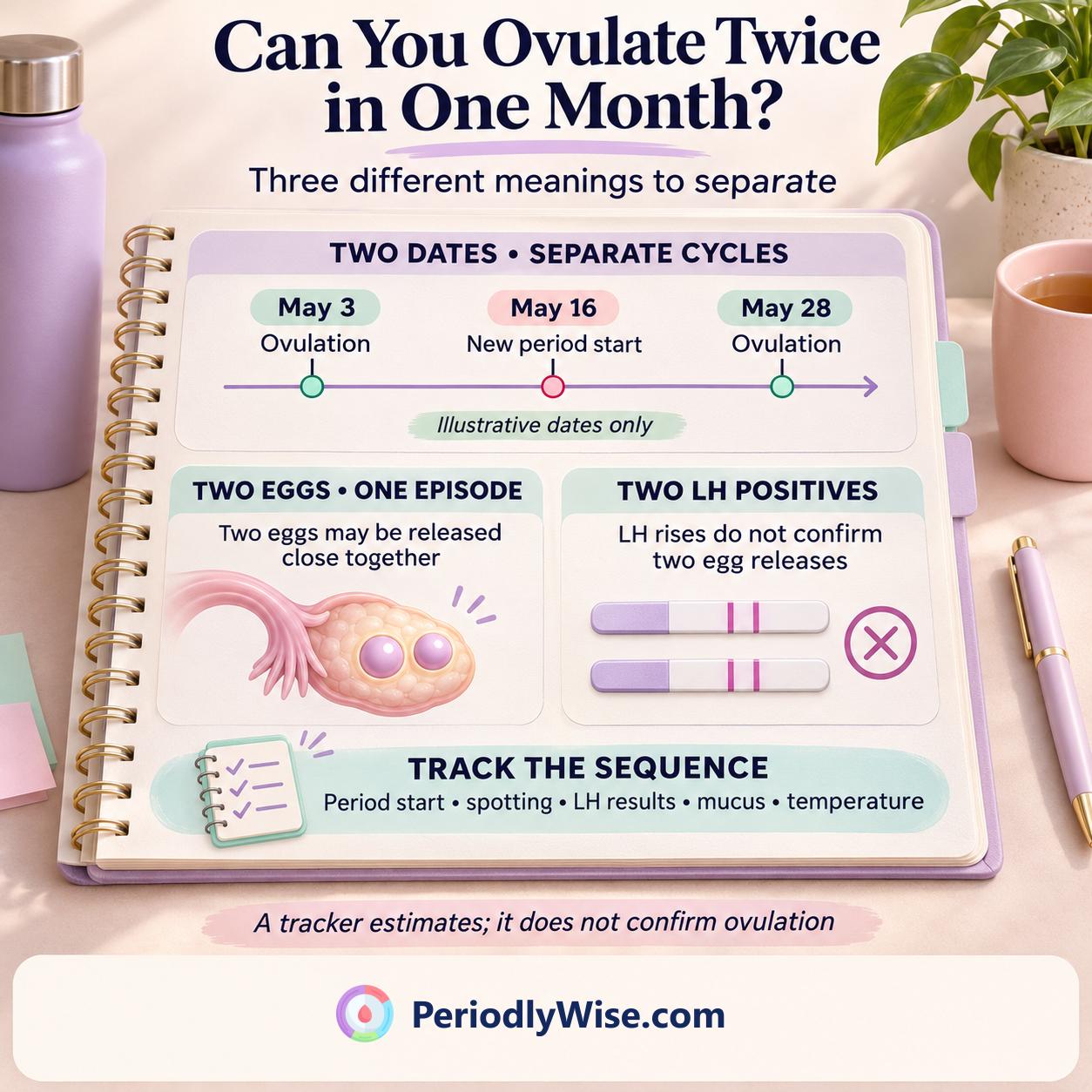
Yes, two ovulation dates can fall within one calendar month if they belong to different menstrual cycles. Two eggs may also be released around the same ovulatory episode in one cycle. That is different from routinely ovulating once and then again a week or two later within the same cycle.
If you are asking because you saw a second positive ovulation test, two patches of slippery mucus or two dates in an app, start by asking what each sign actually measures. None counts released eggs. Even two episodes of bleeding do not establish that two ovulations occurred.
Calendar month versus menstrual cycle
The NHS counts the cycle from the first day of a period through the day before the next period. A month starts on its own fixed date, regardless of what your ovaries are doing. With shorter cycles, two estimated ovulation dates can fit in the same month.
For example, imagine ovulation on May 3, a new period beginning May 16, and ovulation in the next cycle on May 28. The two May dates are 25 days apart and have a period start between them. This is an illustration, not a schedule to apply to yourself. A spot of blood between test peaks should not automatically be counted as a new period.
| What happened | A reasonable interpretation | What it cannot prove |
|---|---|---|
| What happenedTwo likely dates with a usual period between them | A reasonable interpretationOvulation may have occurred in two separate cycles. | What it cannot proveA calendar alone cannot confirm either date. |
| What happenedTwo eggs released near one ovulation | A reasonable interpretationBoth eggs could be fertilized, leading to fraternal twins. | What it cannot proveHome signs cannot count eggs. |
| What happenedTwo positive tests days apart | A reasonable interpretationAn LH rise may last several days or another rise may occur. | What it cannot proveThe tests do not show that either egg release occurred. |
| What happenedTwo episodes of spotting or slippery mucus | A reasonable interpretationBleeding or mucus patterns can change during the same cycle. | What it cannot proveNeither establishes that a new cycle began. |
What does releasing two eggs mean?
A follicle is a small structure in the ovary that can contain an egg. Most ovulatory cycles release one egg. Sometimes more than one follicle matures and two eggs can be released around the same ovulatory episode. If both are fertilized and develop, fraternal twins are possible. Identical twins generally develop when one fertilized egg divides.
Ultrasound research shows that follicles can grow in more than one wave within a cycle. Growth and release are different events. A later study of follicular waves distinguishes waves that result in ovulation from waves that do not. Counting waves as separate fertile windows confuses what was observed with what actually happened.
Why might an LH test turn positive twice?
Ovulation tests detect luteinizing hormone in urine. According to ASRM clinical guidance, an LH rise generally precedes ovulation within one or two days. That is indirect evidence. A test may stay positive across consecutive days or another rise may appear if ovulation is delayed. With PCOS, persistently elevated baseline LH can make urine tests misleading.
Read results within the time on the packet and follow instructions on timing, fluid intake and what counts as positive. Line darkness is affected by the test and urine concentration. For example, a positive on Tuesday, a negative on Thursday and another positive on Saturday is worth recording as a sequence. It is not a count of eggs or proof of two fertile windows.
Compare the clues you have
| Tracking method | What it can tell you | Main limit |
|---|---|---|
| Tracking methodApp or calendar | What it can tell youAn estimate based on previous dates. | Main limitIt cannot observe a hormone change or egg release. |
| Tracking methodLH urine test | What it can tell youA rise in LH that may precede ovulation. | Main limitIt cannot confirm release, date it exactly, or count eggs. |
| Tracking methodCervical mucus | What it can tell youSlipperier mucus can be a sign of approaching fertile days. | Main limitA second patch does not demonstrate a second ovulation. |
| Tracking methodWaking temperature | What it can tell youA sustained rise can support the idea that ovulation already happened. | Main limitSleep disruption, illness and inconsistent timing can affect readings. |
| Tracking methodClinical tests | What it can tell youTimed progesterone can support recent ovulation, and serial ultrasound can track follicles. | Main limitThe care team interprets the findings in context. A single result is not a complete cycle timeline. |
What to do with a confusing cycle
- Write down your last usual period start and keep spotting separate.
- Record each LH result and date, mucus observations and temperature readings, if you already take them. Note illness, disrupted sleep or hormone medicines.
- Compare the sequence over time. Do not set the day of ovulation from the darkest strip alone or move the start date to match an app.
- If the result matters for fertility care, bring the record to a clinician. Ask whether timed testing would answer your question better.
An ovulation estimate is not a contraceptive decision. If you are avoiding pregnancy, use a reliable contraceptive method and seek prompt advice after recent unprotected sex if emergency contraception might be needed. For pregnancy testing, follow the NHS timing guidance rather than treating an LH test as a pregnancy test.
When to ask for clinical advice
Ask for advice if you repeatedly have very short or long cycles, frequently miss periods, bleed between periods or are having trouble conceiving. If you are trying to conceive and have irregular or absent periods, a clinician can advise whether to start evaluation earlier. If you are using ovulation induction medicines or fertility treatment, use your clinic's monitoring plan.
With possible pregnancy, severe one-sided pelvic pain, shoulder-tip pain or fainting needs emergency assessment for possible ectopic pregnancy. Very heavy bleeding with faintness or breathlessness also needs urgent care.
Frequently asked questions
Can I ovulate twice two weeks apart?
Dates that far apart may represent a prediction error, delayed ovulation or different cycles if a period intervened. Two independent ovulations weeks apart are not the usual pattern in a spontaneous cycle.
Can the ovaries alternate in the same month?
They may release an egg in successive cycles, but ovaries do not have to alternate on a fixed schedule. Pain on both sides cannot establish which ovary released an egg.
Does a second LH peak mean twins?
No. LH strips measure a hormone signal. They do not count eggs or diagnose a multiple pregnancy.
Is bleeding twice in a month evidence of two ovulations?
No. Two usual period starts can fit into a month, but spotting or a bleed without ovulation can also occur. Compare dates and flow with your usual pattern.
Can a tracker confirm ovulation?
No. A tracker can organize cycle dates and observations. If confirmation matters, discuss suitable clinical testing.
Organize your cycle dates and observations. Predictions are estimates.
Use the Period Tracker