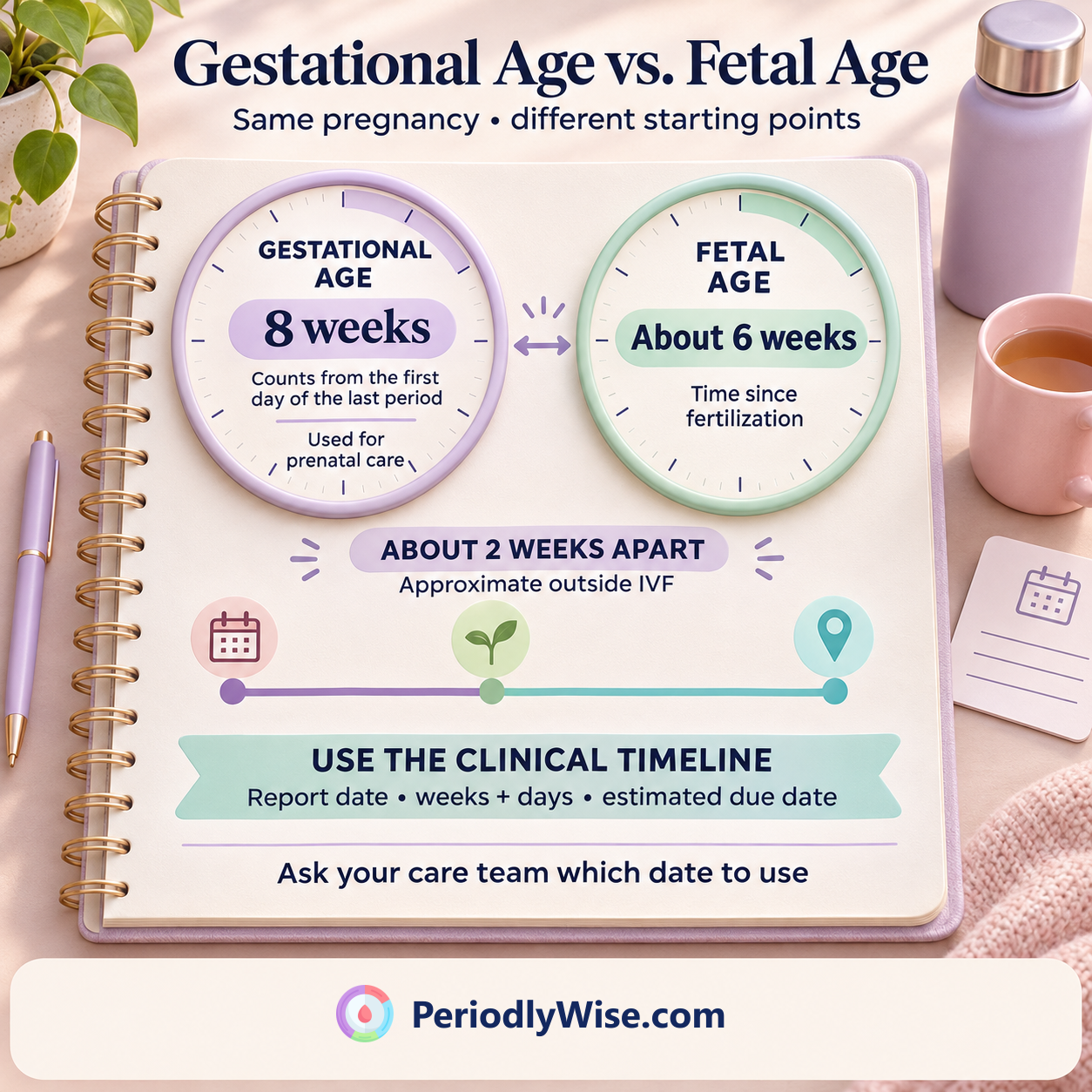
Gestational age counts pregnancy weeks on the clinical calendar. Fetal age, when used to mean age since fertilization, counts from a later starting point. That is why a report can say 8 weeks pregnant while development is roughly 6 weeks past fertilization. The two numbers describe the same point in pregnancy using different starting dates.
If you are comparing an app, a scan report and a development guide, look for the starting point each uses. Most prenatal visits, screening schedules and patient pregnancy guides use gestational age. Check the wording before subtracting two weeks from any number.
How the two counts compare
| Term | Starting point | Example |
|---|---|---|
| TermGestational age | Starting pointConventionally, the first day of the last menstrual period. Ultrasound or IVF records can establish the equivalent clinical timeline. | Example8 weeks and 3 days pregnant. |
| TermFetal or fertilization age | Starting pointFertilization. The term also describes age since fertilization during early development, when the developing pregnancy is still an embryo. | ExampleApproximately 6 weeks and 3 days after fertilization in the same example. |
The period-based calculation assumes ovulation and fertilization occur about two weeks after the period starts in a typical 28-day cycle. It includes those early days in the pregnancy count because the start of a period is often easier to identify than fertilization. Ovulation can occur earlier or later, especially with irregular cycles, so subtracting two weeks provides context rather than an exact conception date.
How to read weeks and days on a report
8+3 means eight completed weeks and three more days. You might also see 8w 3d or 8 3/7 weeks. Six days after 8+0 the count is 8+6, and the following day is 9+0. When a guide says “in the ninth week,” check whether it means the ninth week in progress or nine completed weeks.
A report refers to the date of that appointment. If the report showed 8+3 four days ago, the same clinical timeline puts you at 9+0 today. If you have a confirmed estimated due date, the due date is the 40+0 reference in the 280-day convention. Being 28 days from that date corresponds to 36+0. This is a way to read the calendar. Birth can happen on either side of the estimate.
How a clinician establishes gestational age
| Information available | How it is used |
|---|---|
| Information availableA clearly remembered last period | How it is usedThe first day of bleeding gives an initial estimate. Tell your team if cycles are irregular or if that bleeding was unusual for you. |
| Information availableAn early dating ultrasound | How it is usedThe clinician can use the embryo or fetus measurement to confirm or adjust the estimate, especially when the period date is uncertain. |
| Information availableIVF transfer records | How it is usedThe clinic uses the transfer date and embryo age to set the gestational timeline. On the day of a day-5 transfer the gestational count is 2 weeks and 5 days. |
| Information availableAn established due date | How it is usedThe care team follows the documented clinical date. A size estimate on a later scan is interpreted alongside it. |
An ultrasound measures size at the time of the scan. It does not identify the day of fertilization. An app date, a positive pregnancy test and a date of sex answer different questions. None can independently date fertilization in a pregnancy conceived without IVF.
Which number should you use?
- Find the estimated due date and gestational age recorded by your care team.
- Note the scan or visit date alongside any weeks-and-days figure.
- Use the clinical timeline to plan prenatal appointments and screening. Ask which date the team is using if your app shows another one.
- When reading a development guide, check whether its week numbers are counted from the last period or from fertilization.
Keep these details together when comparing a report and an app.
- The date of the scan or visit.
- The gestational age recorded on that date.
- The estimated due date and whether the team confirmed it.
In pregnancy notes, a difference between clinical age and the age estimated from a measurement may need context. Bring the report rather than trying to infer growth or viability from a single number. If you have bleeding or pelvic pain and could be pregnant, contact your care team promptly. Seek emergency care for severe pain, pain at the tip of the shoulder, heavy bleeding, severe dizziness or fainting.
Frequently asked questions
Is fetal age always two weeks less?
It is usually about two weeks less in standard pregnancy dating. In a pregnancy conceived without IVF, the actual day of fertilization often cannot be pinned down because the timing of ovulation varies.
At 6 weeks pregnant, how old is the embryo?
About four weeks since fertilization under the usual convention. The 6-week figure is still the gestational age used for care.
Can a positive test tell me my fetal age?
A pregnancy test detects hCG. A positive result alone cannot tell you the date of fertilization, gestational age or where the pregnancy is located.
Is an ultrasound report already in gestational weeks?
Routine pregnancy ultrasound reports generally use gestational weeks. Ask the team to explain any abbreviation, especially if the report shows both the age from dates and the age estimated from measurements.
Should I switch my app to fetal age?
For a calendar you use to plan care, enter the clinical due date or gestational age. That keeps your personal calendar aligned with your maternity team.
Explore how pregnancy weeks and an estimated due date are calculated. Use the date your care team has documented for your appointments.
Use the Pregnancy Calculator