
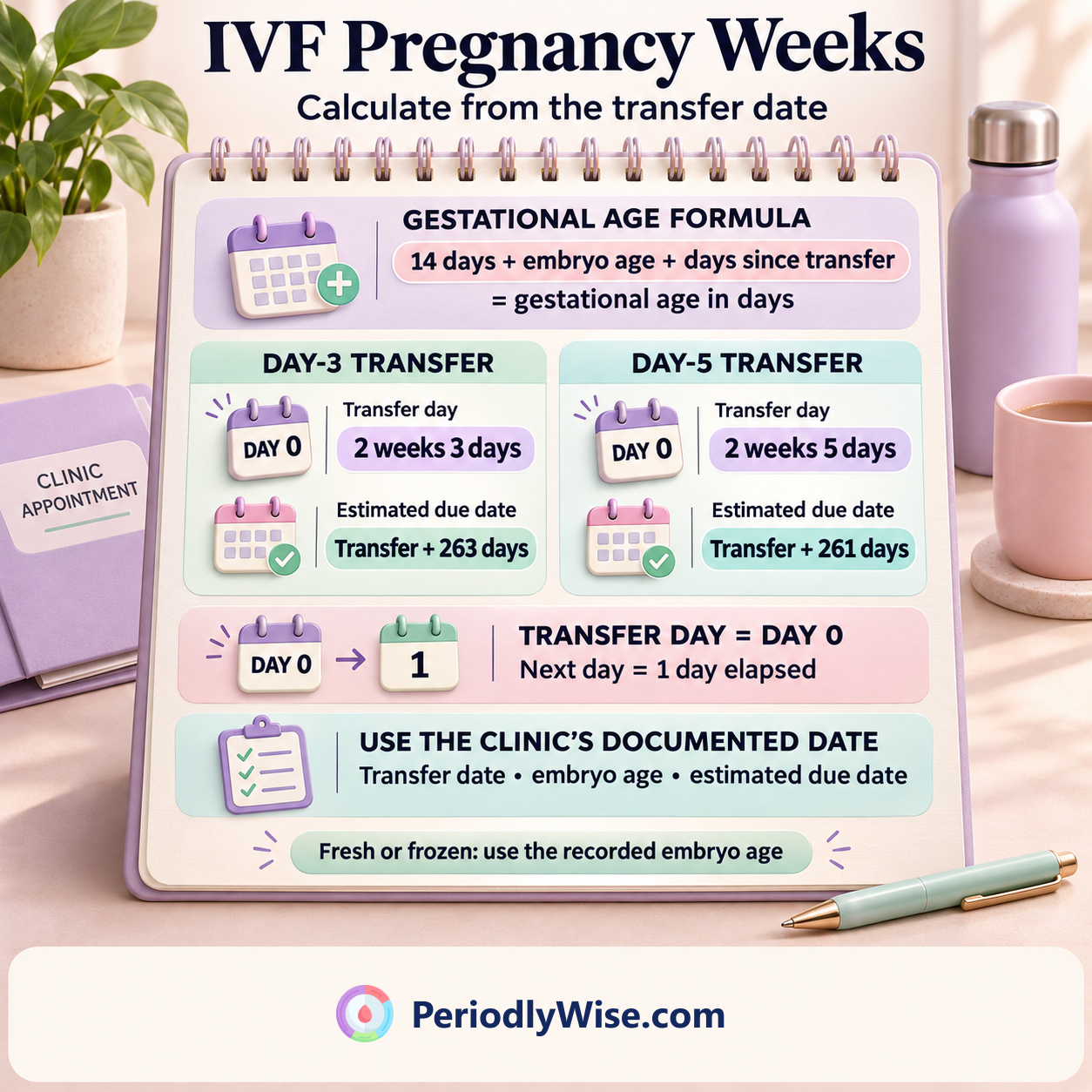
To calculate pregnancy weeks after IVF, start with your embryo transfer date and the embryo’s age at transfer. Add 14 days to the embryo’s age, then add the days that have passed since transfer. The total is the gestational age in days. Divide by seven for completed weeks and keep the remainder as days.
The 14 days align IVF dating with the same pregnancy-week convention used in prenatal care. They do not describe time spent pregnant before transfer. The embryo has already developed for several days by the time it is transferred, which is why transfer day is counted as more than two weeks of gestational age.
Day-3 and day-5 transfer at a glance
| Embryo age at transfer | Gestational age on transfer day | Days from transfer to estimated due date |
|---|---|---|
| Embryo age at transferDay 3 | Gestational age on transfer day2 weeks and 3 days (17 days) | Days from transfer to estimated due date263 days |
| Embryo age at transferDay 5 | Gestational age on transfer day2 weeks and 5 days (19 days) | Days from transfer to estimated due date261 days |
Some embryos are recorded as day 6 or another age. Use the day number your clinic confirms for dating, especially if the report gives both the day the embryo was frozen and the details of thawing. A description such as “blastocyst” or an embryo grade does not by itself tell you which day number to enter.
Calculate your weeks and days
- Look up the actual transfer date and the embryo age recorded for that transfer.
- Count the days elapsed from the transfer date to the date you want. Transfer day is day zero. The next day is one day after transfer.
- Add 14 days plus the embryo age plus the elapsed days.
- Divide by seven. The whole number is completed weeks, and the remainder is extra days.
Worked example for a day-5 transfer. Ten days after transfer, add 14 + 5 + 10 to get 29 gestational days. That is 4 weeks and 1 day. Fourteen days after the same transfer, you get 33 days, or 4 weeks and 5 days.
Worked example for a day-3 transfer. Ten days after transfer, add 14 + 3 + 10 to get 27 gestational days. That is 3 weeks and 6 days. The two examples are two days apart because the embryos were two days apart in development at transfer.
Calculate the estimated due date
In the 280-day dating convention, the estimated due date is at 40 weeks and 0 days. Subtract the gestational age on transfer day from 280, then add the result to the transfer date. This is equivalent to transfer date plus (266 minus embryo age) calendar days.
For example, a day-5 embryo transferred on May 1, 2026 gives an estimated due date of January 17, 2027. A day-3 transfer on the same date gives January 19, 2027. The two dates are estimates used to plan care. They do not predict the day labor will start.
Fresh versus frozen transfers
Fresh and frozen transfers both use the recorded embryo age and actual transfer date. Months or years spent in storage are not added to the embryo’s developmental age. The day of egg collection, date of freezing and date you started progesterone are useful parts of your treatment history. Use the clinic’s recorded transfer information for the dating calculation.
If the clinic’s estimated due date and an app disagree, check the date format and embryo day, and make sure you selected the IVF method in the app. Ask the clinic which date it has documented. A size-based age printed on an ultrasound may differ slightly from the clinical age based on transfer records.
Testing and your first scan
- Follow the pregnancy testing date given by your clinic. The age calculation alone cannot tell you whether the embryo implanted or whether the pregnancy is progressing.
- Continue medicines according to the clinic’s instructions. Contact the clinic about bleeding, pain or questions about test results.
- Follow the scan schedule your clinic recommends. The scan checks findings such as where the pregnancy is located.
After IVF, get prompt medical advice if you have pelvic pain, bleeding or increasing abdominal bloating. Seek emergency care for severe or one-sided abdominal pain, pain at the tip of your shoulder, heavy bleeding, fainting, chest pain or difficulty breathing. The NHS lists serious symptoms of ectopic pregnancy and ovarian hyperstimulation that need urgent assessment.
Frequently asked questions
Is transfer day counted as day one?
For elapsed days, the day of transfer is day zero. Its gestational age is already 2 weeks plus the recorded embryo age in days.
How far along am I two weeks after a day-5 transfer?
Four weeks and five days by gestational age. Your fertility clinic’s testing date can be earlier or later than that calendar point.
Do I use the date of my last period after IVF?
Use the transfer date and embryo age confirmed by the clinic. A period or medication-related bleed may not line up with embryo development during treatment.
How do I date a day-6 embryo transfer?
If your clinic confirms day 6 as the embryo age to use, the gestational count starts at 2 weeks and 6 days on transfer day. In the 280-day convention, the estimated due date is 260 days after transfer.
What should I enter if I already have a due date?
Use the documented estimated due date from your fertility or maternity team. You can enter it directly in the calculator to find the gestational weeks and days.
Explore how pregnancy weeks and an estimated due date are calculated. Use the date your care team has documented for your appointments.
Use the Pregnancy Calculator