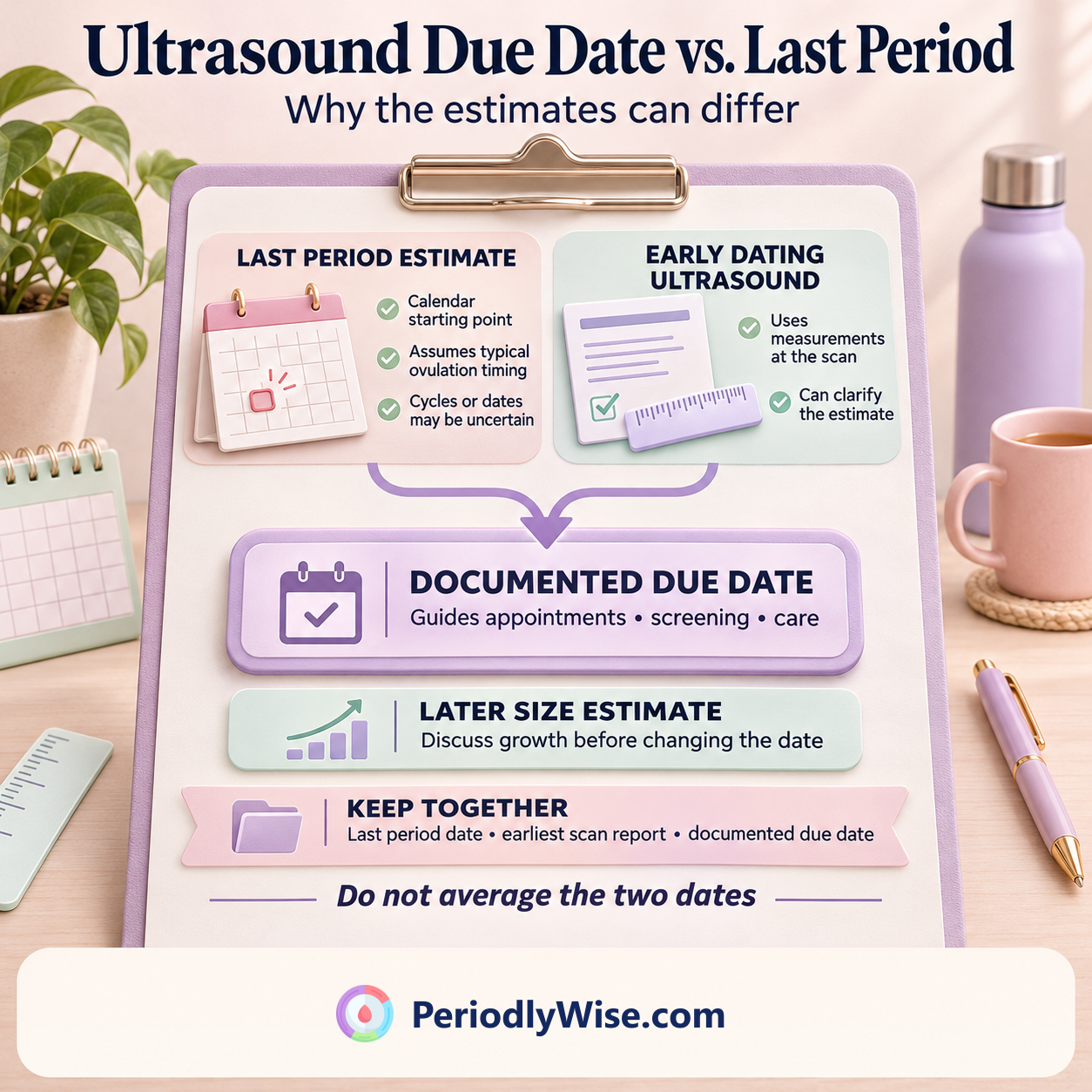
Your ultrasound and your last period use different information to estimate when you are due. Your last menstrual period gives a calendar starting point. A dating ultrasound compares the embryo or fetus measurement with an expected size for that stage. Different dates can reflect the timing of ovulation, uncertainty about the period, or ordinary variation in measurement.
When you have two dates on paper, ask the clinic which is the estimated due date (EDD) recorded for care. That date guides the timing of screening, appointments and later decisions. A difference between the dates alone cannot establish whether there is a problem.
Why the dates may be different
| What changed the estimate? | How to interpret it |
|---|---|
| What changed the estimate?Ovulation was later than expected | How to interpret itA standard last-period calculation assumes ovulation around two weeks after bleeding began. Later ovulation can make the pregnancy measure younger and move the estimated due date later. |
| What changed the estimate?Ovulation was earlier than expected | How to interpret itA pregnancy can measure a little further along, which can move the scan estimate earlier. |
| What changed the estimate?The first day of the last period was uncertain | How to interpret itIrregular cycles or bleeding that was mistaken for a period can make the calendar estimate less reliable. Tell your care team what you remember. |
| What changed the estimate?A later scan uses size measurements | How to interpret itA size-based age can differ from the established pregnancy age because individual growth varies. Ask whether the report is comparing growth or formally dating the pregnancy. |
What the first ultrasound measures
Up to 13 weeks and 6 days, clinicians generally use crown-rump length (CRL), the length from the top of the head to the bottom of the torso. ACOG describes first-trimester CRL dating as accurate to about 5 to 7 days in either direction. That range reflects the precision of the method. It is separate from the threshold a clinician uses to decide whether to change a due date.
After the first trimester, clinicians use a combination of measurements, including measurements of the head, abdomen and thigh bone. Dating becomes less precise later in pregnancy because differences in size increasingly reflect individual growth.
When can an early scan change the date?
The table paraphrases ACOG Committee Opinion 700. These are differences that support reviewing an initial last-period estimate with ultrasound, using the gestational age from the last period at the time of the scan. The care team also considers how reliable the period date was, earlier scans and whether the pregnancy followed IVF.
| Gestational age at ultrasound | Difference supporting a change |
|---|---|
| Gestational age at ultrasoundBefore 9 weeks | Difference supporting a changeMore than 5 days |
| Gestational age at ultrasound9 weeks to 13 weeks and 6 days | Difference supporting a changeMore than 7 days |
| Gestational age at ultrasound14 weeks to 15 weeks and 6 days | Difference supporting a changeMore than 7 days |
| Gestational age at ultrasound16 weeks to 21 weeks and 6 days | Difference supporting a changeMore than 10 days |
| Gestational age at ultrasound22 weeks to 27 weeks and 6 days | Difference supporting a changeMore than 14 days |
| Gestational age at ultrasound28 weeks and later | Difference supporting a changeMore than 21 days when this is the first scan used for dating, with particular caution |
For example, at 10 weeks by the last period, a difference of exactly 7 days does not exceed the more-than-7-day threshold. A difference of 8 days does. This illustrates the table, rather than telling you to change your own due date. If your last period is uncertain, an early reliable scan can establish the estimate without relying on a comparison with that period date.
Why a growth scan usually keeps the original date
Once a clinician establishes and documents a due date, later changes are reserved for unusual circumstances. A later scan may list an “ultrasound age” or a measurement-based due date automatically. Compare that with the clinical due date in your notes. Redating a small fetus late in pregnancy could make a growth problem harder to recognize.
If you conceived through IVF, the documented transfer date and embryo age normally establish gestational age. Ask the clinic to check its records if a scan printout or an app gives a different date.
What to ask your care team
- Which due date is in my medical record, and what information was used to set it?
- Was this scan used for dating or to assess growth?
- If the clinical date changed, does that affect any screening or follow-up appointments?
- Do I need another scan, and what will it check?
Bring any records that make the comparison easier.
- The date of your last period and any uncertainty about it.
- The date and report from your earliest ultrasound.
- The documented due date or, for IVF, the transfer date and embryo age.
Keep the actual report and the first day of the last period, if known. If you are pregnant or could be pregnant and have bleeding or pelvic pain, contact your care team promptly. Seek emergency care for severe pain, pain at the tip of the shoulder, heavy bleeding, severe dizziness or fainting. Dates alone cannot explain these symptoms.
Frequently asked questions
Which is more accurate, ultrasound or my last period?
For estimating gestational age by ultrasound, a reliable first-trimester scan gives the highest accuracy. The clinician interprets it with the last-period history, IVF records and earlier results.
Can my due date move earlier or later?
Yes. When the care team formally revises the initial estimate, the date can move in either direction.
Does measuring a week behind mean a miscarriage?
A difference in dating or size alone does not diagnose pregnancy loss. The clinician uses what can be seen on the scan, the measurements and, when needed, a repeat scan.
Should I average the two dates?
Use the documented clinical due date. Averaging estimates can put your appointment calendar out of step with the pregnancy record.
What if the app still shows the old date?
If the care team confirms a new due date, update the app using that date. Check any saved reminders or screening dates with the clinic.
Explore how pregnancy weeks and an estimated due date are calculated. Use the date your care team has documented for your appointments.
Use the Pregnancy Calculator