
To remove period blood stains from a washable garment, start with cold water, use a treatment suitable for the fabric, wash as directed and check the mark before heat-drying. Fresh stains are often easier to tackle than dried ones, but neither a red spot nor a brown mark means a favorite item is automatically ruined. The safest method depends on the item, not on how urgently you want the stain gone.
A cotton sheet, dark jeans, a silk skirt, absorbent period underwear and a foam mattress do not have the same cleaning rules. Stronger products, longer soaking and harder scrubbing are not necessarily better. This guide starts with the simplest washable-fabric sequence and then explains where to change course, stop or ask a professional.
A leak is a practical problem, not a failure of hygiene or planning. You can deal with the laundry without apologizing for having a period. At the same time, repeated flooding, a major change in bleeding or feeling faint should not be hidden behind a more efficient cleaning routine.
Check three things before reaching for a stain remover
Start with what the item is, whether the blood is fresh or dried, and what the care label permits. Look for the fiber content, hand- or machine-washing instructions, bleach restrictions and drying directions. A zipper on a cushion or mattress cover does not automatically mean the cover is removable and washable. If the label is missing, contact the maker or treat an expensive or delicate item as a reason to pause.
Gather cold water, clean white absorbent cloths, a suitable laundry detergent, and a basin only if soaking is allowed. Add a pretreatment product only when needed. Read its fabric exclusions, dilution, contact time, rinsing and temperature directions. A product called gentle, natural or color-safe is not automatically suitable for every material.
Spot-test a cleaner in a hidden area when its label recommends it, and allow the test to dry before checking for color or texture change. Colorfastness means the dye tolerates the treatment; it does not prove that elastic, coatings, embroidery or absorbent layers will. Protect the surface under the item and keep products away from children and pets.
Fresh stains: a calm, fabric-safe sequence
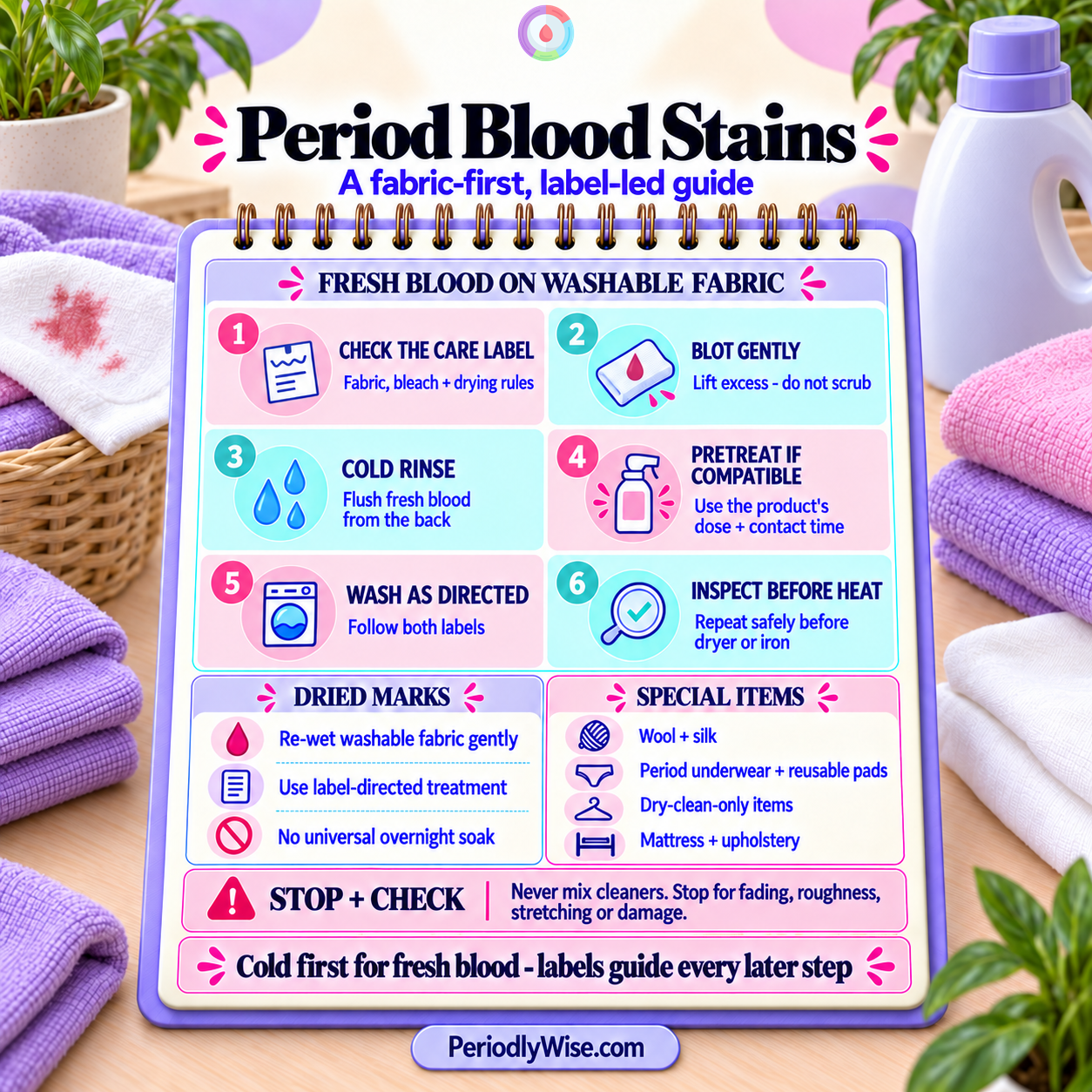
The American Cleaning Institute recommends cold water for fresh blood, and Tide's blood-stain guide pairs pretreatment with a check before drying. Use the sequence below only for an item that allows water washing; the special-item sections explain the exceptions.
- Read the care label first. Check the whole garment, including trims, elastic and any layered lining. Remove it before applying a laundry product; do not treat clothing while it is against your skin.
- Lift excess gently. Blot fresh liquid with a clean cloth. Do not grind the mark into the fibers or spread it over a wider area.
- Rinse with cold water. Where practical, hold the back of the stained fabric under the water so it flushes outward. Support delicate fabric and avoid stretching it. This is not an instruction to run water through a mattress or upholstered seat.
- Pretreat if needed. Use a compatible detergent or laundry stain remover at its stated dose and contact time. Keep it on only as directed, and do not let a treatment dry on fabric unless the product specifically instructs that.
- Wash according to both labels. Use the detergent amount, load size, cycle and temperature appropriate for the item and product. Do not overfill the machine or assume an extra-large dose cleans better.
- Inspect before heat-drying. In good light, check the wet fabric and, if uncertain, let it air-dry in the way its label permits before checking again. Repeat a compatible treatment if needed; wait on the dryer and iron while a stain remains.
Dried or already-washed marks need patience, not a guarantee
A stain discovered the next morning may look brown and feel stiff. On washable fabric, gently re-wet it with cold water before choosing the next step. Avoid scraping with a sharp object or aggressive brushing. A compatible enzyme-containing pretreatment may help with protein stains, but it is not suitable for every fiber. Read the ingredient and fabric guidance rather than assuming every detergent contains the same enzymes.
Use the product's soaking time, not a universal overnight rule. The ACI separates fresh from dried blood and describes enzyme treatment for dried marks. Particular products differ in preparation and temperature. If the cleaner and garment instructions conflict, choose another compatible method or ask the manufacturer; the stronger instruction does not win just because a stain is old.
After washing, inspect again before adding heat. If the mark has already been through a dryer or iron, another permitted treatment can be worth trying, but complete removal is not assured. Stop if the fabric fades, roughens, stretches, develops holes or loses its finish. A faint residual mark may be preferable to destroying a useful item with repeated chemical treatment.
Match the method to the fabric, color and construction
White does not mean bleach-safe, and washable does not mean soak-safe. A white garment can contain elastane, silk, wool, special finishes or trims with their own restrictions. GINETEX care symbols distinguish a crossed-out triangle for no bleach from oxygen-only and broader bleach permission. The cleaner must still be compatible with the fabric.
For wool, Woolmark recommends a suitable mild wool detergent and warns against enzyme-heavy bio detergents and bleach. Do not transfer a cotton-sheet enzyme routine to wool or silk. For delicate blends, embellished items and unknown dyes, maker guidance or professional cleaning is a more useful next step than another household experiment.
| Item or material | Reasonable starting approach | Important limit |
|---|---|---|
| Item or materialWashable cotton or linen | Reasonable starting approachCold rinse for fresh blood, compatible pretreatment, then label-directed washing. | Important limitCheck colors, finishes and any trim; inspect before heat. |
| Item or materialColored clothes and denim | Reasonable starting approachGentle blotting and a hidden-area test for the selected product. | Important limitDye can fade; chlorine bleach is not a default. |
| Item or materialStretch underwear and synthetic blends | Reasonable starting approachFollow the label for detergent, cycle and stain treatment. | Important limitElastic and finishes can be damaged even when the base fabric looks sturdy. |
| Item or materialWool or silk | Reasonable starting approachUse fiber-specific care instructions and an approved suitable detergent. | Important limitDo not assume enzyme treatments, bleach or long soaking are allowed. |
| Item or materialDry-clean-only or valuable delicate items | Reasonable starting approachBlot excess gently and contact a professional promptly. | Important limitDo not soak or add a series of products; report what was already used. |
| Item or materialLayered period underwear or reusable pads | Reasonable starting approachFollow that brand and style's care instructions. | Important limitA stain recipe for ordinary cotton may damage absorbent or leak-resistant layers. |
Detergent, enzymes, oxygen bleach and peroxide are not interchangeable
A laundry detergent is often the first product to consider for a washable item; a separate treatment is optional, not a compulsory shopping list. Enzyme products and oxygen-based stain removers have specific uses and exclusions. OxiClean's instructions, for example, exclude wool, silk, leather and dry-clean-only fabrics for the product described. That is a useful reminder that a branded stain solution is not an all-material solution.
Hydrogen peroxide can alter dyes and is not a risk-free substitute for a laundry formula. Clorox's guide notes its potential to bleach colors. Do not make a universal peroxide recipe, use concentrated industrial or hair-bleaching products, or apply it to your body for a menstrual stain. If considering any treatment, require explicit compatibility and directions rather than a social-media demonstration.
| Product type | What to check | What not to assume |
|---|---|---|
| Product typeLaundry detergent | What to checkFiber compatibility, dose, wash cycle and pretreatment directions. | What not to assumeMore detergent or longer contact always gives better results. |
| Product typeEnzyme pretreatment | What to checkFabric exclusions, contact time and required temperature. | What not to assumeIt is suitable for wool, silk or every reusable period product. |
| Product typeOxygen-based stain remover | What to checkBleach permission, colorfastness and product-specific exclusions. | What not to assumeOxygen or color-safe means safe for every garment. |
| Product typeChlorine bleach | What to checkExpress fabric permission and the product's laundry instructions. | What not to assumeAll white clothes, elastic or layered products can tolerate it. |
| Product typeHydrogen peroxide or household remedies | What to checkWhether a reliable fabric-specific instruction supports use. | What not to assumeNatural, familiar or bubbling proves safety or stain removal. |
Clothes and sheets: treat the spot before the whole load
On ordinary washable underwear, trousers or sheets, isolate the stain so you can inspect it. Place a clean absorbent cloth underneath if needed and avoid folding the wet mark against an unstained area. Treat printed and solid-colored sections with the same dye caution. For jeans, vigorous brushing can change the surface and color even if it makes the mark look lighter.
For a large sheet, locate each mark before loading the washer rather than hoping one cycle reaches everything equally. Remove a washable mattress protector and treat it separately according to its label. Sort the load by care requirements and colors. You do not need to add disinfectant merely because the stain is menstrual blood; use the normal item-appropriate cleaning process unless specific health or care advice says otherwise.
Stain removal and disinfection are different goals. A faded spot is not a test of microbial cleanliness, and a remaining pigment mark does not tell you whether a wash was performed correctly. Use an adequate wash, rinse and complete drying, not just a quick cold rinse as the entire routine. Do not put away an item that is still dirty, damp or persistently malodorous.
Period underwear and reusable pads have their own rules
Absorbent products combine several materials and may have a waterproof or leak-resistant barrier. Read the current directions for your exact product and style. Knix and Thinx publish their own washing guidance; their instructions are examples, not rules for every brand. Do not assume every style permits the same drying method, enzyme detergent or soaking time.
If the maker permits a cold rinse, it can remove excess blood before the full wash. Rinsing is not a substitute for detergent washing. Avoid wringing, hot treatment, bleach, fabric softener or aggressive brushing when the product excludes them. A mesh bag can be useful when recommended, but leave enough room for the wash to work and follow the machine's load guidance.
Wash promptly where practical and dry fully before storage or reuse. If you cannot wash immediately, follow the maker's temporary-storage advice rather than leaving a wet item sealed for days. Persistent odor, damaged seams, separation of layers or reduced absorbency calls for a care review or replacement advice. Do not keep escalating chemical strength to make damaged protective layers look new.
Mattresses, carpets and upholstery: do not turn a spot into saturation
Remove sheets and any separately washable protector first. Read the mattress maker's guidance before wetting a cover or core. Tempur-Pedic warns against soaking or washing its foam material. A recipe for a cotton pillowcase should never become an instruction to pour a basin of water into foam.
For a surface that explicitly allows water-based spot cleaning, apply the approved treatment using a lightly damp clean cloth, blot gently and avoid spreading the mark. Use only the moisture and product permitted. Remove residue as directed and allow the item to dry fully with suitable airflow before covering it. If blood has penetrated deeply, repeated wetting is not a reliable repair; ask the manufacturer or a professional cleaner.
Upholstery cleaning codes are another limit. La-Z-Boy's guidance distinguishes W, S, W-S and X. These are broad directions, not permission for every stain product, steam machine or removable-cover wash. If you cannot identify the code or the material, pause before a wet treatment.
| Surface or code | What it means for your next step | Avoid |
|---|---|---|
| Surface or codeW upholstery | What it means for your next stepUse only permitted water-based upholstery treatment, after testing. | AvoidSaturation or assuming the cover can be machine-washed. |
| Surface or codeS upholstery | What it means for your next stepWater-free solvent care; professional advice is often appropriate. | AvoidApplying the cold-water clothing sequence. |
| Surface or codeW-S or X upholstery | What it means for your next stepW-S allows suitable water/solvent methods; X excludes liquid cleaning. | AvoidTreating those two codes as the same or improvising solvent mixtures. |
| Surface or codeMattress or carpet | What it means for your next stepFollow the maker and material-specific spot-care guidance. | AvoidSoaking a core, trapping moisture or using a universal peroxide paste. |
When you are away from home, protect the item without a chemistry experiment
At work, school or while traveling, a change of underwear and a clean cloth may help more than a bag of stain-removal ingredients. If the item allows water and privacy is available, a small cold rinse or gentle blot can be a temporary first step. Change into dry clothing; do not leave laundry treatment on fabric against the vulva or other skin.
If there is no suitable sink or time, contain the affected item for transport and wash it as soon as practical. A closed bag can protect other belongings during a short trip; it is not long-term storage for damp laundry. Do not scrub a delicate garment in a public restroom because you feel pressured to erase the mark immediately.
- Carry spare underwear, a familiar period product and a small transport bag if useful.
- Use a clean cloth rather than transferring dye from a dark towel onto a pale item.
- Do not assume a travel stain pen works on blood or on your fabric; check its instructions.
- Make a simple note of any cleaner already used so you do not unknowingly layer treatments later.
Avoid cleaner cocktails, skin treatment and heat shortcuts
Do not mix stain removers or make a homemade bleach mixture. The CDC warns against mixing bleach or disinfectants with other cleaners. Bleach with vinegar, acids or ammonia can produce dangerous fumes. Follow manufactured laundry products' instructions and machine compartments; do not combine concentrates in a bowl or pour a second cleaner over the first.
Salt, lemon, baking soda, vinegar, toothpaste or saliva are not a universal backup protocol. Household familiarity does not show that a substance is effective, color-safe or appropriate for a coating. Adding several remedies also makes it harder to identify what caused discoloration or irritation. Use one compatible process, with the required rinse or wash between stages, instead of trying to build a stronger mixture.
Laundry chemicals are for the permitted item, not for menstrual blood on skin or inside the vagina. Remove the garment before treatment, avoid splashing, and use ventilation and protective equipment specified on the label. Keep products in their original containers. If a chemical exposure occurs, seek product-specific poison advice; breathing difficulty or serious symptoms needs emergency help, not another neutralizing ingredient.
Troubleshoot what remains after a safe wash
A brown shadow after one wash may be residual staining, especially after drying or heat exposure. Check whether the cleaner was appropriate, whether pretreatment had its allowed contact time, and whether the washer was overloaded. Repeat only a permitted process. If a colored area becomes pale, that may be dye loss rather than a stain waiting for stronger cleaner; removing more pigment will not restore the original color.
A ring on upholstery can reflect moisture spreading or residue. Stop expanding the wet area and seek material-specific advice. A stiff patch on clothing may need an appropriate rinse or full wash, not perfume. Persistent odor in period underwear should prompt review of the wash, drying, storage and product condition rather than an improvised disinfectant bath.
A perfectly invisible mark is not a reasonable promise for every fabric or old stain. Set a stopping point based on the item's condition and value. For a costly garment, heirloom textile, unknown upholstery or deeply soaked mattress, professional assessment can be more economical than damage from repeated experiments. Tell the cleaner exactly what was applied and whether the item was heat-dried.
Reduce repeat leaks without blaming yourself or ignoring heavy bleeding
A washable protector, spare sheet and a product that fits your flow can make a future leak less disruptive. Review whether the product shifted, reached capacity, was worn beyond its instructions or was uncomfortable. Follow its wear-time limits; do not extend them to protect laundry, double up internal products or insert a product not intended for menstrual use. A tracker can help organize actual dates and leakage patterns, not guarantee a leak-free night.
A single stain does not diagnose heavy menstrual bleeding. Fabric spread, product fit and time before changing all affect what you see. Repeated bleeding through clothes or bedding, very frequent product changes, prolonged bleeding or a substantial impact on daily life merits a healthcare conversation. The NHS heavy-period guide includes these practical signs. Record bleeding days, product changes, leaks, pain and how you feel; a private written note is enough, without routine photos of blood or intimate areas.
Seek prompt advice for new or worsening heavy bleeding, bleeding between periods or after sex, or unusual bleeding when pregnancy is possible. Do not judge severity only by a stain's diameter or compare it with an online image. Clinical context and symptoms matter more than whether a sheet can be cleaned.
Frequently asked questions
Should I use hot or cold water on fresh period blood?
Start with cold water on a water-washable item. Hot water can make fresh blood harder to remove. Later washing or dried-stain treatments may have their own temperature directions, so follow both the fabric and product labels rather than applying one temperature rule to every stage.
Can dried period blood still come out?
It can, but complete removal is not guaranteed, especially after heat-drying. Re-wet washable fabric gently, use a compatible pretreatment for its stated time, wash and inspect. Do not keep escalating treatment if the fabric or dye starts changing.
Is hydrogen peroxide safe for every stain?
No. It can lighten dyes and may not be suitable for fibers, elastic, coatings or absorbent layers. Do not use concentrated industrial or hair-bleaching products or a universal homemade recipe. Prefer a labeled, compatible laundry treatment and never apply it to your body for menstrual staining.
Can I bleach white underwear or sheets?
Only if the full item's care label and bleach instructions allow it. White color alone is not permission: wool, silk, elastic, trim and layered underwear may be incompatible. Oxygen-only permission is different from chlorine permission. Never mix bleach with vinegar, ammonia or other cleaners.
How long should I soak a blood-stained item?
There is no universal time. Use the exact product's contact-time instructions only if soaking is permitted for the item. Longer or overnight soaking may damage dyes or materials. For dry-clean-only clothing, upholstery and mattress cores, a soaking routine is not the right starting method.
Can I use the same method on period underwear?
Not automatically. Follow the brand and style's instructions for rinsing, detergent, additives and drying. Protective layers may have restrictions that ordinary cotton does not. A rinse alone is not a full wash; dry completely before storage or reuse.
What if a stain is still there after washing?
Check in good light before a dryer or iron, repeat a fabric-safe process if appropriate, and stop for dye loss or material damage. A residual mark is not a measure of blood loss or a cleanliness test. Persistent dirt, dampness or odor requires attention to cleaning and drying, not just hiding the mark.
Does leaking onto bedding mean my period is too heavy?
One leak cannot tell you that. Fit, movement and product capacity matter too. Repeated flooding, frequent changes, prolonged bleeding or symptoms affecting daily life deserves assessment. Severe bleeding with faintness, chest pain, significant breathlessness or weakness needs urgent help rather than only a laundry plan.
Use PeriodlyWise to organize actual period dates and keep a short private note of repeated leaks, product changes and symptoms. Predictions cannot guarantee protection, estimate blood loss from a stain, diagnose a cause or replace timely care.
Open the period trackerThe takeaway
For fresh blood on washable fabric, cold water first, compatible pretreatment, a proper wash and inspection before heat is a useful starting sequence. Dried marks may need another permitted treatment, but fabric damage is not a worthwhile price for a promise no cleaner can make.
Let the care label and product instructions decide the details. Keep period underwear, delicate fibers, upholstery and mattresses on their own care paths; avoid chemical mixtures and body exposure. Support your comfort without shame, and give repeated heavy bleeding or serious symptoms the medical attention they deserve.