Choosing between period underwear and pads is less about finding one universal winner and more about matching a product to a specific day, body, and routine. Both are external menstrual products: they absorb blood after it leaves the vagina. Pads attach to underwear; period underwear builds absorbent and leak-resistant layers into the garment itself.
That simple difference changes the practical experience. A disposable pad can be removed and replaced without changing all your underwear, which may be easier at school, at work, during travel, or on a very heavy day. Period underwear can feel less bulky, move more naturally with the body, and reduce the number of disposable products used, but it needs a reliable fit, enough pairs for rotation, private washing and drying, and a plan for changing away from home.
Marketing often turns the comparison into a contest of how many tampons a garment or pad supposedly replaces. Real performance is more complicated. Flow speed, clots, body position, garment compression, pad placement, gusset length, and the difference between water-based laboratory tests and menstrual fluid can all affect leaking. The most useful question is “Which setup keeps me comfortable and confident for this part of my period?”
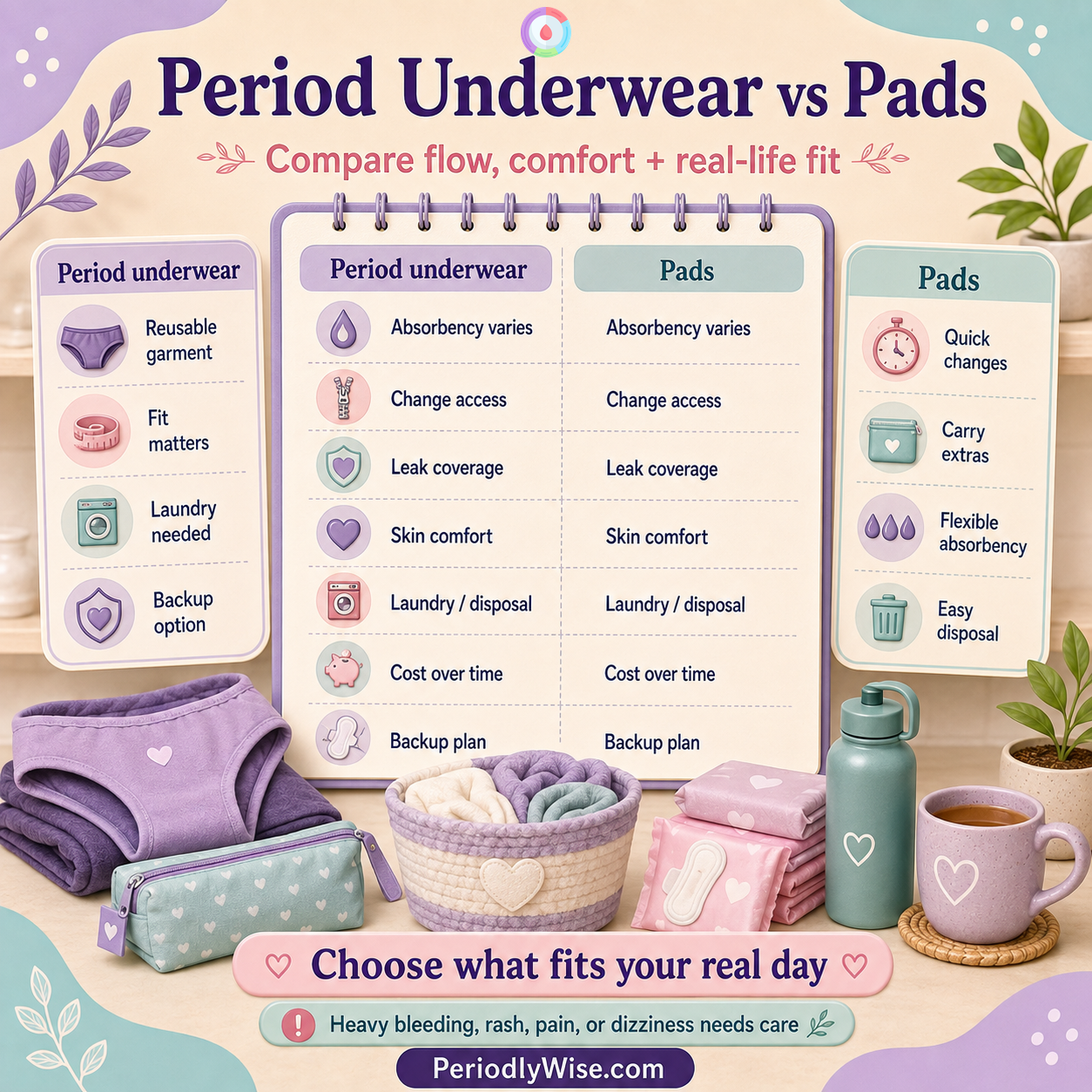
Period underwear vs pads at a glance
| Question | Period underwear | Pads |
|---|---|---|
| How it works | Absorbent and leak-resistant layers are sewn into reusable underwear. | An absorbent disposable or reusable insert attaches to or sits inside underwear. |
| Changing | Usually requires removing trousers and changing the whole garment; a wet bag may be needed. | The pad can be replaced while the underwear stays on, unless a leak soils it. |
| Flow flexibility | Capacity and gusset coverage are fixed for that pair; brands vary widely. | You can carry light, regular, heavy, and overnight options and switch during the day. |
| Laundry and waste | Must be rinsed or washed and fully dried according to the label; repeated reuse can reduce disposables. | Disposable pads create ongoing waste; reusable pads need washing and drying too. |
| Cost pattern | Higher upfront cost and replacement when fit or performance declines. | Lower cost per pack but repeated purchases; reusable pads have an upfront cost. |
| Good fit for | People who value a clothing-like feel, reuse, overnight coverage, or backup protection. | People who prioritize quick changes, easy access, adjustable absorbency, or no take-home laundry. |
What matters more than the product label
Absorbency claims are not a universal measuring system. The FDA regulates menstrual products sold in the United States as medical devices, but product categories do not all share one consumer-facing capacity scale. A small laboratory study that slowly applied packed red blood cells to 21 products found large variation: the three period-underwear samples held less than 3 mL each, while several heavy pads held much more. That does not prove every pad outperforms every pair. Only three underwear products were tested, the experiment was outside the body, and flow speed, compression, design, size, and menstrual tissue can change real-world performance. It does show why “equivalent to X tampons” should not be treated as a guaranteed cross-brand measurement.
Fit and coverage can decide whether either option leaks. Period underwear should sit closely around the leg openings without digging in or leaving gaps, and its absorbent gusset must cover where your flow reaches when you sit, sleep, or move. A pad needs underwear firm enough to hold it in place; wings, length, and front-to-back placement matter. Loose clothing may hide bulk but cannot correct a shifting pad or gaping garment.
Skin comfort depends on moisture, friction, ingredients, and time. Either product can feel irritating when it stays wet, rubs, traps heat, contains fragrance or dye, or leaves adhesive against sensitive skin. ACOG advises choosing deodorant-free products and changing pads at least every 4 to 8 hours, or sooner when full, wet, or uncomfortable. ACOG notes that period underwear may sometimes be worn for a full day, but flow and the particular garment may require earlier changes. The manufacturer's instructions and your skin are the practical limits.
Reusable does not mean maintenance-free. Follow the garment label because heat, bleach, fabric softener, or a tumble dryer can damage some absorbent or waterproof layers. Store used underwear in a breathable or sealed wet bag only for the time the manufacturer allows, wash it thoroughly, and dry it completely before reuse. If you cannot wash and dry privately and reliably, disposables may be the more workable choice for that setting.
PFAS questions deserve precision, not panic. A 2025 survey of 43 period-underwear products found indicators of intentional fluorination in 11, while products without intentional fluorine existed in every tested category. Other research has detected small amounts of target PFAS in garment layers, including non-menstrual control underwear. These studies are product snapshots, not proof that every pair contains intentionally added PFAS, and they do not establish the health risk from wearing a specific garment. WHO also notes that global safety standards for menstrual materials remain limited. If this issue matters to you, look for current brand-specific test reports, the compounds and detection limits tested, and a clear policy on intentionally added PFAS rather than relying only on a broad “non-toxic” claim.
Before deciding, compare the whole system rather than one feature:
- your lightest, typical, and heaviest flow hours, including sudden flooding or clots
- daytime movement, seated work, exercise, overnight position, and the length of coverage you need
- how quickly and privately you can change at school, work, travel, or a public restroom
- whether you can carry clean items and contain a used garment without odor or leakage
- skin reactions to fragrance, adhesive, elastic, synthetic fabric, detergent, heat, and prolonged dampness
- washing instructions, water and drying access, number of pairs, garment lifespan, and replacement cost
- whether a backup pad, tampon, cup, or disc is needed during heavy or uncertain hours
- manufacturer details on materials, independent testing, capacity methods, warranties, and returns
Which option fits common situations?
| Situation | Often easier starting point | Why and what to test |
|---|---|---|
| First period or learning your flow | Pads, or period underwear with backup | Pads make changes and saturation easier to see; underwear may feel secure. Practice at home and pack a spare. |
| Heavy flow or rapid flooding | High-absorbency pad with backup, or the setup already proven for you | A whole garment is harder to change quickly. Do not rely on marketing capacity until you have tested it. |
| Light days or spotting | Period underwear or a light pad | Both can work; comfort, discharge needs, laundry, and cost may decide. |
| Long school or work shift | Whichever can be changed safely and privately | Carry enough clean products, a spare garment, and a leak-resistant bag. Do not stretch wear time because changing is awkward. |
| Overnight | Long-coverage underwear or an overnight pad | Test front-to-back coverage and sleep position; use a towel or backup for the first trial. |
| Sensitive vulvar skin | Unscented, breathable option with minimal rubbing | Material matters more than category. Change damp products, use fragrance-free laundry care, and stop any product that repeatedly irritates. |
| Limited water, laundry, or private drying | Disposable pads where disposal is safe | Reusable products only work hygienically when they can be washed and fully dried. |
| Reducing disposable waste | Durable period underwear or reusable pads | Count washing, drying, useful life, and realistic rotation; keep disposables for situations where they are more practical if needed. |
How to compare period underwear and pads without a leak surprise
Treat a new menstrual product as a small fit-and-flow trial. A careful first cycle tells you more than a headline absorbency number.
- Map one ordinary cycle first. Note which hours are light, moderate, heavy, or prone to clots and flooding. Record how saturated your current product is when you change it, not only the number used.
- Read the exact label. Check intended flow level, maximum wear guidance, fibre and waterproof-layer information, washing instructions, dryer limits, and whether the brand publishes test methods or PFAS information.
- Test fit before relying on capacity. Move, sit, squat, and lie down. The waistband and legs should stay close without pain; a pad should remain centred and flat. Return an unworn product if sizing is clearly wrong and the policy allows it.
- Start during a lighter or at-home window. Check the product earlier than the advertised maximum. Note where moisture first appears and whether leaking came from saturation, flow speed, shifting, or inadequate front-to-back coverage.
- Build a change kit. Pack the number of pads or underwear changes your day requires, plus ordinary underwear, a sealable wet bag, tissues or water access for external cleaning, and any proven backup product.
- Protect the skin. Wash hands before and after changes, use unscented products, avoid vaginal douching or deodorants, change when wet or uncomfortable, and stop using a product that repeatedly causes itching, burning, broken skin, or swelling.
- Review cost across several cycles. For underwear, include enough pairs for washing and drying, replacement, detergent, water, and energy. For pads, include monthly use, delivery or travel purchases, and disposal access.
- Mix methods when that works better. There is no prize for using one product exclusively. A pad on heavy commuting hours and underwear at night, or underwear as backup for an internal product, can be a practical plan.
What to track during your trial
A product diary should capture performance and comfort, not just the brand name. This is also useful if you need to discuss heavy bleeding with a clinician because product counts mean different things when capacities vary.
Use the same basic notes for two or three cycles if the first cycle is unusual. Replace vague labels such as “failed” with where, when, and how the leak happened.
- cycle day, time put on, time changed, and whether it was changed for saturation, comfort, schedule, or hygiene
- product type, brand, size, style, advertised absorbency, age of garment, and any backup used
- light, moderate, heavy, flooding, or clotted flow and how full or wet the product was
- front, back, side, leg-opening, or seam leakage and what you were doing or how you were sleeping
- dampness, heat, odor, bulk, shifting, pressure, chafing, itching, burning, rash, or adhesive marks
- washing method, detergent, rinse, drying time, persistent smell, staining, delamination, stretched elastic, or reduced performance
- changes needed away from home, bathroom accessibility, storage of used items, and whether the routine felt manageable
- total products and approximate cost per cycle, without forcing yourself to keep using an uncomfortable product to justify its price
When the issue is the bleeding, not the product
A product comparison cannot diagnose heavy menstrual bleeding. Seek medical advice when periods repeatedly last longer than seven days, bleeding interferes with sleep, school, work, or ordinary activity, clots or flooding are new, or you have fatigue, shortness of breath, paleness, headaches, dizziness, or cravings for ice that could accompany iron deficiency. Tell the clinician exactly which products you use, how saturated they are, and how often you change them.
New itching, burning, rash, swelling, sores, unusual discharge, strong odor, pelvic pain, or pain with urination deserves attention. Remove a likely irritant and switch to an unscented option, but do not assume every symptom is a product allergy or yeast infection. Persistent or recurrent vulvar symptoms may need an exam and testing.
Product choice should also account for disability, mobility, sensory needs, access to toilets and water, and support from a caregiver if relevant. A method that is theoretically economical or sustainable is not a good fit when it cannot be changed, washed, dried, or used with dignity in your actual environment.
Use PeriodlyWise to record flow, change times, leaks, skin comfort, product cost, and cycle-to-cycle patterns privately, then choose the combination that works in your day rather than the one with the loudest claim.
Open the period trackerFrequently asked questions
Is period underwear better than pads?
Not for everyone or every day. Period underwear may feel more like ordinary clothing and can be reused, while pads are easier to change quickly and offer flexible absorbency. Flow speed, fit, skin, laundry access, cost, and where you will change matter more than a universal ranking.
Can period underwear replace pads completely?
It can for some people and some flow days, but capacity varies. Start at home, check sooner than the maximum wear claim, and keep backup until you know the pair's fit and performance. Heavy flooding, clots, long days, or limited changing privacy may make a pad or combined setup easier.
How often should I change period underwear?
Follow the garment instructions and change sooner when it feels wet, leaks, smells unusual, irritates, or reaches its tested capacity for your flow. ACOG says some period underwear can be worn for a full day, but explicitly notes that flow and the garment may require more frequent changes.
Is period underwear safe because of PFAS concerns?
Research has found indicators of intentional fluorination in some but not all tested products, and low levels of target PFAS in garment layers. The studies do not quantify the health risk to an individual wearer. Seek transparent, current brand-specific testing and ask whether PFAS are intentionally added; stop using any garment that damages or irritates skin.
Which is cheaper, period underwear or pads?
Pads usually cost less at the first purchase but require repeated replacement. Underwear costs more upfront and needs enough pairs, washing, drying, and eventual replacement. The cheaper choice depends on local prices, garment lifespan, utilities, flow, and whether you still need backup products.
Can I wear a pad with period underwear?
You can if the garment design and manufacturer allow it, although adhesive may not stick well to every fabric and could affect the gusset. Many people instead use period underwear as backup for a pad or internal product. Test comfort and placement, and never extend the wear time of either product because both are being used.
The bottom line
Period underwear and pads do the same basic job outside the body but solve different practical problems. Pads make absorbency changes fast and portable. Period underwear offers a reusable, clothing-like option when its fit, coverage, care requirements, and capacity suit your cycle. A mixed routine is often more useful than declaring one category the winner.
Judge performance by your own documented flow, not a tampon-equivalent headline. Change wet products, protect the vulva from fragrance and friction, wash reusables exactly as directed, and ask for care when bleeding or symptoms are the real concern.