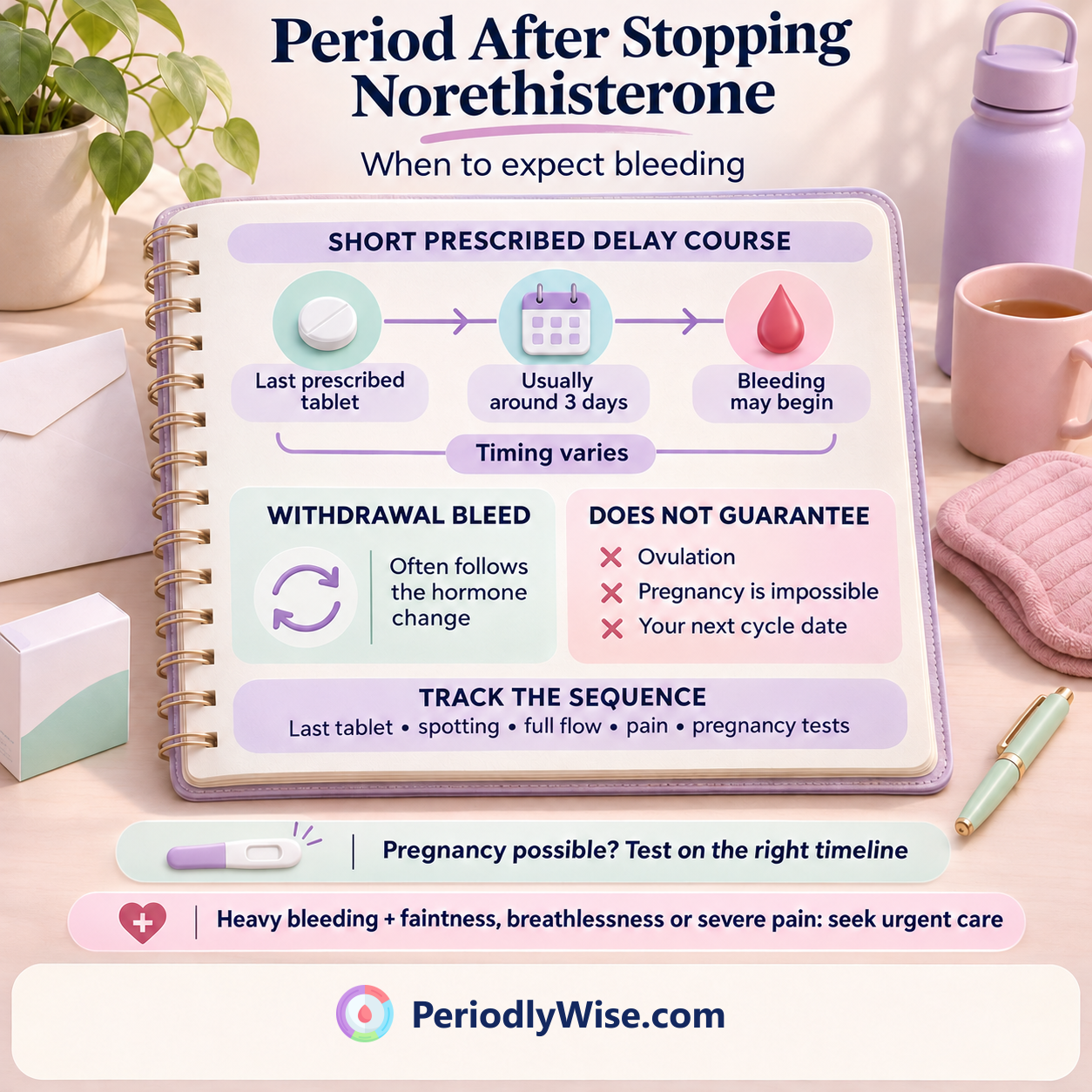
After stopping a short course of norethisterone used to delay a period, bleeding usually starts within about 3 days. This is a typical pattern rather than a deadline. Your prescription, the reason for treatment and your usual cycle all matter. Follow any follow-up instructions given with your medicine.
The bleeding soon after stopping is often called a withdrawal bleed: the hormone support changes when the tablets end, allowing the uterine lining to shed. It does not confirm that you ovulated, that pregnancy is impossible, or that your next cycle will follow an exact timetable. This guide focuses on a short period-delay course; other treatment schedules need their own advice.
When should bleeding start?
| Time or event | What it can mean | Useful next step |
|---|---|---|
| Time or eventLast prescribed tablet | What it can meanThe course has ended; bleeding does not have to start immediately. | Useful next stepNote the date and follow your prescription. |
| Time or eventAround the next 3 days | What it can meanThis is the usual time for bleeding after a short period-delay course. | Useful next stepRecord spotting separately from established flow. |
| Time or eventNo bleeding after the expected interval | What it can meanTiming can vary, but pregnancy and the treatment plan need consideration. | Useful next stepContact the prescriber, especially if you have passed their expected window. |
| Time or eventA later natural cycle | What it can meanIts date cannot be guaranteed from the withdrawal bleed alone. | Useful next stepKeep tracking and ask about persistent changes. |
The NHS Specialist Pharmacy Service gives approximately this 3-day pattern for period-delay treatment. If your last tablet was Monday evening, bleeding may begin in the following few days; that example is not a prediction for a particular person. Do not take extra tablets to move the date yourself.
Does the reason for taking it change the advice?
Yes. Norethisterone can be prescribed for different bleeding problems and endometriosis, with different lengths and schedules of treatment. A planned break after a short delay course is different from stopping a longer prescribed treatment. The patient leaflet for norethisterone 5 mg tablets explains several uses.
Check the name, strength, directions and reason on your own prescription. In some countries the related name norethindrone is used, and there are contraceptive products with different doses and instructions. The MedlinePlus medicine guide distinguishes treatment schedules from contraceptive use. Do not swap products, stop a contraceptive pill, or use a period-delay guide as a dosing plan. If the pack or instructions are unclear, show them to a pharmacist.
What might the bleeding be like?
Flow, spotting and discomfort can differ from your usual pattern. Note what actually happens rather than assuming that every change is caused by the tablets. The medicine leaflet lists irregular bleeding and spotting among possible effects. Color alone cannot identify the cause of bleeding or rule out pregnancy.
A light start that becomes a flow can be logged in two stages. For example, note “brown spotting Tuesday; usual flow Wednesday,” together with cramps and product use. If you are following a fertility or treatment protocol, ask the clinic which day it wants counted as day 1.
A very heavy or painful bleed should not be dismissed as a necessary “clear-out.” There is no need to wait for an arbitrary number of bleeding days if you feel unwell. The NHS heavy-periods guide describes practical signs such as frequent product changes, leaking, prolonged bleeding and disruption to daily life. Arrange assessment for a substantial or recurring change, even when it is not an emergency.
What if there is still no period?
The manufacturer advises checking with your doctor if a period does not follow the course, because pregnancy needs consideration. Contact the prescriber rather than repeatedly extending the wait or starting leftover tablets. Do not start another course to force bleeding without advice. A negative test taken too early does not settle the question.
If you have reached about a week after stopping with no bleed, it is reasonable to contact the prescriber even if you feel well. This is a practical follow-up point, not a universal diagnostic cutoff or a promise that everyone must bleed by then. Contact them sooner if that is what your instructions say, if pregnancy is possible, or if you have symptoms.
Before the call, gather:
- The exact medicine, strength, prescribed schedule and reason for taking it.
- The date of the last tablet and any missed doses.
- Your last usual period and any spotting or bleeding since.
- Pregnancy possibility, test dates and results, and relevant symptoms or other medicines.
Could you be pregnant after a period-delay course?
Yes. The short norethisterone course used to delay periods does not provide contraception. Continue the pregnancy prevention method advised for you. If there was recent unprotected sex or a contraceptive failure, seek prompt advice about emergency contraception; the suitable options depend on timing and your circumstances.
For testing, use the NHS pregnancy-test guidance: test from the first missed period, or at least 21 days after the last unprotected sex if the expected date is unclear. A changed bleeding schedule can make that second approach especially useful. Follow the test instructions.
If an early test is negative but pregnancy remains possible, repeat it after a few days. Seek advice if a second test is negative and bleeding still has not arrived. A positive result needs clinical follow-up; norethisterone should not be taken in pregnancy. Do not wait for a positive test before seeking help for concerning pain or faintness.
How should you track the next cycle?
Use a record to describe events, while treating calendar predictions cautiously:
- Save the course dates and last dose as medication notes.
- Log the first spotting and the start of established bleeding separately.
- Record bleeding days, product changes, pain and anything unusual.
- Add pregnancy-test dates and any advice from the prescriber.
- Compare later spontaneous cycles with your usual pattern.
A tracker can help you explain the sequence at a consultation. It cannot tell whether a withdrawal bleed followed ovulation or provide reliable contraceptive dates after a medication change. If the underlying problem was irregular or heavy periods, ask what follow-up is planned instead of assuming the course permanently corrected it.
When should you get medical help?
| Situation | Action |
|---|---|
| SituationHeavy bleeding affecting daily life, repeated unexpected bleeding, or ongoing absence of bleeding | ActionArrange a clinical review; the timing and tests depend on your history. |
| SituationHeavy bleeding with faintness, marked weakness, breathlessness or severe pain | ActionGet urgent medical assessment; use emergency services if severe or you may collapse. |
| SituationPossible pregnancy with one-sided pelvic pain or unusual bleeding | ActionSeek urgent advice even without a positive test. |
| SituationSudden severe abdominal pain, shoulder-tip pain, dizziness or fainting when pregnancy is possible | ActionGet emergency help for possible internal bleeding. |
| SituationSudden chest pain, breathing difficulty, coughing blood, or a painful swollen leg; new speech, vision or one-sided weakness symptoms | ActionSeek urgent or emergency assessment for a possible clot or stroke. Tell the team about recent norethisterone use. |
The NHS ectopic-pregnancy guidance explains why unusual bleeding with pregnancy-related pain needs attention. The medicine leaflet also describes blood-clot warning signs. Tell the clinician when you last took the tablets; do not assume symptoms are harmless because the course has finished.
Frequently asked questions
Is no bleeding 3 days after stopping automatically abnormal?
No. About 3 days is a usual pattern after a short delay course, not a strict deadline. Follow your prescription’s advice and contact the prescriber if bleeding does not follow as expected.
Can the first bleed be lighter or heavier than usual?
It can differ, but the amount alone cannot confirm the cause. Record it and seek care for a major change, persistent bleeding or symptoms such as faintness and severe pain.
Does bleeding mean I cannot be pregnant?
No. Bleeding is not a pregnancy test. Test at the appropriate time if pregnancy is possible, and seek urgent help for concerning pain or fainting.
Should I take another course if no period comes?
Do not restart or change the dose yourself. Contact the prescriber and address pregnancy possibility before further treatment.
Will my next period be exactly 28 days later?
There is no guarantee. Your usual cycle and reason for treatment matter. Use the record as a history of events and ask for review if changes persist.
Keep a record of your medicine’s last dose, spotting and established bleeding. Treat predictions cautiously after a medication change.
Use the Period Tracker