Period changes after weight loss can look contradictory. One person may notice a previously unpredictable cycle becoming more regular, while another develops later periods, lighter bleeding, long gaps, or no period at all. Weight on the scale is only one clue. The pace, method, starting condition, and amount of energy available to the body often explain more than the number lost.
ACOG lists rapid weight loss and low body weight among causes of secondary amenorrhea. The Endocrine Society explains that functional hypothalamic amenorrhea can occur when energy intake, exercise load, and stress disrupt the signals between the brain and ovaries. In contrast, ACOG notes that for some people with PCOS and overweight, modest weight loss may help regulate ovulation and menstrual timing.
This means a changed period should not automatically be labeled good, bad, or caused only by weight loss. Pregnancy, contraception, thyroid disease, PCOS, illness, perimenopause, medication changes, and other conditions can overlap. A clear timeline helps separate an expected adjustment from a pattern that needs testing.
Start with how the weight loss happened
A gradual change made with regular meals, adequate protein and micronutrients, moderate activity, and medical support is different from a sudden drop caused by illness, vomiting, severe restriction, an eating disorder, overtraining, surgery, or a medication. The body responds to the entire energy and stress picture, not to a single target weight.
When energy availability becomes too low, the hypothalamus may reduce the hormone pulses that help coordinate ovulation. Ovulation can happen later or not happen that cycle. Without the usual ovulation pattern, bleeding may be delayed, lighter, unpredictable, or absent. This is not a useful sign that a plan is working; persistent low-estrogen states can affect bone health and fertility.
At the other end of the spectrum, weight loss may improve insulin resistance and ovulation for some people with PCOS. A cycle becoming more predictable may indicate that ovulation is occurring more often, which also means pregnancy can become possible sooner than expected. Continue contraception if pregnancy is not wanted.
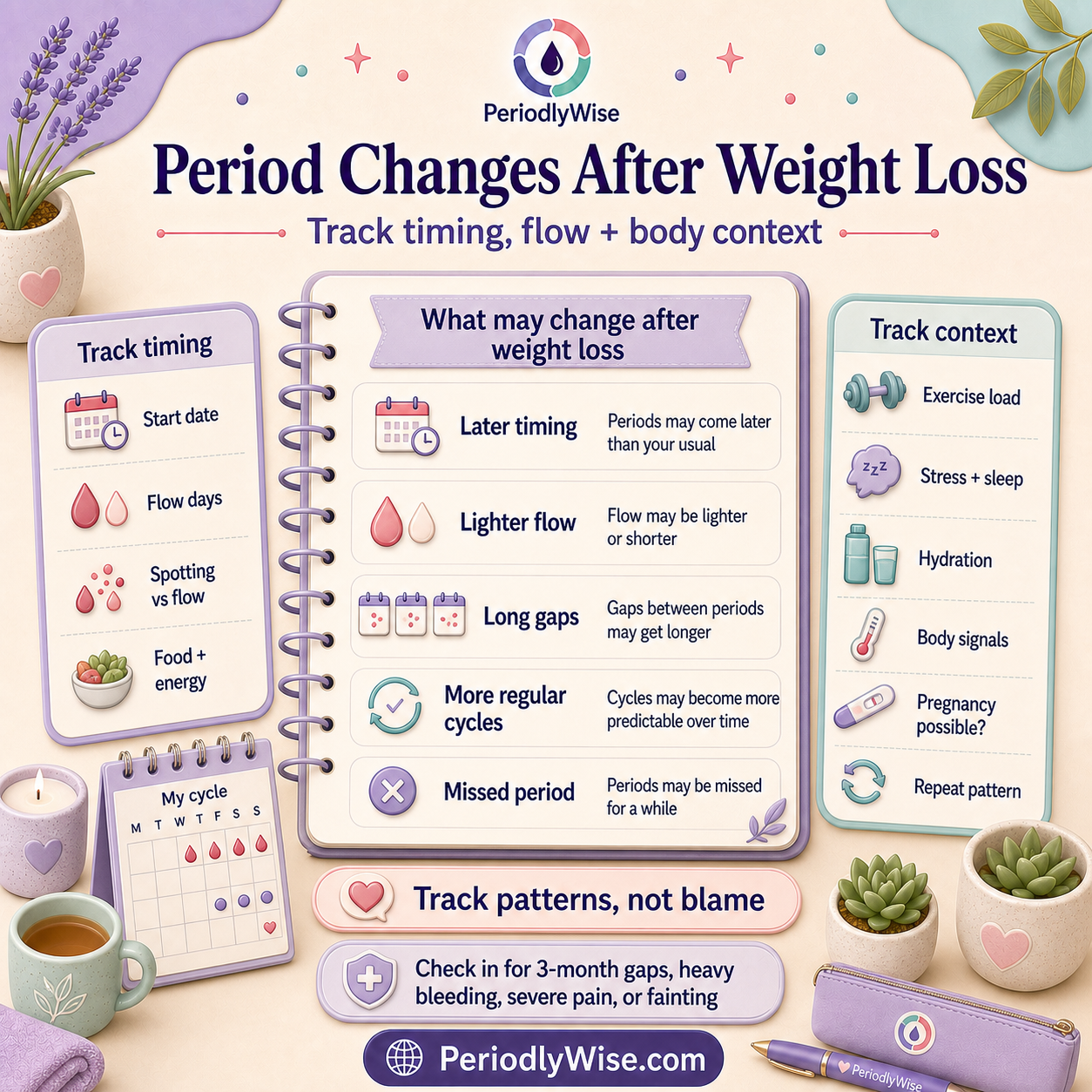
What different period changes may mean
| What changed | Possible context | Useful next step |
|---|---|---|
| A previously irregular cycle becomes more regular | Ovulation may be occurring more consistently, especially in some PCOS contexts. | Keep tracking and review contraception or pregnancy plans. |
| The period arrives later | Ovulation may have been delayed by rapid loss, low intake, harder training, illness, stress, or another cause. | Check pregnancy timing and compare the full month of changes. |
| Bleeding is lighter or shorter | The uterine lining may have had less hormonal stimulation, but spotting or early pregnancy bleeding can look light too. | Record full-flow days separately and test if pregnancy is possible. |
| Cycles become unpredictable | Energy deficit, PCOS, thyroid issues, medication changes, or inconsistent ovulation may be involved. | Track for several cycles and arrange care if the pattern persists. |
| Periods stop | Pregnancy, hypothalamic amenorrhea, hormonal contraception, breastfeeding, menopause, or another condition must be considered. | Do not assume weight loss is the only cause; seek evaluation. |
| Bleeding becomes heavy after a long gap | A delayed ovulation pattern can allow the lining to build, but pregnancy-related or structural causes also exist. | Seek advice, especially for rapid pad saturation, large clots, dizziness, or severe pain. |
Why pace, fuel, exercise, and starting diagnosis matter
Menstrual cycles depend on coordinated signals between the hypothalamus, pituitary gland, and ovaries. The system is sensitive to substantial changes in energy balance and stress. Weight loss can therefore be a marker of a larger shift rather than the direct cause by itself.
Avoid using body mass index, one calorie number, or one missed period to diagnose the problem yourself. People can experience low energy availability at different body sizes, and someone with PCOS can also develop hypothalamic suppression. A clinician may need to exclude pregnancy and review thyroid, prolactin, ovarian, medication, and nutritional factors.
- Rate of loss: a sudden or continuing drop is more concerning than a slow, planned change.
- Energy availability: eating too little for daily life and training can disrupt ovulation even before someone appears underweight.
- Exercise load: a sharp increase in endurance or high-intensity training adds physiological stress.
- PCOS context: improved insulin sensitivity may support more regular ovulation for some people.
- Medicines or surgery: weight-loss treatment can change appetite, absorption, fertility, or contraceptive planning and deserves prescriber-specific advice.
- Illness and stress: infection, digestive disease, poor sleep, grief, and mental strain may contribute to both weight and cycle changes.
- Eating-disorder signs: fear around food, compulsive exercise, purging, dizziness, feeling cold, or secrecy needs compassionate support.
A practical decision guide
| Situation | Reasonable response | Do not overlook |
|---|---|---|
| One period shifts by a few days and you otherwise feel well | Track the date, flow, loss pace, food, exercise, stress, and medicines. | Pregnancy testing if relevant. |
| Cycles repeatedly exceed 45 days | Book a non-urgent medical review. | PCOS, thyroid issues, prolactin, energy deficit, and pregnancy. |
| No period for three months | Arrange evaluation rather than waiting indefinitely. | Bone health and the reason ovulation stopped. |
| Periods become more regular after previously irregular cycles | Keep tracking and update contraception plans. | Fertility may have increased. |
| Weight loss is unplanned or accompanied by illness | Seek medical advice promptly. | Digestive, thyroid, metabolic, infectious, or other causes. |
| Heavy bleeding, fainting, severe pain, or possible pregnancy | Use urgent medical care based on severity. | Ectopic pregnancy and significant blood loss. |
What to do when your cycle changes
Use a calm, evidence-based reset rather than trying to force a period or changing the plan repeatedly.
- Rule out pregnancy. Use a home test from the first day of a missed period, or at least 21 days after unprotected sex when cycle timing is unclear. Repeat or seek advice if symptoms and timing do not fit the result.
- Map the timeline. Record when weight loss began, approximate pace, period start dates, full-flow days, spotting, exercise changes, illness, stress, sleep, and every medicine or supplement.
- Check adequacy, not perfection. Regular meals, enough overall energy, protein, fats, carbohydrates, calcium, vitamin D, and iron all matter. A registered dietitian can help when intake is restricted or confusing.
- Reduce an obvious energy mismatch. If training rose sharply while intake fell, discuss increasing nourishment, changing exercise, and adding recovery rather than pushing harder through fatigue or missed periods.
- Arrange assessment when thresholds are met. A clinician may check pregnancy, blood count, electrolytes, thyroid hormones, prolactin, reproductive hormones, or other tests based on the history.
What to track for two or three cycles
A tracker cannot diagnose why a period changed, but it can show whether timing is settling or drifting further. Use neutral observations rather than treating a missed period as a reward or failure.
- Weight-loss context: planned or unplanned, start date, approximate pace, medicine, surgery, illness, or diet change.
- Cycle timing: first day of full flow, cycle length, late days, and any three-month gap.
- Bleeding: spotting versus flow, duration, product use, clots, and leaks.
- Pregnancy context: sex timing, contraception, missed doses, and test dates.
- Fuel and recovery: meal regularity, appetite, training load, rest days, sleep, and stress.
- Body signals: fatigue, dizziness, feeling cold, hair changes, headaches, digestive symptoms, or reduced performance.
- Hormonal clues: acne, facial hair, nipple discharge, hot flashes, vaginal dryness, or new pelvic pain.
- Bone and safety clues: stress injuries, fractures, fainting, a very slow pulse, or weakness.
When period changes need medical care
Contact a healthcare professional if cycles repeatedly last longer than 45 days, a previously regular cycle becomes persistently irregular, or there has been no period for three months without pregnancy, breastfeeding, menopause, or an expected contraceptive effect. Seek earlier advice for rapid or unplanned weight loss, suspected disordered eating, stress injuries, fertility concerns, or symptoms of thyroid or other illness.
Get urgent help for severe or one-sided pelvic pain with possible pregnancy, fainting, chest pain, trouble breathing, confusion, persistent vomiting, severe weakness, very heavy bleeding, or signs of dehydration. The Endocrine Society notes that severe slow heart rate, low blood pressure, orthostatic symptoms, or electrolyte imbalance in suspected hypothalamic amenorrhea can require urgent treatment.
Use PeriodlyWise to record period dates and symptoms, then keep weight, food, exercise, medicine, and pregnancy details in a private note for your healthcare visit.
Open the period trackerFrequently asked questions
Can losing weight make your period late?
Yes. Rapid loss, under-fueling, intense exercise, illness, or stress can delay ovulation, which delays the period. Pregnancy and other medical causes still need consideration.
Can weight loss make periods more regular?
For some people with PCOS and overweight, even modest loss may improve ovulation and regularity. It is not guaranteed, and the same person can still have another cause of irregular bleeding.
How much weight loss stops a period?
There is no universal number. Pace, starting body composition, energy intake, exercise, stress, and individual hormone sensitivity matter. A period stopping for three months needs evaluation regardless of the number lost.
Will my period return if I eat more or exercise less?
If low energy availability is the cause, correcting the energy mismatch often helps, but recovery timing varies and other causes must be excluded. Work with a clinician and dietitian rather than self-treating prolonged amenorrhea.
Can I get pregnant if periods are irregular after weight loss?
Yes. Ovulation can occur before the next bleed and irregular cycles do not prevent pregnancy. Use contraception if pregnancy is not wanted and test when timing indicates.
The bottom line
Period changes after weight loss are not one single phenomenon. More regular cycles can occur when metabolic and ovulatory patterns improve, while late, light, irregular, or absent periods can signal that the body is not receiving enough energy or is under another form of stress.
Track the direction and context, check pregnancy when relevant, and use clear thresholds for care. A sustainable health plan should support menstrual, bone, mental, and overall health rather than treating a disappearing period as success.