You can have a urinary tract infection during your period. Menstrual bleeding does not protect against a UTI, and it can make the symptoms harder to sort out. Lower abdominal discomfort may feel familiar, while burning during urination or repeated urgent trips to the bathroom may be something new.
The most useful question is not simply 'Is this because of my period?' It is whether the symptoms point to the urinary tract, the vulva or vagina, ordinary menstrual discomfort, or another condition that needs assessment. More than one problem can occur at the same time.
This guide explains what to notice, how to discuss a urine test while bleeding, and how to manage period care without substituting home remedies for an indicated treatment. It focuses on adults; children, pregnancy and people with significant medical conditions need an appropriate clinical pathway.
What is infected, and where does period blood come from?
The urinary tract includes the kidneys, ureters, bladder and urethra. A bladder infection is a common type of UTI. Urine leaves through the urethra; menstrual blood leaves through the vagina. These are separate openings, although they are close together and discomfort can be difficult to localize.
Most bladder infections are caused by bacteria. The NIDDK explanation of symptoms and causes describes burning, urgency and lower abdominal discomfort as possible signs. Bleeding that happens at the same time does not establish where an infection began or what caused it.
A UTI is not proof that you are dirty or managed your period badly. Avoid turning a difficult episode into a hygiene failure. The priority is an accurate description of symptoms and appropriate care.
UTI, period cramps or external irritation?
Period cramps often follow a recognizable personal pattern. A UTI is more suggestive when urinary changes accompany the discomfort, such as burning inside when peeing, urgency or repeated small voids. Symptoms overlap, so this comparison helps you describe the problem rather than diagnose it yourself.
| What you notice | Possible context | What to tell the clinician |
|---|---|---|
| What you noticeUrgency and frequent small amounts | Possible contextA bladder or urethral problem may be involved. | What to tell the clinicianHow often you go, when it started and whether this is new. |
| What you noticeFamiliar cramping without urinary changes | Possible contextMay fit your usual menstrual discomfort. | What to tell the clinicianWhether the pain is different, severe or persistent. |
| What you noticeStinging as urine touches sore skin | Possible contextExternal irritation or vulval/vaginal inflammation is possible. | What to tell the clinicianItching, rash, new products or unusual discharge. |
| What you noticeBack or side pain with fever or shivering | Possible contextA kidney infection or another serious problem is possible. | What to tell the clinicianSeek prompt care; do not monitor at home as ordinary cramps. |
| What you noticeRed or pink fluid in the toilet | Possible contextMenstrual blood and urinary bleeding can be hard to separate. | What to tell the clinicianWhether blood appears in urine, persists after the period or is uncertain. |
Dark or strong-smelling urine alone does not prove a UTI. Conversely, the absence of a noticeable smell does not exclude one. Do not use colour, smell or a single symptom as the only decision rule.
Symptoms that should change your plan today
Seek urgent medical advice for suspected UTI with fever or shivering, pain in the back or side beneath the ribs, vomiting, visible blood thought to be in the urine, rapidly worsening symptoms or significant lower abdominal pain. Kidney involvement can become serious and needs a different assessment from routine menstrual discomfort.
Pregnancy or possible pregnancy matters because it changes the risks, testing and medicine choice. Bleeding does not reliably exclude pregnancy. Diabetes, immune suppression, kidney disease, a catheter, older age or a history of urinary problems are also important context to mention.
If you are confused, unusually drowsy, collapse or feel dangerously unwell, seek emergency help using your local emergency service. Do not wait for a urine dipstick, a period to end or an online reply. The NHS UTI guidance separates these warning signs from uncomplicated symptom care.
Can you give a urine sample while menstruating?
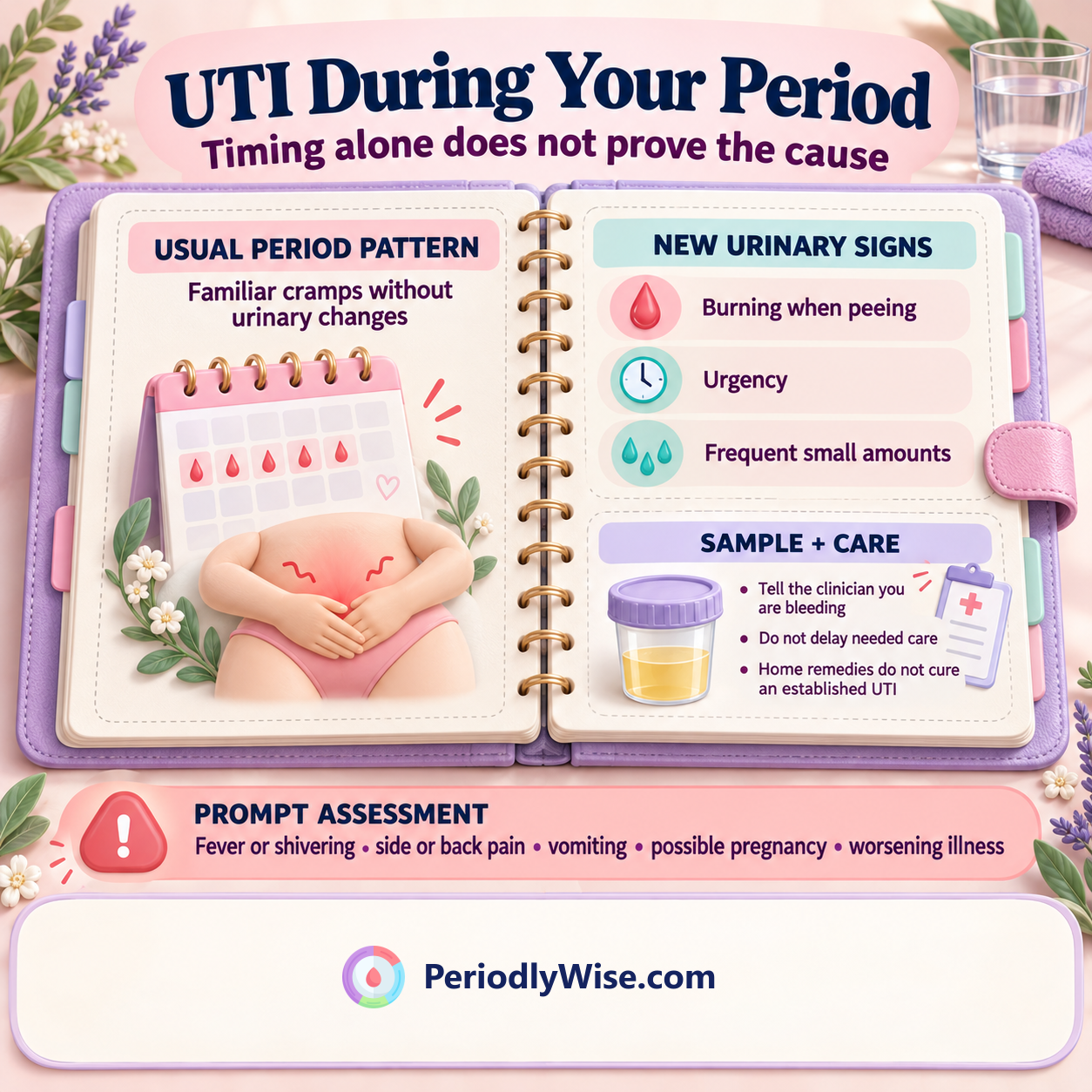
Yes, a sample can still be collected when clinically needed. Menstrual blood can contaminate it and affect interpretation, especially a finding of blood. MedlinePlus advises telling the provider if you are on your period. That information belongs on the sample request, not only in your private notes.
Follow the exact instructions from your clinic or laboratory. A midstream sample usually means beginning in the toilet and collecting the middle portion in a sterile container, while avoiding touching its inside. There is no need to insert a tampon solely for a test unless the service specifically discusses an appropriate collection plan with you.
If the result is contaminated or does not fit the symptoms, the clinician may request another sample. That is different from telling every person with urinary symptoms to wait several days. When possible, a requested culture is collected before antibiotics, but do not delay urgent treatment to achieve a perfect sample.
- Tell the service about menstrual bleeding, pregnancy possibility and any antibiotics already taken.
- Use its sterile container and collection instructions, not a household jar.
- Wash your hands, avoid touching the inside and collect the requested midstream sample.
- Label and return it promptly as directed; ask about storage if there will be a delay.
- Ask how results will reach you and what to do if symptoms worsen before they arrive.
What testing can, and cannot, tell you
A clinician may diagnose a straightforward bladder infection from symptoms and history, or request urine testing depending on the situation. Pregnancy, repeated episodes, treatment failure and atypical symptoms can change that decision. Not every episode requires exactly the same tests.
Urinalysis checks features such as blood and white blood cells. A culture looks for bacterial growth and can help guide antibiotic choice. The NIDDK diagnosis guide explains these different roles. A result must be read with symptoms and collection details, including menstruation.
A home strip is not a reliable all-clear when you have concerning symptoms. Nor should a positive strip, in isolation, prompt borrowed antibiotics. If symptoms persist despite a negative or unclear result, ask for reassessment rather than assuming there is no problem.
Treatment: the period does not replace the usual decision-making
A bacterial bladder infection is often treated with a clinician-selected antibiotic. Choice and duration depend on factors such as pregnancy, allergies, kidney function, prior results and local resistance. Some uncomplicated situations may be managed with a clinician-directed delayed prescription; that is not a blanket instruction to wait when you feel unwell.
Take the medicine exactly as prescribed and contact the service about side effects or difficulty taking it. Do not use leftovers, someone else's prescription or an antibiotic chosen because it helped a previous episode. NIDDK treatment advice emphasizes following the prescribed course.
Seek reassessment if symptoms worsen or are not improving within 48 hours of starting treatment, and sooner for warning signs. Do not interpret temporary pain relief or the end of menstrual bleeding as proof that an infection has cleared.
Comfort measures while you arrange or receive care
Rest, keep normal access to fluids and empty your bladder when you need to. Aim for comfortable hydration rather than forcing excessive water. People with heart or kidney conditions or a prescribed fluid limit should ask what is appropriate for them.
A warm, safely wrapped heat pad may help discomfort. Ask a pharmacist or clinician which pain relief is suitable, especially with possible pregnancy, kidney disease, dehydration, stomach problems or other medicines. Avoid doubling up on the same ingredient in separate cold, flu and pain products.
Cranberry drinks, cystitis sachets and supplements are not substitutes for treatment of an established infection. Symptom relief and prevention claims are different from curing a current UTI. Do not let a home remedy delay assessment of fever, flank pain or worsening illness.
- Do not hold urine to avoid an uncomfortable bathroom trip; ask for help if pain makes it difficult to pass urine.
- Avoid irritants that worsen your symptoms, such as fragranced intimate products; more aggressive washing is not treatment.
- Keep a clear medicine record so the prescriber knows what you have already taken.
Period products: choose comfort, not a supposed UTI cure
Changing to a pad, tampon, cup or period underwear does not treat an infection inside the urinary tract. Use a product that feels comfortable, follow its instructions and wash hands before and after handling it. If insertion or pressure is painful, do not force an internal product.
For tampons, the FDA advises changing them every four to eight hours and never exceeding eight hours, with the lowest absorbency needed. Follow any more restrictive product directions. Toxic shock syndrome is a different emergency risk, not another name for a UTI.
Keep external skin care gentle and avoid douching or fragranced products. If a product seems to trigger recurrent soreness or pressure, note the exact product and timing and discuss it. A repeated association deserves attention, but does not by itself prove a bacterial infection or that one product type is unsafe for everyone.
Could this be a vaginal condition or an STI instead?
Itching, external soreness, changed discharge, pain during sex or symptoms after a new sexual exposure can point to a different or additional problem. NHS vaginitis guidance describes overlapping symptoms and several possible causes, including irritation and infections.
Tell the clinician about these symptoms even while bleeding. Depending on the history, vaginal swabs or sexual-health testing may be more useful than simply repeating UTI medicines. An ordinary urine culture is not a comprehensive STI screen.
If sex is uncomfortable, pause rather than pushing through pain. Ask for a sexual-health assessment when there is an exposure concern. Avoid assuming that itching after antibiotics must be another UTI or that every burning sensation needs an antifungal.
What if the symptoms return around every period?
A repeating pattern is worth bringing to care, not treating indefinitely with over-the-counter products. The NHS defines recurrent UTIs as two in six months or three in twelve months. Whether your episodes were culture-confirmed, what treatment helped and whether symptoms fully resolved are useful details.
A clinician may review infections, product irritation, vaginal conditions, contraceptive factors or other causes of bladder and pelvic pain. Repeated negative or mixed results do not make symptoms imaginary; they mean the explanation needs careful review.
| Record | Example of a useful note | Why it helps |
|---|---|---|
| RecordTiming | Example of a useful noteBurning began on day two of bleeding, not before it. | Why it helpsSeparates the observed pattern from an assumed cause. |
| RecordUrinary symptoms | Example of a useful noteUrgency, small amounts and pain during urination. | Why it helpsDistinguishes urinary changes from cramps alone. |
| RecordOther context | Example of a useful noteNew product, sexual exposure, contraception or unusual discharge. | Why it helpsSupports consideration of alternative explanations. |
| RecordTests and treatment | Example of a useful noteCollection date, menstrual bleeding, culture result and response. | Why it helpsHelps avoid repeating an ineffective treatment plan. |
You do not have to wait for another episode to make the diary complete. Seek care when symptoms occur and bring whatever history you already have.
A practical plan for the next day or two
Start by checking for urgent signs, then contact an appropriate service for new urinary symptoms. In some places pharmacists can assess selected uncomplicated UTIs; eligibility varies by age, pregnancy and local rules. If you are unsure whether you qualify, ask rather than self-selecting antibiotics.
While waiting for advice, describe bleeding and urinary symptoms separately, keep a short medication record and use comfortable period care. Agree a follow-up point rather than waiting indefinitely. If your condition worsens, the earlier plan needs updating even if a culture is still pending.
Frequently asked questions
Does my period cause a UTI?
The timing alone cannot show that. Most bladder infections are bacterial, and several risk factors may be involved. A period can coincide with infection or irritation without being the established cause.
Can a UTI go away when the period ends?
Symptoms may change, but the end of bleeding is not a test of whether an infection has resolved. Follow your treatment and review plan, and seek care for persistent or worsening symptoms.
Can period blood make a urine test positive for blood?
Yes. Menstrual contamination can affect the result. Tell the clinician and follow collection instructions; a repeat may be needed, but necessary assessment should not be postponed automatically.
Can I use a tampon if I have a UTI?
A tampon does not treat the UTI. Use it only if comfortable and follow safe wear times and product instructions. Switch to a comfortable alternative if insertion hurts, and seek advice for persistent pain.
Should I drink cranberry juice instead of antibiotics?
No. Cranberry products are not established treatment for an infection that has already started. If an antibiotic is prescribed, take it as directed; ask about any supplement interactions or pregnancy concerns.
Is blood definitely from my period?
Not necessarily. Vaginal and urinary blood can be difficult to separate. Tell the clinician if it seems to be in the urine, persists after bleeding stops or remains uncertain, especially with pain or other urinary symptoms.
What if I might be pregnant?
Mention it promptly. Bleeding does not reliably exclude pregnancy, and suspected UTI in pregnancy needs timely assessment and an appropriate medication choice.
Can a period tracker identify a UTI?
No. A tracker can record when symptoms occur but cannot diagnose infection, interpret a urine culture or choose antibiotics. Use records to support care, not to replace it.
Use your period history to describe timing, alongside a short note of symptoms and treatment. A predicted period window cannot tell you whether you have a UTI.
Open the Period TrackerThe bottom line
A UTI can occur during menstruation, and it deserves the same attention as at any other time. New urinary symptoms should not be written off as a normal part of your period.
Tell the service about bleeding, follow its sampling and treatment advice, and seek prompt help for fever, side or back pain, vomiting, pregnancy possibility or worsening illness.