Itching that starts or flares while you are bleeding can make every pad change, tampon insertion, shower, and night of sleep uncomfortable. The timing may point to a menstrual product, moisture, or friction, but a period is not a diagnosis. Yeast, bacterial vaginosis (BV), trichomoniasis, another infection, low-estrogen dryness, or a vulvar skin condition can happen during the same days.
The first useful distinction is anatomical. The vulva is the external skin and folds around the vaginal opening; the vagina is the internal canal. People often use “vaginal itching” for either location. External itch where a pad, liner, adhesive, wipe, soap, or tight clothing touches suggests a different pathway from deep internal irritation with changed discharge or odor.
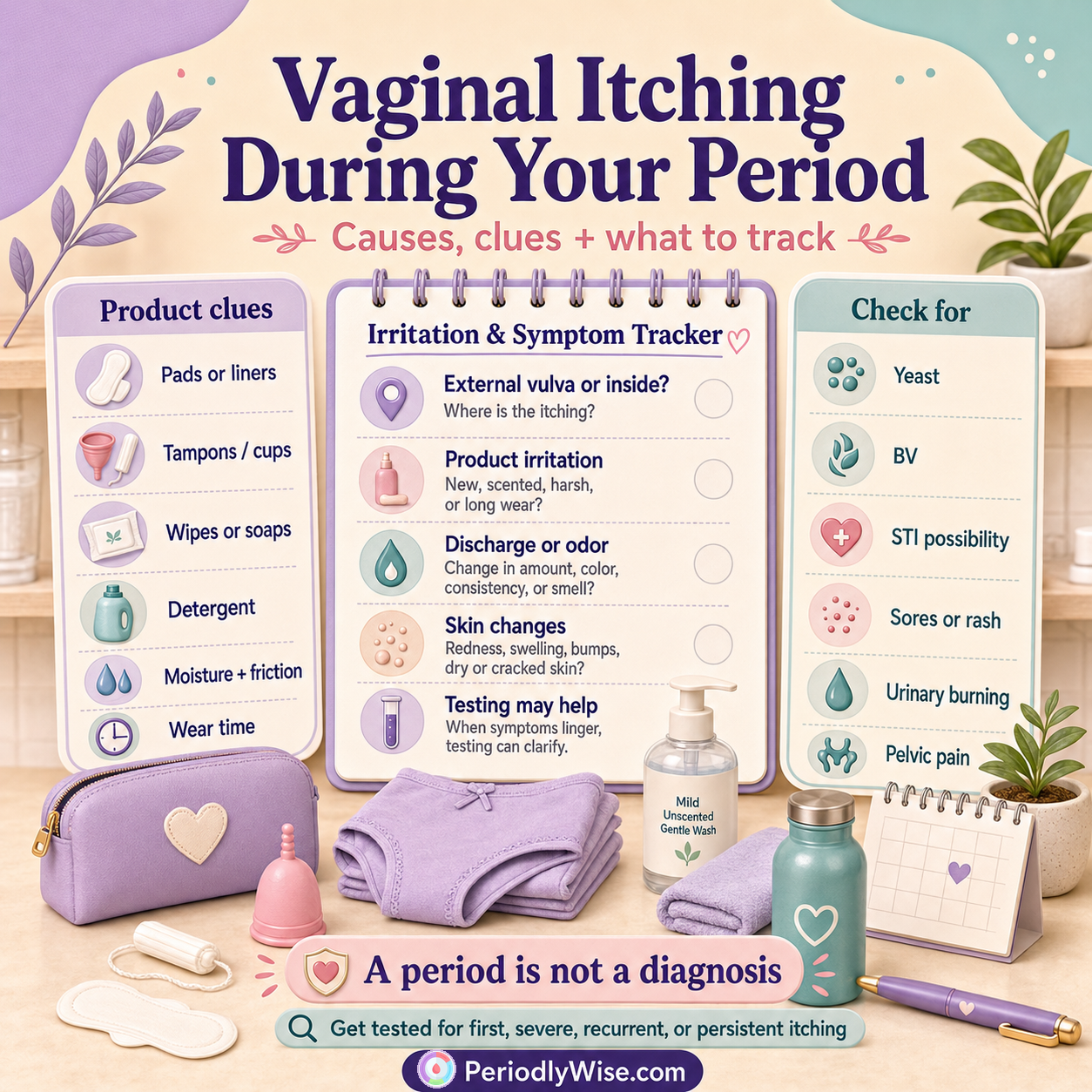
Symptoms alone still overlap. CDC guidance notes that medical history by itself is often insufficient to diagnose vaginitis accurately. Notice the location, product timing, discharge, odor, skin changes, urinary symptoms, sexual-health context, and recurrence, then use examination or testing when the cause is not clear.
First locate the itch and describe what accompanies it
Use a mirror if comfortable and ask whether the itch is mainly on the hair-bearing outer skin, inner folds, vaginal opening, or deeper inside. Look without scratching for redness, swelling, cracks, blisters, sores, white patches, thickened skin, bumps, or a sharply defined area matching a pad edge. Persistent skin change needs professional examination even when discharge seems normal.
Next compare discharge with what is usual for you. Menstrual blood can make color and quantity difficult to judge, so note symptoms just before bleeding, on lighter days, and after the period ends. Thick white discharge without a strong odor can occur with yeast; thin gray or white discharge and a fish-like odor can occur with BV; yellow-green or malodorous discharge with genital irritation can occur with trichomoniasis. None of these clues confirms a diagnosis by itself.
Also distinguish burning when urine touches irritated external skin from burning that feels internal or comes with urinary urgency and frequency. Ask whether a tampon, cup, disc, lubricant, condom, spermicide, new partner, antibiotic, diabetes, pregnancy, breastfeeding, perimenopause, or immune-suppressing medicine changes the risk or the safest treatment.
What different patterns may suggest
| Pattern | Possible context | What to check next |
|---|---|---|
| Itch follows the shape of a pad or liner and improves away from it | Contact dermatitis, fragrance, adhesive, plastic coating, trapped moisture, heat, or friction may be contributing. | Switch to an unscented alternative, change it regularly, stop wipes or sprays, and see whether external skin settles. |
| Intense vulvar itch, redness, swelling, soreness, or thick white discharge | Vulvovaginal candidiasis is possible, but these symptoms are not specific to yeast. | Use clinical testing for a first, recurrent, severe, pregnancy-associated, or treatment-resistant episode. |
| Thin discharge with a strong fish-like odor, sometimes more noticeable during the period | BV is possible; itching may occur but odor and discharge are often more prominent. | A clinician can test vaginal fluid and prescribe the appropriate antibiotic if confirmed. |
| Yellowish or greenish discharge, odor, genital irritation, painful urination, or sexual exposure | Trichomoniasis or another STI needs consideration. | Arrange STI testing; partners and retesting may matter if an infection is diagnosed. |
| Repeated itch with white patches, cracks, sores, thickening, pigment change, or no discharge | Eczema, contact dermatitis, lichen sclerosus, lichen planus, psoriasis, or another vulvar disorder may fit. | Request a vulvar examination rather than repeatedly treating for yeast. |
| Sudden fever, vomiting, diarrhea, dizziness, faintness, or sunburn-like rash while using a tampon | Rare toxic shock syndrome is possible. | Remove the tampon and seek emergency medical attention immediately. |
Why itching may flare during menstrual bleeding
Contact and friction: bleeding days introduce pads, liners, tampons, cups, discs, period underwear, wipes, stain treatments, and more frequent washing. Fragrance, deodorizing ingredients, plastic coatings, adhesives, detergents, fabric softeners, heat, and rubbing can disrupt sensitive vulvar skin. The resulting contact dermatitis may cause itching, rawness, stinging, burning, or pain.
Moisture and the itch-scratch cycle: prolonged dampness and occlusion can soften and irritate skin. Scratching then creates tiny surface injuries, which increase inflammation and invite more itching. Gentle drying, breathable clothing, and changing a saturated product can help external irritation, but “keeping clean” should not become repeated scrubbing or internal washing.
Vaginitis: yeast overgrowth, bacterial imbalance, and trichomoniasis require different treatments. CDC and ACOG both emphasize testing because itching, burning, discharge, odor, and redness overlap. Yeast symptoms are not specific, and finding Candida without symptoms does not automatically mean it needs treatment.
Hormonal and skin conditions: lower estrogen during breastfeeding or perimenopause can cause dryness, burning, and itch. Eczema, psoriasis, lichen sclerosus, lichen planus, lichen simplex chronicus, folliculitis, and other vulvar disorders can flare independently of menstrual blood and may need prescription treatment or occasionally a biopsy.
Context worth reviewing includes:
- the exact location of itch and whether skin looks red, swollen, cracked, pale, thickened, blistered, or ulcerated
- pad, liner, tampon, cup, disc, period-underwear, wipe, soap, detergent, lubricant, condom, or spermicide changes
- discharge amount, color, texture, and odor before, during, and after bleeding
- recent antibiotics, steroids, diabetes, immune conditions, pregnancy, breastfeeding, or perimenopause
- a new sexual partner, sex without barrier protection, partner symptoms, or previous STI
- burning with urination, pelvic pain, pain with sex, fever, bleeding after sex, or sores
- whether over-the-counter yeast treatment helped, did nothing, or repeatedly gave only brief relief
- tampon wear time, possibility of a retained tampon, and any sudden systemic illness
Self-care, testing, or urgent care?
| Situation | Reasonable next step | Why |
|---|---|---|
| Mild external itch began with a new scented pad or wipe and no other symptoms | Stop the suspected irritant, use an unscented product, rinse the vulva gently, pat dry, and monitor briefly. | A clear contact pattern can improve when the exposure ends. |
| This is the first episode or symptoms do not clearly match a past confirmed diagnosis | Arrange an examination or vaginal test before treating repeatedly. | History alone often misclassifies yeast, BV, STI, and noninfectious irritation. |
| Symptoms recur, are severe, or persist after an over-the-counter treatment | Contact a clinician for microscopy, pH, culture, or molecular testing as appropriate. | The organism, resistance, mixed infection, or a skin disorder may require different care. |
| There is STI possibility, yellow-green discharge, odor, sores, or partner symptoms | Arrange confidential STI testing and pause sex or use guidance from the clinic. | Trichomoniasis and other infections cannot be ruled out from cycle timing. |
| Itching occurs in pregnancy, with diabetes, immune suppression, or recurrent episodes | Seek individualized advice before self-treatment. | These situations can change testing, treatment choice, duration, and follow-up. |
| Fever, rash, faintness, severe pain, rapidly spreading swelling, or tampon-related systemic symptoms occur | Use urgent or emergency care. | These features go beyond uncomplicated irritation or vaginitis. |
What to do when itching starts during your period
The aim is to calm avoidable irritation without masking an infection or skin disorder that needs the right test and treatment.
- Locate and look before treating. Note external versus internal itch, redness, swelling, skin lesions, discharge, odor, urinary symptoms, pain, and when the symptoms began relative to bleeding and product use.
- Remove likely irritants. Stop scented pads, tampons, liners, wipes, sprays, deodorants, bubble bath, and new fragranced detergents. Try a breathable, unscented product and change it according to flow and manufacturer directions.
- Clean gently and externally. Use plain lukewarm water on the vulva, avoid scrubbing, and pat dry. Do not douche or place soap, antiseptic, fragrance, or cleansing products inside the vagina; it is self-cleaning.
- Avoid automatic repeat treatment. If this is a first episode, symptoms are atypical or severe, pregnancy is possible, episodes recur, or treatment failed, arrange testing instead of assuming every itch is yeast.
- Include sexual-health context. Testing is sensible with a new partner, unprotected sex, partner symptoms, sores, unusual odor or discharge, or concern about an STI. Follow partner-treatment and retesting guidance if diagnosed.
- Use internal products safely. Stop a tampon, cup, or disc if insertion or wear causes pain, allergy, or unusual discharge. Never leave a tampon longer than directed; remove it and seek immediate care for sudden fever, vomiting, diarrhea, dizziness, faintness, or a sunburn-like rash.
What to record before an appointment or test
A short symptom-and-exposure record helps a clinician choose useful testing. If an appointment is planned, ask how vaginal medicines, douching, sex, or spermicides could affect sample accuracy; ACOG advises avoiding these before vaginitis testing.
- cycle day, first day of full flow, and whether itching began before, during, or after bleeding
- external vulva, vaginal opening, or deeper internal location
- itch intensity, burning, rawness, swelling, cracks, bumps, blisters, sores, or white patches
- discharge color, consistency, amount, and odor when menstrual blood is lighter or absent
- pad, tampon, liner, cup, disc, or period-underwear brand, material, scent, and change frequency
- soap, wipes, sprays, detergent, fabric softener, lubricant, condoms, spermicides, or topical products
- urinary burning, urgency, pelvic pain, pain with sex, fever, rash, dizziness, or bleeding after sex
- antibiotics, steroids, diabetes, pregnancy possibility, breastfeeding, perimenopause, or immune conditions
- sexual exposure, partner symptoms, prior STI, and dates of relevant tests
- every treatment tried, exact dates, whether symptoms fully cleared, and how quickly they returned
When to contact a clinician
Arrange care for a first episode of vaginal symptoms, intense itching, changed or malodorous discharge, pain with urination or sex, pelvic pain, sores, bleeding outside the expected period, pregnancy, or symptoms that do not settle after removing a clear irritant. Testing can distinguish infection from contact dermatitis, dryness, and vulvar skin disease.
Seek review when itching repeatedly returns with each period, because repeated exposure may be the trigger but recurrent yeast, BV, a mixed infection, or a chronic skin condition may also be present. White patches, thickened skin, cracks, ulcers, pigment change, lumps, or persistent itch without discharge deserve a careful vulvar examination.
If a tampon may be retained, remove it if you can do so easily and contact a clinician for uncertainty, foul odor, discharge, fever, or pain. Do not insert another object to search for it.
Use PeriodlyWise to record cycle timing, products, discharge, odor, irritation, treatments, and recurrence privately, then bring the pattern to a clinician when testing is needed.
Open the period trackerFrequently asked questions
Is vaginal itching normal during a period?
Mild external irritation can happen from products, moisture, heat, or friction, but persistent, intense, recurrent, internal, or painful itching is not something to dismiss as normal. Look for discharge, odor, skin changes, urinary symptoms, sores, and a clear product pattern.
Can pads cause itching or a yeast infection?
A pad can irritate vulvar skin through fragrance, adhesive, plastic coating, heat, moisture, or rubbing. That does not prove yeast. Switch away from the suspected product, but seek testing if symptoms are intense, include changed discharge, recur, or do not improve.
Why does itching happen only when my period starts?
Bleeding days introduce repeated contact with menstrual products and more moisture or washing. BV odor can also be more noticeable during a period, while infection or skin disease may coincidentally flare. A repeating calendar pattern is a clue, not a diagnosis.
Can I use an over-the-counter yeast treatment during my period?
Product instructions and local advice differ, and bleeding may make some vaginal treatments less practical. More importantly, symptoms are not specific to yeast. Ask a clinician or pharmacist for a first episode, pregnancy, severe symptoms, frequent recurrence, or failure of prior treatment.
Can tampons or menstrual cups cause itching?
They can cause friction, dryness, pressure, or a contact reaction, and a retained product can cause odor or discharge. Stop use if it hurts or triggers symptoms, follow cleaning and wear-time directions, and seek care if removal is difficult or systemic symptoms occur.
How can I tell yeast, BV, and an STI apart?
Clues can help, but they overlap. Yeast often causes intense vulvar itch and sometimes thick white discharge; BV often causes thin discharge and fish-like odor; trichomoniasis may cause yellow-green or malodorous discharge and irritation. Examination and testing are more reliable than symptoms alone.
The bottom line
Vaginal or vulvar itching during a period can be as simple as an external product reaction, but menstrual timing does not rule out infection, low-estrogen dryness, or a skin condition. Locate the symptom, remove irritants, clean gently, and resist treating every episode as yeast without enough evidence.
Testing is the safest next step for a first, severe, recurrent, unusual, pregnancy-associated, or persistent episode. Sudden systemic illness with tampon use, severe pelvic pain, rapidly spreading swelling, or pregnancy-related pain and bleeding needs urgent care.