The best time of day to take an ovulation test depends on the exact test you use. For many urine LH strips, late morning, afternoon or early evening is a practical choice. But that is not a rule for every kit: certain dual-hormone digital tests specifically require the first urine after your longest sleep, and other digital tests allow any consistent daily time.
If you have seen both never use morning urine and always use morning urine online, the advice may be referring to different products. The word digital describes the display, not a universal sampling method. A strip that measures LH alone and a monitor that tracks changes in an estrogen metabolite as well as LH may need different routines.
This guide helps you choose a repeatable schedule, avoid diluted or incorrectly read samples, and interpret a missed or positive result without overclaiming what it means. The leaflet supplied with your current product and any fertility-clinic instructions take priority over a generic timetable. Brand examples illustrate differences; they are not a product ranking or endorsement.
What an ovulation test measures, and why timing matters
Most home ovulation predictor kits look for a rise in luteinizing hormone, or LH, in urine. That hormonal rise often precedes ovulation by roughly one to two days, but the test does not watch an egg leave the ovary. The FDA's overview also distinguishes LH-only tests from products that measure an estrogen metabolite called E3G.
Hormone concentration in a urine sample is affected by when the sample is collected and how diluted it is. Blood hormone changes and their appearance in urine are not a minute-by-minute match. ASRM guidance notes that urinary LH results correlate particularly well with serum peaks using midday or evening specimens, while acknowledging differences between products and false results.
That general evidence does not override a device's validated instructions. A kit may compare today's hormone pattern with a baseline from earlier days. Changing sample conditions, starting too late or borrowing another brand's schedule can make that comparison less useful. Consistent conditions are more helpful than chasing an exact minute.
Timing by test type: read the exact product name
The table gives concrete examples from current manufacturer guidance. Local versions, new models and pack leaflets can differ, so verify the kit in your hand. Do not assume all strips, all digital tests or all products from one brand work alike. A screen showing a result does not tell you which hormones the device measures.
Clearblue Digital and Clearblue Advanced Digital are deliberately listed separately. Easy@Home support provides an example of later-day strip guidance. These instructions describe how to use the named products, not proof that one is better for every person.
| Test example | Timing approach | Important distinction |
|---|---|---|
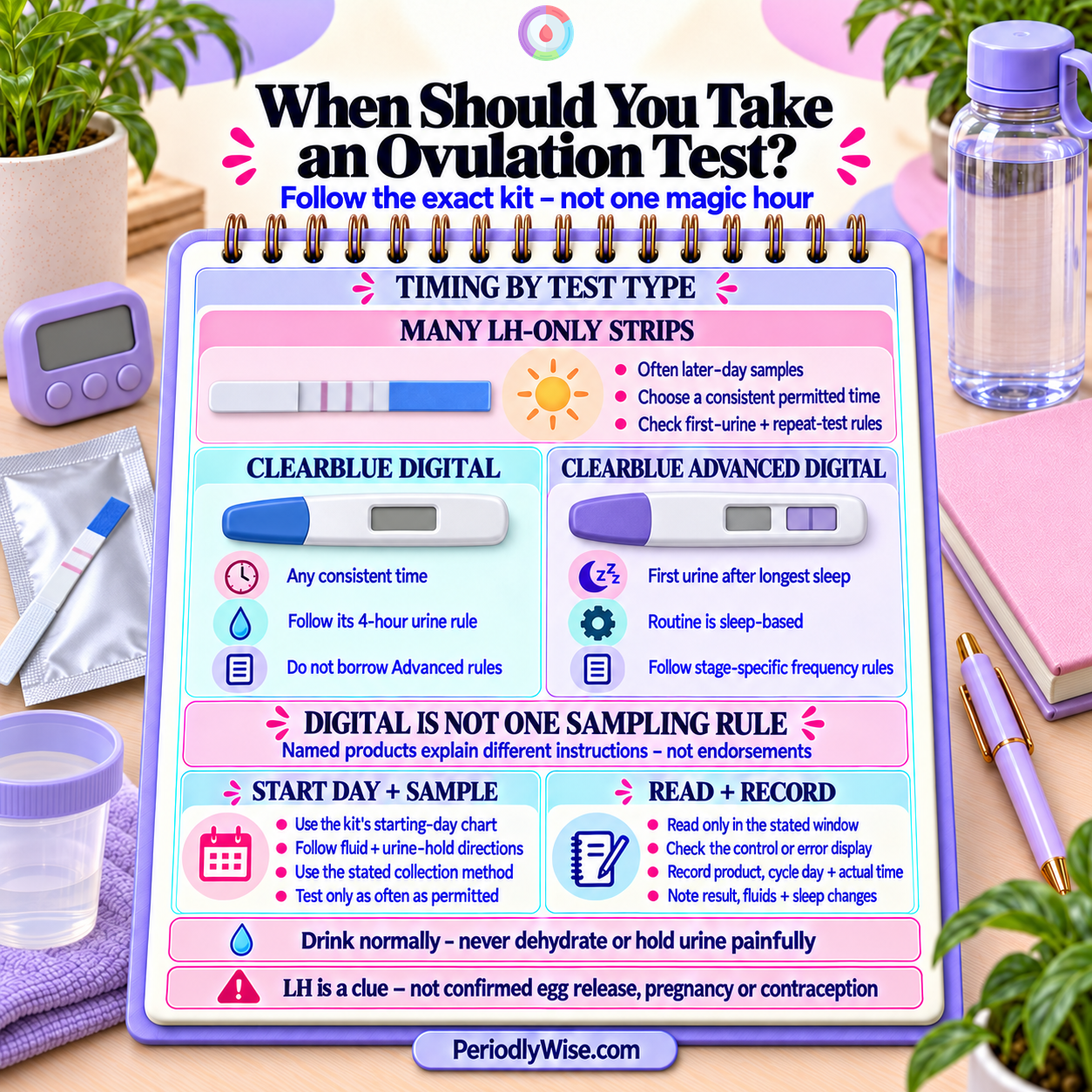
| Test exampleMany LH-only strips, including Easy@Home | Timing approachOften late morning through early evening; choose a consistent permitted time. | Important distinctionCheck the strip leaflet for first-urine, fluid and repeat-testing rules. |
| Test exampleClearblue Digital Ovulation Test | Timing approachAny time of day, consistently; manufacturer specifies a four-hour interval without urinating before testing. | Important distinctionFirst urine can be convenient for this product; do not apply the rules of Advanced Digital. |
| Test exampleClearblue Advanced Digital Ovulation Test | Timing approachFirst urine after the longest sleep for the routine daily test. | Important distinctionTracks estrogen-related changes and LH; repeat-testing rules depend on its fertility stage. |
| Test exampleA fertility monitor or another multi-hormone device | Timing approachFollow its designated sampling and testing window. | Important distinctionNeither the word digital nor a familiar brand supplies a universal schedule. |
Should you use first morning urine?
Sometimes yes, sometimes no: follow the kit. Premom's strip instructions favor testing later in the day rather than the first sample on waking. In contrast, some dual-hormone systems are designed around the first sample after the main sleep period. Advice for a pregnancy test is not interchangeable with advice for an LH test.
For a test that asks for urine after the longest sleep, think about your actual sleep pattern rather than the label morning. If your longest sleep ends in the afternoon because you work nights, that may be the relevant sample. If sleep is fragmented, you urinate during the night or your shift changes frequently, ask the manufacturer how its instruction applies instead of inventing a new rule.
Using a nonpreferred sample once does not automatically prove that a result is false or that a cycle is lost. Record the departure from the instructions, follow the product's missed-test guidance and avoid comparing that reading as though every condition were identical. A repeat test, if permitted, is a new sample; a dried used strip cannot be made valid by reading it again.
Can you test at night, after work or on shifts?
A later-day LH strip can often fit after work if that time is within the product's permitted range. There is no reason to force a lunch-break test solely because an online article names one exact hour. Choose a schedule you can repeat with the right sample preparation, then keep it reasonably consistent across testing days.
For a wake-based device, use the required sleep-related sample rather than moving the test to bedtime for convenience. A monitor may also impose a programmed window: the Clearblue Advanced Fertility Monitor is one example. Check the instructions for setting or changing that window before travel, overnight work or a new sleep schedule.
If a consistent schedule is genuinely difficult, ask whether the product is suitable for your routine. Do not wake repeatedly, miss necessary hydration or hold urine painfully to chase a theoretical ideal. A practical plan can include a reminder, access to a clean collection container when needed, and a place to read the result within the stated window.
Fluids and urine holds: concentration without dehydration
A large drink shortly before testing can dilute urinary hormone concentration and make a rise harder to detect. This does not mean you should avoid normal daily fluids or make your urine as dark as possible. Follow the specific preparation interval, and keep normal hydration outside it. Do not deliberately dehydrate yourself, especially with illness, heat, exercise or a medical reason to maintain fluid intake.
A recommendation to limit excessive drinks is not automatically a recommendation to hold urine for the same number of hours. These are separate instructions. Some strip guidance discusses roughly two hours of fluid preparation; Clearblue Digital specifies a four-hour interval without urinating. Do not turn either example into a requirement for every kit.
If a urine hold causes pain, urgency or conflicts with advice for a urinary or other health condition, speak with a pharmacist, clinician or the manufacturer about an appropriate approach. Coffee and tea contribute fluid too; there is no need to invent a special forbidden-food routine. Record unusually high fluid intake if it helps interpret an unexpected reading, without assigning blame to one cup of water.
Once or twice a day: follow the frequency rules
Daily testing across the relevant days is a common starting routine. Some LH-strip instructions allow a second later sample near a suspected surge, which may help catch a short rise. More testing is optional and product-specific, not a universal upgrade. It adds cost and can make tracking more burdensome without answering every uncertainty.
Do not transfer a twice-daily strip schedule to a digital system that requires once-daily baseline sampling. Clearblue Advanced Digital's instructions distinguish the stage before High Fertility from the stage after it first appears; its displayed Peak result also has its own rules. Read the complete leaflet rather than choosing whichever line of advice seems most convenient.
Testing every hour is not a way to determine the precise moment of egg release. Small line changes can reflect urine concentration or reading conditions, and even a clear positive remains an indirect signal. If a second test is allowed, space it according to the product's instructions and treat each sample as a separate observation, not a competition to find the darkest possible line.
Which cycle day should you start testing?
The best time of day will not compensate for starting on the wrong cycle day. Use the kit's chart and its definition of day one, usually the first day of full menstrual bleeding rather than light spotting. Do not assume everyone ovulates on day 14, or that a calendar estimate is evidence that the surge has already happened.
Even similar products may use different start charts. For a 28-day cycle, the currently published Clearblue Digital chart begins on day 11, while its Advanced Digital chart begins on day 8. Those are named-product examples, not a formula for all kits. Earlier baseline collection can be important for a device looking for an estrogen-related change.
If cycles vary, use the rule in your leaflet rather than automatically choosing the average or the longest recent cycle. If your usual cycle length is unknown, there may be specific instructions or limitations. Irregular, very long or absent cycles can require more supplies or a different assessment plan; buying endless strips is not the only next step. Ask for advice if the starting-day rule is unclear.
A repeatable testing routine, step by step
Build the routine around the leaflet, not an app notification alone. Check the expiry date, storage conditions, package integrity and compatibility of sticks with a holder. Have the instructions available before collecting urine, because dipping time, sample amount and reading window differ between products.
Write down an actual observation rather than changing the record to fit a prediction. If you use an app, its camera may help organize strip photos, but lighting and the product's line characteristics affect an image-based reading. A photograph or app ratio is not automatically a laboratory LH concentration.
- Identify the exact kit, what hormones it measures, the starting cycle day and whether its routine is clock-based or sleep-based.
- Choose an achievable permitted time, and follow its fluid and urine-hold instructions without causing discomfort or dehydration.
- Collect and apply the sample exactly as directed. Use a clean, dry container if one is required, and do not over-dip a strip.
- Use a timer and read only in the stated window. Check the control indicator or error message before interpreting fertility.
- Record the date, cycle day, actual testing time, product and result. Note a missed day, unusual fluids or a changed sleep pattern when relevant.
- Continue or stop according to that kit's result and frequency rules. Keep any fertility-clinic plan separate and follow it first.
Reading lines, digital results and app labels correctly
For many visual LH strips, a positive result requires the test line to be at least as dark as the control line within the reading window. A faint test line can be normal because some LH is present outside the surge. A visible second line is not automatically positive; confirm your own strip's criteria, especially if it is a quantitative or otherwise different product.
A missing control indicator or an error symbol is not a negative ovulation result. Follow the error instructions, using a fresh test when appropriate. Lines inside an ejected digital stick are not a substitute for the device's display. Do not mix holders and sticks unless the manufacturer specifically permits it.
Labels such as high, peak and positive are not identical across products or apps. An estrogen-based High Fertility result is different from detecting an LH surge. A camera-derived test-to-control ratio is influenced by the strip and image conditions; do not compare numbers across brands as if they were standardized clinical measurements. An old photograph also cannot recover a result that was first read after drying.
Missed, negative or confusing results: what to check
One negative test means the kit did not detect its target rise in that sample. It does not prove you are infertile, that ovulation cannot occur later, or that pregnancy is impossible. Check the testing process before assigning a medical explanation, but do not assume technique is the cause of every confusing cycle either.
A short surge, a late start, a missed day, diluted urine, a different detection threshold or a cycle without ovulation can all affect the pattern. Several positive results may reflect a prolonged or repeated rise, not necessarily multiple eggs. The troubleshooting table separates a sensible next action from a conclusion the kit cannot support.
| What happened | Useful next check | Do not conclude |
|---|---|---|
| What happenedNegative after unusually high fluid intake | Useful next checkReview preparation and retest only as the leaflet permits. | Do not concludeThat no ovulation is possible this cycle. |
| What happenedA day or preferred sample was missed | Useful next checkFollow missed-test guidance and document the gap. | Do not concludeThat the entire cycle is lost or an old strip can be reread. |
| What happenedNo positive across several testing days | Useful next checkCheck start day, cycle variability and product rules; seek advice if the pattern persists. | Do not concludeThat one cycle or one clock time diagnoses infertility. |
| What happenedRepeated or persistently positive results | Useful next checkReview cycle history, medicines and possible pregnancy with a professional when relevant. | Do not concludeThat each positive proves another ovulation. |
| What happenedFaint line or an app label you cannot reconcile | Useful next checkUse the exact strip's interpretation rules in the valid reading window. | Do not concludeThat every second line or app peak is confirmed ovulation. |
| What happenedControl missing or a device error | Useful next checkRead the error guidance and use a new valid test if directed. | Do not concludeThat an invalid result means low fertility. |
Irregular cycles, PCOS and fertility medicines
Changing the hour cannot resolve every hormone pattern. Some people with polycystic ovary syndrome, or PCOS, have elevated baseline LH or repeated rises that make urine kits difficult to interpret; others can use them successfully. The strip does not diagnose PCOS or prove that ovulation occurred. Persistently confusing results deserve a plan tailored to your cycle history.
Pregnancy, a recent pregnancy, perimenopause and certain fertility medicines can also affect interpretation, depending on the product. An hCG trigger injection or medication containing LH is particularly important to discuss with the treating clinic. Do not use home readings to alter medication doses, the trigger time, scans or insemination appointments.
If periods are irregular or absent, or there is a known fertility concern, discuss assessment rather than testing indefinitely. A clinician may use cycle history, appropriately timed progesterone testing or ultrasound when indicated; these answer different questions from a urine LH strip. Progesterone timing is related to the expected next period, not automatically day 21 for everyone. No single home kit evaluates all factors affecting conception.
After a positive test: timing, pregnancy and contraception
If you are trying to conceive, a positive LH result suggests a potentially useful time, not a reason to wait for a darker line tomorrow. The fertile window includes days before ovulation. ASRM's fertility guidance discusses intercourse every one to two days during that window; the NHS also describes sex every two to three days across the cycle as a practical approach.
Choose a plan that fits your preferences, comfort and any clinical advice. You do not need to schedule intercourse at an exact hour after the test. For a medically timed procedure, donor insemination or a treatment cycle, follow the clinic's instructions instead of translating a home kit's result into an appointment time yourself.
Ovulation tests are not contraception and are not pregnancy tests. A negative LH result does not identify a safe day for unprotected sex. If your period is late or pregnancy is possible, use a pregnancy test as directed; NHS guidance explains when to test. Do not use an LH strip to confirm or rule out pregnancy, including a pregnancy outside the uterus.
When to seek advice instead of adjusting the clock again
Ask for help if cycles are repeatedly irregular, periods are absent, tests remain confusing despite correct use, or tracking is becoming distressing. The NHS irregular-periods guide recommends review when cycle changes or difficulty conceiving need assessment. You do not need a perfect app chart or several more months of strips before raising a concern.
ASRM generally advises a fertility evaluation after 12 months of trying under age 35, after six months from age 35, and more promptly over 40. Known or suspected fertility problems, irregular cycles and other relevant history can justify earlier assessment. Local pathways differ, so treat those as guidance for a conversation, not a rule that requires you to wait when something is wrong.
Possible pregnancy with pelvic pain or unusual bleeding needs prompt medical advice, even without a positive pregnancy test. Severe or one-sided pain, shoulder-tip pain, marked dizziness, fainting or collapse can require urgent or emergency help; see the NHS ectopic-pregnancy guidance. Do not delay care to repeat an ovulation test or wait for an app to agree.
- Contact the manufacturer or a pharmacist for product instructions, incompatible components or persistent device errors.
- Contact a clinician for irregular or absent periods, repeated unclear patterns, medicines that affect testing or fertility concerns.
- Seek urgent assessment for concerning pain, bleeding or faintness when pregnancy is possible; seek emergency help for severe symptoms or collapse.
Frequently asked questions
Is 2 PM the best time to take an ovulation test?
It can be convenient for an LH strip that permits afternoon testing, but it is not a universally proven best hour. A sleep-based digital system may need a different sample. Follow the exact product's instructions and choose a repeatable permitted routine rather than chasing one clock time.
Can I use first morning urine for an ovulation test?
That depends on the kit. Many LH strips recommend later-day testing; some digital products allow first urine, and certain dual-hormone systems require the sample after the longest sleep. The words digital or ovulation test alone do not identify the right rule.
Can I take an ovulation test at night?
For a kit that allows that time, yes, provided you follow sample preparation and frequency instructions. Do not replace a required post-sleep sample with a bedtime sample. Night-shift workers should check both sleep-related instructions and any programmed device window.
Do I have to hold urine for four hours?
Only when your particular product instructs you to do so. A fluid-preparation interval and a urine hold are different requirements. Do not borrow one brand's four-hour rule for every strip or hold urine painfully; seek advice if the requirement conflicts with your health needs.
Should I test twice daily to avoid missing the surge?
Some LH-strip instructions permit a second sample near the expected surge, but it is not necessary or suitable for every product. Digital devices can have stage-specific limits. More tests do not establish the exact ovulation hour, and every-hour testing can add expense and stress without resolving uncertainty.
Did I miss ovulation if all my tests were negative?
Not necessarily. Timing, a missed sample, diluted urine, a short rise, product sensitivity or a cycle without ovulation can contribute. A negative pattern alone does not diagnose infertility. Review your technique and start day, and seek advice for repeated unclear patterns or irregular periods.
Does a positive test guarantee ovulation or pregnancy?
No. It indicates that the kit detected its hormone criterion. It does not directly confirm egg release, assess all fertility factors or guarantee conception. If confirmation is clinically needed, a professional can consider the appropriate investigation rather than another clock-time adjustment.
Can a tracker tell me when to test or when sex is safe?
A tracker can organize period dates and estimate a broad window, but it cannot identify your kit's sampling requirements, measure LH, confirm ovulation or supply reliable contraception. Use the product chart and leaflet for testing, and an appropriate contraceptive method if avoiding pregnancy.
Use PeriodlyWise to organize actual period dates, and keep brief notes of testing time, product, result and relevant context. Calendar predictions are estimates, not hormone measurements, a diagnosis or contraception. You do not need to upload intimate photos to ask a professional for help.
Open the period trackerThe bottom line
The useful answer is not one magic hour: it is the correct routine for your exact test. Many LH strips suit later-day samples, while some digital systems work differently. Check the start day, sampling conditions, reading window and frequency together, and choose a schedule you can maintain without dehydration or discomfort.
Treat an LH result as a clue to possible fertile timing, not confirmation of egg release, pregnancy or a safe day. Persistent uncertainty, irregular cycles or fertility concerns deserve a broader conversation; concerning pain or bleeding needs timely care regardless of what the strip shows.