Egg white cervical mucus after ovulation does not have one certain explanation. If the date came from an app or a calendar, ovulation may simply be later than predicted. If other evidence supports that it already happened, ordinary variation in discharge or another vaginal fluid may explain the observation. Clear, stretchy mucus alone cannot settle which explanation applies.
The phrase egg white describes appearance: clear or translucent, slippery and sometimes stretchy. It is often associated with the days around ovulation, so seeing it later can feel confusing, especially when trying to conceive. However, the fluid visible on underwear or toilet paper is not a laboratory measurement of hormones, an ultrasound result or a pregnancy test.
This guide separates what you actually saw from what you inferred about the date. It explains why mucus can seem to return, what different tracking tools can tell you, and how to choose a useful next step without turning one symptom into a diagnosis. Symptoms such as pelvic pain, unpleasant odor or unusual bleeding deserve attention regardless of where an app places you in the cycle.
What egg-white-like cervical mucus actually describes
Cervical mucus is produced by the cervix. Vaginal discharge is a broader description of fluid leaving the vagina and can include mucus together with other secretions. The two terms are often used interchangeably online, but identifying the exact source by appearance is not always possible. A clear discharge observation does not automatically mean it is entirely cervical mucus.
NHS guidance explains that clear or white, sticky or slippery discharge without an unpleasant smell can be normal. What matters is the whole pattern: how it compares with your usual discharge, whether it is persistent, and whether pain, irritation, odor or bleeding accompanies it. There is no requirement to match a perfect daily texture chart.
Describe rather than grade the observation. Clear, wet, slippery, stretchy, creamy or sticky are useful words. You do not need to measure how many centimeters it stretches or repeatedly insert fingers to produce a sample. A simple external observation and a note about symptoms are usually more useful for a general health record than trying to give every sample a fertility score.
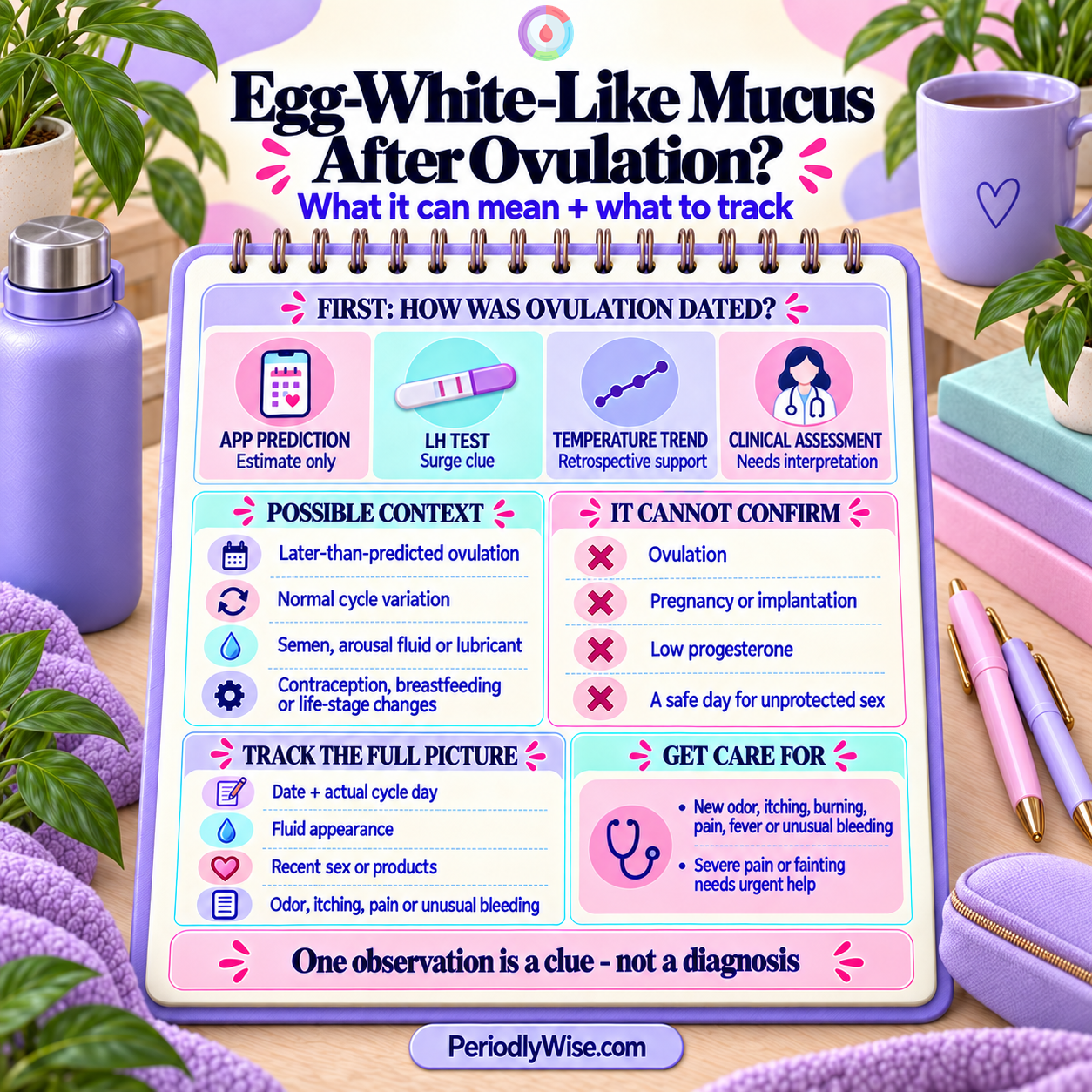
Was ovulation predicted, suggested or clinically assessed?
The most important word in this question is often after. An app may label today as several days after ovulation because it calculated a date from previous cycles. That is a prediction, not a record of an egg being released. If this cycle differs from the previous ones, the label can be wrong even if you entered every period correctly.
An LH ovulation test detects a hormonal signal that usually comes before ovulation. It does not directly observe egg release. A sustained basal-temperature pattern can support a retrospective interpretation, but illness, sleep and measurement conditions complicate it. ASRM guidance distinguishes these tools from appropriately timed clinical testing.
You do not need a medical test to interpret every ordinary discharge change. The point is to avoid giving all evidence the same certainty. If a clinic has assessed ovulation, ask how the later discharge fits that assessment rather than moving the date yourself. If only an app supplied the date, keep the uncertainty visible in your notes.
| Basis for the date | What it can contribute | Important limit |
|---|---|---|
| Basis for the dateCalendar or app estimate | What it can contributeA planning date based on recorded cycles. | Important limitCannot confirm ovulation in the current cycle. |
| Basis for the datePositive urinary LH test | What it can contributeEvidence of a hormone surge that may precede ovulation. | Important limitA surge is not proof of egg release; kit results can mislead. |
| Basis for the dateTemperature pattern | What it can contributeA sustained change may support a retrospective pattern. | Important limitOne higher reading is not confirmation; sleep and illness matter. |
| Basis for the dateMucus observation | What it can contributeA clue about secretions associated with changing hormones. | Important limitAppearance cannot establish an exact ovulation day. |
| Basis for the dateClinical assessment | What it can contributeHistory, appropriately timed progesterone or ultrasound when indicated. | Important limitResults need timing and clinical interpretation, not a home mucus diagnosis. |
Why slippery discharge can appear later than expected
More than one explanation can fit the same clear, stretchy appearance. Ovulation may not yet have occurred, the observation may be ordinary variation, or fluid from recent sexual activity may be involved. A new pattern with symptoms also deserves assessment. None of these possibilities can be selected confidently from one photograph or a single day's texture.
Look at the sequence rather than only today's sample. Was the earlier date a prediction? Were the slippery days followed by a consistent temperature change, or was there only one high reading? Was there recent sex, lubricant use or a contraception change? These questions organize the uncertainty; they are not a checklist that proves a diagnosis at home.
A second patch of slippery discharge is an observation, not proof of a second ovulation. Likewise, the absence of this texture does not establish infertility. Some people never see a textbook sample. Your record should describe what happened without assuming that every appearance reflects the same hormonal event.
| Possible context | Why it matters | Useful next step |
|---|---|---|
| Possible contextLater-than-predicted ovulation | Why it mattersThe calendar may have placed ovulation too early. | Useful next stepKeep predictions separate from actual signs and dates. |
| Possible contextNormal variation after ovulation | Why it mattersDischarge does not follow one identical pattern in every cycle. | Useful next stepCompare with your own baseline and accompanying symptoms. |
| Possible contextSemen or arousal-related fluid | Why it mattersRecent sex can change the fluid you notice. | Useful next stepNote the timing; appearance alone cannot reliably separate fluids. |
| Possible contextLubricant or vaginal products | Why it mattersProducts can affect the sample and may irritate sensitive tissue. | Useful next stepRecord product use and seek advice if irritation develops. |
| Possible contextHormonal or life-stage context | Why it mattersContraception, breastfeeding and cycle transitions can change patterns. | Useful next stepInterpret the observation within your own history. |
| Possible contextA change with concerning symptoms | Why it mattersPain, itching, odor or unusual bleeding requires a different approach. | Useful next stepGet appropriate assessment rather than assuming fertile mucus. |
What estrogen and progesterone can explain, and what they cannot
Around ovulation, rising estrogen is associated with clearer, more slippery cervical secretions. After ovulation, progesterone generally favors thicker mucus and less of that classic appearance. These are broad physiological tendencies, not a rule that every person becomes completely dry immediately after a particular day.
Endotext describes another estrogen rise during the luteal phase. This makes the idea that estrogen is absent after ovulation incorrect. However, a normal hormonal pattern does not let you infer your own hormone concentrations from discharge. A later slippery observation is not proof that this rise caused it, and there is no universal day on which it must appear.
Mucus cannot diagnose low progesterone or a luteal-phase disorder. Even a clinical progesterone result must be timed and interpreted appropriately; one result does not measure the quality of the entire luteal phase. Do not start progesterone, change fertility treatment or buy a hormone-balancing supplement to correct an isolated texture observation. Ask your clinician about persistent patterns or treatment-specific concerns.
After sex, the fluid may not be only cervical mucus
Semen, arousal-related secretions and lubricants can affect what is visible after sex. Fluids may mix, and a clear or slippery appearance is not enough to identify each component. The fact that fluid comes out afterward does not tell you whether sperm entered the reproductive tract or whether pregnancy can occur.
Record recent sexual activity or product use if it helps explain an uncertain observation. You do not have to identify the fluid perfectly. Claims that a household water test, stretch test or photograph can definitively separate semen from fertile mucus are not a substitute for clinical assessment or the rules of a taught fertility-awareness method.
Do not clean inside the vagina to obtain a clearer sample. Avoid douching and perfumed intimate products; gentle external care is enough. If checking repeatedly causes soreness or anxiety, reduce the checking and focus on dates and symptoms. Persistent discomfort or a new smell deserves medical advice rather than more home experiments.
- Note recent sex, lubricant use or a new vaginal product without assuming the exact fluid source.
- Keep an uncertain observation marked as uncertain instead of forcing it into a fertility category.
- Do not treat fluid leakage after sex as proof that pregnancy is impossible.
Does egg-white-like mucus after ovulation mean pregnancy?
No discharge pattern can confirm pregnancy. Discharge can increase during pregnancy, but changes also happen when someone is not pregnant. Clear, white, creamy or stretchy fluid cannot establish implantation or distinguish an early pregnancy from ordinary cycle variation. It also cannot determine whether a pregnancy, if present, is developing normally.
Use a pregnancy test according to its instructions rather than choosing the date from mucus. Most tests can be used from the first day of a missed period. If the next period date is unknown, NHS guidance recommends testing at least 21 days after the last unprotected sex. A calendar's uncertain ovulation label can make a claimed number of days past ovulation uncertain too.
If the result is negative but pregnancy remains possible, repeat after a few days as advised by the test instructions and seek advice if a second negative result is followed by continued absence of your period. Do not wait for a positive result before seeking help for severe pain, faintness or other urgent symptoms. Discharge is not a pregnancy verdict in either direction.
What to do if you are trying to conceive
If ovulation was only predicted, a later slippery patch is a reason to reconsider the estimate, not to assume the opportunity has definitely passed. Mucus observations can help with awareness, but no single sign guarantees ovulation, egg quality, open fallopian tubes or a pregnancy. You should not feel that failing to see egg-white mucus means you have failed to identify every useful day.
ASRM guidance discusses regular intercourse around the fertile window rather than reliance on one calendar date. If you are receiving fertility treatment, follow your clinic's instructions for tests, medication and timing. Do not alter an insemination, trigger injection or embryo-transfer plan because the discharge looks different.
Later mucus does not extend the lifespan of an egg already released. The fertile interval relates to sperm survival and ovulation timing, not to how long an attractive-looking sample remains visible. Keep the distinction between possible later ovulation and discharge after supported ovulation. If monitoring creates distress or makes sex feel compulsory, discuss a less burdensome approach with your clinician.
What to do if you are avoiding pregnancy
Do not interpret an app's 'after ovulation' label as permission to have unprotected sex. If the estimate is wrong, the actual fertile window may be different. Nor does one dry day, a negative LH test or the later return of slippery mucus independently tell you that the current day is safe from pregnancy.
Formal fertility-awareness methods involve training, method-specific rules and consistent observations. A general mucus article is not that training. NHS guidance advises learning from a trained practitioner; a calendar tracker and an improvised mucus rule are not interchangeable with a taught contraceptive method. Condoms also have a role in reducing sexually transmitted infection risk.
If pregnancy is not desired and unprotected sex or a contraception failure happened recently, get prompt advice from a pharmacist, sexual-health service or clinician about emergency contraception. Options have time limits, commonly within 3 to 5 days depending on the method, and earlier advice matters. Do not delay because discharge or an app seems to show that ovulation has already happened; a professional can assess appropriate options.
Which discharge changes need medical attention?
Clear, stretchy discharge by itself is not an emergency. The concern changes when a new pattern is accompanied by a strong or unpleasant odor, itching, burning, pain when urinating or having sex, unusual bleeding or pelvic pain. Color and texture can suggest possibilities, but they do not identify a specific infection reliably enough for self-treatment.
A clinician or sexual-health service may consider an examination or testing, including sexually transmitted infection testing when relevant. Some infections cause few symptoms, so a reassuring-looking sample does not replace testing after a relevant exposure. Avoid automatically treating every discharge change with an antifungal or antibiotic without appropriate advice.
Severe pain, fainting or signs of serious illness require urgent action, not cycle tracking. If pregnancy is possible, new one-sided lower abdominal pain or unusual bleeding deserves prompt assessment, even without a positive home test. Shoulder-tip pain, sudden severe abdominal pain, collapse or marked dizziness can be emergency warning signs. Use your local urgent or emergency services.
| Pattern or symptoms | Suggested level of action | What not to assume |
|---|---|---|
| Pattern or symptomsClear or white fluid, no new odor or discomfort | Suggested level of actionRecord and compare with your usual pattern; ask if concerned. | What not to assumeIt does not establish ovulation or pregnancy. |
| Pattern or symptomsNew odor, itching, burning or unusual bleeding | Suggested level of actionArrange appropriate medical or sexual-health assessment. | What not to assumeAppearance alone cannot identify the infection or treatment. |
| Pattern or symptomsPelvic pain, fever, or pain/bleeding with possible pregnancy | Suggested level of actionSeek prompt medical advice; urgency depends on severity. | What not to assumeDo not dismiss it as ovulation mucus or wait for another cycle. |
| Pattern or symptomsSudden severe pain, fainting/collapse or significant illness | Suggested level of actionGet emergency help, particularly with possible pregnancy or shoulder-tip pain. | What not to assumeDo not wait for a tracker update or positive pregnancy test. |
A useful tracking routine without overchecking
A record is most useful when it separates observations, estimates and test results. For example, 'app predicted day 14; slippery fluid on day 18; no sustained temperature pattern recorded' is more accurate than 'four days after ovulation.' This is an illustrative note, not a fertility schedule or a recommendation for when to have sex.
A different note might say that a clinic assessed ovulation and later clear discharge appeared without pain or odor. That observation does not automatically overturn the assessment; the clinic can interpret it if needed. These two records may look similar on a texture chart while containing very different information about timing.
Use the smallest record that answers your question. A date, description and symptom note may be enough. Intimate photographs, partner details and cloud uploads are not required for general tracking. Keep sensitive information private, and do not let daily checking delay a pregnancy test, a contraception decision or an appointment for symptoms.
- Record the date and cycle day: use actual period starts, with spotting labeled separately.
- Identify the date's basis: app prediction, LH result, temperature pattern or clinic assessment.
- Describe the fluid: color, wetness, slipperiness and whether it differs from your usual pattern.
- Add relevant context: recent sex, products, contraception, medicines, breastfeeding, illness or disrupted sleep.
- Separate symptoms and tests: note odor, irritation, pain, bleeding and pregnancy-test dates/results.
- Choose the next action: observe a comfortable familiar pattern, test at the right time or seek care when symptoms warrant it.
When to discuss repeated patterns or fertility concerns
Ask for advice if this is a persistent new change, if cycles are repeatedly irregular or absent, or if pain, bleeding or other symptoms interfere with daily life. Bring a short record of actual dates and how ovulation was estimated. The consultation should address your history rather than focus only on whether one sample stretched.
When trying to conceive, fertility evaluation is generally considered after 12 months without pregnancy for people under 35, or after 6 months from age 35. People over 40 or with known risk factors may need earlier advice. Irregular or absent cycles and other relevant concerns are reasons not to wait for those time thresholds. Local pathways and individual history matter.
Not everyone with unusual-looking mucus needs a hormone panel, ultrasound or fertility diagnosis. If testing is appropriate, clinicians choose its timing and purpose. A progesterone test is not automatically useful on the same numbered cycle day for every person. The goal is an appropriate explanation and plan, not collecting more tests to validate an app's label.
Frequently asked questions
Is egg white cervical mucus after ovulation normal?
It can be part of normal variation, especially when 'after ovulation' is only an estimate. Appearance alone cannot establish the cause. Compare it with your usual pattern, how the date was determined, and whether odor, irritation, pain or bleeding is present.
Can I have egg-white-like mucus at 3, 5 or 7 days past ovulation?
A later observation can happen, but the number of days is only as reliable as the ovulation estimate. There is no texture that proves a specific day past ovulation. Record the date's basis instead of diagnosing hormone levels or pregnancy from that label.
Does it mean I am ovulating again?
No. A second slippery patch does not demonstrate another egg release. The earlier ovulation estimate may have been wrong, or discharge may have another explanation. Clinical context and the overall pattern matter more than one sample.
Does this discharge mean implantation or pregnancy?
No discharge appearance can confirm implantation or pregnancy. Test from the appropriate missed-period date, or at least 21 days after the last unprotected sex when the due date is unknown. Seek care for urgent symptoms without waiting for a positive result.
Does it mean low progesterone?
Mucus appearance cannot diagnose progesterone deficiency or assess luteal-phase quality. Even blood results need appropriate timing and interpretation. Do not self-start hormones or supplements because of this observation; discuss persistent changes with your clinician.
Can semen or lubricant look similar?
Recent sex and products can change or mix with the fluid you see. Appearance or a household test cannot reliably determine the source. Note the context, avoid internal cleaning, and do not assume fluid leaving afterward means pregnancy is impossible.
Is unprotected sex safe if my app says ovulation is over?
An app prediction and one discharge observation are not contraception. Use a suitable method correctly, or follow the specific rules of a professionally taught fertility-awareness method. Seek timely emergency-contraception advice after recent unprotected sex or method failure if pregnancy is not desired.
When should I see a clinician?
Seek advice for persistent new changes, odor, itching, burning, pain or unusual bleeding, and for repeated irregular cycles or fertility concerns. Severe pain, fainting, collapse or possible pregnancy with concerning pain/bleeding needs prompt or emergency care according to severity.
Use PeriodlyWise to organize your period dates and educational cycle estimates alongside your own observations. A tracker does not confirm ovulation, diagnose discharge, establish pregnancy or provide contraception. Keep testing and care decisions separate from its predicted dates.
Open the period trackerThe takeaway
Egg-white-like discharge after expected ovulation is a clue to record, not a diagnosis. Check how the date was established, consider normal variation and other fluids, and use pregnancy tests or medical assessment when appropriate. Neither mucus appearance nor a calendar label proves that the fertile window has closed. Symptoms and your individual history determine when to seek care.