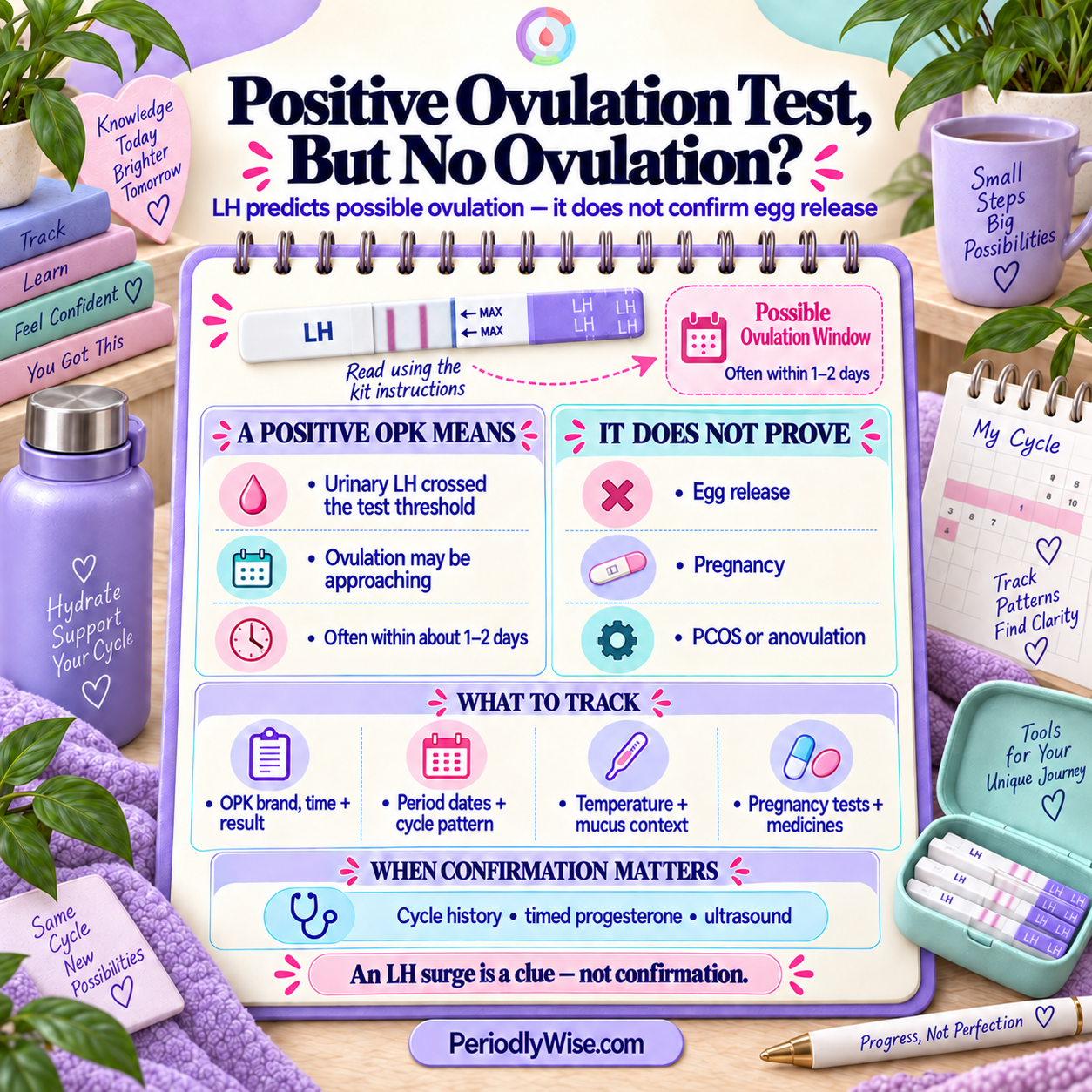
A positive ovulation test shows an LH rise; it does not directly show the ovary releasing an egg. Urine ovulation predictor kits detect luteinizing hormone, or LH. The midcycle LH surge helps trigger ovulation, so a positive result often suggests that ovulation may follow within roughly 24 to 48 hours. ASRM describes urinary LH detection as indirect evidence, not confirmation.
Sometimes ovulation occurs normally but the person checks for proof too early or relies on a second sign that is easy to miss. In other cycles, the body may make one or more LH attempts before ovulation is delayed, or an LH rise may not lead to egg release. PCOS, postpartum or perimenopausal hormone patterns, thyroid or prolactin problems, low energy availability, major stress, illness, and some medicines can affect the picture.
The first question is therefore not simply whether the kit was positive. It is whether the result was read correctly, what happened over the following days, whether the cycle is usually regular, whether pregnancy or fertility medication changes interpretation, and how important confirmation is for your goal.
What your result pattern may mean
| Pattern | Possible interpretation | Reasonable next step | What it cannot prove |
|---|---|---|---|
| One positive today | An LH surge may precede ovulation by about one to two days. | If trying to conceive, treat today and the next day or two as potentially fertile; keep tracking. | It does not yet show whether the follicle ruptured. |
| Positive, then no temperature rise the next morning | The temperature shift usually follows ovulation and may take several readings to become clear. | Keep measuring under consistent conditions for several days. | One flat reading does not prove no ovulation. |
| Positive, then another surge days later | The first LH rise may not have led to ovulation, or test variation may create an apparent second surge. | Record both, keep testing as instructed, and compare with the next period or clinical testing. | Two surges do not identify the cause. |
| Positive for many days | Baseline LH may be high, as can happen in some people with PCOS, or the kit threshold may not suit the pattern. | Check the exact reading rules and discuss repeated prolonged positives with a clinician. | A long positive does not diagnose PCOS. |
| Positive but no slippery cervical mucus | Mucus may be missed, affected by medicines or vaginal products, or simply less noticeable. | Use the LH result as one clue and avoid internal checking that irritates tissue. | Absent visible mucus does not prove absent ovulation. |
| Positive and period is now late | Ovulation may have occurred later than assumed, or pregnancy may be possible. | Use a pregnancy test at the appropriate time and repeat or seek care if uncertainty remains. | An OPK is not a reliable pregnancy test. |
| Positive while using ovulation-induction or trigger medicine | Treatment can alter hormone results and timing. | Follow the clinic's monitoring and testing instructions rather than a generic app rule. | A home strip cannot replace treatment-cycle monitoring. |
What an ovulation test actually measures
LH is made by the pituitary gland. A rise in LH helps the final maturation of the ovarian follicle and triggers processes involved in egg release. A urine kit is designed to recognize LH above a product-specific threshold. It does not image the ovary, see follicle rupture, measure progesterone, or test whether the fallopian tubes are open.
ASRM states that urine LH kits usually identify the surge that precedes ovulation within one to two days, but accuracy, ease of use, and reliability vary, and both false-positive and false-negative results occur. The timing of ovulation can also fall before, during, or after the observed urine peak because blood hormone changes and urine detection are not identical clocks.
A positive result can therefore be biologically real while the conclusion drawn from it is too certain. The body produced enough LH for the kit to register; whether and when an egg was released is a separate question.
- A line-based test is positive only according to its own instructions, often when the test line is as dark as or darker than the control; a faint second line may be normal baseline LH.
- Digital symbols must be interpreted using that brand's definitions, including whether it measures LH alone or additional hormones.
- A dried strip read outside the stated time window should not be reinterpreted as a new result.
- Urine concentration, missed testing days, and testing at a different time can change the visible pattern.
- A calendar app estimates dates; it cannot see the urine result, follicle, or egg release unless the user records data, and even then it cannot confirm ovulation.
How to check the result before assuming anovulation
Use the exact kit leaflet because brands differ. This sequence helps separate a genuine confusing cycle from a reading or timing problem.
- Confirm what counts as positive. Compare test and control lines only within the reading window, or follow the digital reader. Do not count every visible LH line as a surge.
- Check the cycle day and prior results. One isolated test cannot show the start, peak, or end of the surge. Record negatives before and after when practical.
- Review urine instructions. Follow the brand's time-of-day, fluid-intake, and urine-hold guidance. ASRM notes that midday or evening urine often correlates well with serum LH, but the package controls the specific test.
- Allow time after the positive. Ovulation may follow over the next one to two days; a same-day lack of temperature rise is expected rather than diagnostic.
- Compare several later clues. Look for a sustained temperature shift, the actual next period, or clinician-arranged progesterone or ultrasound when confirmation is important.
- Use a pregnancy test for pregnancy. If the period is late or pregnancy is possible, do not interpret an OPK as proof for or against pregnancy.
- Account for treatment. Ask the fertility clinic how trigger injections, ovulation medicines, hormone support, or cycle monitoring change home-test use.
Why LH can rise without confirmed ovulation
The possibilities range from normal timing uncertainty to a repeated pattern that needs evaluation. A home result cannot distinguish them by itself.
| Context | How the pattern may arise | Other clues | Useful follow-up |
|---|---|---|---|
| Ovulation is still upcoming | The positive appeared before egg release, as intended. | No confirmed temperature shift yet; cycle otherwise typical. | Continue goal-appropriate timing and observe the next several days. |
| Delayed or repeated LH attempts | The body may show more than one LH rise before a later ovulation or an anovulatory cycle. | Longer cycle, illness, stress, travel, sleep disruption, or recent hormone change. | Track the whole cycle and seek review if the pattern repeats. |
| PCOS | Some people have higher baseline or repeated LH patterns, and ovulation may be infrequent. | Irregular or absent periods, acne, excess facial or body hair, scalp hair thinning, or insulin-resistance signs. | Clinical evaluation; a positive kit alone does not diagnose PCOS. |
| Functional hypothalamic disruption | Low energy availability, substantial weight change, intense exercise, stress, or illness can suppress or destabilize ovulation. | Long cycles, missed periods, fatigue, restricted intake, high training load, or recent illness. | Medical and nutritional assessment rather than trying to force a surge with supplements. |
| Thyroid or prolactin disorder | Endocrine signals can interfere with ovulation and cycle regularity. | Heat or cold intolerance, major energy change, palpitations, breast discharge, headache, or visual symptoms may coexist. | Pregnancy test plus clinician-directed TSH, prolactin, and other testing. |
| Postpartum, breastfeeding, or perimenopause | Hormone variability can create irregular cycles and less predictable LH patterns. | Recent birth and feeding changes, or age-related cycle variability and hot flashes. | Use life-stage context and seek advice for persistent or concerning changes. |
| Primary ovarian insufficiency or other ovarian dysfunction | Irregular follicle activity can produce unpredictable hormone signals. | Under age 40 with months of irregular or absent periods, hot flashes, vaginal dryness, or family or treatment history. | Prompt clinical assessment; the OPK cannot measure ovarian reserve or diagnose POI. |
| Medication or testing effect | Fertility drugs and product-specific limitations may alter results; concentrated urine can intensify lines. | Recent trigger or stimulation cycle, new medicine, or inconsistent testing method. | Follow prescriber and manufacturer instructions and report the full timeline. |
Ways ovulation may be assessed or confirmed
Confirmation is not necessary for every person or every cycle. ASRM notes that regular cycles between about 21 and 35 days usually provide strong clinical evidence of ovulation in people without signs such as hirsutism. Testing becomes more useful when cycles are irregular, results repeatedly conflict, fertility treatment is underway, or conception has not occurred within the recommended evaluation window.
No method answers every question. A serum progesterone result can support recent ovulation but cannot grade egg quality or guarantee pregnancy. Ultrasound may show follicle development or evidence consistent with ovulation, but a single scan can miss the event. BBT is inexpensive and retrospective but often noisy.
| Method | What it can show | Timing | Important limit |
|---|---|---|---|
| Menstrual history | Regular predictable cycles often suggest ovulation. | Across several cycles. | Bleeding can still occur without ovulation, and regularity is not proof of fertility. |
| Basal body temperature | A sustained biphasic rise may support that ovulation already occurred. | Daily on waking under similar conditions. | Illness, sleep changes, alcohol, shift work, and measurement variation can obscure the pattern; ASRM calls it often unreliable. |
| Serum progesterone | A correctly timed level above 3 ng/mL is presumptive evidence of recent ovulation under ASRM guidance. | About one week before the expected next period, not automatically cycle day 21. | Levels fluctuate markedly; one value confirms recent ovulation better than it assesses luteal quality. |
| Transvaginal ultrasound | Follicle growth and later changes may provide evidence of ovulation or luteinization. | Timed scans arranged clinically. | More resource-intensive, timing-sensitive, and not a complete fertility evaluation. |
| Urine or serum hormone monitoring in treatment | Can help a clinic coordinate medication, insemination, or retrieval timing. | According to the treatment protocol. | Home thresholds and clinic assays are not interchangeable. |
What to do depends on your goal
If you are trying to conceive: a positive LH result is useful prospectively even though it is not confirmation. Sex or insemination timing should follow your personal or clinic plan; do not wait for a temperature rise, because that occurs after the most fertile days. If timing sex without clinic monitoring, intercourse every one to two days through the likely fertile interval can reduce pressure around one exact test.
If you are avoiding pregnancy: treat a positive result as potentially fertile, but do not use positive or negative OPKs as a stand-alone contraceptive method. Ovulation may shift, sperm can survive for several days, and the kit does not define the full fertile window. Use a reliable contraceptive method or work with a qualified fertility-awareness instructor.
If you are monitoring a condition: do not self-diagnose PCOS, low progesterone, luteal phase deficiency, or ovarian reserve from strips. Bring the complete pattern to the clinician, including periods, symptoms, medicines, and pregnancy possibility.
- Do not take or increase progesterone, letrozole, clomiphene, supplements, or other fertility products based only on a home strip.
- Do not use an OPK to decide that unprotected sex is safe before or after one result.
- Use an actual pregnancy test when a period is late or pregnancy symptoms occur.
- During fertility treatment, follow the clinic's exact timing even if the app or home strip disagrees.
- Remember that ovulation is only one part of fertility; sperm, fallopian tubes, uterus, age, timing, and other factors also matter.
What to record for a clearer answer
A short, factual timeline is more useful than labeling a cycle anovulatory from one sign. Record enough detail to compare patterns without letting testing consume the day.
- first day of full menstrual flow, spotting, cycle length, and whether cycles are usually predictable
- OPK brand, cycle day, test time, result, digital symbol or line comparison, and any missed testing days
- cervical mucus observations without repeated internal checking or unvalidated scoring
- basal temperature time, sleep duration, illness, alcohol, shift work, and any sustained rise
- sex or insemination timing if pregnancy is the goal, without treating the tracker as a guarantee
- pregnancy-test dates and results, breastfeeding or postpartum status, and contraception
- medicines and supplements, especially fertility medicines, hormone injections, progesterone, and recent birth-control changes
- stress, illness, travel, eating pattern, weight change, exercise load, sleep, acne, hair changes, hot flashes, breast discharge, headache, or vision changes
- clinical tests such as progesterone, TSH, prolactin, FSH, estradiol, or ultrasound, including the cycle timing and reference range
When to arrange medical or fertility evaluation
Arrange a routine appointment when positive tests repeatedly fail to align with a period or other cycle pattern, cycles are persistently shorter than 21 or longer than 35 days, periods are repeatedly absent, or symptoms suggest PCOS, thyroid disease, high prolactin, low energy availability, perimenopause, or ovarian insufficiency. Missing periods for more than three months after previously regular cycles generally deserves investigation once pregnancy is excluded.
For people trying to conceive without a known risk factor, ASRM and ACOG recommend evaluation after 12 months when under 35 and after 6 months at 35 or older; over 40, discuss evaluation promptly. Do not wait for those thresholds when cycles are irregular or absent, there is known endometriosis or tubal disease, fertility treatment is involved, or another condition may impair fertility.
A fertility evaluation should consider both partners when applicable. Confirming ovulation does not assess sperm or whether the fallopian tubes are open, and a positive OPK does not explain unsuccessful conception by itself.
Three realistic examples
Example 1: A person gets a positive OPK on cycle day 15 but sees no temperature rise the next morning. They continue testing and measuring; a sustained rise begins two days later. The original result was useful prediction, and the immediate flat temperature was not evidence of failure.
Example 2: A person with 45- to 70-day cycles sees positive-looking strips on many days plus acne and increased facial hair. Because higher baseline LH can confuse kits and PCOS is possible, they bring the full record for clinical evaluation rather than buying more sensitive strips.
Example 3: A person using a trigger injection has a positive home test that conflicts with an app. They follow the fertility clinic's timing, because medication and monitored follicle data are more relevant than a generic algorithm.
Frequently asked questions
Can an ovulation test be positive without ovulation?
Yes. It detects LH, not the egg leaving the follicle. Ovulation may still be approaching, may happen after a repeated surge, may have occurred without clear home signs, or may not occur in that cycle.
How long after a positive OPK should I ovulate?
Many kits are designed to identify an LH surge roughly one to two days before possible ovulation, but individual timing varies and ovulation can occur before, during, or after the urine peak. The kit cannot promise a precise hour.
Why did I get two LH surges in one cycle?
A first rise may not have led to ovulation, a later attempt may occur, or testing variation can resemble two surges. This can happen in longer or irregular cycles. Repeated patterns deserve clinical review.
Does PCOS make ovulation tests always positive?
Not always. Some people with PCOS have higher baseline or repeated LH rises that make results difficult to interpret, while others can use kits normally. The strip does not diagnose PCOS.
Can I confirm ovulation with basal body temperature?
A sustained rise can support that ovulation already occurred, but BBT can be obscured by sleep, illness, alcohol, shift work, and measurement variation. It is retrospective and should not be the sole basis for contraception or diagnosis.
When should progesterone be checked?
ASRM recommends approximately one week before the expected next period rather than automatically on day 21. A value above 3 ng/mL is presumptive evidence of recent ovulation, but one result does not grade luteal quality.
Can an ovulation test detect pregnancy?
It is not designed to diagnose pregnancy and should not be used to confirm or exclude it. If your period is late or pregnancy is possible, use a pregnancy test according to its instructions.
Record period dates, LH results, temperature context, cervical mucus, pregnancy tests, medicines, and symptoms so one strip is interpreted as part of a cycle rather than a diagnosis.
Open the Ovulation TrackerThe bottom line
A positive ovulation test means LH was detected above the kit's threshold. It is useful for predicting a potentially fertile window, but it cannot prove egg release. Give the cycle time to unfold, read the kit exactly, and compare the result with the wider menstrual and medical context.
When results repeatedly conflict, periods are irregular or absent, or conception is taking longer than expected, clinical evaluation can confirm recent ovulation and investigate why it may be inconsistent. Use pregnancy tests for pregnancy, reliable contraception to avoid pregnancy, and clinic instructions during fertility treatment.