The question 'Can you ovulate without a period?' has two different meanings. One person may mean, 'Can I release an egg even though I have not bled recently?' Another may mean, 'Can I ovulate and then never bleed?' Those situations need different answers.
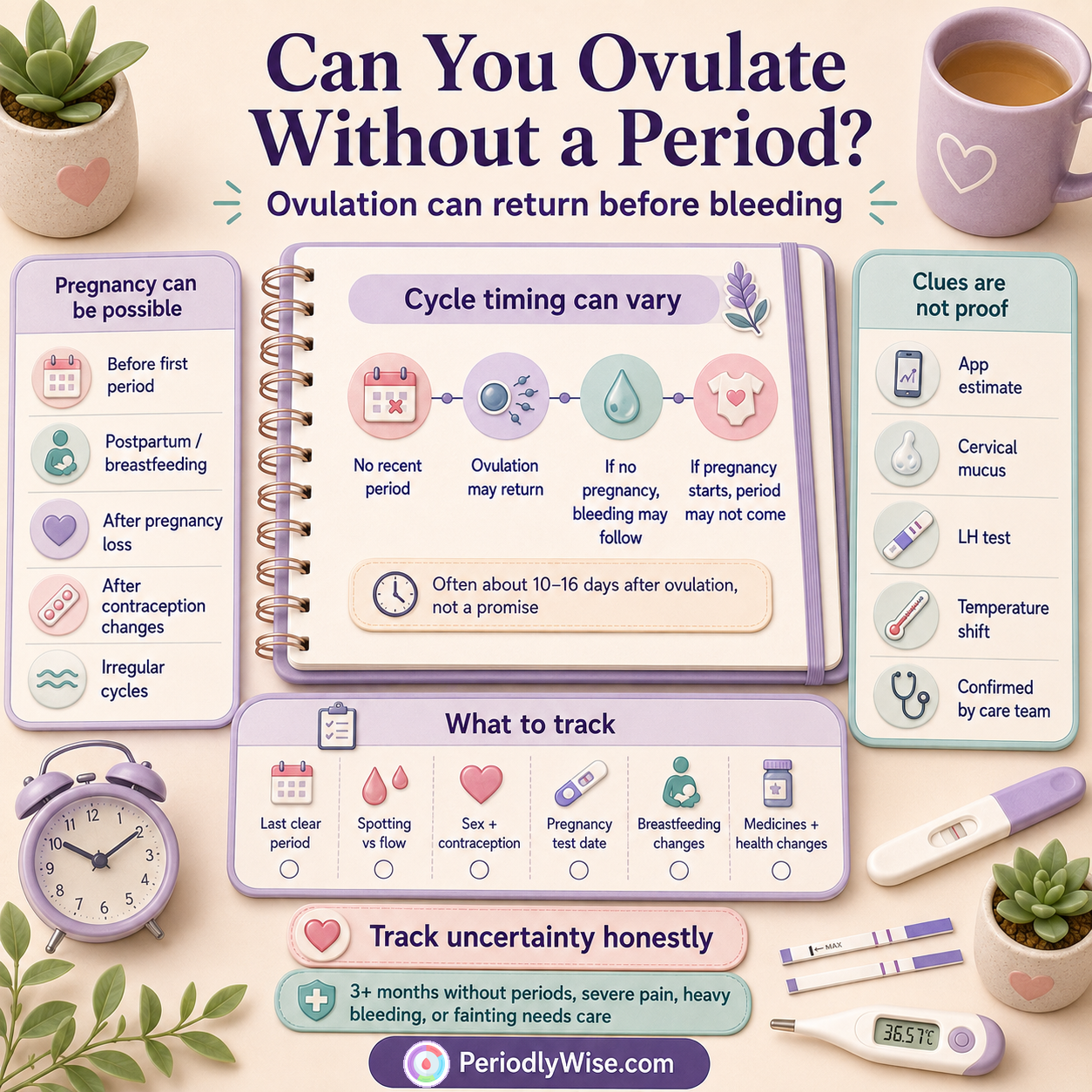
Ovulation normally happens before the period that follows it. ACOG explains that in an average cycle it occurs about 14 days before the next period; the NHS gives a common range of about 10 to 16 days, and population timing can be broader. Therefore, the first ovulation after a gap cannot be predicted from a period that has not happened yet.
This is why pregnancy is possible before the first recognized period, before the first postpartum period, or during an irregular stretch. If an egg is fertilized and pregnancy starts, the next period will not arrive. No bleeding is not proof of no fertility.
How can ovulation happen when there has been no period?
A period is the shedding of the uterine lining. Ovulation is the release of an egg from an ovary. They are connected, but they are not the same event. In a typical ovulatory cycle, estrogen helps the lining grow, ovulation occurs, progesterone rises, and falling estrogen and progesterone later trigger bleeding if pregnancy has not begun.
Because ovulation comes first, a person can have an unexpected first ovulation after weeks or months without bleeding. If that egg is not fertilized and the hormonal and uterine pathways are functioning, a period commonly follows. If fertilization and implantation occur, pregnancy hormones support the lining and there is no true period.
This can happen at several transitions: the first ovulation of puberty may precede the first recognized menstruation; ovulation can return before postpartum bleeding; fertility can return as breastfeeding becomes less frequent; and ovulation can resume quickly after miscarriage or abortion. CDC guidance notes ovulation after pregnancy loss can occur within 2 to 3 weeks and has been observed as early as 8 to 13 days after the pregnancy ends.
Long-term amenorrhea is different. The American Society for Reproductive Medicine says a history of very infrequent periods or amenorrhea is generally sufficient clinical evidence of ovulatory dysfunction. PCOS, low energy availability, major weight change, excessive exercise, thyroid disease, high prolactin, primary ovarian insufficiency, chronic illness, medicines, pregnancy, breastfeeding, and menopause transition can all be involved.
Even when ovulation is unlikely, it may return unpredictably. That means amenorrhea should not be used as contraception unless someone meets all criteria for a validated method such as the lactational amenorrhea method and understands its limits. A healthcare professional should evaluate unexplained absence of periods rather than assuming the ovaries are permanently inactive.
What 'ovulating without a period' may mean in different situations
| Situation | Can ovulation occur before bleeding? | What matters now |
|---|---|---|
| Before the first-ever period | Yes. A first ovulation can precede the first recognized menstrual bleed. | Puberty stage, pregnancy possibility after sexual contact, age, and whether periods have started by 15. |
| After childbirth without breastfeeding | Yes. Ovulation may return within weeks and before the first period. | Postpartum contraception, recovery advice, sex dates, and pregnancy testing. |
| While breastfeeding | Yes, especially as feeds become less frequent or longer gaps develop. | LAM criteria, baby's age, night feeds, supplemental feeding, and contraception. |
| After miscarriage or abortion | Yes. Ovulation can return before the next period, sometimes within about 2 weeks. | Follow-up instructions, hCG timing, contraception, and new pregnancy possibility. |
| After stopping hormonal contraception | Yes. Ovulation may resume before a natural period is seen. | Method type, last dose or device removal, backup contraception, and test timing. |
| With PCOS or irregular cycles | Sometimes, but timing may be sporadic and difficult to predict. | Do not assume every LH rise is ovulation; assess prolonged gaps and fertility goals. |
| On hormonal birth control with no bleed | It depends on the method. Some suppress ovulation; others mainly thin the lining or alter mucus. | Use the method correctly and follow method-specific advice rather than using bleeding as a fertility test. |
| After confirmed menopause | Natural ovulation is not expected after menopause is established. | Bleeding after menopause requires medical assessment rather than cycle tracking. |
What usually happens after ovulation
After an egg is released, the emptied follicle forms the corpus luteum and makes progesterone. If pregnancy does not begin, progesterone and estrogen fall and the uterine lining sheds. The interval from ovulation to the next period is usually more stable than the days before ovulation, but it is not exactly 14 days for everyone.
The Office on Women's Health notes that the interval can range from about 7 to 19 days, while the NHS describes about 10 to 16 days as common. Therefore, a positive ovulation clue today does not guarantee bleeding on one exact date. It also does not make calendar prediction reliable when cycles are irregular.
If no bleeding follows a suspected ovulation, the first step is to question whether ovulation was truly confirmed. Clear slippery cervical mucus reflects estrogen and can appear without egg release. A urine LH kit detects a surge that generally precedes ovulation by 1 to 2 days, but ASRM notes false-positive and false-negative results, including persistently elevated LH in some people with PCOS.
A sustained basal body-temperature rise may support that progesterone increased after ovulation, but temperature is affected by illness, sleep, alcohol, travel, and measurement timing. ASRM considers basal temperature cumbersome and sometimes unreliable. It is better for retrospective pattern learning than for proving fertility in real time.
A clinician can use a correctly timed serum progesterone test as presumptive evidence of recent ovulation. ASRM advises timing it about one week before the expected period rather than automatically on cycle day 21. Ultrasound monitoring can provide additional evidence in fertility care, but no home sign makes pregnancy impossible.
If ovulation was real and bleeding still does not appear, possibilities include:
- pregnancy, including a test taken too early to detect it
- the ovulation estimate being wrong or an LH surge not leading to egg release
- hormonal contraception, progesterone treatment, or another medicine altering bleeding
- a very thin or inactive uterine lining after prolonged low estrogen or certain contraceptive methods
- PCOS, thyroid dysfunction, high prolactin, hypothalamic amenorrhea, or primary ovarian insufficiency
- recent childbirth, breastfeeding, pregnancy loss, abortion, illness, surgery, or major stress
- uterine scarring or another outflow problem, especially after procedures inside the uterus
- perimenopause, when ovulation and bleeding can both become intermittent
Clue, prediction, or confirmation?
| Method | What it can tell you | Important limit |
|---|---|---|
| Period calendar or app | Estimates timing from past cycle dates. | Cannot detect a first ovulation after amenorrhea and is less reliable with irregular cycles. |
| Cervical mucus | Slippery, clear mucus can mark rising estrogen and a potentially fertile time. | Estrogen can rise without completed ovulation; infection, semen, and products can confuse observations. |
| Urine LH test | Detects an LH surge that often occurs 1 to 2 days before ovulation. | Indirect evidence only; false results and repeated surges can occur, especially with PCOS. |
| Basal body temperature | A sustained rise may suggest progesterone increased after ovulation. | Confirms only retrospectively and is affected by sleep, illness, alcohol, and measurement conditions. |
| Serum progesterone | A properly timed level can provide presumptive evidence of recent ovulation. | Timing is crucial; one value confirms occurrence better than luteal quality. |
| Ultrasound monitoring | Can follow follicle development and provide evidence of ovulation or luteinization. | Used in clinical care; one scan may not answer every question and does not replace pregnancy testing. |
What to do if you have no period and wonder about ovulation
Start with the question that changes immediate decisions: could pregnancy be possible? Then add cycle context instead of relying on one sign.
- Take a home pregnancy test from the first day a period is missed. If you do not know when it was due, NHS guidance uses at least 21 days after the last unprotected sex as a practical testing point.
- Repeat the test after a few days if it is negative but pregnancy remains possible, or contact a clinician for testing after recent pregnancy when hCG may take time to fall.
- Use condoms or another reliable contraceptive method if pregnancy is not wanted. Do not wait for bleeding to return before protecting against pregnancy.
- If breastfeeding, check all three LAM criteria: no periods, fully or nearly fully breastfeeding without long gaps, and less than 6 months postpartum. If any criterion is not met, use another method.
- Record dates of sex, contraception, pregnancy tests, childbirth or pregnancy loss, feeding changes, medicines, and any ovulation clues. Keep sensitive information private.
- Do not start progesterone, fertility medicines, supplements, or internet remedies just to force a bleed. Treatment depends on pregnancy status and the cause of amenorrhea.
- Arrange evaluation after three months without a period when there is no expected explanation, or sooner with fertility goals, major weight or exercise changes, galactorrhea, headaches, vision change, hot flashes, or androgen symptoms.
- For pregnancy attempts, seek earlier fertility guidance when cycles are very irregular or absent rather than waiting a full year, because the menstrual history already suggests ovulatory dysfunction.
What to track for a useful medical or fertility conversation
A record cannot prove ovulation, but it can show whether the pattern is changing and help a clinician choose sensible tests. Keep dates exact and label observations as observations, not conclusions.
Separate a positive LH result from confirmed ovulation, and separate spotting from a true menstrual flow. When postpartum or after pregnancy loss, follow the care team's definitions because lochia or recovery bleeding may not be a period.
- first day of the last clearly recognized period and usual cycle range
- every day of spotting or bleeding, including amount and colour
- dates of sex and contraception used, missed, late, or changed
- pregnancy-test brand, date, timing after sex, and result
- cervical mucus observations and urine LH results without treating either as proof
- basal temperature only if it can be taken consistently and without anxiety
- childbirth, breastfeeding frequency, night-feed gaps, pumping, formula, and solids
- pregnancy loss or abortion date, follow-up hCG instructions, and when bleeding stopped
- weight, nutrition, exercise, sleep, stress, illness, travel, and medicine changes
- acne, increased facial or body hair, milk-like breast discharge, headache, vision change, hot flashes, or pelvic pain
When absent periods or uncertain ovulation need medical care
ACOG advises evaluation when periods stop for more than 3 months without explanation. ASRM similarly recommends investigating more than 3 months without menses after previously regular cycles, or 6 months when cycles were already irregular. Pregnancy is usually excluded first, followed by history and selected tests such as TSH, prolactin, FSH, estradiol, and ultrasound based on the situation.
Seek advice sooner if periods disappear after rapid weight loss, food restriction, excessive exercise, severe stress, a new medicine, uterine procedure, postpartum hemorrhage, or if there are hot flashes, vaginal dryness, galactorrhea, persistent headache, vision changes, acne or new coarse hair. These clues can change which cause is most likely.
If trying to conceive, irregular or absent periods justify earlier evaluation because waiting for a predicted fertile window may miss sporadic ovulation. If pregnancy is not wanted, choose contraception based on effectiveness and personal health, not whether a period has appeared.
PeriodlyWise can organize period dates, spotting, pregnancy-test timing, contraception, and ovulation clues. It estimates patterns but does not confirm ovulation or provide contraception.
Open the cycle trackerFrequently asked questions
Can you get pregnant without having a period first?
Yes. Ovulation occurs before the period that would follow, so pregnancy can happen before a first-ever period or before periods return postpartum or after another gap. Use contraception if pregnancy is not wanted.
Can you ovulate while breastfeeding with no period?
Yes. Ovulation may return as feeding patterns change. LAM is reliable only when all criteria are met: amenorrhea, fully or nearly fully breastfeeding without long gaps, and less than 6 months postpartum.
Can you ovulate with PCOS and no regular periods?
Ovulation may happen sporadically, but long or absent cycles usually indicate ovulatory dysfunction. LH kits can also be misleading in PCOS. A clinician can help assess pregnancy risk, fertility goals, and endometrial health.
Does a positive ovulation test mean I definitely ovulated?
No. It detects an LH surge, which is indirect evidence. Some surges do not result in egg release, and PCOS can cause repeated or persistently positive results. Temperature, progesterone, or ultrasound add different evidence.
How long after ovulation should a period start?
Commonly about 10 to 16 days if pregnancy does not occur, although individual timing can range more broadly. If no bleed appears, test for pregnancy and reconsider whether ovulation was truly confirmed.
Can I have monthly ovulation but never bleed?
That is not the usual pattern. Repeated absent bleeding generally suggests ovulation is not regular, pregnancy, medication effects, low estrogen, a thin lining, or an anatomic problem. It needs medical assessment rather than assumptions.
The bottom line
You can ovulate before a first or returning period, and that unexpected ovulation can lead to pregnancy. If pregnancy does not occur, a period usually follows within roughly two weeks, but home signs and apps do not prove the egg was released.
Months without periods more often signal infrequent or absent ovulation than silent monthly cycles. Test for pregnancy when relevant, use reliable contraception if needed, document the context, and seek evaluation for persistent amenorrhea or warning symptoms.