Bleeding after sex just before your period is not automatically an early period. The timing may overlap with menstruation, but blood can also come from irritated vaginal tissue or the cervix. A small pink mark, brown discharge or fresh red spotting cannot identify the source on its own.
Many causes are treatable and are not cancer. Still, unexplained bleeding during or after sex deserves a medical or sexual-health appointment rather than repeated reassurance from a calendar prediction. Clinicians call non-menstrual bleeding associated with sex postcoital bleeding; the name describes when it happens, not why.
This guide helps you decide how urgently to seek care, separate pregnancy questions from period predictions, and prepare a useful record. It does not diagnose the bleeding or ask you to wait for another cycle before getting checked.
First decide how urgently you need care
The amount of visible blood is only one part of the decision. Pain, how you feel, pregnancy possibility and whether bleeding is continuing matter too. Do not wait for your period or for a positive pregnancy test when warning symptoms are present.
| What is happening | Next step | Why it matters |
|---|---|---|
| Sudden severe abdominal/pelvic pain, collapse, fainting, marked dizziness, or shoulder-tip pain with possible pregnancy | Seek emergency care now. | These can be warning signs of an ectopic pregnancy or another urgent problem. |
| Heavy ongoing bleeding, especially with weakness, breathlessness, chest pain or feeling faint | Seek urgent or emergency care; do not drive yourself if faint. | Symptoms can matter before a precise pad count is available. |
| Possible pregnancy plus unusual bleeding and abdominal/pelvic pain | Get urgent same-day medical assessment, even without a positive test. | A missed period makes this especially important, but an app date does not rule out pregnancy. |
| Pelvic pain with fever, unusual discharge or feeling unwell | Seek prompt same-day advice; severe or worsening symptoms need emergency assessment. | Infection, including pelvic inflammatory disease, may need treatment. |
| Light bleeding after sex, otherwise feeling well | Book a medical or sexual-health appointment. | A small or one-off episode can still need an examination. |
| Any bleeding after menopause | Arrange prompt medical assessment, even if it stops. | It should not be recorded as a returning ordinary period. |
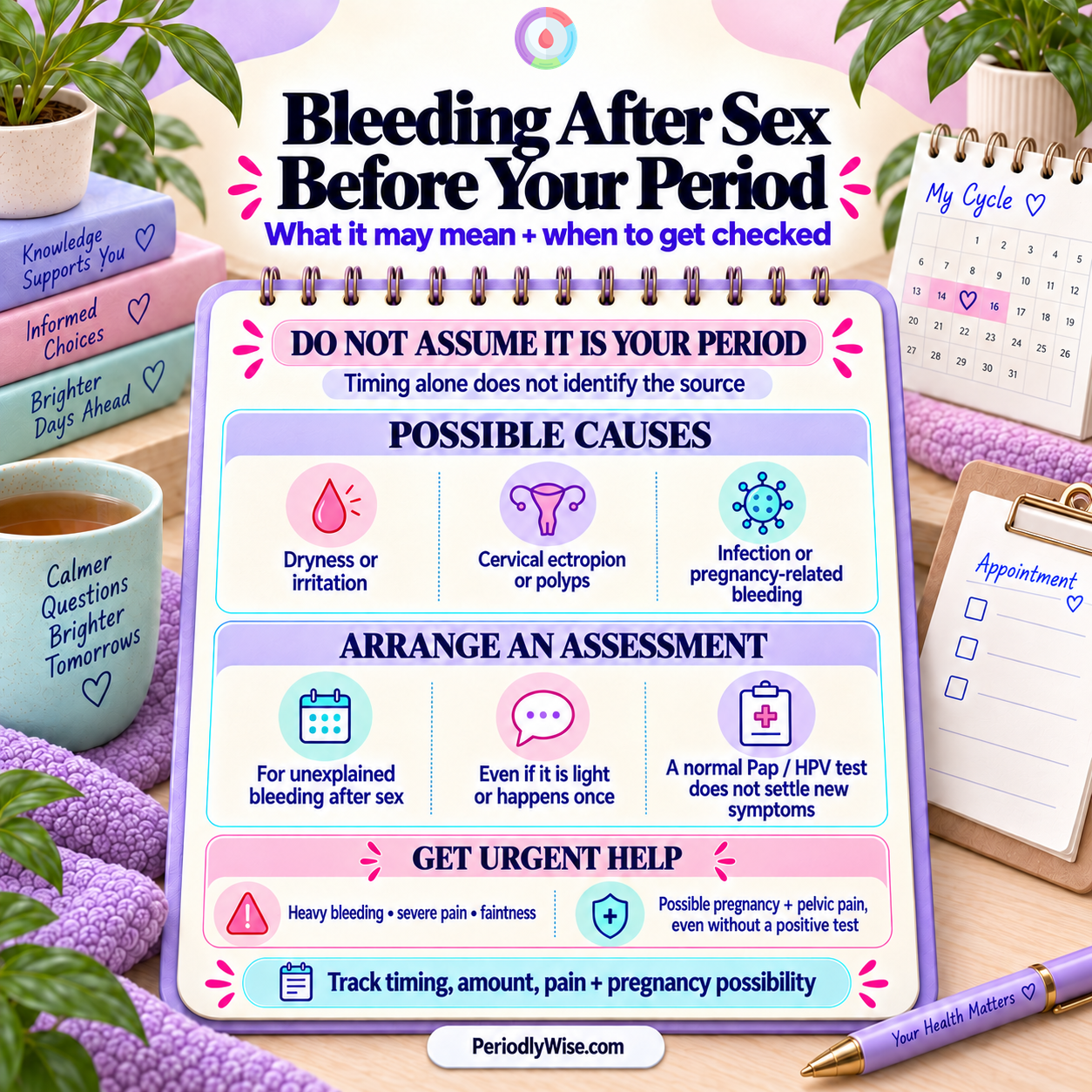
Is it your period, or bleeding triggered by contact?
A period is bleeding from shedding of the uterine lining. Contact bleeding may instead arise at the cervix, vaginal wall or vaginal opening. These can occur near the same date. If your usual menstrual flow starts afterward, that helps describe the sequence but does not prove that the earlier bleeding was menstrual.
Ask whether blood was present before sex, appeared during penetration, or was first noticed afterward. Note whether it stopped after a few marks or developed into your familiar flow. Do not repeat penetration to test whether it happens again; that can aggravate soreness and is not a diagnostic method.
An app's expected date is an estimate, particularly with irregular cycles or hormonal contraception. Withdrawal bleeding and breakthrough bleeding are not identical to a natural period. Log uncertainty honestly instead of moving the cycle start date to make the episode fit a prediction.
- Timing: before, during or after sex; hours or days before the expected period.
- Pattern: one wipe, intermittent spotting, ongoing flow, or a repeat after several encounters.
- Symptoms: dryness, surface soreness, deep pain, cramps, discharge, fever or urinary discomfort.
- Source uncertainty: blood in urine, from the rectum, or from a partner can be mistaken for vaginal bleeding. Tell the clinician if you are unsure.
Possible causes and the clues worth mentioning
These clues guide questions, not a home diagnosis. Several causes can coexist, and absence of pain does not prove the bleeding is harmless. The NHS advises assessment of bleeding after sex, including when the likely explanation seems minor.
| Possible explanation | Context to mention | What not to assume |
|---|---|---|
| Dryness, friction or a small injury | Soreness, insufficient lubrication, a new product or uncomfortable penetration. | An apparent friction trigger does not exclude another cause. |
| Cervical ectropion | Previously diagnosed ectropion, pregnancy or combined-pill use. | This benign change must be identified by examination, not blood color. |
| A cervical polyp | Bleeding after contact or between periods, sometimes without pain. | You cannot confirm or safely remove a polyp yourself. |
| Cervicitis or an STI | New exposure, unusual discharge, pain when urinating or pelvic discomfort; symptoms may be absent. | No odor, pain or known exposure does not rule out infection. |
| Menstrual or contraceptive-related bleeding | Expected flow, a contraception change, missed pills or irregular bleeding at other times. | A period due soon does not explain every episode after sex. |
| Pregnancy-related bleeding | Possible conception, a late period or a positive test. | Spotting does not confirm implantation or show that a pregnancy is safe. |
| Abnormal cervical cells or, less commonly, cancer | Persistent/recurrent bleeding, discharge changes or a changed symptom pattern. | A recent normal screen is not a reason to ignore new symptoms. |
Dryness, friction, ectropion and polyps are different issues
Dryness can make vaginal tissue uncomfortable and easier to irritate. It may occur with breastfeeding, menopause, some medicines, hormonal contraception or insufficient arousal. A suitable water-based lubricant can reduce friction, but improving lubrication is comfort care, not proof that the cause has been treated. Avoid perfumed washes, douching and putting ordinary skin creams inside the vagina.
Cervical ectropion means delicate glandular cells are present on the outer surface of the cervix. Cambridge University Hospitals describes it as a benign, estrogen-related change that can cause discharge or contact bleeding. It is not itself a precancerous condition. A clinician checks for other explanations before deciding whether troublesome symptoms need treatment; many cases do not.
A cervical polyp is a small tissue growth that may bleed when touched. Most are benign, but identification and any removal belong in clinical care, with laboratory examination when indicated. Do not try to feel for a growth, scrape tissue or use an online remedy to cauterize an area. The same symptom can have different causes and treatments.
Infection can be present without obvious symptoms
Inflammation of the cervix, called cervicitis, can cause discharge or bleeding between periods, particularly after sex. The CDC notes that it is often symptom-free. Chlamydia and gonorrhea are possible causes, but not every case is an STI. A swab or urine test and an examination may be needed.
Pelvic pain, deep pain during sex, fever, unusual discharge or feeling unwell can suggest a broader infection such as pelvic inflammatory disease. Seek prompt care instead of using a thrush treatment or leftover antibiotics based only on the appearance of blood. Severe pain or serious illness needs emergency assessment.
If an infection is diagnosed, follow the treatment and partner-testing advice. Ask when it is safe to resume sex and whether follow-up testing is needed. A positive result does not by itself establish when an infection was acquired, and symptoms should not be used to assign blame.
Could this be pregnancy or implantation bleeding?
Bleeding after sex does not establish or exclude pregnancy. Pregnancy can make the cervix more prone to bleeding, but there are also other causes of bleeding in pregnancy that need assessment. Do not identify implantation from pink or brown color, a short duration, or a date that matches an app's fertile window.
Bleeding immediately after a particular encounter cannot demonstrate a pregnancy caused by that encounter. Pregnancy from earlier sex may still be possible. A test performed immediately after recent unprotected sex cannot answer whether that recent exposure led to pregnancy.
If pregnancy is confirmed and you bleed, contact your maternity or early-pregnancy service promptly, even if the bleeding followed sex and seems light. Pain, shoulder-tip pain, faintness or heavy bleeding changes the urgency. The NHS advises urgent assessment for possible ectopic symptoms even without a positive test.
| Situation | Testing or advice | Important limitation |
|---|---|---|
| Your period is due or late | Use a home test from the first day of a missed period, following the instructions. | Bleeding amount does not substitute for a test. |
| You do not know when the period is due | Test at least 21 days after the most recent unprotected sex. | Later exposures need their own timing. |
| An early test is negative | Repeat at the appropriate time; if uncertainty remains, repeat after a few days and seek advice. | An early negative can miss pregnancy. |
| Recent contraceptive failure and pregnancy is not wanted | Seek emergency-contraception advice promptly, usually within 3 to 5 days depending on the method. | Do not wait for a missed period or use spotting as reassurance. |
| Bleeding with significant pain or faintness | Seek urgent care; testing may be part of the assessment. | Do not delay care to wait for a home result. |
What a clinician may check
The appointment usually starts with your history: dates, amount, repeat episodes, pain, discharge, contraception, pregnancy possibility, medicines and previous screening. A clinician may examine the vulva and vagina and use a speculum to see the cervix. You can ask what each step is for, request a chaperone, discuss discomfort and ask for the examination to pause or stop.
Tests depend on the findings. They may include pregnancy testing, infection swabs or urine testing, and a blood count if bleeding has been substantial. Cervical testing, ultrasound or referral may be appropriate, but not everyone needs every investigation after one episode. Bring prior results rather than relying on memory of a 'normal test.'
A colposcopy gives a closer view of the cervix and may include a small biopsy. Referral does not mean cancer has been diagnosed. The important question is whether the planned assessment explains the bleeding and what you should do if it happens again.
Why a normal Pap or HPV result is not the whole answer
Routine cervical screening estimates risk in people without symptoms; investigating bleeding is a diagnostic task. Screening does not examine every possible source of blood or rule out all vaginal, cervical or uterine conditions. Tell the booking service that you have bleeding after sex rather than requesting only a routine smear.
Guidelines differ by country. In the Australian diagnostic pathway, a single episode with a clinically normal cervix and a negative co-test may need no further investigation after assessment; persistent or recurrent episodes warrant specialist review. This is not advice to skip the initial examination or assume a previous screen settles new bleeding.
Seek care even if you are below routine screening age, vaccinated against HPV or up to date with screening. Those details are useful context, not reasons to dismiss a symptom. Report recurrence after treatment or after a reassuring initial assessment.
What to do while waiting for the appointment
- Stop if sex hurts or bleeding starts. Avoid penetration that aggravates symptoms. You do not need to push through discomfort or reproduce the bleeding for a diagnosis.
- Observe without repeated internal checking. An external pad or liner can help you describe the amount. Record start and stop times and whether ordinary menstrual flow follows.
- Check pregnancy timing. Write down relevant sex dates and contraception problems; test when appropriate and seek time-sensitive advice for recent risk.
- Keep care gentle. Avoid douching, fragranced products and unprescribed internal treatments. Lubrication may help dryness later, but does not replace assessment of bleeding.
- Keep prescribed medicines under review. Mention blood thinners, hormones and supplements. Do not stop a prescribed medicine on your own to see whether bleeding changes.
- Escalate when symptoms change. New pain, fever, heavier flow or faintness should change the plan. If an appointment is delayed and bleeding persists, contact the service again.
A short record that makes the consultation easier
Use a factual note, not a guessed diagnosis. For example: Expected period in three days. Small red mark immediately after penetration, stopped within an hour. Surface soreness, no deep pain. Condom used; no known break. No previous episode. This gives a clinician more to work with than 'probably just my period.' It still does not establish the cause.
- Cycle: last actual period start, usual range and whether the expected date is only an estimate.
- Bleeding: timing relative to sex, amount, color, duration, clots and whether it has happened before.
- Symptoms: pain location/severity, fever, odor, discharge, dizziness or urinary symptoms.
- Context: contraception, pregnancy tests, possible STI exposure, breastfeeding, menopause or a recent procedure.
- Follow-up: screening dates, prior diagnoses, medicines, treatment and whether bleeding returned afterward.
If it happens once, repeatedly, or after menopause
A single light episode may have a straightforward explanation, but the sensible next step is still to discuss unexplained bleeding with a clinician. How much investigation follows depends on the examination, history and test results. There is no universal number of episodes you must collect before seeking care.
Repeated bleeding after sex or bleeding that continues between encounters deserves follow-up even when the first examination was reassuring. Tell the service exactly what has changed. Do not simply restart a dryness remedy, assume the same infection has returned or wait through several more cycles without advice.
After menopause, even one small episode, pink discharge or brown staining should be checked. Breastfeeding-related dryness and contraceptive bleeding also need context; neither automatically explains bleeding associated with sex. After a recent cervical procedure, follow the specific aftercare instructions and contact the treating team for unexpected bleeding.
Frequently asked questions
Is bleeding after sex normal when my period is due tomorrow?
The timing can overlap, but it does not identify the bleeding source. If this is unexplained bleeding associated with sex, arrange assessment rather than assuming tomorrow's expected period explains it. Seek urgent help for warning symptoms.
Can sex bring on my period early?
Bleeding noticed after sex is not proof that sex started a menstrual period. Your usual flow may be beginning at the same time, or contact bleeding may have another source. The pattern and an assessment matter more than the coincidence.
What does brown blood after sex mean?
Color alone cannot diagnose the cause. Brown blood may have been present longer before it was noticed, but it does not prove harmless old menstrual blood. Record the amount, timing and symptoms and get unexplained bleeding checked.
Does painless bleeding mean there is nothing wrong?
No. Ectropion, polyps, cervicitis and other conditions may cause bleeding without pain. Lack of pain may affect urgency, but it is not a reason to skip assessment.
Could a little spotting mean implantation?
You cannot reliably identify implantation from spotting after sex, its color or the calendar. Use a pregnancy test at the appropriate time and seek care for pregnancy-related bleeding or concerning symptoms.
How long is it safe to wait for it to stop?
There is no single safe waiting interval for every cause. Book an appointment for unexplained post-sex bleeding even if it stops. Ongoing heavy bleeding, pain, fever, faintness or pregnancy concerns may need faster assessment.
Do I need checking if my last Pap or HPV test was normal?
Yes, new symptoms should be assessed. A normal screening result is useful history but does not replace examining the source of bleeding. Persistent or repeated episodes need follow-up.
Can I have sex again before I am checked?
Avoid penetration that causes pain or bleeding, and do not use sex to test the symptom. Ask the clinician about resuming activity, especially with possible infection, pregnancy or a recent procedure. Follow any treatment and partner advice.
Use PeriodlyWise to record actual period dates and keep a brief symptom note for your appointment. Predictions cannot identify the bleeding source, confirm pregnancy or replace medical assessment.
Open the period trackerThe bottom line
Bleeding after sex before a period can have several causes, many treatable. Being close to your period does not make the cause certain. Arrange assessment, use pregnancy tests at the right time, and get urgent help for heavy bleeding, severe pain or faintness. A useful record supports care; it should never delay it.