Spotting after your period ends can be as simple as a small amount of older blood leaving the uterus, especially when it appears immediately after the last day of flow and stops quickly. But spotting between periods also has many other causes, so the safest answer depends on timing, amount, symptoms, contraception, pregnancy possibility, age, and whether the pattern repeats.
Spotting usually means blood that is too light to require a normal period product, perhaps seen on toilet paper or underwear. It may be brown, pink, or red. Brown often means blood has taken longer to leave the body, but color does not prove that the cause is harmless or that the blood definitely came from the uterus.
ACOG includes bleeding or spotting between periods among abnormal uterine bleeding patterns. That label does not mean an emergency or cancer; it means the bleeding falls outside a usual period and should be interpreted in context. A clear record helps a clinician distinguish an isolated tail end from a repeating intermenstrual pattern.
Is it the end of the period or bleeding between periods?
The calendar boundary is not always sharp. A period may taper from red flow to brown spotting over a day or two. If the marks directly continue the same bleed, remain very light, and stop, they may simply be the last part of that period. Record them separately as spotting so you can still see the full pattern.
A gap matters. If bleeding stops completely and then returns days later, if it happens repeatedly in the middle of the cycle, or if it follows sex, it is more clearly intermenstrual bleeding. The NHS advises having bleeding between periods or after sex checked, even though many causes are treatable and not serious.
First confirm where the blood comes from. Blood in urine, rectal bleeding, a small skin injury, or vaginal irritation can be mistaken for uterine bleeding. Do not insert anything solely to investigate if doing so would be painful or unsafe; a clinician can examine the vagina and cervix when needed.
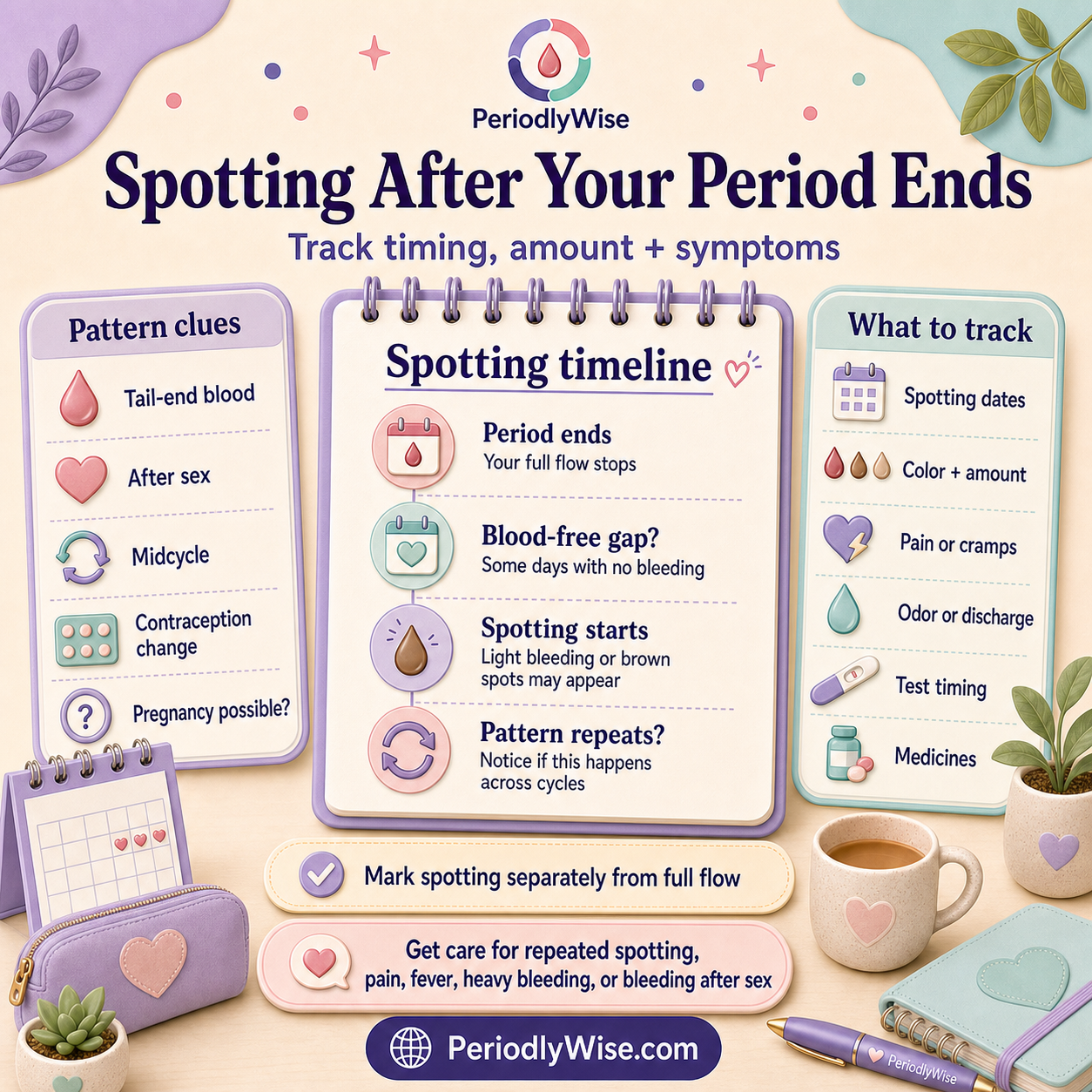
Pattern clues worth recording
| Pattern | Possible context | What to do |
|---|---|---|
| Brown marks for 1 to 2 days immediately after flow | May be the tail end of the same period. | Track it and note whether it resolves. |
| Spotting after several blood-free days | More clearly between periods. | Arrange medical advice if unexplained or repeated. |
| Spotting after sex | Can relate to dryness, cervical changes, polyps, or infection. | Get checked, especially if it recurs. |
| Spotting with a late or missed period | Pregnancy-related bleeding is possible. | Take a pregnancy test at the correct time. |
| Spotting with pelvic pain, fever, or unusual discharge | Infection or another pelvic problem may need treatment. | Seek prompt clinical assessment. |
Common reasons for spotting after a period
Hormonal contraception is a common reason. Starting a pill, implant, injection, hormonal IUD, patch, or ring; missing pills; taking emergency contraception; or changing a method can cause breakthrough bleeding. A copper IUD may also change bleeding, particularly after insertion. Do not stop prescribed contraception without considering pregnancy protection and professional advice.
Ovulation timing and inconsistent ovulation can affect bleeding. Some people notice light midcycle spotting, but bleeding cannot confirm ovulation by itself. PCOS, thyroid disorders, high prolactin, stress, large weight changes, intense exercise, adolescence, breastfeeding, and perimenopause can make ovulation or cycle timing less regular.
The cervix or vagina can bleed after sex, an examination, dryness, or irritation. Cervical ectropion and benign polyps can bleed easily. Sexually transmitted infections, cervicitis, or pelvic inflammatory disease may cause spotting, pelvic pain, pain during sex, unusual or foul-smelling discharge, fever, or urinary symptoms, though an infection can also have few symptoms.
Structural causes include uterine or cervical polyps, fibroids, and adenomyosis. Medicines such as anticoagulants and some bleeding disorders can alter bleeding. Abnormal bleeding can also occur with pregnancy, miscarriage, or ectopic pregnancy, and less commonly with precancer or cancer of the cervix or uterus.
Causes and accompanying clues
| Possible cause | Clues that may occur | How it is clarified |
|---|---|---|
| Contraception change | Started, stopped, missed, or recently used emergency contraception. | Method history and pregnancy testing when relevant. |
| Cervical or vaginal source | Bleeding after sex, dryness, irritation, or discharge. | Examination and STI testing when appropriate. |
| Ovulation or hormone pattern | Midcycle timing or newly irregular cycles. | Cycle history and sometimes blood tests or ultrasound. |
| Polyps or fibroids | Repeated spotting, heavier periods, pressure, or cramps. | Pelvic assessment and imaging if indicated. |
| Pregnancy-related bleeding | Late period, positive test, pain, or pregnancy symptoms. | Pregnancy test and urgent evaluation when symptoms warrant. |
What to track before an appointment
Use specific observations instead of trying to diagnose the cause from color alone:
- Timing: period start and end, blood-free days, spotting dates, cycle day, and whether it followed sex.
- Amount: marks on wiping, underwear, liner, pad or tampon changes, clots, and whether it is increasing.
- Appearance: brown, pink, bright red, watery, mixed with discharge, or with tissue-like material.
- Symptoms: cramps, one-sided pain, pain during sex, dizziness, fatigue, fever, urinary symptoms, odor, or unusual discharge.
- Pregnancy context: sex dates, contraception failures, emergency contraception, expected period, and test dates.
- Health context: new medicines, birth control changes, procedures, postpartum or breastfeeding status, perimenopause, thyroid symptoms, and previous similar episodes.
A practical next-step plan
The goal is to identify urgent situations, test when appropriate, and preserve a useful record without self-diagnosing.
- Mark spotting separately from full flow. This prevents a light trace from changing every cycle calculation.
- Check pregnancy possibility. Test from the first day of a missed period, or at least 21 days after the last unprotected sex if the expected date is unknown.
- Review contraception and medicines. Note missed doses, recent emergency contraception, an IUD, anticoagulants, or new prescriptions.
- Arrange care for new, recurrent, or unexplained spotting. A clinician may suggest a pregnancy test, STI test, examination, blood tests, or ultrasound based on your history.
- Escalate urgent symptoms immediately. Do not wait for the spotting to stop before seeking help for severe pain, faintness, heavy bleeding, or pregnancy-related warning signs.
When spotting needs prompt or urgent care
Get urgent medical help if you recently missed a period and have unusual bleeding with pelvic or abdominal pain. If pregnancy is possible, severe one-sided pain, shoulder-tip pain, fainting, marked dizziness, or heavy bleeding can signal an ectopic pregnancy or another emergency.
Seek emergency care for very heavy bleeding, particularly if you are soaking a pad or tampon every hour for more than 2 hours and also feel lightheaded, short of breath, or have chest pain. Fever with pelvic pain or foul-smelling discharge also needs prompt assessment.
Arrange medical review for bleeding between periods or after sex, repeated spotting, a new pattern, bleeding that lasts, or any bleeding after menopause. The purpose is not to assume the worst; it is to identify pregnancy, infection, hormone changes, medication effects, structural causes, and rarer serious causes while they can be addressed.
Log period flow and spotting separately, then add pain, discharge, contraception, sex timing, pregnancy tests, and medicines. A consistent timeline supports safer decisions and a more focused appointment.
Open the period trackerFrequently asked questions
Is brown spotting after a period normal?
A small amount immediately after flow can be older blood and may be part of the same period. Color alone cannot confirm the cause, so track whether it is brief, new, painful, or recurring.
Can ovulation cause spotting just after a period?
Midcycle spotting can occur, but if it is just after a period the timing depends on cycle length and actual ovulation. Spotting cannot confirm ovulation, especially with irregular cycles.
Could spotting after a period mean pregnancy?
Pregnancy-related bleeding is possible if sex could have led to pregnancy, especially if the bleed was not a normal period. Use a properly timed test rather than appearance alone.
Can birth control cause spotting after a period?
Yes. Starting, changing, missing, or stopping hormonal contraception and using emergency contraception can cause breakthrough bleeding. An IUD can also affect bleeding. Check instructions and pregnancy risk.
When should I worry about spotting?
Seek care if it repeats, happens after sex, follows a missed period, occurs after menopause, or comes with pain, fever, unusual discharge, dizziness, or heavy bleeding. Severe symptoms require urgent help.
The bottom line
Spotting immediately after a period may be the last small amount of that bleed, but repeated or unexplained spotting belongs in a medical conversation. Timing, amount, symptoms, contraception, pregnancy possibility, and recurrence are more informative than color alone.
Track the pattern, test when pregnancy is possible, and use the urgency signs above. Most causes are treatable, and a precise timeline helps you obtain the right evaluation without dismissing the symptom or assuming the worst.