For many people, the direct answer is reassuring: having sex during a period is generally possible when everyone freely consents, feels comfortable, and has no medical reason to avoid that activity. Menstrual blood is a normal body fluid, not evidence that the body is dirty or unsafe to touch.
The word 'safe' still needs unpacking. Period timing does not prevent pregnancy. It does not stop sexually transmitted infections (STIs). Cramps, vulvar irritation, heavy flow, endometriosis, infection symptoms, recovery after childbirth or a procedure, and personal boundaries can all change what feels appropriate that day.
This guide covers vaginal, oral, and other consensual sexual activity without assuming one body, partner, orientation, or goal. A period is never an obligation to have sex and never a reason someone must avoid intimacy they genuinely want.
What does 'safe during your period' actually mean?
Safety has at least four parts: consent, comfort, infection prevention, and pregnancy prevention. A yes to one sexual activity is not a yes to every activity, and consent can be withdrawn at any point. No towel, condom, relationship status, or cycle day replaces that requirement.
For vaginal sex, menstrual bleeding itself does not injure the uterus or push blood backward in a way that needs to be cleaned out. Some people notice more natural lubrication; others feel tender, crampy, dry, fatigued, or simply uninterested. Neither response is more normal or mature.
STIs can pass through vaginal, anal, or oral sex and through genital skin contact. CDC guidance recommends using condoms correctly every time and dental dams for oral-genital contact when STI protection is needed. Barriers reduce risk, but infections spread through uncovered skin or sores can still pass.
Pregnancy is less likely on some bleeding days than near ovulation, but it is not impossible. Sperm can remain capable of fertilization for several days, ovulation timing varies, and not every episode of bleeding is a menstrual period. Keep using the contraceptive method you rely on rather than treating bleeding as birth control.
Medical context can change the answer. Follow individualized instructions after childbirth, miscarriage, abortion, pelvic surgery, fertility treatment, or treatment for an infection. If a clinician has told you to avoid vaginal insertion or sex temporarily, period timing does not override that advice.
Period-sex decision guide
| Question | Safer interpretation | Practical response |
|---|---|---|
| Does everyone actively want this? | Clear, unpressured, specific consent is the starting point. | Check in before and during; stop immediately if anyone changes their mind. |
| Is pregnancy possible? | Bleeding lowers certainty about timing but does not provide contraception. | Use reliable birth control; consider emergency contraception promptly after unprotected sex if pregnancy is not wanted. |
| Could an STI be present? | Many STIs have no symptoms and can transmit on any cycle day. | Use the appropriate barrier, avoid sharing uncleaned toys, and test according to sexual history and local guidance. |
| Is there pain, burning, itching, sores, or unusual discharge? | These symptoms may reflect irritation, infection, a pelvic condition, or another problem. | Pause painful activity and arrange assessment rather than trying to push through. |
| Is an internal period product in place? | A tampon or ordinary menstrual cup can be pushed higher and become difficult or painful to remove. | Remove it before vaginal penetration; follow manufacturer guidance for any product marketed for use during sex. |
| Is bleeding unusually heavy or not clearly a period? | A changed pattern may need its own evaluation. | Track the source and amount; seek care for heavy bleeding, repeated post-sex bleeding, pregnancy possibility, or red flags. |
Pregnancy, STIs, comfort, and period products
A cycle is counted from the first day of one period to the first day of the next. Ovulation often occurs before the next period, not on a fixed calendar date. ACOG notes that sperm may survive about 3 days and sometimes up to 5; NHS guidance also emphasizes that early ovulation and shorter cycles can bring fertile days close to bleeding days.
That means there is no universally pregnancy-safe period day. The chance may be lower during a true period for many people, but short cycles, irregular cycles, prolonged bleeding, and mistaken spotting make calendar assumptions unreliable. Emergency contraception is time-sensitive and, depending on the method and local availability, can be used up to 5 days after unprotected vaginal sex.
Menstrual blood does not create an STI, yet sexual fluids, blood, mucous membranes, genital skin, and small tears can provide routes of exposure when an infection is present. Condoms are highly effective against HIV and several fluid-transmitted STIs when used correctly, while protection is lower for infections passed from uncovered skin. Vaccination, testing, treatment, and honest partner communication also matter.
Comfort can change across the period. Cramps and pelvic fullness may make deep penetration unpleasant. Friction can irritate vulvar skin already affected by pads, moisture, scented products, or infection. ACOG recommends water-based or silicone lubricant with condoms; oil-based products can damage latex.
Tampons and ordinary menstrual cups are not designed to stay in place during penetrative vaginal sex. A menstrual disc sits differently, and some manufacturers market discs for penetrative sex, but product instructions, fit, comfort, and removal still matter. No menstrual product prevents pregnancy or STIs.
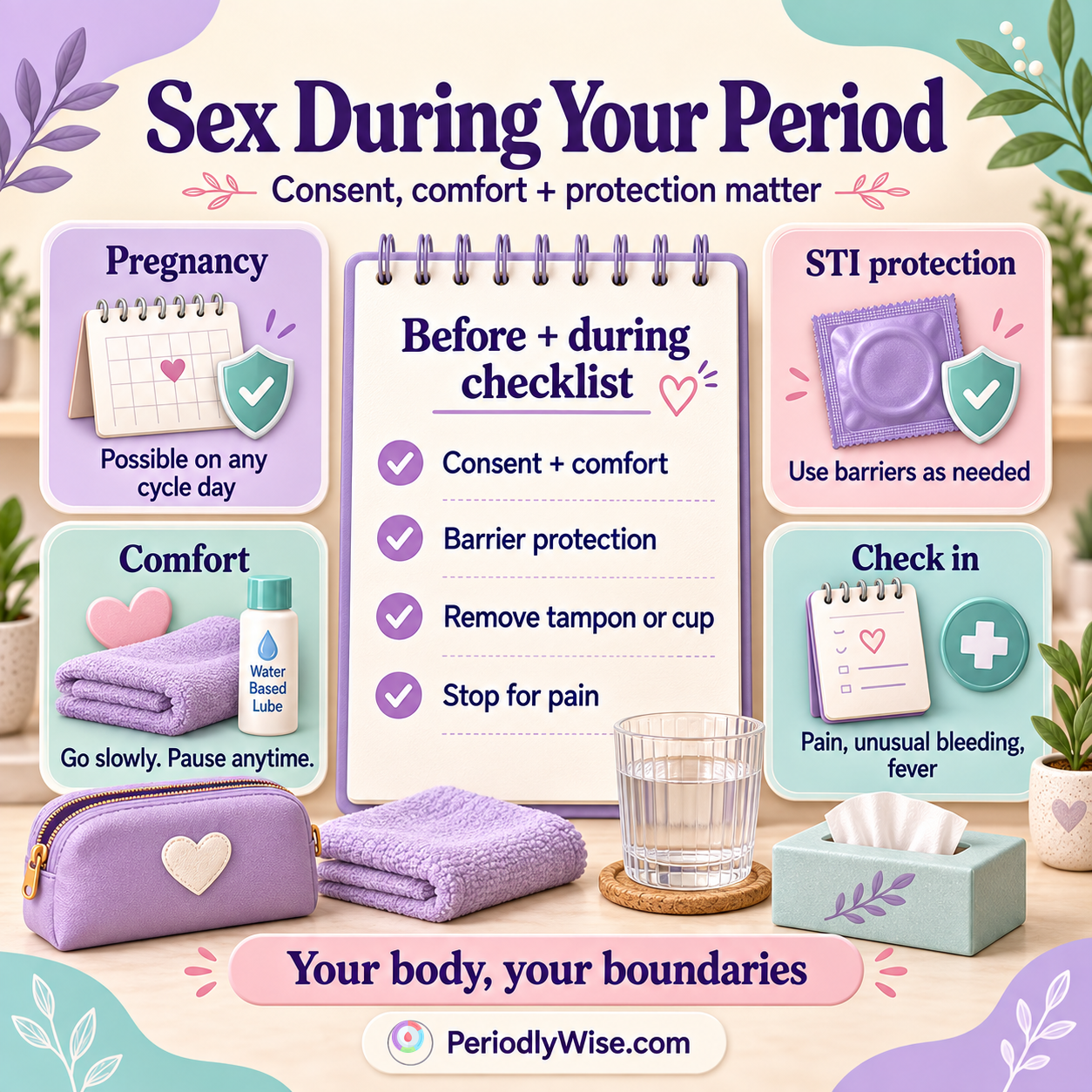
A simple preparation list can include:
- a clear conversation about consent, preferred activities, pain, barriers, and contraception
- a new external or internal condom used correctly for each sex act when appropriate
- a dental dam for oral-genital contact when STI protection is needed
- water-based or silicone lubricant that is compatible with the chosen barrier
- removing a tampon or ordinary menstrual cup before vaginal penetration
- a clean towel, washable surface cover, tissues, or nearby shower for comfort rather than medical necessity
- washing hands and cleaning sex toys according to their material and instructions; using a new condom on a shared toy
- urinating after sex if that is comfortable, while knowing it does not prevent pregnancy or STIs
- stopping at the first sign of sharp pain, burning, dizziness, pressure, or changed consent
- following any pelvic-rest or recovery instructions from a healthcare professional
Common concern versus what the evidence supports
| Concern | What is more accurate | What helps |
|---|---|---|
| 'Period sex is unhygienic.' | Menstrual blood is normal. Mess and infection risk are different questions. | Use clean hands, barriers when needed, and ordinary external washing; avoid douching. |
| 'You cannot get pregnant.' | Pregnancy is possible because ovulation varies and sperm survive for days. | Continue contraception and act promptly after a method failure. |
| 'STIs do not spread during a period.' | STIs can transmit during vaginal, oral, or anal sex on any cycle day. | Use barriers, test when indicated, and complete treatment before resuming sex as advised. |
| 'More bleeding after sex is always the period.' | Friction, cervical changes, infection, pregnancy, polyps, or other causes can produce bleeding after sex. | Get repeated or unexplained post-sex bleeding checked. |
| 'Pain is expected, so push through.' | Severe or recurrent pain is not a requirement of period sex. | Slow down, add lubricant, change activity, or stop; persistent pain needs assessment. |
| 'A menstrual product protects you.' | Tampons, cups, discs, pads, and period underwear do not prevent pregnancy or STIs. | Use purpose-designed contraception and barriers separately. |
A practical before, during, and after checklist
The goal is not a perfect ritual. It is a short sequence that keeps consent, protection, and body signals visible.
- Confirm that everyone wants the specific activity now. Discuss what would mean pause or stop, without treating period sex as something owed or embarrassing.
- Choose pregnancy protection based on the sex you are having and your goals. Do not skip a regular contraceptive dose because bleeding has started.
- Choose STI protection. Use a new condom for each act and follow package instructions; use a dental dam for oral-genital contact when appropriate.
- Remove tampons and ordinary menstrual cups before vaginal penetration. If a product cannot be removed, do not insert another object; seek medical help.
- Use enough barrier-compatible lubricant, move slowly, and choose positions or nonpenetrative activities that do not increase cramps or pelvic pressure.
- Keep cleanup simple: a towel, external rinse with water, clean hands, and properly cleaned toys. Avoid internal washing, douching, fragranced wipes, and harsh soap on the vulva.
- After unprotected vaginal sex or contraceptive failure, ask a pharmacist or clinician about emergency contraception as soon as possible. It does not prevent STIs.
- Test for pregnancy from the first missed period or at least 21 days after the last unprotected sex when the next period date is unclear, following the test instructions.
- Arrange STI testing based on the exposure, symptoms, partners, and local window-period guidance; urgent HIV exposure questions may require rapid professional advice about PEP.
- Record new pain, bleeding after sex, discharge, odor, sores, or urinary symptoms and seek care if they persist, repeat, or worsen.
What to track without turning intimacy into surveillance
A brief record can distinguish ordinary menstrual flow from bleeding triggered by sex and can make a healthcare visit more useful. Keep only the detail you genuinely need, especially on a shared device.
Use neutral observations. Write 'bright-red bleeding began after penetration' rather than deciding it is an infection or cervical problem. Symptoms and timing are evidence; a diagnosis requires assessment.
- cycle day and whether bleeding began before, during, or after sex
- flow before and after, including product changes, clots, leaks, and duration
- type of sexual activity and whether penetration was deep or painful
- contraception used, missed, late, broken, slipped, or absent
- barrier type and whether blood or sexual fluids contacted broken skin
- pain location, intensity, duration, and whether stopping relieved it
- itching, burning, sores, unusual discharge, odor, fever, or urinary symptoms
- pregnancy-test date and result when relevant
- recent childbirth, pregnancy loss, procedure, IUD placement, or pelvic-rest instruction
- medicines, anticoagulants, STI treatment, and any clinician advice
- what made the experience comfortable, uncomfortable, wanted, or not wanted
- privacy choice: what to omit, protect, export, or delete from the record
When period sex should pause and medical care should take priority
Stop and seek non-emergency medical advice for frequent or severe pain during sex, repeated bleeding after sex, a retained tampon or cup, new sores, persistent itching or burning, unusual discharge or odor, fever, or symptoms after a possible STI exposure. Many causes are treatable, and waiting does not make pain more legitimate.
If pregnancy is possible, bleeding should not automatically be labelled a period. Take a test at the appropriate time. A positive test or missed period with one-sided pelvic pain, shoulder pain, weakness, dizziness, or fainting needs urgent assessment for ectopic pregnancy.
Follow professional instructions to avoid sex after some procedures, during treatment for certain infections, or while recovering from childbirth or pregnancy loss. Ask what kinds of intimacy are allowed and when, because the answer depends on the procedure, healing, symptoms, and clinician guidance.
PeriodlyWise can organize bleeding days, pain, contraception notes, tests, and pattern changes. It cannot diagnose an STI, confirm contraception worked, or determine whether sex is safe for your individual condition.
Open private period trackingFrequently asked questions
Can period sex cause an infection?
A period does not create an infection, but STIs can transmit on any cycle day and irritation can occur from friction or products. Use barriers as appropriate, clean hands and toys, avoid douching, and get symptoms assessed.
Can you get pregnant if you have sex on the first day of a period?
It is possible, although often less likely than near ovulation. Early ovulation, short or irregular cycles, long bleeding, and mistaken spotting can overlap with sperm survival. Menstrual timing is not contraception.
Should I remove a tampon or menstrual cup before sex?
Remove a tampon or ordinary cup before vaginal penetration because it may be pushed higher or become painful and difficult to retrieve. Some discs are marketed for use during intercourse; follow the exact product instructions.
Do condoms work when there is period blood?
Yes, when the correct condom is used consistently and correctly. Blood does not deactivate it. Use compatible lubricant, stop if it slips or breaks, and use a new condom for each act.
Why did I bleed more after sex during my period?
Movement may make existing blood more noticeable, but friction, cervical bleeding, infection, pregnancy-related bleeding, or another cause is possible. Repeated, painful, heavy, or clearly post-sex bleeding should be assessed.
Can sex help period cramps?
Some people report temporary relief after arousal or orgasm, while others feel worse with penetration or pelvic contractions. It is optional, not a treatment requirement. Stop if pain increases and seek care for severe or recurrent pain.
Bottom line
Sex during a period is usually possible when it is consensual, comfortable, and consistent with any medical instructions. Menstrual blood is not a reason for shame, but the usual questions about STI prevention, pregnancy prevention, pain, and communication still apply.
Use barriers and contraception based on your goals, remove unsuitable internal products, keep cleanup gentle, and believe the body's stop signals. Repeated bleeding after sex, significant pain, infection symptoms, pregnancy concerns, or heavy bleeding deserve professional care.