Your cervical screening appointment is booked, then your period starts. You may be wondering whether the sample will still work, whether bleeding will make the examination uncomfortable, or whether cancelling means another long wait. The useful next step is to check the clinic's instructions with the details of your bleeding and your appointment.
You can sometimes have a Pap smear on your period. It is often preferable to collect a routine sample when you are not bleeding, because blood can make cervical cells harder to assess. However, a period does not automatically make the appointment unsafe or the test impossible. The amount of blood, the laboratory method, local screening policy, and the reason you are being seen all matter.
Why does advice about periods and Pap tests differ?
The advice addresses two related questions: can a sample be taken, and when is collection most likely to give a useful result? Those questions do not always have the same answer. A clinic may be able to take a sample during bleeding while still recommending another day for planned screening.
| Source and setting | Published guidance | What to do with it |
|---|---|---|
| CDC, United States | Pap and HPV tests can still be done during a period. | Do not assume that starting a period means you must miss the appointment. |
| ACOG and Mayo Clinic, United States | Testing is possible during menstruation, but another time is preferred for routine sampling. | Discuss your current flow and the test the clinic intends to collect. |
| NHS booking guidance, United Kingdom | Book routine screening when you are not on your period; contact the GP practice to rearrange if it starts on the day. | Follow your screening service's booking instructions rather than importing another country's advice. |
These are examples of service guidance, not a universal rule for every country or laboratory. There is no single cycle day that everyone must use. If periods are unpredictable, explain that when booking so repeated postponements do not leave screening unfinished.
A Pap test, an HPV test, and a pelvic examination are different
A Pap test, also called cervical cytology, looks at cells collected from the cervix for changes. Blood or mucus can obscure the cells, and a sample can also be inadequate if too few usable cells are collected. Bleeding does not mean that abnormal cells are present, but it can make interpretation more difficult.
An HPV test looks for high-risk human papillomavirus rather than examining cell appearance. Some services test for HPV first and examine cells only when needed; others use cytology or both tests. People may call all these appointments a "smear test," so ask which test is planned. Different preparation instructions do not necessarily mean either clinic is mistaken.
A pelvic examination, swab for infection, colposcopy, or assessment of pain or bleeding is not interchangeable with routine screening. Screening also does not diagnose every cause of abnormal vaginal bleeding. Having a normal screening result should not stop you from reporting new symptoms.
Keep, call, or rearrange: use the reason for the visit
| Your situation | What matters | Practical next step |
|---|---|---|
| Light spotting around an expected period | The clinic's sampling method and policy still apply. | Describe the spotting and ask whether to attend; do not assume it is automatically acceptable. |
| Moderate or heavy usual period flow | Blood may make collection or interpretation harder. | Call before travelling. The clinic may rearrange the sample or keep other parts of the visit. |
| Bleeding between periods or after sex | This needs symptom assessment, not simply a new screening date. | Tell the clinician what changed, even if screening is up to date. |
| Follow-up after an abnormal result | Timing depends on the previous result and planned procedure. | Contact the responsible team; do not defer the follow-up yourself. |
| Frequent or unpredictable bleeding | Waiting for a perfect date may repeatedly delay care. | Ask for an individual plan that addresses both the bleeding and screening. |
| Severe pain, fainting, or rapidly heavy bleeding | The immediate concern is your health, not sample scheduling. | Seek urgent medical assessment rather than waiting for a routine appointment. |
What to say when you contact the clinic
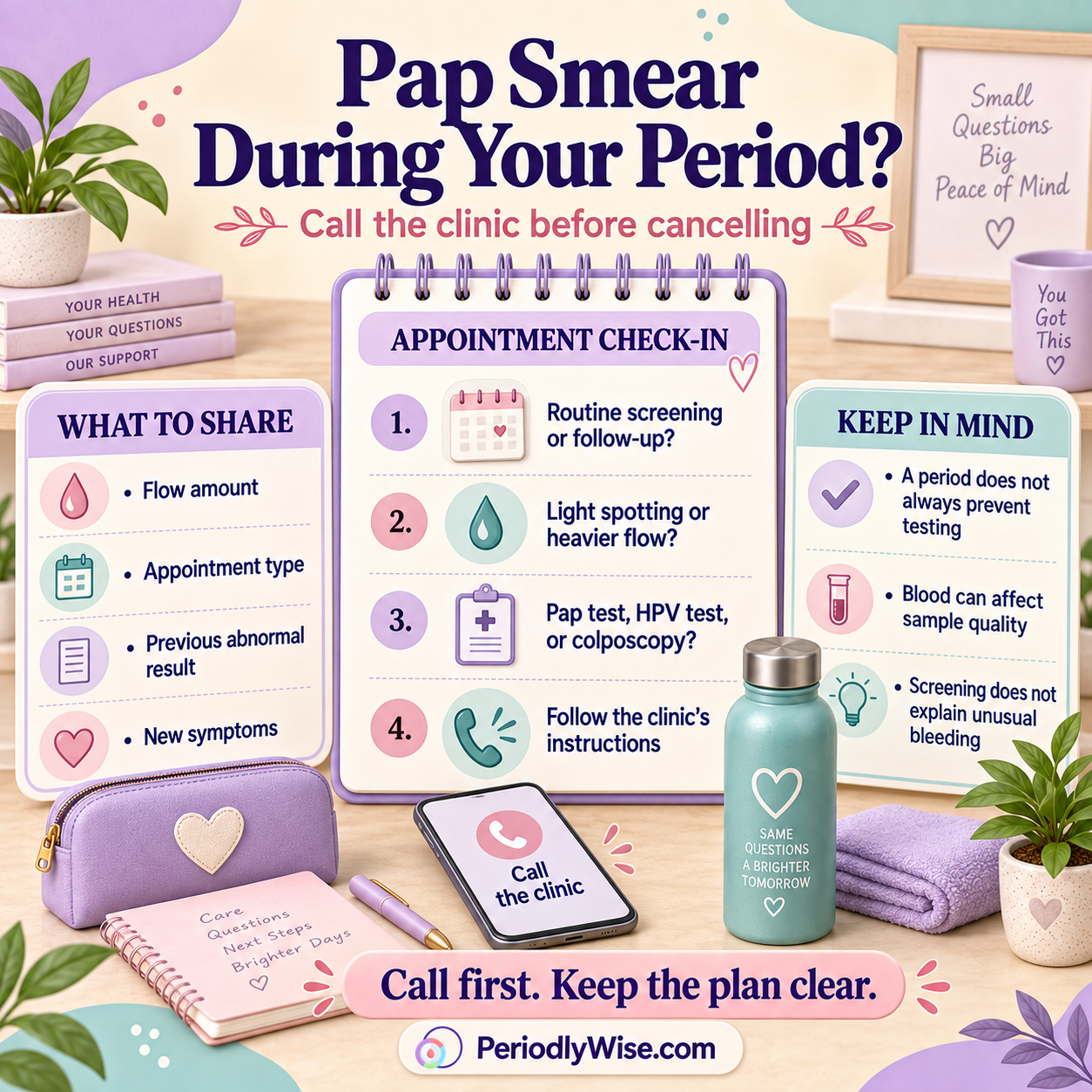
A specific message is more useful than "Can I come while bleeding?" You can adapt this example: "My screening appointment is on Thursday. My period started today and the flow is currently light/moderate/heavy. This is routine screening/follow-up after a previous result. Do you want me to attend, keep the consultation only, or move the sample collection?"
- Confirm the appointment type. Mention any previous abnormal result, referral, biopsy, or treatment. A receptionist may need to pass the question to the clinical team.
- Describe the bleeding. Give its start date, whether it is expected, how it compares with your usual flow, and any new symptoms.
- Ask about preparation. Check the exact instructions for the sample being collected, including vaginal medicines you have been prescribed.
- Explain access difficulties. If work, transport, cost, irregular periods, or anxiety make returning difficult, say so before the appointment is cancelled.
- Close the loop. If it must move, agree a new date and ask whom to contact if bleeding continues. If attending, ask how and when results will arrive.
Preparing without trying to change or hide your period
Follow the instructions from the service collecting the sample. For Pap testing, common guidance is to avoid vaginal intercourse, douching, and vaginal products such as spermicides or medicines for the preceding two days. HPV-only preparation may differ. Do not stop prescribed treatment on your own; ask the clinician how to coordinate treatment and sampling.
- If you had sex or used a vaginal product before the test, tell the clinic. Do not assume you have ruined the appointment or automatically stay away.
- Do not douche or use internal washes to remove blood. Ordinary external washing is enough; bleeding is not something you must disguise.
- Remove a tampon, cup, or disc before the examination when asked. Bring your preferred product for afterwards.
- Tell the clinician about possible pregnancy, recent childbirth, a cervical procedure, pelvic infection treatment, or relevant medicines.
- Do not start hormones or change contraception simply to stop bleeding for a test without medical advice.
- Bring relevant result letters or dates if available, but ask for help retrieving records rather than abandoning care because a document is missing.
Comfort, consent, and what happens during the appointment
For a clinician-collected cervical sample, a speculum opens the vagina so the cervix can be seen, and a small brush collects cells. You can discuss pain, past difficult examinations, trauma, disability, or gender-related concerns before starting. Ask about a support person or chaperone, extra time, a smaller speculum, or a different position. You can ask to pause or stop at any time.
Light spotting may occur after sampling and should usually settle within a few hours. If you were already menstruating, note whether the amount or pain changes rather than attributing everything to the test. Contact the service for heavy bleeding or spotting that continues beyond the expected short period; severe pain, faintness, or feeling acutely unwell needs more urgent attention.
Three appointment examples
Example 1: an expected light period. Someone with routine screening booked calls the clinic and reports light flow with no new symptoms. The clinic either confirms attendance under its protocol or books another day. The important outcome is a clear plan, not deciding from an internet answer that all light bleeding is acceptable.
Example 2: spotting after sex. Someone notices repeated bleeding after intercourse and waits for it to disappear before booking a "smear." The better next step is a symptom appointment: screening may be part of care, but it cannot replace an examination and other investigations selected for that symptom.
Example 3: irregular cycles and overdue follow-up. Someone has already moved an appointment twice because bleeding is unpredictable. They tell the follow-up team about both the previous result and the scheduling problem. The team can advise whether to proceed, change the timing, or assess the bleeding separately. These examples are illustrative, not individual treatment recommendations.
If the result says the sample was unsatisfactory
Unsatisfactory means the laboratory could not adequately assess the sample. It is not the same as a negative result, and it does not by itself mean cancer. Blood, inflammation, collection issues, or too few cells can contribute. Ask what needs repeating and make sure there is a dated follow-up plan.
In the United States, updated ASCCP guidance recommends repeating age-based screening as soon as convenient and no later than four months for unsatisfactory cytology with no, unknown, or negative HPV results. It does not require waiting two months. A negative HPV result accompanying unsatisfactory cytology should not simply be treated as reassurance that routine follow-up years later is sufficient. Other results, prior history, symptoms, and local programmes can require a different plan; the clinician should interpret your actual report.
Ask when results are expected and who to call if they do not arrive. No message is not proof of a normal result. Keep the result and follow-up date somewhere you can find them, especially if you move or change healthcare providers.
When bleeding needs care beyond a screening appointment
Arrange medical assessment for bleeding between periods, recurrent bleeding after sex, bleeding after menopause, persistent changes in discharge, or pelvic pain. Many conditions can cause these symptoms, and most are not cervical cancer, but a screening appointment alone is not enough to determine their cause.
Seek urgent help for very heavy bleeding with dizziness, fainting, breathlessness, or severe pain. If pregnancy is possible, bleeding with significant or one-sided pelvic pain, faintness, or shoulder pain also needs urgent assessment. Do not wait for a Pap result to decide whether these symptoms matter.
Frequently asked questions
Can I have a Pap smear on the last day of my period?
Possibly, but the calendar day is less useful than the amount of bleeding and the clinic's instructions. Tell them if you still have spotting or flow; some services prefer a blood-free appointment.
Does brown discharge count as bleeding for the appointment?
Describe it to the clinic as brown spotting or discharge, including whether it is usual for you. Colour cannot show whether a sample will be suitable or whether the discharge needs assessment.
Does period blood automatically make a Pap result abnormal?
No. Blood can obscure cells or contribute to an inadequate sample. That is different from identifying abnormal cervical cells. Have the clinician explain the exact wording on your report.
Should I cancel a colposcopy because my period started?
Not automatically. Current NHS guidance says colposcopy can be done during a period; contact the team if you would prefer to reschedule or need advice about your bleeding. Follow the hospital's instructions for your planned procedure, and do not independently delay important follow-up.
Can an at-home HPV test replace this appointment?
Only use an approved self-collection option offered or recommended through your healthcare service, following the kit's bleeding instructions. It is not a home Pap test, and it does not replace assessment of symptoms or every type of abnormal-result follow-up.
Do I need a Pap test every year because I have periods?
No. Having periods does not determine the screening interval. Eligibility and timing depend on age, previous results, health history, the test, and your country's programme. Check your invitation or ask your clinician rather than using a period app to decide.
Bring a useful record, not a predicted diagnosis
PeriodlyWise can help you keep track of period dates for the conversation. Note the actual bleeding start, whether it is expected, your current flow, symptoms, and the clinic's plan. A cycle estimate cannot decide whether a cervical sample is suitable or whether screening is due.
Open the period trackerRelated reading: spotting after a period, irregular periods, and heavy period flow.