An irregular period can feel like your body changed the plan without telling you. One month your period arrives early. Another month it is late. Sometimes there is spotting between periods, a skipped bleed, a heavier-than-usual period after a long gap, or a cycle that no longer matches your usual rhythm.
The phrase "irregular periods causes" covers many different situations, so the first step is not panic and not guessing. The first step is pattern sorting. What changed? When did it change? Was it one cycle or several? Was there pain, heavy bleeding, pregnancy possibility, medication change, stress, illness, or a life-stage transition in the background?
PeriodlyWise cannot diagnose why your period is irregular. It can help you collect the kind of details that make a conversation with a healthcare professional clearer, calmer, and more useful.
What counts as an irregular period?
Irregular does not always mean dangerous. It means the pattern is not predictable for you or does not fit expected timing. The Office on Women's Health explains that menstrual cycles can vary, but period problems deserve attention when bleeding is unusually heavy, very painful, missing, too frequent, or unpredictable in a way that affects life.
Think in patterns rather than one date. A period that is two days late during a stressful week is different from cycles that jump from 24 days to 46 days for several months. Spotting once before a period is different from repeated bleeding between periods or bleeding after sex.
The 5-question cycle pattern check
Before naming a possible cause, answer these five questions. They keep the investigation practical and reduce the chance of blaming everything on stress.
| Question | Why it matters | Example note |
|---|---|---|
| Is the period early, late, missed, longer, shorter, or between periods? | Different changes point to different possibilities. | "Cycle was 41 days, then heavy day 1." |
| Is this new or your long-term pattern? | A sudden change deserves more attention than a stable lifelong rhythm. | "Usually 29 to 31 days; last 3 cycles were 38+." |
| Could pregnancy be possible? | Pregnancy-related bleeding needs medical interpretation, especially with pain or heavy bleeding. | "Late period, pregnancy test pending." |
| What changed in the body or routine? | Stress, sleep, illness, travel, weight, exercise, and medication can shift ovulation timing. | "Flu and poor sleep two weeks before expected period." |
| Are there warning symptoms? | Heavy bleeding, severe pain, dizziness, fever, or bleeding after sex should not be treated as routine variation. | "Bleeding after sex twice this month." |
Common irregular periods causes, grouped clearly
Irregular periods are usually related to ovulation timing, hormone signaling, the uterine lining, pregnancy-related bleeding, contraception, life stage, or another health condition. The list below is not a diagnosis menu. It is a way to organize what may be worth tracking and discussing.
1. Ovulation happened later, earlier, or not clearly
Many period date changes begin with ovulation timing. If ovulation happens later than usual, the next period may be late. If ovulation happens earlier, the period may arrive earlier. Some cycles may be anovulatory, meaning ovulation did not happen in the usual way. That can lead to missed, delayed, unpredictable, or sometimes heavier bleeding.
This is one reason calendar predictions can be wrong even when the tracker is functioning properly. The tracker estimates from past patterns; the body can still shift in the current cycle. For a deeper timing explanation, read Why Period Dates Change and Cycle Length Meaning.
2. Stress, sleep disruption, illness, and travel
The menstrual cycle is connected to the wider body. Stress, poor sleep, illness, travel, major routine changes, and recovery from a demanding month can all affect hormone signaling for some people. This does not mean "it is just stress" or that symptoms should be dismissed. It means life context belongs in the cycle record.
If a late period followed exams, grief, long travel, night shifts, illness, or a major sleep change, write that down. If the irregularity continues after life stabilizes, that repeated pattern deserves more attention.
3. Weight changes, intense exercise, or not enough fuel
Significant weight loss or gain, very intense exercise, under-fueling, or disordered eating can affect cycle regularity. The body may reduce reproductive hormone signaling when it senses not enough energy availability. This can show up as longer cycles, missed periods, lighter bleeding, or unpredictable timing.
This is not about blaming body size. It is about noticing whether nutrition, training load, energy, and cycle timing changed together. If periods stop or become very infrequent, medical guidance is important.
4. PCOS, thyroid issues, prolactin, and other hormone-related conditions
Polycystic ovary syndrome (PCOS) can cause irregular or infrequent periods for some people, often with signs such as acne, increased facial or body hair, scalp hair thinning, weight changes, or insulin resistance patterns. Thyroid conditions can also affect cycle length and flow. High prolactin can interfere with ovulation and may be associated with nipple discharge, headaches, or vision symptoms in some situations.
Only a clinician can evaluate these possibilities with history, examination, and testing when appropriate. Tracking can help you describe the timing, but it cannot confirm the cause.
5. Contraception changes, missed pills, IUDs, and medicines
Starting, stopping, switching, or missing hormonal contraception can change bleeding patterns. Some people have spotting, lighter bleeding, skipped withdrawal bleeds, or irregular bleeding while the body adjusts. Copper IUDs may make bleeding heavier or crampier for some people, especially early on. Emergency contraception can also shift timing temporarily.
Some medicines and supplements may affect bleeding or interact with hormones. If your period changed after a medication change, record the date and ask a healthcare professional or pharmacist for guidance.
6. Pregnancy-related bleeding or pregnancy possibility
If pregnancy is possible, an unusual bleed should not be interpreted only as a period. Bleeding can happen in early pregnancy, miscarriage, or ectopic pregnancy. Seek urgent care for bleeding with severe or one-sided pelvic pain, shoulder pain, fainting, dizziness, heavy bleeding, or symptoms that feel unsafe.
A period tracker can remind you that a period is late, but it cannot confirm or rule out pregnancy. A pregnancy test and medical guidance are the safer route when pregnancy is possible.
7. Puberty, postpartum, breastfeeding, and perimenopause
Cycles are often less predictable during puberty, after pregnancy, during breastfeeding, and during perimenopause. In these life stages, ovulation timing can vary more. Flow may also change. That said, very heavy bleeding, severe pain, bleeding after sex, or bleeding after menopause should still be evaluated.
If you are in perimenopause, "irregular" should not become a reason to ignore everything. New heavy bleeding, bleeding between periods, and bleeding after menopause deserve medical review.
8. Fibroids, polyps, infection, cervical changes, and other conditions
Fibroids, polyps, adenomyosis, endometriosis, pelvic infection, sexually transmitted infections, cervical changes, and other conditions can sometimes contribute to irregular bleeding, spotting, heavy flow, pelvic pain, or bleeding after sex. ACOG groups many of these patterns under abnormal uterine bleeding, which should be assessed based on symptoms, age, health history, and pregnancy possibility.
When irregular periods need medical attention
Consider medical guidance if irregularity is new, persistent, worsening, or affecting your life. Also seek care if periods stop for several months without an obvious reason, if bleeding happens between periods or after sex, if bleeding lasts more than 7 days, if pain is severe, if flow is very heavy, if you have symptoms of anemia such as unusual fatigue or shortness of breath, or if pregnancy is possible.
Seek urgent help if heavy bleeding comes with fainting, severe dizziness, chest pain, shortness of breath, confusion, weakness, severe one-sided pelvic pain, fever, or pregnancy-related warning signs.
What to track in PeriodlyWise
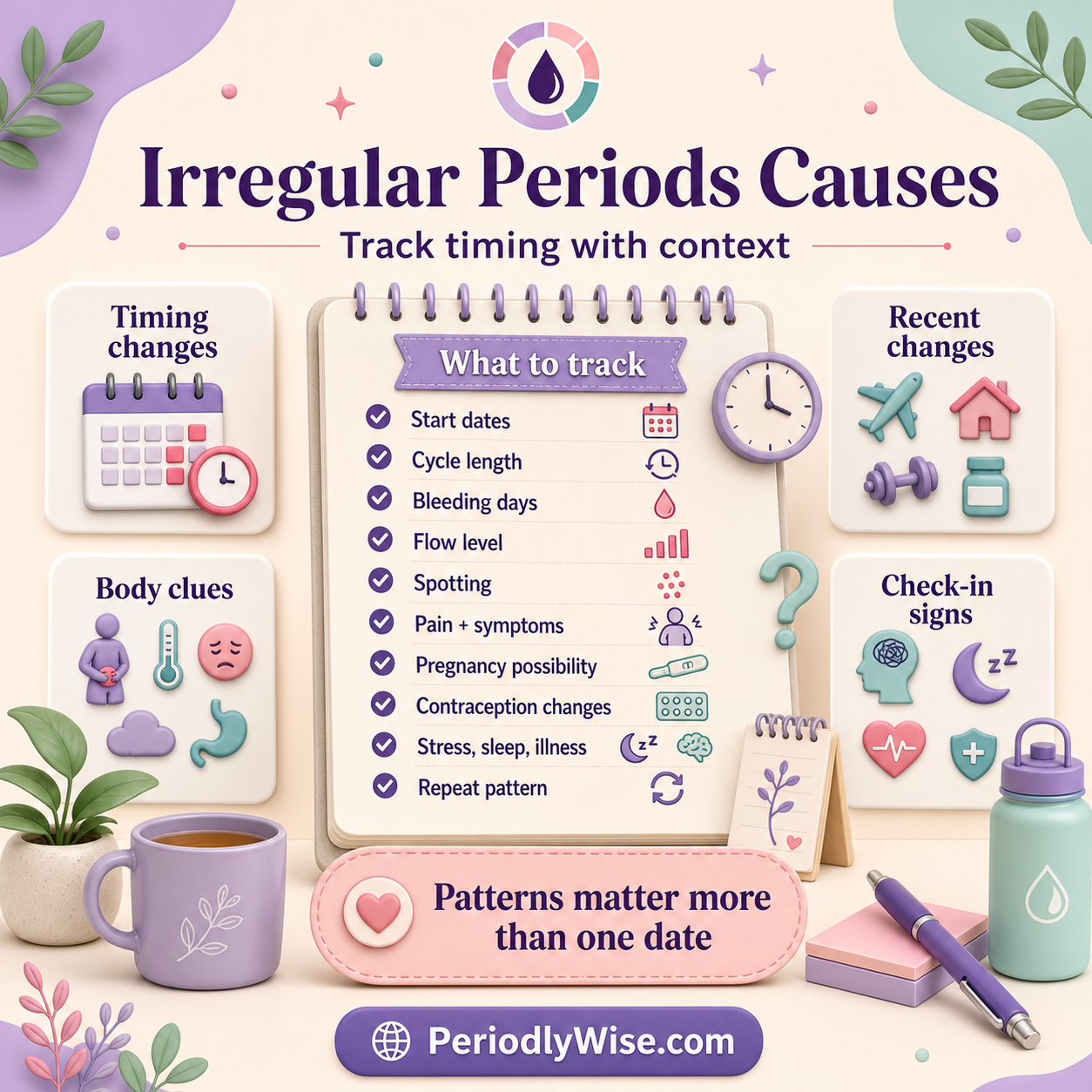
When periods are irregular, tracking should answer two questions: what happened, and what else was happening around it?
| Track this | Why it helps | Example |
|---|---|---|
| Period start date | Defines day 1 and cycle length. | "Bleeding started Aug 8." |
| Cycle length | Shows whether cycles are short, long, or variable. | "Last cycles: 27, 35, 42 days." |
| Bleeding length | Long bleeding can change the concern level. | "Flow 8 days, spotting 2 days." |
| Flow and spotting | Separates true period flow from spotting or between-period bleeding. | "Brown spotting day 18, no cramps." |
| Pain and location | One-sided, severe, or new pain changes the safety picture. | "Sharp right-side pain with spotting." |
| Pregnancy possibility | Important for late periods and unusual bleeding. | "Pregnancy possible; test negative day 3 late." |
| Contraception and medications | Bleeding may shift after starting, stopping, switching, or missed doses. | "Missed two pills week 2." |
| Stress, sleep, illness, travel | Shows context that may explain timing shifts. | "Flu, travel, slept 4 hours for 3 nights." |
| Weight, food, and exercise changes | Energy availability can affect cycle signaling. | "Training increased; appetite low." |
| Repeat pattern | Clinicians often need to know if it happened once or repeatedly. | "Third cycle over 40 days." |
A simple clinician-ready summary
If you decide to seek care, you do not need perfect notes. Bring a clear summary. You can write:
That kind of summary is more useful than saying "my periods are all over the place." It gives timing, duration, symptoms, and context.
How PeriodlyWise helps without making tracking obsessive
Use the Irregular Period Tracker to compare cycle lengths and timing shifts. Use the Irregular Period Calculator guide when you need a more realistic next-period window. If bleeding comes twice in one calendar month, read Period Twice in One Month. If the main concern is lateness, read Why Is My Period Late Besides Pregnancy?.
The goal is not to explain every tiny fluctuation. The goal is to know when your pattern is normal for you, when it is changing, and when support would be wise.
FAQ
Can stress cause irregular periods?
Stress can affect ovulation timing and cycle regularity for some people, but it should not be used to dismiss repeated, painful, very heavy, or unsafe bleeding. Track stress as context, not as a guaranteed explanation.
Can irregular periods mean PCOS?
PCOS can cause irregular or infrequent periods, but irregular periods do not automatically mean PCOS. A healthcare professional may consider symptoms, history, examination, and testing.
Is a late period always pregnancy?
No. Late periods can happen for many reasons, including delayed ovulation, stress, illness, travel, weight change, contraception, PCOS, thyroid issues, and perimenopause. If pregnancy is possible, take a test and seek medical guidance for concerning symptoms.
When should I worry about irregular periods?
Seek care when irregularity is new, persistent, worsening, paired with very heavy bleeding, severe pain, bleeding after sex, missed periods for several months, pregnancy possibility, dizziness, shortness of breath, or anything that feels unsafe.
Use PeriodlyWise to record start dates, cycle length, flow, spotting, pain, symptoms, and life context so irregular timing is easier to understand and explain.
Open the Irregular Period Tracker