A period that becomes late, early, lighter, heavier, or absent soon after starting an antidepressant naturally raises the question of cause. Antidepressants can affect menstrual bleeding or timing in some people, but the relationship is not simple and many users have no cycle change at all.
The available research includes observational studies, medicine safety reports, and case reports. These can identify a possible signal, but they cannot always separate the medicine from depression or anxiety itself, stress, sleep and appetite changes, weight change, pregnancy, contraception, perimenopause, thyroid disease, PCOS, or another cause of abnormal bleeding.
The safest response is therefore neither to ignore the change nor to stop treatment abruptly. Record the timing, rule out urgent and common alternatives, and involve the prescriber or pharmacist so mental-health care and menstrual health are considered together.
What kind of period change happened?
Name the change before trying to explain it. A period can be late or skipped because ovulation happened later or not at all. Heavier or longer bleeding concerns blood loss and clotting. Spotting between periods has a different differential diagnosis from a lighter-than-usual period.
Compare with your own baseline: usual cycle length, normal flow, contraception, age, and whether pregnancy is possible. One outlier cycle can happen for many reasons; a repeating change that began after a start, dose increase, switch, missed-dose pattern, or taper is more useful evidence for the prescriber.
Antidepressant is a broad label. SSRIs, SNRIs, tricyclics, mirtazapine, bupropion, monoamine oxidase inhibitors, and other medicines have different actions and side-effect profiles. The exact name, dose, and combination matter more than the category alone.
Period changes and the questions they raise
| Change | How medicine could fit | What else to check first |
|---|---|---|
| Heavier or longer bleeding | SSRIs or SNRIs may increase bleeding tendency in susceptible people. | Fibroids, adenomyosis, contraception, pregnancy-related bleeding, thyroid disease, bleeding disorders, and NSAID or anticoagulant use. |
| Spotting or bleeding between periods | A medicine-related bleeding effect is possible but not specific. | Pregnancy, contraception changes, infection, cervical causes, polyps, fibroids, and perimenopause. |
| Late or missed period | Rare prolactin or reproductive-hormone effects have been reported; indirect stress, sleep, appetite, or weight pathways may contribute. | Pregnancy, delayed ovulation, PCOS, thyroid changes, low energy intake, illness, and perimenopause. |
| Lighter or shorter period | A temporal association may occur, but direct evidence is limited. | Pregnancy-related spotting, hormonal contraception, normal variation, weight or exercise change, and uterine-lining factors. |
| Worse cramps or PMS symptoms | Mood, pain perception, sleep, and medication adjustment can change how symptoms feel. | Endometriosis, adenomyosis, fibroids, infection, and other causes when pain is new or severe. |
How antidepressants might affect menstruation
Bleeding pathway: platelets use serotonin as part of normal clot formation. SSRIs and SNRIs reduce serotonin uptake not only in the brain but also in platelets. Reviews support an association with abnormal bleeding overall, although direct research on menstrual blood loss is much thinner and newer reviews describe uncertainty in the platelet evidence.
The practical concern is greater when other bleeding risks are present. NSAIDs such as ibuprofen or naproxen, aspirin, anticoagulants, antiplatelet medicines, liver disease, or a personal bleeding disorder can change the risk picture. This does not mean everyone taking an SSRI must avoid an NSAID; it means the combination should be checked with a clinician or pharmacist when bleeding is heavy or risk factors exist.
Hormone pathway: menstrual cycles depend on signalling among the brain, pituitary gland, ovaries, and uterus. Case reports and emerging reviews describe amenorrhea, ovulatory changes, or increased prolactin with some antidepressants. These effects appear uncommon and the evidence is not strong enough to predict who will be affected.
Indirect pathway: depression, anxiety, major stress, sleep disruption, reduced or increased appetite, weight change, illness, and exercise changes can themselves alter ovulation and cycle timing. Effective treatment may improve some of these factors, while early side effects or a difficult medication transition may temporarily worsen them.
Possible contributors to review include:
- the exact antidepressant, dose, start date, dose-change date, and any missed doses
- ibuprofen, naproxen, aspirin, anticoagulants, antiplatelet drugs, steroids, supplements, or alcohol
- hormonal contraception, emergency contraception, an IUD, HRT, or fertility treatment
- pregnancy possibility and the timing of any pregnancy tests
- recent stress, illness, sleep loss, appetite or weight change, and exercise load
- milk-like breast discharge, headaches, or vision changes that could justify a prolactin assessment
A practical medication-and-cycle decision guide
| Situation | Reasonable next step | Why |
|---|---|---|
| One slightly different period and you otherwise feel well | Track this cycle and continue the medicine as prescribed. | Single-cycle variation is common and rarely identifies one cause. |
| Period is late and pregnancy is possible | Take a pregnancy test at the appropriate time and repeat as directed if needed. | Medication cannot safely be assumed to explain a missed period. |
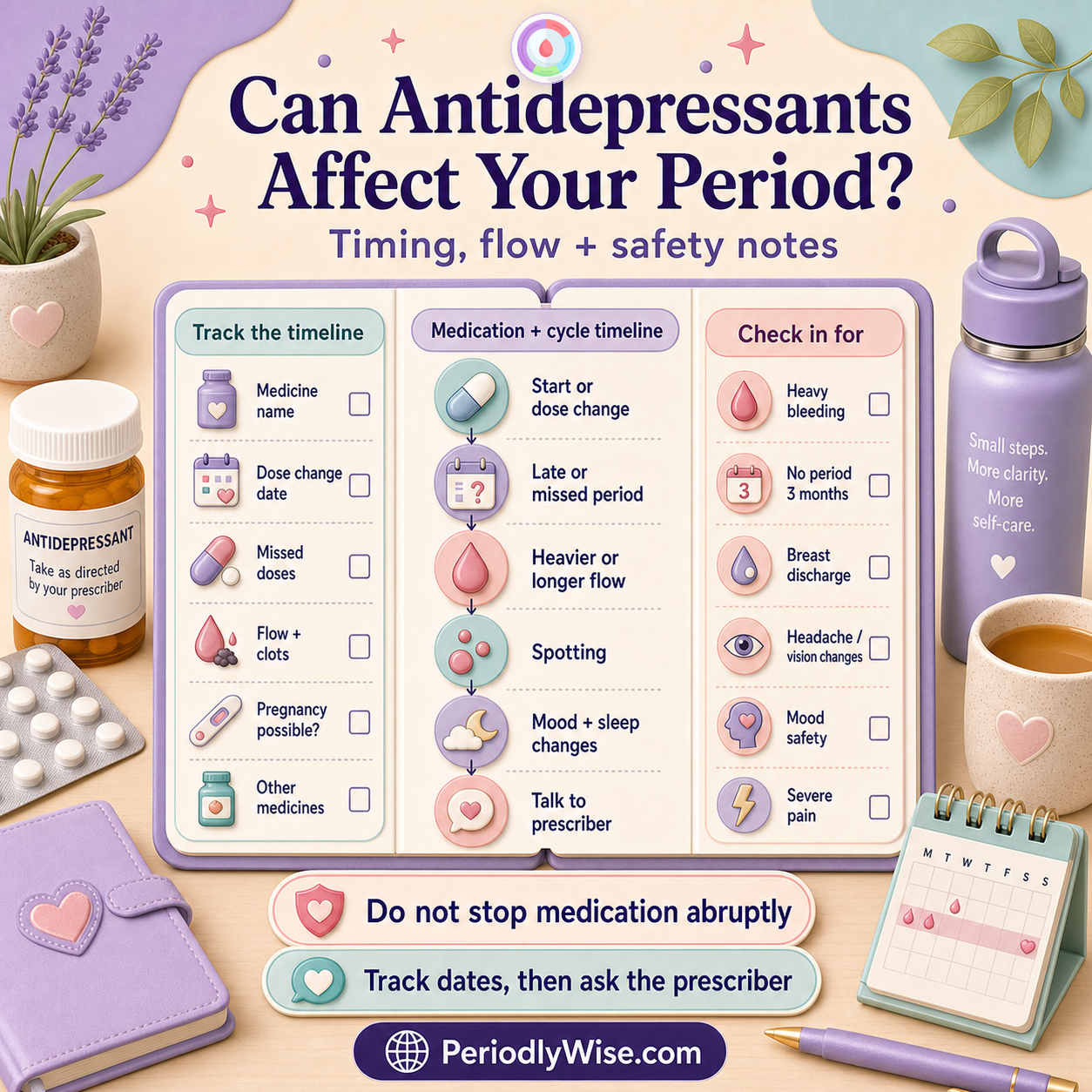
| The same change repeats after starting or increasing a dose | Contact the prescriber or pharmacist with dates, dose, flow, and associated symptoms. | A consistent timeline helps assess side effects and alternatives without an abrupt stop. |
| Bleeding is heavier and you also use an NSAID, aspirin, or blood thinner | Seek prompt medication review; urgent care may be needed for severe blood loss symptoms. | Combined bleeding risks can matter even when each medicine was previously tolerated. |
| Missed periods plus breast discharge, headache, or vision change | Arrange clinical assessment rather than waiting several more cycles. | Pregnancy and prolactin or pituitary causes may need testing. |
| Mood rapidly worsens or self-harm thoughts appear | Use urgent mental-health or emergency support now. | Mental-health safety takes priority over determining the period mechanism. |
What to do if your period changes after an antidepressant
Protect continuity of mental-health treatment while giving the prescriber enough information to evaluate the menstrual change safely.
- Keep taking the medicine as prescribed unless urgent medical care tells you otherwise. Abrupt stopping can cause withdrawal symptoms and may worsen or bring back depression or anxiety.
- Check pregnancy when relevant. Test according to the kit instructions if a period is late, unusually light, or absent and pregnancy is possible.
- Document the timeline. Record the medicine name, dose, start or change date, missed doses, period dates, flow, clots, spotting, pain, and other symptoms.
- Review combinations. Tell the pharmacist or prescriber about over-the-counter painkillers, aspirin, blood thinners, supplements, contraception, alcohol, and all other medicines.
- Contact the prescriber for a repeated or meaningful change. They may review the dose, timing, medicine choice, pregnancy risk, and whether tests such as a blood count, ferritin, thyroid function, or prolactin fit your symptoms.
- Use urgent care for dangerous bleeding or mental-health symptoms. Do not wait for a routine appointment when safety is at risk.
What to record before speaking with the prescriber
A concise record is more useful than trying to prove causation. Include a few cycles before the medication change when you have them, because the baseline shows what is genuinely new.
- antidepressant name, dose, formulation, and reason for use
- start date, dose increases or reductions, switches, and missed doses
- first day of full menstrual flow and total cycle length
- bleeding days, spotting days, flow level, clots, leaks, and product-change frequency
- pain, dizziness, weakness, breathlessness, headaches, or palpitations
- mood, sleep, appetite, weight, illness, stress, and exercise changes
- pregnancy possibility, contraception, and pregnancy-test dates and results
- other prescriptions, over-the-counter pain medicines, supplements, and alcohol
- breast discharge, breast changes, vision symptoms, or persistent headaches
- how the change affects work, school, sleep, sex, exercise, or daily activities
When to contact a clinician
Contact the prescriber or another clinician if period changes repeat, are substantial, or began clearly after starting, switching, or changing the dose. Also seek advice for bleeding between periods, after sex, or after menopause; periods that stop for three months without explanation; or symptoms suggesting anemia.
Heavy bleeding deserves assessment even when a medicine effect seems plausible. ACOG describes warning patterns such as bleeding longer than seven days or soaking through pads or tampons hourly for several hours. A blood count and ferritin may be relevant when fatigue, dizziness, breathlessness, palpitations, or heavy flow are present.
For missed periods with milk-like breast discharge, persistent headache, or vision changes, pregnancy and prolactin-related causes should be considered. The clinician decides which examination or tests are appropriate.
Use PeriodlyWise to record period dates, flow, spotting, and symptoms privately. Keep the medicine name, dose, and changes in your notes for a focused conversation with the prescriber.
Open the period trackerFrequently asked questions
Can SSRIs delay or stop your period?
Late and missed periods have been reported, but they are not predictable and other causes are common. Check pregnancy when relevant and seek assessment if the pattern repeats or periods stop for three months without explanation.
Can antidepressants make periods heavier?
SSRIs and SNRIs can increase bleeding tendency in some people, so heavier flow is possible. Direct menstrual evidence is limited, and fibroids, adenomyosis, contraception, pregnancy-related causes, thyroid disease, and bleeding disorders still need consideration.
Can an antidepressant make a period lighter?
A lighter or shorter period may coincide with treatment, but it is nonspecific. Pregnancy-related spotting, hormonal contraception, delayed ovulation, weight change, and normal variation may fit as well.
Can starting, switching, or stopping an antidepressant change a cycle?
A medication transition can coincide with cycle changes through direct or indirect pathways. Record the dates, but do not stop suddenly; withdrawal can cause sweating, sleep problems, dizziness, anxiety, and mood worsening.
Is ibuprofen safe for cramps while taking an SSRI?
It depends on your bleeding risk, dose, other medicines, and health history. NSAIDs can add to bleeding risk with serotonin-reuptake antidepressants, so ask a pharmacist or prescriber, especially with heavy flow, ulcers, a bleeding disorder, aspirin, or anticoagulants.
Should I stop my antidepressant if my period changes?
No, not on your own. Contact the prescriber. They can weigh the benefit of treatment, severity of the cycle change, other causes, interactions, tests, dose options, or a supervised switch or taper.
The bottom line
Antidepressants can be part of the explanation for a new menstrual change, especially when a repeatable pattern follows a start or dose change. Yet the evidence is incomplete, effects differ by medicine and person, and pregnancy or another gynecologic, endocrine, hematologic, or life-context cause may be more important.
Keep treatment stable while you collect the timeline, unless an urgent clinician directs otherwise. Test for pregnancy when relevant, review bleeding-risk combinations, and seek prompt help for heavy blood loss, severe pain, faintness, dangerous mood changes, or other red flags.