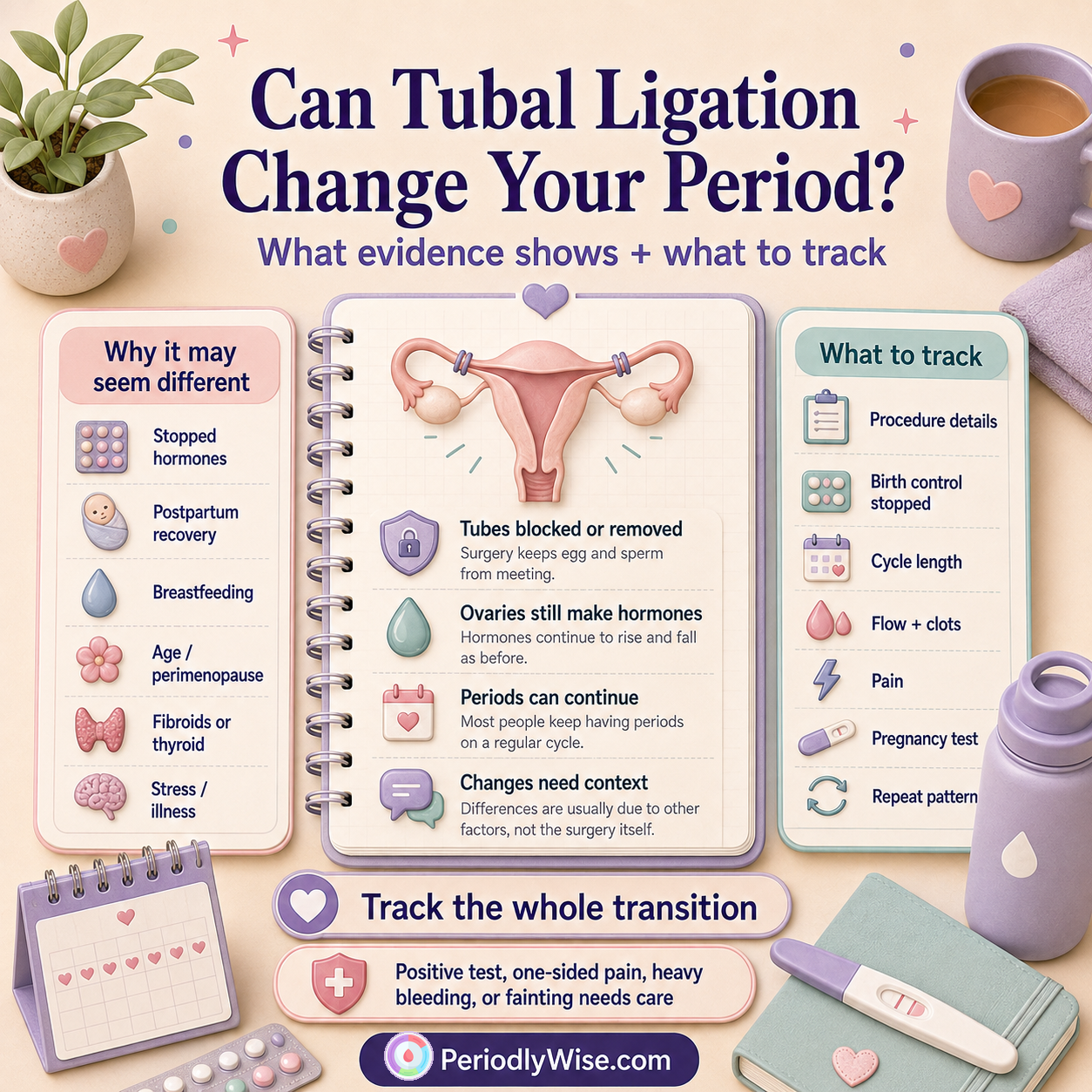
If a period becomes heavier, more painful, irregular, late, or absent after having your tubes tied, it is reasonable to wonder whether the operation changed your hormones. Tubal sterilization itself is not expected to alter the ovarian hormones or uterine lining that create a menstrual cycle. The fallopian tubes provide a route for egg and sperm; blocking or removing them prevents fertilization but does not normally stop ovulation.
That does not mean the timing of a change should be dismissed. Sterilization is often performed when another major transition is happening: hormonal birth control may be stopped, the operation may occur during a cesarean birth or soon after delivery, and natural cycle patterns may be returning for the first time in years. Fibroids, adenomyosis, thyroid disease, perimenopause, pregnancy, and other causes can also appear around the same time by coincidence.
The useful question is therefore not only, “Did surgery cause this?” but “What else changed, what exactly is different from my baseline, and are there warning signs?” A short record can separate an expected transition from bleeding, pain, or pregnancy symptoms that need medical evaluation.
What tubal ligation changes, and what it leaves in place
“Tubal ligation,” “having your tubes tied,” tubal occlusion, and female sterilization can describe procedures that clip, band, seal, divide, or remove the fallopian tubes. A bilateral salpingectomy removes both tubes. In the usual procedure, the uterus and ovaries remain, so eggs can still mature, ovulation can still occur, and the uterine lining can still thicken and shed as a period.
This is different from removal of both ovaries, which causes an abrupt loss of ovarian hormones, and from hysterectomy, which removes the uterus and stops menstrual bleeding. If another operation was performed at the same time, the answer depends on the complete procedure rather than the words “tubal ligation” alone. Check the operative report or ask the surgical team if you are unsure.
Light spotting shortly after surgery is not the same as a long-term cycle change. Follow the discharge instructions about wounds, activity, sex, bathing, and temporary bleeding. New heavy bleeding, fever, worsening abdominal pain, foul discharge, redness, or drainage from an incision should be reported to the surgical team rather than logged as an ordinary period.
Common timing patterns after sterilization
| Pattern | What may explain it | Useful next check |
|---|---|---|
| Periods are heavier or more painful after stopping the pill, injection, implant, or hormonal IUD | The previous method may have suppressed ovulation or lightened bleeding; the untreated baseline can now reappear. | Compare with periods before hormonal contraception, not only the final medicated months. |
| Cycles are absent or irregular after sterilization at delivery | Postpartum hormone recovery and breastfeeding can delay ovulation and the return of periods. | Track feeding changes, postpartum bleeding, true first-period dates, and pregnancy possibility. |
| A single early, late, light, or heavy period occurs | Normal variation, stress, illness, weight change, travel, or recovery may contribute. | Track the next two or three cycles unless symptoms require earlier care. |
| Changes persist for several cycles or worsen | Fibroids, adenomyosis, thyroid disease, PCOS, perimenopause, infection, medication, or another cause deserves evaluation. | Bring dates, flow, pain, contraception history, age, and associated symptoms to a clinician. |
| A period is missed or unusual spotting occurs with pregnancy symptoms | Sterilization failure is uncommon but pregnancy must still be considered. | Use a pregnancy test and seek prompt care for a positive result, pelvic pain, shoulder pain, dizziness, or fainting. |
Why periods can seem different even without a tubal hormone effect
The operation does not normally interrupt the hormone pathway. The brain, pituitary gland, ovaries, and uterus coordinate ovulation and menstruation. The fallopian tubes transport an egg but are not the main source of estrogen or progesterone. ACOG and the NHS therefore state that sterilization does not affect menstrual hormones and that periods continue.
The best-known prospective evidence also argues against a consistent “post-tubal ligation syndrome.” In the U.S. Collaborative Review of Sterilization, 9,514 people who had tubal sterilization were compared with 573 whose partners had vasectomy and followed for up to five years. The sterilization group was no more likely to report persistent changes in cycle length or intermenstrual bleeding. Observational research cannot answer every individual case, but it does not support assuming a new persistent menstrual disorder is an expected consequence of the procedure.
Hormonal contraception can hide the natural baseline. Pills, injections, implants, and hormonal IUDs can make bleeding lighter, less painful, irregular, or absent. When one is stopped around sterilization, the first unmedicated cycles may seem dramatically different even though the operation is not the hormonal cause. The contraceptive injection can also have a longer transition after the last dose.
Childbirth can be the larger biological event. When sterilization is performed during a cesarean birth or soon postpartum, lochia, breastfeeding, sleep disruption, and recovery affect when ovulation and true menstrual periods return. A postpartum pattern should not be compared with the cycle before pregnancy as though nothing else changed.
Other contributors worth reviewing include:
- the exact sterilization procedure and whether the ovaries or uterus were also operated on
- the hormonal method stopped, its last dose or removal date, and what periods were like before it
- recent childbirth, breastfeeding frequency, weaning, and the difference between lochia and a new period
- age and possible perimenopause, especially with hot flashes, night sweats, or changing cycle gaps
- fibroids, adenomyosis, endometriosis, PCOS, thyroid disease, bleeding disorders, or prior anemia
- medicines such as anticoagulants, aspirin, or treatments that alter bleeding
- stress, illness, travel, major weight change, low energy intake, or a new exercise load
- pregnancy possibility despite sterilization, particularly with a missed period or unusual pain
A practical guide to what to do next
| Situation | Reasonable next step | Why |
|---|---|---|
| Periods continue in their familiar range | No special cycle action is needed; keep routine records if useful. | Sterilization is compatible with ongoing ovulation and menstruation. |
| Flow changed after hormonal contraception ended | Track two to three cycles and compare with the pre-hormonal pattern if known. | Removal of hormonal suppression is a more plausible explanation than the tubes themselves. |
| Bleeding is repeatedly heavier, lasts more than seven days, or affects daily life | Arrange a gynecologic assessment and ask whether blood count or iron testing is appropriate. | Persistent abnormal bleeding should be investigated rather than labelled a surgical side effect. |
| The period is late or absent | Take a pregnancy test at the appropriate time, even after sterilization. | No permanent contraceptive method is completely failure-proof. |
| The test is positive, or bleeding comes with one-sided pelvic pain | Seek prompt medical assessment for pregnancy location. | Pregnancy after sterilization can be ectopic and cannot be located by symptoms alone. |
| Pain, fever, wound redness, vomiting, or heavy bleeding follows recent surgery | Contact the surgical service urgently or use emergency care according to severity. | A postoperative complication is different from a menstrual-cycle question. |
What to do when your period changes after tubal ligation
Use the chronology to protect against two opposite mistakes: blaming every change on sterilization, or ignoring a meaningful change because the operation was recent.
- Confirm the complete procedure. Note whether the tubes were clipped, sealed, divided, or removed and whether surgery also involved an ovary, the uterus, an ablation, a cesarean birth, or another treatment.
- Build the contraception timeline. Record the last pill, injection, implant, patch, ring, hormonal IUD, or other method and what bleeding was like before and during it.
- Separate postpartum bleeding from menstruation. If surgery occurred around delivery, record lochia, breastfeeding, weaning, and the first day of unmistakable new menstrual flow.
- Test for pregnancy when appropriate. A missed period, unusually light bleeding, nausea, breast tenderness, or pelvic pain should not be dismissed solely because of sterilization.
- Measure the change. Track cycle length, bleeding days, product changes, clots, leaks, pain, spotting, dizziness, and how the pattern affects sleep or daily activity.
- Arrange care for persistence, severity, or uncertainty. A clinician can evaluate pregnancy, anemia, thyroid function, structural causes, infection, and age-related changes rather than guessing from timing alone.
What to record for a useful medical conversation
A simple before-and-after timeline is more useful than the label “post-tubal syndrome.” Include the months before surgery when available and identify any simultaneous birth-control or postpartum transition.
- date, method, and setting of sterilization, including whether it occurred with a cesarean birth
- other procedures performed on the uterus, ovaries, cervix, or pelvis
- hormonal contraception type and the final dose, removal, or stop date
- first day of full menstrual flow, cycle length, and number of bleeding days
- light, usual, or heavy flow; product-change frequency; leaks; and approximate clot size
- spotting between periods, after sex, or after menopause
- pain location, severity, duration, pain with sex, and bowel or bladder symptoms
- pregnancy-test dates and results plus nausea, breast tenderness, shoulder pain, or dizziness
- postpartum timing, breastfeeding or weaning, and when lochia ended
- medicines, illnesses, stress, sleep, weight changes, and symptoms of anemia or perimenopause
When to contact a clinician
Book an appointment if a clear change persists for several cycles, bleeding occurs between periods or after sex, periods last longer than seven days, pain is new or escalating, or bleeding interferes with sleep, work, exercise, or ordinary activity. Evaluation may include a pregnancy test, examination, blood count, ferritin, thyroid testing, or pelvic imaging depending on the pattern.
Contact the surgical team sooner for worsening abdominal pain, fever, vomiting, wound redness or drainage, foul-smelling discharge, or heavier-than-expected bleeding soon after the procedure. Follow the operation-specific discharge advice because recovery differs between laparoscopy, minilaparotomy, postpartum surgery, and salpingectomy.
Take a pregnancy test for a missed period or pregnancy symptoms. If it is positive, contact a clinician promptly to establish where the pregnancy is located. The absolute risk of pregnancy after sterilization is low, but pregnancy symptoms after sterilization should never be written off.
Use PeriodlyWise to record period dates, flow, spotting, pain, contraception changes, postpartum context, and pregnancy tests privately, then bring the timeline to care if the change continues.
Open the period trackerFrequently asked questions
Can having your tubes tied make periods heavier?
Tubal ligation is not expected to directly increase flow because it does not normally change ovarian hormones. Heavier periods may become noticeable after stopping a method that previously lightened them, or may have another cause such as fibroids, adenomyosis, thyroid disease, perimenopause, or a bleeding disorder.
Can tubal ligation stop your period?
No, not by its usual mechanism. The ovaries and uterus remain, so menstruation should continue unless pregnancy, breastfeeding, hormonal contraception, perimenopause, low energy availability, illness, or another condition suppresses or changes ovulation.
Why are my cramps or periods worse after sterilization?
The natural pre-contraception pattern may have returned after a pill, hormonal IUD, implant, or injection was stopped. New or worsening pain can also come from endometriosis, adenomyosis, fibroids, infection, or another pelvic condition and deserves assessment if persistent or severe.
Does tubal ligation cause hormonal imbalance or early menopause?
Routine tubal sterilization does not remove the ovaries and is not expected to switch off estrogen or progesterone production or cause menopause. If ovaries were removed or another procedure occurred, the effect is different, so confirm the operative details.
Can I still become pregnant after tubal ligation?
It is uncommon but possible. ACOG states that fewer than 1 in 100 become pregnant in the first year, and risk varies by procedure and time. Test a missed period or pregnancy symptoms and seek prompt care for a positive result or pain because ectopic pregnancy is possible.
Is bilateral salpingectomy different for periods?
It removes both fallopian tubes rather than only blocking them, but if the ovaries and uterus remain it should not stop the hormone cycle or menstrual bleeding. Recovery and other simultaneous surgery can still affect the short-term picture.
The bottom line
Tubal ligation should not directly change the hormones that control menstruation, and good evidence does not support treating persistent menstrual abnormalities as an expected post-sterilization syndrome. Periods that look different still deserve a real explanation, especially after hormonal contraception ends, after childbirth, or as age and health conditions change.
Track the full timeline, test for pregnancy when relevant, and seek care for persistent heavy bleeding, new significant pain, or postoperative symptoms. A positive pregnancy test or severe one-sided pain after sterilization requires prompt evaluation for ectopic pregnancy.