Yes, you can get pregnant during perimenopause. Your ovaries may still release an egg, even when periods have become unpredictable or you have missed several bleeds. Pregnancy is generally less likely as reproductive age increases, but a lower chance is not the same as a contraceptive method.
That distinction matters whether you are hoping for a pregnancy, trying to avoid one, or looking at a late period and wondering what it means. A hot flush, a long gap between periods or a reassuring-looking tracker screen cannot answer a pregnancy question on its own.
This guide separates perimenopause, confirmed natural menopause and medication-related changes in bleeding. It explains when testing is useful, why HRT and contraception are different, and which next steps deserve prompt medical support. It does not calculate your individual fertility or diagnose menopause.
Why pregnancy is still possible during perimenopause
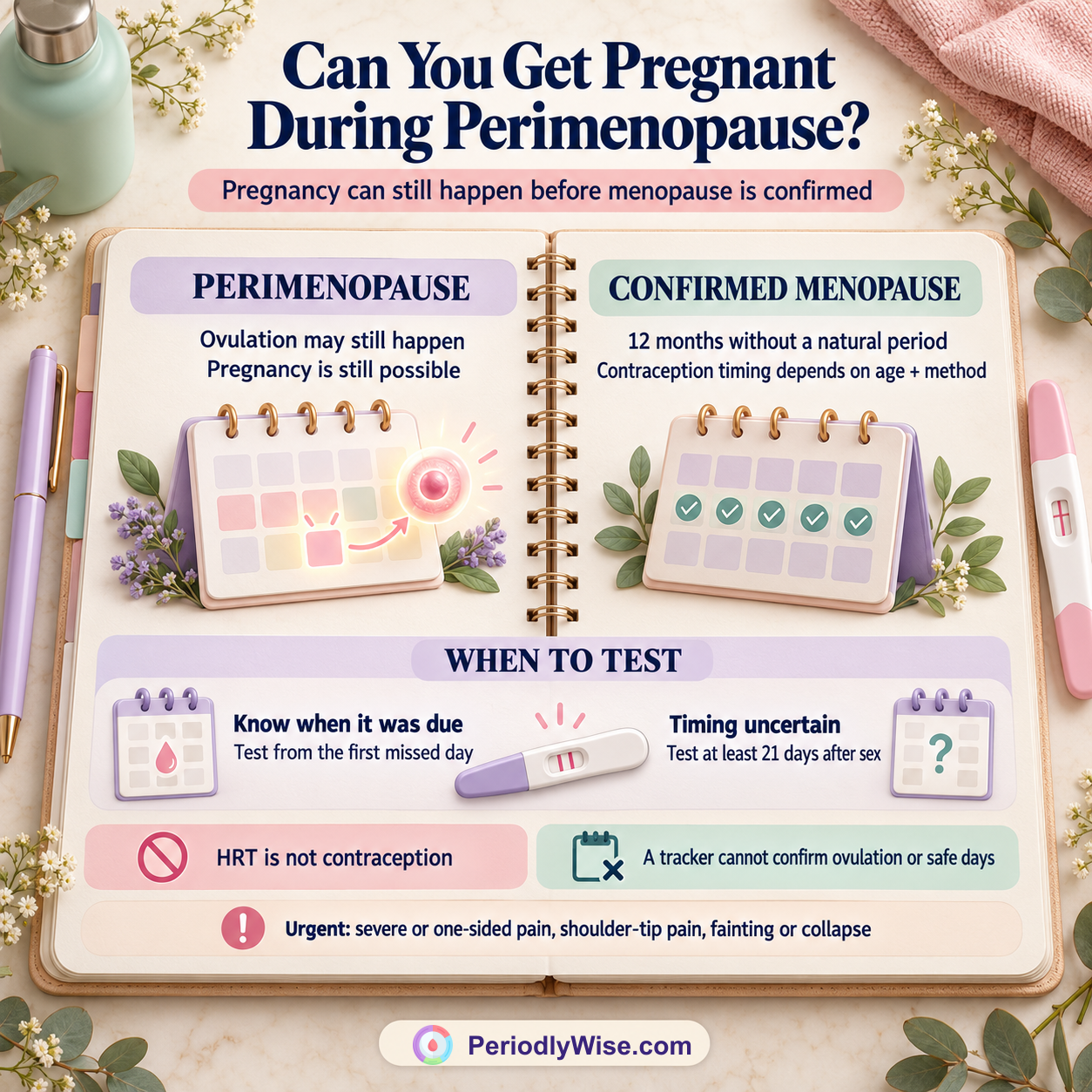
The Office on Women's Health describes perimenopause as the transition before the final menstrual period. Hormone production becomes less predictable, and ovulation may happen in some cycles but not others. It is possible to have months without a period and later release another egg.
Pregnancy can happen if sperm and a viable egg meet at the right time. The Office on Women's Health menstrual-cycle guide notes that sperm may remain alive in the reproductive tract for several days. Sex does not have to occur on an accurately predicted ovulation day for conception to be possible.
A long cycle is therefore not automatically a protected cycle. Looking back after bleeding returns may help you describe the pattern, but it cannot make an earlier decision to skip contraception safe. If avoiding pregnancy matters to you, choose protection for the uncertainty rather than trying to prove that a particular month was probably anovulatory.
Perimenopause is not the same as confirmed menopause
Natural menopause is identified after 12 months without a period when the absence is not explained by hormonal contraception or another cause. Perimenopause is the transition leading up to that point. NHS guidance explains that periods can become closer together, further apart, heavier or lighter during the transition.
That definition is not a universal instruction to stop birth control after any 12-month gap. Hormonal methods can stop bleeding, and contraception-stopping recommendations also depend on age and method. A clinician can distinguish a likely natural final period from bleeding changes caused by treatment.
| What you notice | What it does not establish | A useful next step |
|---|---|---|
| What you noticeA few missed periods | What it does not establishThat all future ovulation has stopped. | A useful next stepConsider pregnancy testing and review the changed pattern. |
| What you noticeHot flushes and irregular cycles | What it does not establishThat pregnancy is impossible. | A useful next stepDiscuss symptoms and contraception as separate questions. |
| What you noticeNo bleeding with a hormonal method | What it does not establishThat natural menopause has been confirmed. | A useful next stepAsk for advice specific to your contraceptive method. |
| What you noticeBleeding after established menopause | What it does not establishThat normal fertility has returned. | A useful next stepArrange assessment rather than calling it another period. |
How likely is pregnancy, and why is there no single percentage?
Age affects both the number of eggs remaining and their reproductive potential. ACOG explains that fertility declines more quickly from the mid-30s and that natural pregnancy is unlikely by 45. Unlikely is not the same as impossible for someone who is still ovulating.
A statistic for a broad age group is not an individualized chance for a person in perimenopause. Age, whether ovulation occurs, timing of sex, contraception, sperm factors, reproductive history and health all matter. A pregnancy rate per cycle is also different from a chance of live birth or a contraceptive failure rate over a year.
For prevention, the useful question is whether you still need reliable protection, not whether an online estimate seems small. For conception, the useful question is which assessment or treatment discussion could help now. Neither goal is served by a precise-looking number without the right context.
Could symptoms tell you whether it is pregnancy or perimenopause?
A missed period, breast tenderness, fatigue, sleep changes or a change in how you feel can be difficult to interpret. The NHS early-pregnancy guide lists several possible pregnancy symptoms, but not everyone has them. Symptoms cannot replace a test, and having symptoms you associate with menopause does not exclude pregnancy.
Nor does a missed period always mean either pregnancy or perimenopause. Stress, changes in weight or exercise, illness and medicines can also affect bleeding. The NHS guide to missed periods advises medical review when periods remain absent or other symptoms accompany the change. Avoid making every new symptom fit a single explanation.
Keep the immediate questions separate: Is there a pregnancy possibility to test for? Are there symptoms that need urgent care? Does the ongoing cycle pattern need a routine assessment? Answering these in order is more useful than trying to recognize a pregnancy from a familiar feeling.
When to take a pregnancy test with irregular periods
The NHS testing advice gives two practical starting points: the first day of a missed period when you know when it was due, or at least 21 days after the most recent unprotected sex if you do not. Perimenopause does not create a separate earlier testing schedule.
- Identify the most recent sex without effective contraception or a possible contraceptive failure. A new exposure creates a new testing timeline.
- Use an in-date test and follow its instructions, including when to read the result. Do not interpret an old test later.
- If the result is negative but pregnancy remains possible, repeat after a few days. Seek medical advice after a second negative result if your period still has not arrived.
- For a positive result, contact a healthcare professional for pregnancy care or confidential options support. Do not dismiss it because you believe you are too old to conceive.
Recent unprotected sex: do not wait for a missed period
If you do not want pregnancy and sex without reliable protection happened recently, contact a pharmacist, sexual-health service or clinician promptly. The NHS emergency-contraception guide describes oral options used within 3 or 5 days, depending on the medicine, and a copper IUD usually fitted within 5 days after sex. Earlier advice gives you more opportunity to use an appropriate option.
Tell the professional when sex occurred, whether there were several exposures, what contraception or HRT you use, and which other medicines you take. The best option and instructions for restarting or continuing hormonal contraception can differ. Availability and prescribing rules also vary by country.
Do not wait to see whether symptoms develop or a test becomes positive: emergency contraception and pregnancy testing address different time windows. You may still need a follow-up test and a plan for ongoing contraception after emergency treatment.
Choosing contraception during the transition
The CDC states that contraception is still needed for people older than 44 who wish to avoid pregnancy. Method choice should consider health and preferences as well as age. There is no requirement to tolerate an unsuitable method simply because menopause may be approaching.
Discuss bleeding preferences, how reliably a method fits daily life, medical history and future pregnancy goals. The NHS method-choice guide treats effectiveness, use, side effects and effects on periods as separate considerations. A method that suits a friend may not suit your circumstances.
- Long-acting methods, pills and non-hormonal choices may be options, but their suitability and follow-up requirements differ.
- Condoms also help protect against sexually transmitted infections. Reduced fertility does not remove that need.
- For combined hormonal contraception, mention smoking, high blood pressure, migraine with aura, clot history and other medicines. CDC eligibility guidance shows why these details can change which methods are appropriate.
- Do not stop or switch an established method without a replacement plan if pregnancy would be unwanted. Ask what protection is needed during the change.
When can you stop birth control?
The answer is age- and method-dependent. For example, UK FSRH guidance distinguishes stopping after natural periods cease from decisions made while using hormonal methods. The table summarizes UK guidance for discussion, not a personal instruction or a universal rule for every country.
US CDC guidance discusses continuing contraception until menopause or approximately ages 50 to 55, with individualized consideration of the risks of pregnancy and the contraceptive method. Ask your clinician which guidance applies to you.
| Situation | UK guidance in context | Important qualification |
|---|---|---|
| SituationFinal natural period before age 50 | UK guidance in contextContraception is generally continued for 2 years after the last natural period. | Important qualificationA medication-related gap in bleeding is not automatically a final natural period. |
| SituationFinal natural period at age 50 or older | UK guidance in contextContraception is generally continued for 1 year after the last natural period. | Important qualificationCheck that the bleeding history can be interpreted reliably. |
| SituationNo bleeding while using hormonal contraception | UK guidance in contextUse method-specific advice; do not simply apply the natural-period rule. | Important qualificationSome people need a planned method change or selected clinician-directed testing. |
| SituationAge 55 | UK guidance in contextContraception can generally stop because spontaneous conception is exceptionally rare. | Important qualificationAn IUD or another medicine may still have a separate treatment role or require removal advice. |
HRT is not birth control
Standard menopausal hormone replacement therapy does not provide contraception. The NHS specifically explains that oestrogen tablets, patches, gel and spray do not act as contraceptives. Having progesterone in an HRT regimen does not make it equivalent to a contraceptive pill.
Some treatment plans combine HRT with a contraceptive method, but the protection comes from the contraceptive component used correctly and within its appropriate duration. If a hormonal IUD has more than one role in your care, ask the prescriber to confirm which purpose its replacement date covers. NHS IUD guidance distinguishes contraception duration from HRT-related replacement timing; do not assume they are interchangeable.
The NHS HRT timing guide also distinguishes the combined contraceptive pill from progestogen-only contraception when discussing HRT combinations. Do not add HRT to a combined pill or change a prescribed combination yourself. If pregnancy is confirmed while using menopausal HRT, contact the prescriber promptly for advice about stopping it and arranging care.
What hormone tests and ovulation trackers cannot prove
A positive home menopause test is not proof that you can no longer become pregnant. The FDA explains that these urine tests detect elevated FSH, not a definitive end of fertility, and warns against stopping contraception on the result. A negative result also does not settle whether symptoms are menopausal.
NICE usually identifies perimenopause clinically in otherwise healthy people aged 45 or over who have characteristic symptoms and cycle changes. Hormonal treatments can complicate interpretation. FSH testing has selected uses; it is not a universal one-result fertility certificate.
AMH is another different question. ASRM guidance explains that ovarian-reserve tests can help estimate response to fertility treatment but are poor independent predictors of reproductive potential. Low AMH does not by itself establish that spontaneous pregnancy is impossible, and a reassuring number does not guarantee conception.
Similarly, an app estimate is not confirmation of ovulation. A home LH result should not be used as proof that sex is safe without contraception. If tracking is part of a fertility-care plan, ask the clinician which observations or tests are useful for your particular cycle pattern.
If you want to become pregnant, ask for advice early
You do not need to spend a year trying to interpret highly irregular cycles before requesting help. ASRM recommends evaluation after 6 months of trying from age 35, and notes that more immediate evaluation may be appropriate over 40. Irregular or absent cycles can justify assessment without waiting for a standard interval.
An assessment may consider ovulation, reproductive anatomy and relevant sperm factors together. Explain your goals, cycle pattern, prior pregnancies or losses, surgeries, medicines and any known fertility concerns. An appointment is an opportunity to discuss realistic possibilities, not a promise that a particular treatment will work.
- Arrange a preconception visit and medication review. Do not stop a necessary long-term medicine without a safe alternative plan.
- Discuss folic acid. The NHS recommends 400 micrograms daily when trying to conceive and through the first 12 weeks of pregnancy; some medical histories need a prescribed higher dose.
- Ask about relevant health conditions, vaccinations and an appropriate fertility referral. Bring earlier test results rather than ordering repeated panels independently.
- If pregnancy occurs, arrange early prenatal care. Ask for individualized discussion of screening, medical risks and the care schedule.
Pregnancy risks and pregnancy after menopause are separate questions
ACOG describes increasing risks with later reproductive age, including pregnancy loss, chromosome conditions and certain pregnancy complications. Those risks vary, and age alone does not predict what will happen in an individual pregnancy. Care planning should be specific, supportive and free from blame.
After confirmed natural menopause, spontaneous pregnancy from a newly ovulated egg is not expected. That is different from carrying a pregnancy created through assisted reproduction. The HFEA explains that donated eggs may be used by people who have gone through menopause, while its donor-conception guidance describes circumstances in which donated eggs or embryos may be considered.
Treatment eligibility, a suitable uterus, overall health, local rules and clinic assessment all matter. A story about an IVF pregnancy after menopause therefore does not tell you the chance of spontaneous conception during perimenopause. Nor does it establish that treatment is appropriate or accessible for everyone.
When symptoms need urgent or prompt assessment
If pregnancy is possible, severe or worsening lower-abdominal pain, pain on one side, shoulder-tip pain, dizziness, fainting or collapse may signal an urgent problem. The NHS ectopic-pregnancy guidance advises assessment even without a positive pregnancy test when concerning symptoms occur. Sudden intense pain with faintness or collapse needs emergency help.
Very heavy bleeding accompanied by breathlessness, marked weakness, chest pain or feeling faint also needs urgent care. ACOG discusses the importance of assessing heavy bleeding and associated anemia. Do not assume a new severe bleeding episode is harmless because heavy periods can happen during perimenopause.
After established menopause, arrange assessment for any new vaginal bleeding, including a small amount, spotting or brown discharge. The NHS advises getting this checked even if it happens only once. It does not necessarily mean cancer, but it should not be treated as proof that ovulation or ordinary periods have restarted.
What to record without turning tracking into contraception
A concise record can make an appointment easier. It can show what changed and help you remember dates without requiring you to diagnose the cause. Record only what you are comfortable storing, especially when sex, contraception or pregnancy concerns are sensitive.
For example, write down the date of the last bleeding episode, whether it was normal flow or spotting, any later sex that could lead to pregnancy, and the date and result of each test. Add contraception or HRT changes. This is a timeline for a discussion, not proof of which day ovulation occurred.
- Bleeding start dates, duration and whether the amount differs from your usual pattern.
- Pregnancy-test dates and results, with the relevant exposure date if you choose to record it.
- Contraception, missed doses or possible failures, HRT and other medication changes.
- Pain, hot flushes, sleep disruption and symptoms that affected everyday activities.
- Your main question: pregnancy prevention, trying to conceive, symptom treatment or bleeding assessment.
Frequently asked questions
Can I get pregnant after missing periods for several months?
Yes, if you are still in perimenopause and ovulation resumes. A few missed periods do not establish permanent loss of fertility. If pregnancy is possible, use appropriately timed testing rather than interpreting the gap alone.
Can I get pregnant at 45 or 50?
Spontaneous pregnancy becomes less likely with age, particularly later in the 40s, but age alone is not a personal guarantee. If you want to avoid pregnancy, discuss when contraception can stop based on your age, method and clinical history.
Does HRT prevent pregnancy?
No. Standard menopausal HRT is not contraception. Some care plans include a separate contraceptive method, but you need to confirm which part provides pregnancy protection and whether it is still within its appropriate duration.
Is one year without a period enough to stop contraception?
Not for everyone. Age, hormonal contraception and the cause of absent bleeding matter. UK guidance generally uses a longer interval after a final natural period before 50. Ask for a method-specific plan rather than applying one rule to every situation.
Does a positive home menopause test mean pregnancy is impossible?
No. The FDA warns that a home FSH test cannot reliably establish whether you can become pregnant. Do not stop contraception because of a positive or negative menopause-test result.
Does low AMH mean I cannot conceive naturally?
Not by itself. AMH helps with some fertility-treatment decisions, but it is not an independent yes-or-no test for spontaneous conception. Interpret it with age, cycle history and the rest of a clinical assessment.
Can hot flushes rule out pregnancy?
No. A symptom you associate with perimenopause does not answer a pregnancy question. Consider the timing of sex and a pregnancy test, and seek assessment for symptoms that are persistent, unusual or concerning.
Should I wait 12 months before asking for fertility help?
Not if your age, irregular cycles or history justify earlier assessment. ASRM supports more prompt evaluation over 40 and without delay for known concerns such as markedly irregular or absent cycles. Discuss your goals early.
Can bleeding after menopause mean my fertility returned?
Do not make that assumption. Bleeding after established menopause needs medical assessment, even when light or only once. It is not evidence that natural ovulation has restarted.
Can PeriodlyWise tell me which days are safe from pregnancy?
No. Its calendar predictions are for cycle awareness and record keeping. Unpredictable ovulation during perimenopause makes it especially important not to use an estimated fertile window as permission to skip contraception.
Use PeriodlyWise to record cycle dates and changes you want to discuss. Treat predictions as estimates, not as contraception or a fertility test.
Open the Irregular Period TrackerThe bottom line
Pregnancy is still possible during perimenopause, even when periods are infrequent. The next useful step depends on your goal: timely testing or emergency-contraception advice after a possible exposure, an individualized birth-control plan, or early fertility support if you want to conceive.
Keep symptom care, pregnancy prevention and fertility assessment as separate conversations when needed. You do not have to choose between treating menopause symptoms and taking a pregnancy concern seriously. If you feel unwell or bleeding changes are concerning, seek care rather than trying to settle the question with an app or home hormone test.