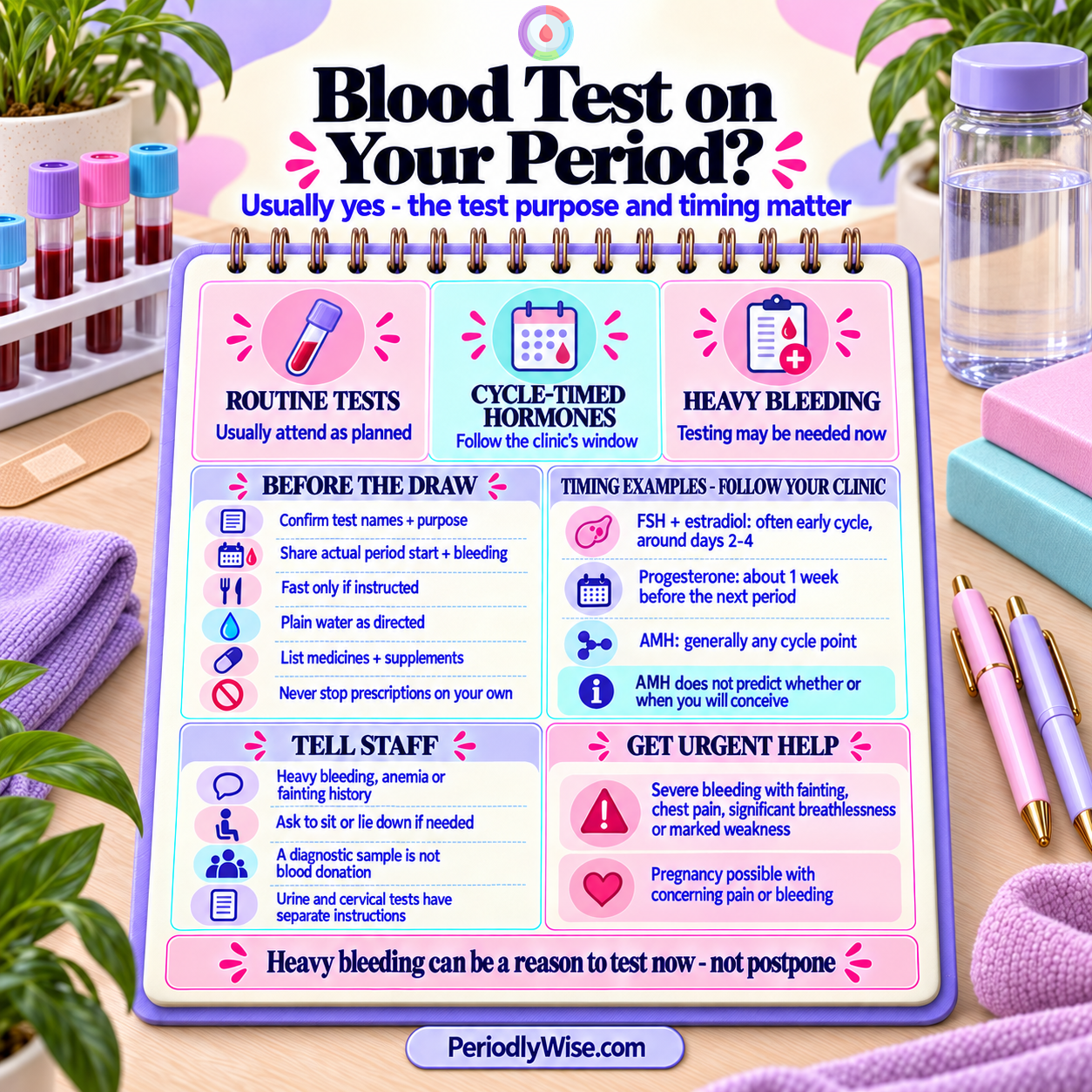
Yes, you can usually have a blood test on your period. Menstrual bleeding is not, by itself, a reason to cancel a routine blood draw from your arm. The important questions are which tests were ordered, why they are needed, and whether the clinician or laboratory specified a particular cycle day or preparation plan.
There are two different concerns behind this question: whether drawing blood is appropriate while you are bleeding, and whether the result will answer the intended medical question. Many routine tests can go ahead. Some fertility-related tests are deliberately scheduled during a period, while a progesterone test intended to assess recent ovulation is usually timed later. Treating every blood test as the same procedure can lead to an unnecessary cancellation or a poorly timed sample.
This guide helps you prepare for the conversation with the ordering team, understand common exceptions and know when symptoms need more than a routine appointment. It does not provide a personal hormone-testing calendar or diagnose anemia from a symptom list. A period tracker can supply dates; the test request and clinical situation determine what happens next.
Start with the purpose of the test, not the period date
A blood test is a sample, not one single investigation. The same appointment may include a blood count, kidney markers, thyroid testing or a hormone panel, each answering a different question. Ask for the actual names on the request instead of relying on a broad phrase such as a full checkup or women's health panel. The NHS blood-test overview describes this range of purposes.
A useful way to sort the request is into routine health monitoring, cycle-timed reproductive testing, or assessment of current symptoms. A planned health check may have no menstrual-day requirement. A fertility clinic may want an early-cycle baseline. A clinician investigating heavy bleeding may want a sample now because the current bleeding and symptoms are relevant to the assessment.
If the period starts unexpectedly the night before an appointment, do not automatically cancel. Read the instructions and contact the ordering team if timing is unclear. A receptionist may confirm attendance, but a clinician or laboratory should resolve medical preparation questions. If several tests are bundled together, ask whether one requires special timing or whether the order needs to be split.
Common blood tests: what to check during a period
The table is a conversation guide, not a replacement for a laboratory's instructions. No single rule says that every blood result is unchanged by menstruation or that every result becomes unreliable. Blood loss, underlying illness, medication and the reason for testing can matter even when the sample is correctly collected.
For many routine requests, preparation is more important than avoiding bleeding days. A sample drawn from a vein in your arm is not exposed to menstrual blood in the way a urine sample can be. Being on your period therefore does not physically contaminate that venous sample. The team may still need the period date to interpret reproductive hormones or understand the bleeding history.
| Test or reason | Period-day context | Question to ask |
|---|---|---|
| Test or reasonComplete blood count (CBC/FBC) | Period-day contextCan be used to assess anemia during heavy bleeding. | Question to askIs this urgent, and when will the result be reviewed? |
| Test or reasonFerritin or other iron studies | Period-day contextBleeding history and other health factors inform interpretation. | Question to askDo I need fasting, a morning sample or supplement instructions? |
| Test or reasonGlucose or lipid testing | Period-day contextFollow the particular fasting or nonfasting request. | Question to askWhich preparation applies to this exact order? |
| Test or reasonKidney, liver or electrolyte tests | Period-day contextUsually not scheduled solely around a period. | Question to askAre there medicine, food or timing instructions? |
| Test or reasonThyroid testing | Period-day contextA period is not usually a reason to cancel; the full panel may have instructions. | Question to askShould I keep the usual medicine schedule before this draw? |
| Test or reasonReproductive hormone testing | Period-day contextThe intended cycle phase may be important. | Question to askWhich cycle day or interval did the clinician request? |
| Test or reasonBlood pregnancy test (hCG) | Period-day contextUnusual bleeding does not exclude pregnancy. | Question to askIs a repeat test or clinical assessment needed? |
Heavy periods, a blood count and iron: why waiting can be unhelpful
A test ordered because of heavy bleeding should not be postponed just to make the result look normal. A blood count measures blood cells and hemoglobin; the clinician uses those findings alongside your symptoms and history. A low result during bleeding is not automatically a false result caused by choosing the wrong day. It may be relevant to why you need care.
NICE guidance for heavy menstrual bleeding includes a full blood count in assessment. Additional tests depend on the situation; this does not mean that everyone with a period needs a hormone panel or that everyone with heavy flow needs the same iron-testing package. Local guidance, previous results, age, diet and symptoms may shape the plan.
Ferritin relates to stored iron, while a blood count and other iron studies supply different information. Ferritin can also rise with inflammation, so an apparently reassuring value must be interpreted in context. MedlinePlus explains this limitation. Do not diagnose iron deficiency from fatigue alone or assume that a normal blood count explains all persistent symptoms.
Tell the clinician about flooding, repeated night changes, bleeding that disrupts life, previous low iron, recent illness and any iron treatment. Do not start high-dose iron, double a dose or stop prescribed treatment to prepare without advice. Testing and treating the cause of heavy bleeding are different tasks; a result alone does not explain why bleeding is happening.
Hormone blood tests: early-cycle tests are different from progesterone
Reproductive hormones change during the cycle. Testing during a period may be the correct timing, not a problem to avoid. An early-follicular baseline and a later ovulation-related test answer different questions. Use the request from your own clinic rather than a universal internet hormone calendar.
For some baseline assessments, FSH and estradiol are measured together around cycle days 2-4. Clinics may give a slightly different early-cycle window, such as days 2-5, and include LH. Frimley Health's patient guidance specifically explains testing while bleeding may still be present. Do not move that appointment until after the period just because you are uncomfortable with the idea of testing during it.
Progesterone intended to support assessment of recent ovulation is generally checked about a week before the expected next period. Day 21 is not the right date for every cycle. AMH can generally be measured at any cycle point, but interpretation and the clinic's combined testing plan still matter. These distinctions are explained in ASRM's fertility-evaluation guidance; do not use them to order or diagnose yourself from a panel.
| Hormone request | Typical timing principle | Important limit |
|---|---|---|
| Hormone requestBaseline FSH and estradiol | Typical timing principleOften early follicular phase, around days 2-4. | Important limitFollow the clinic's specified window and interpretation. |
| Hormone requestLH with a baseline panel | Typical timing principleMay be requested in the early-cycle appointment. | Important limitAn LH value alone does not prove ovulation or diagnose PCOS. |
| Hormone requestProgesterone for recent ovulation | Typical timing principleOften about one week before the expected next period. | Important limitA single value does not grade luteal-phase quality. |
| Hormone requestAMH | Typical timing principleCan generally be measured at any cycle point. | Important limitDoes not independently predict whether or when you will conceive. |
| Hormone requestOther endocrine tests | Typical timing principleTiming or resting instructions depend on the test and clinical question. | Important limitDo not apply a day-3 rule to every hormone. |
How to describe cycle day when bleeding or cycles are unclear
Cycle day 1 is counted from the start of a period. Fertility services commonly distinguish established menstrual flow from preceding light spotting; ask how your clinic defines day 1, including bleeding that begins late in the day. A predicted date in an app is not the same as the actual start date. Report what happened rather than adjusting the record to fit the appointment.
If you have irregular cycles, no periods, prolonged spotting or a new bleeding pattern, call for an individualized plan. You may not be able to calculate a reliable next-period date for progesterone testing. The clinician may choose a different schedule, repeat assessment or investigate the pattern first. Do not keep delaying evaluation until a supposedly perfect cycle appears.
Hormonal contraception, hormone therapy, fertility treatment, breastfeeding and postpartum changes can alter what bleeding and hormone values mean. A withdrawal bleed on some contraceptive schedules is not automatically evidence of an ordinary ovulatory cycle. Tell the team exactly what you use and whether the bleeding is expected. ASRM notes contraceptive effects on ovarian-reserve markers; any treatment pause belongs to a clinical plan, not a self-directed attempt to improve the numbers.
Fasting, water and food: follow the actual request
Do not fast simply because you are having a blood test. A CBC alone usually needs no special preparation, although another test in the same draw may. Fasting and nonfasting glucose or lipid requests are not interchangeable. Ask whether fasting is required, exactly how long, and whether there are additional instructions for a morning sample.
If fasting is requested, plain water is generally allowed for a routine fasting blood test. Coffee, sweetened drinks, milk and juice are not substitutes. Follow your own instructions and any fluid restriction for another medical condition; do not force large amounts of water. MedlinePlus fasting guidance explains why preparation should match the order rather than an assumed all-day fast.
When no fasting is required, there is no need to skip meals to make the blood seem cleaner. If you accidentally eat during a requested fast, tell the team instead of hiding it or extending the fast indefinitely. They can decide whether a sample is still useful or should be rescheduled. If you have diabetes, are pregnant, have a condition affected by fasting or use medicines tied to meals, obtain a safe individualized plan in advance.
Medicines and supplements can matter more than the period label
Bring an accurate list of prescription medicines, over-the-counter pain medicines, contraception, hormone treatment, vitamins and supplements. Include dose and when you last took them if asked. Do not stop prescribed medicine, including anticoagulants or hormones, on your own before testing. The clinician may need to know the usual treatment exposure, not a temporarily altered routine.
Biotin in some hair, skin and nail products can interfere with certain laboratory methods. The FDA describes this issue. Tell the laboratory what you take; do not invent a universal washout interval because it depends on the product, dose and test. The same practical approach applies to iron supplements when iron studies are ordered: ask for specific instructions, rather than guessing whether to take or omit a dose.
If you took a pain medicine for cramps before remembering the appointment, tell the team what and when. That does not automatically mean every test is ruined. Equally, do not assume that a nonprescription or natural product is irrelevant. Clear disclosure lets the ordering clinician decide how to interpret the sample or whether preparation needs changing.
A practical appointment checklist, including faintness
A routine diagnostic draw uses a small sample and is not the same as a whole-blood donation. Still, symptoms and previous reactions matter. Tell the person taking the sample about heavy bleeding, known anemia, dizziness, needle anxiety or a previous faint before the draw starts. Ask whether you can lie down if you have fainted during a blood test before.
Do not try to stand through worsening lightheadedness. Tell staff immediately, remain seated or lie down as directed, and let them assess you. Needle-related fainting is one possible explanation, not proof that severe dizziness during heavy bleeding is harmless. Kettering General Hospital's guidance emphasizes telling staff about faintness.
- Confirm the order: test names, purpose, location and any cycle-day window.
- Check preparation: fasting, water, time of day and medicine or supplement advice.
- Bring context: actual period start, current bleeding, symptoms and relevant previous results.
- Plan comfort: accessible sleeves, your usual period supplies and support if you need it.
- Tell staff early: fainting history, current dizziness, difficult previous draws or significant bleeding.
- Arrange follow-up: who reviews the results, when to contact them and what symptoms need earlier care.
How to read results without blaming every abnormal value on menstruation
An abnormal flag is not a diagnosis, and a normal flag is not an explanation for every symptom. The clinician considers the lab's reference range, the test purpose, trends, treatment and your health history. Reproductive-hormone ranges may depend on cycle phase. Comparing an early-cycle result with a different phase or another laboratory's units can create unnecessary alarm.
A low hemoglobin or an unexpected hormone result should not be dismissed with a blanket statement that periods always skew blood tests. Ask whether the finding is clinically meaningful, whether timing or preparation matters, and what follow-up is appropriate. A repeat test should have a reason and plan, not simply be scheduled every month until a preferred number appears.
An AMH result is not a personal fertility deadline, an LH/FSH comparison is not a stand-alone PCOS diagnosis, and one progesterone result cannot assess the quality of an entire luteal phase. Results are pieces of an assessment. MedlinePlus's results guide explains why ranges and context matter; use the ordering team's explanation rather than social-media screenshots as your reference.
Ask who will contact you and what to do if no message arrives. A portal that releases numbers before a discussion can be useful, but it can also leave important context missing. Persistent fatigue, breathlessness, troublesome bleeding or new symptoms deserve follow-up even when one test falls within its stated range.
Blood tests are not urine tests, cervical screening or donation
A health-check appointment may include several different samples. Menstrual blood can enter a urine container and complicate interpretation, unlike a correctly drawn arm-vein sample. Tell staff if a urine test is also planned and ask for the specific collection or scheduling instructions. This NHS urine-sample guide explains the contamination issue. Do not postpone assessment of urgent urinary symptoms on your own.
Cervical screening has its own sample-quality considerations, so advice about booking a smear cannot be copied directly onto a blood-test request. Blood donation also follows donor eligibility, hemoglobin screening and wellbeing rules; a diagnostic blood sample is a different procedure. If you mean donation rather than testing, use the related guide and the local donor service's instructions.
A blood pregnancy test can be performed when someone has bleeding. Bleeding that seems like a period does not always exclude pregnancy, and hCG results may need follow-up based on timing and symptoms. A positive result does not establish where the pregnancy is located. Do not wait for a routine result if pregnancy is possible and you develop severe pain, collapse or other urgent signs.
When to seek care instead of waiting for the appointment
Arrange assessment for heavy or prolonged bleeding that is new, recurrent or affecting daily life, especially with fatigue, reduced exercise tolerance or recurring lightheadedness. Tell the team about bleeding between periods, easy bruising, a family history of bleeding problems or bleeding after menopause. The right evaluation may include more than blood tests.
Seek emergency help for severe bleeding with fainting, chest pain, significant breathlessness or marked weakness. ACOG highlights soaking a pad or tampon hourly for more than two hours together with concerning symptoms as an emergency pattern. You do not need to reach a particular product count before seeking help for collapse or severe illness. Do not drive yourself if faint or unsafe.
If pregnancy is possible, unusual bleeding with one-sided pain or shoulder-tip pain needs urgent medical advice; severe pain, fainting or collapse needs emergency assessment. NHS ectopic-pregnancy guidance notes that bleeding can be mistaken for a period. This is a safety threshold, not a diagnosis from symptoms alone.
Useful notes and questions for the ordering team
A brief record can prevent misunderstandings without turning daily life into a laboratory project. Record actual dates, the test names, flow and symptoms, and the instructions you received. Keep sensitive health information only where you are comfortable storing it; a private note or the clinic's own portal may be enough. No photograph of menstrual blood or intimate anatomy is needed for this routine checklist.
The examples below are constructed appointment scenarios, not patient reports or recommended treatment schedules. They show how the same period date can lead to different questions depending on the test. Do not use a sample scenario to override your own request or to infer a diagnosis.
| Illustrative situation | Useful information | Next question |
|---|---|---|
| Illustrative situationPeriod starts before a routine CBC | Useful informationActual start date and whether bleeding or symptoms are unusual. | Next questionCan I attend as planned, and is any other test bundled in? |
| Illustrative situationEarly-cycle fertility panel | Useful informationFirst day of established flow and the clinic's requested window. | Next questionDoes this appointment match your definition of cycle day? |
| Illustrative situationIrregular cycle with progesterone request | Useful informationRecent period dates and uncertainty about the next period. | Next questionHow should timing be individualized or followed up? |
| Illustrative situationHeavy bleeding and faintness | Useful informationFlow, symptom severity, pregnancy possibility and medicine list. | Next questionDo I need immediate assessment rather than routine testing? |
- What medical question will these tests answer, and why are they being ordered?
- Is the sample needed now, in a cycle window, or at a particular time of day?
- What should I do if bleeding is only spotting, cycles are irregular or preparation changes?
- Which result or symptom needs prompt contact, and who will explain the next steps?
Frequently asked questions
Should I cancel a routine blood test because my period started?
Usually not. Check the exact tests and preparation instructions. A routine draw is not normally cancelled solely for menstruation, and some fertility tests are intentionally early-cycle. Contact the ordering team if the purpose, cycle day or symptoms make attendance uncertain.
Can I have a CBC or iron test while bleeding?
Yes, these may be ordered to assess heavy bleeding or anemia symptoms. Current bleeding is relevant context, not an automatic reason to reject the sample. Iron studies can have their own preparation instructions. Let the clinician choose the needed tests and interpret them rather than ordering every marker yourself.
Are all hormone tests best on day 3?
No. Some baseline FSH and estradiol requests use an early-cycle window, while progesterone for recent ovulation is generally timed about a week before the expected next period. AMH can generally be measured at any cycle point. Other endocrine tests have their own requirements; follow the clinical request.
Is progesterone always a day-21 blood test?
No. Day 21 fits a particular cycle pattern, not every person. Longer, shorter or irregular cycles may require a different plan. Ask how the test should be timed to its purpose. One appropriately timed result can support recent ovulation but cannot grade luteal-phase quality.
Can I drink water or take cramp medicine beforehand?
Plain water is generally allowed for a routine fasting blood test, subject to your own instructions and medical fluid restrictions. Ask about medicines in advance, including pain medicines. Do not stop prescriptions or assume every supplement is harmless for testing. If you already took something, report what and when.
Does a period make every abnormal result false?
No. Menstruation does not invalidate an entire blood sample. Bleeding history and cycle phase may matter for particular results, but anemia or another abnormal finding deserves interpretation, not automatic dismissal. Ask whether preparation, illness, medicines or repeat testing need to be considered.
What if I feel faint at the blood-test appointment?
Tell staff immediately and remain seated or lie down as directed. Mention previous fainting before the draw. Do not stand up or drive while unsafe. Severe dizziness with heavy bleeding, chest pain, breathlessness, severe pain or pregnancy-related concerns needs assessment, not reassurance based only on needle anxiety.
Can bleeding rule out pregnancy before a blood test?
No. Some pregnancy-related bleeding can be mistaken for a period. Tell the clinician about pregnancy possibility, unusual bleeding and pain. hCG testing may need follow-up, and a positive result alone does not locate a pregnancy. Severe pain, fainting or collapse warrants emergency help without waiting for a routine result.
Use PeriodlyWise to organize actual period start dates, then keep a brief private note of the test request and symptoms for your clinician. App predictions do not decide a laboratory schedule, diagnose anemia, interpret hormones or replace urgent assessment.
Open the period trackerThe takeaway
A period usually does not stop you having a blood test. The test's purpose determines whether the right approach is to attend as planned, confirm a cycle-day window or seek prompt clinical assessment. Do not postpone a sample ordered for heavy bleeding just to wait for a quieter day.
Confirm the exact order, preparation and follow-up, disclose medicines and supplements, and report bleeding or faintness. Useful dates and clear questions help the team; they do not replace clinical judgment or make a universal hormone-testing calendar safe.