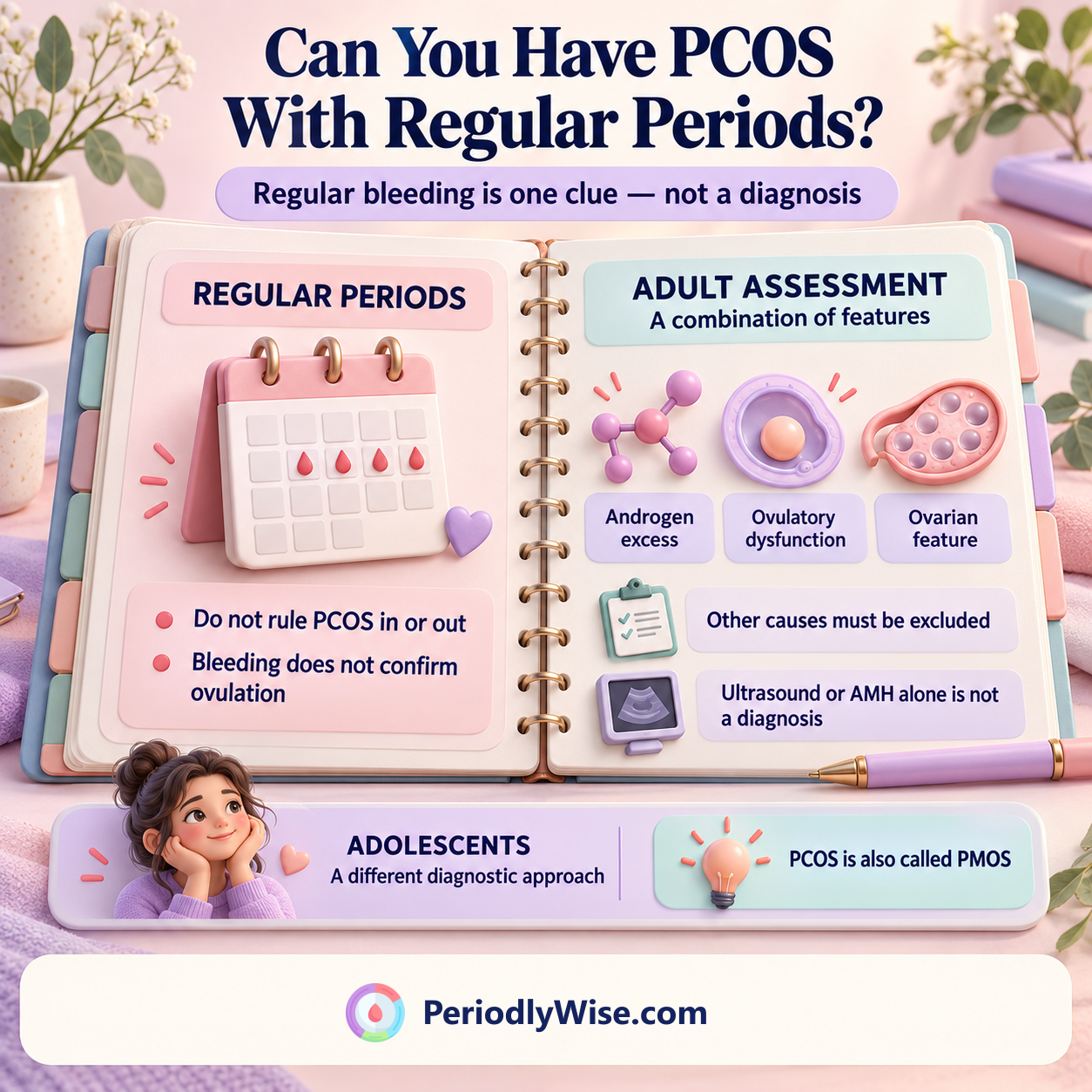
Yes, you can have PCOS with regular periods. Predictable bleeding is helpful information, but it does not by itself exclude the condition. Some adults have regular ovulation alongside other diagnostic features; others have bleeding that seems regular even when ovulation is not happening consistently.
The reverse matters just as much: acne, a few unwanted hairs or a worrying online checklist do not establish PCOS. A useful assessment asks what symptoms are present together, whether medicines affect the picture, and which other explanations need checking. The aim is neither to dismiss symptoms because your calendar looks tidy nor to label ordinary variation as disease.
A note on terminology: the NHS now uses polyendocrine metabolic ovarian syndrome (PMOS) for the condition previously called polycystic ovary syndrome. This guide keeps the familiar search term PCOS while explaining the same clinical question. Names on older reports and newer resources may therefore differ.
What regular periods do, and do not, tell you
Cycle length is counted from the first day of one period to the first day of the next, not by whether bleeding lands on the same calendar date. A monthly pattern can be reasonably consistent without being exactly 28 days. Note actual starts, the range between them and whether bleeding is a normal flow or only spotting.
For adults more than three years after their first period, the international PCOS guideline flags cycles shorter than 21 days, longer than 35 days or fewer than eight cycles per year as irregular in this diagnostic context. These thresholds are not a complete definition of health and should not be applied unchanged to younger teenagers.
Regular spontaneous cycles often suggest ovulation. Nevertheless, the international guideline explicitly recognizes ovulatory dysfunction with regular cycles. A diary records bleeding; it cannot look inside the ovary. Whether you need ovulation testing depends on symptoms and goals, not simply on having downloaded a tracking app.
How an adult diagnosis can fit with regular bleeding
Adult diagnosis generally requires at least two of three features after other causes have been excluded: clinical or biochemical androgen excess; ovulatory dysfunction; and polycystic ovarian morphology. In adults, appropriately interpreted AMH can sometimes be used instead of ultrasound to define the ovarian feature, not as an extra fourth criterion.
That allows more than one clinical picture. Someone may ovulate regularly but have both androgen excess and characteristic ovarian findings. Someone else may have apparently regular bleeding, an assessment showing ovulatory dysfunction and another qualifying feature. Neither situation can be established from dates alone.
| Finding | What it can contribute | What it cannot establish alone |
|---|---|---|
| FindingRegular natural periods | What it can contributeUseful cycle history; ovulation may be likely. | What it cannot establish aloneThat PCOS is impossible, or that every cycle is ovulatory. |
| FindingAndrogen excess | What it can contributeRelevant symptoms and/or reliable hormone measurements. | What it cannot establish aloneA diagnosis based on one pimple, one hair or one uncontextualized result. |
| FindingOvarian morphology | What it can contributeAn adult diagnostic feature when assessed appropriately. | What it cannot establish alonePCOS from an ultrasound description alone. |
| FindingOvulatory dysfunction | What it can contributeA reason to assess the wider hormonal picture. | What it cannot establish aloneThe cause of the dysfunction without further assessment. |
These are explanations of the diagnostic framework, not a do-it-yourself scoring tool. Test methods, age, medicines and alternative conditions change interpretation.
Which symptoms make a conversation worthwhile?
Discuss new or troublesome facial or body hair, persistent acne, scalp hair thinning, difficulty conceiving or a changing bleeding pattern. Bring the symptoms that affect you, even if they seem unrelated. The NICHD symptom overview illustrates why the condition may not look identical from person to person.
The pattern and speed of change matter. Gradually increasing coarse hair over several years is different from rapid, marked changes over a few months. Acne or hair thinning in isolation is less specific than a broader clinical picture. Other skin, thyroid, medication-related or hormonal explanations may be more appropriate.
Body size is not a reliable exclusion test. Do not assume that being lean rules out PCOS, or that being in a larger body establishes it. Assessment should address your concerns without making weight the only subject of the appointment.
- Describe the change: when it began, how quickly it developed and how it affects daily life.
- Describe your natural cycles: include the pattern before hormonal contraception, when known.
- Include family and treatment context: relevant diagnoses, medicines and supplements can help interpret symptoms.
Why a scheduled pill bleed is a different clue
A bleed during a combined-pill break is a withdrawal bleed, not proof of a natural ovulatory cycle. Other hormonal methods can change or suppress bleeding too. A predictable medication schedule can make the calendar look regular without answering what your untreated cycles would do.
Combined hormonal contraception also changes androgen measurements. Tell the clinician exactly what you take and when you started it. If testing would require a different plan, contraception and symptom control need to be considered together. Do not stop prescribed contraception just to obtain a more 'natural' test result.
Old records may be useful when current cycles are medicine-controlled. It is fine if you cannot reconstruct years of dates: a clear statement that the previous pattern is uncertain is more helpful than invented precision.
What an assessment may include
A consultation usually begins with your bleeding history, symptoms, medication use, pregnancy possibility and reproductive goals. Depending on the findings, a clinician may examine skin and hair changes and request selected blood tests. The appropriate work-up is not a universal shopping list.
Other explanations may need excluding, including thyroid dysfunction, elevated prolactin and non-classic congenital adrenal hyperplasia. Pregnancy testing may be relevant when bleeding is late or unusual. Rapid or marked androgen changes can require assessment for less common causes rather than an assumption of routine PCOS.
- Write down the main question: symptoms, an existing scan, future pregnancy planning or a change in cycles.
- Bring your actual period dates and state which cycles occurred without hormonal contraception.
- List prescribed medicines, contraception and supplements, with recent changes.
- Ask which diagnostic features are present and what other causes are being considered.
- Agree what results would change care, how you will receive them and when follow-up is needed.
You can ask for an explanation before an examination or scan, discuss a chaperone and decline a procedure. Shared decisions are part of an assessment, not an obstacle to it.
If ovulation needs checking, timing matters
Not everyone with regular periods needs repeated ovulation tests. When confirmation would affect fertility care or diagnostic reasoning, a clinician may request progesterone. ASRM advises timing it roughly one week before the expected next period, rather than using day 21 for every cycle length.
A single result needs its collection date, cycle context and laboratory interpretation. It should not be treated as a stand-alone verdict on egg quality, fertility or the whole luteal phase. A mistimed sample can produce confusion rather than an answer.
Urine LH kits detect a hormonal signal, not the physical release of an egg. PCOS can complicate their interpretation, and a positive result does not diagnose either ovulation or PCOS. Temperature charts and cervical mucus observations can add context, but no home tracking method replaces an indicated clinical work-up.
Ultrasound, 'cysts' and AMH: avoid the shortcut
The small follicles described in polycystic ovarian morphology are not the same as a large ovarian cyst causing acute pain. The older name can make a scan sound more alarming or more definitive than it is. An ovarian appearance must be interpreted with the rest of the assessment.
AMH is not a stand-alone PCOS test, a guarantee about fertility or a result with one universal diagnostic cut-off. Age, assay and hormonal contraception influence interpretation. The adult guideline allows AMH as an alternative to ultrasound in a defined diagnostic pathway; it does not encourage ordering both to collect more positive findings.
If you have a scan report, ask what exactly was seen, whether it meets an age-appropriate definition and whether another independent diagnostic feature is present. A report saying 'polycystic ovaries' does not automatically explain every symptom you have.
Teenagers need a different diagnostic approach
Cycles and skin can change substantially in the years after the first period. Applying the adult two-out-of-three framework without that context risks overdiagnosis. The international guideline requires both ovulatory dysfunction and hyperandrogenism for adolescent diagnosis, after other causes are excluded.
Ultrasound ovarian morphology and AMH are not recommended for diagnosing PCOS in adolescents. Someone with features that do not yet meet criteria may still need symptom support and a planned reassessment. Not receiving an immediate diagnostic label should not mean being dismissed or left without care.
Regular periods do not make broader care irrelevant
If PCOS is confirmed, management is guided by what matters to you: skin or hair symptoms, pregnancy intentions, metabolic health, emotional wellbeing and bleeding concerns. A regular cycle does not automatically remove the need for follow-up, and it does not automatically mean medication is necessary.
The WHO overview describes the condition as more than a period problem. Discuss appropriate blood-pressure, glucose and lipid assessment and any mood or sleep concerns with your clinician. Monitoring should be individualized rather than based on appearance.
There is no need to begin restrictive diets, hormone-balancing supplements, metformin or fertility medicines on your own. Ask what a proposed treatment is intended to improve, what evidence supports it, whether pregnancy prevention is needed and what follow-up will be used.
Trying to conceive: keep the question broader than PCOS
PCOS does not equal infertility, and regular periods do not guarantee pregnancy. Ovulation is only one part of conception. Depending on your situation, a fertility evaluation may also address sperm, fallopian tubes and other medical factors rather than attributing every delay to a single diagnosis.
ASRM generally recommends evaluation after 12 months of trying when younger than 35, after six months from age 35, and more immediate assessment over 40 or when a known condition warrants it. You do not need to wait for those intervals to ask about concerning symptoms or suspected ovulatory dysfunction.
If you are not trying to conceive, do not use a PCOS diagnosis, a regular cycle or an app's fertile-window estimate as contraception. Ask about a method that fits your health and preferences.
A useful diary, without turning tracking into a test
Keep records short enough that you will actually use them. The purpose is to support a consultation and recognize changes, not to prove a diagnosis or chase perfect daily numbers. You can bring a simple paper note if that feels more comfortable than an app.
| What to note | Useful detail | What to avoid inferring |
|---|---|---|
| What to noteBleeding | Useful detailActual start dates, duration, usual flow versus spotting. | What to avoid inferringThat monthly bleeding proves ovulation. |
| What to noteSymptoms | Useful detailHair or skin changes, onset and impact. | What to avoid inferringThat a photograph or symptom count diagnoses PCOS. |
| What to noteMedicines | Useful detailContraception, supplements and start or stop dates. | What to avoid inferringThat treatment-controlled bleeding shows untreated cycle function. |
| What to noteTesting | Useful detailTest type, collection date and clinician explanation. | What to avoid inferringThat one home LH or laboratory result tells the whole story. |
For example, 'three natural cycles were 28, 30 and 29 days; new coarse chin hair began eight months ago' is clearer than 'my hormones are definitely unbalanced'. The first statement provides observations while leaving the explanation open.
When to seek prompt rather than routine help
Arrange assessment for persistent symptoms, repeated long gaps or an important new change even if earlier cycles were regular. Seek prompt care for rapidly developing marked hair growth or voice changes. These should not be automatically assigned to PCOS.
Severe sudden pelvic pain, fainting, very heavy bleeding or pain with possible pregnancy needs urgent medical attention. Those are not symptoms to resolve by comparing PCOS checklists or waiting for another tracked cycle.
Frequently asked questions
Can I have PCOS and ovulate every month?
Yes. In adults, androgen excess plus qualifying ovarian findings can meet the diagnostic framework after other causes are excluded, even when ovulation is regular. A clinician must establish those findings; regular periods alone do not suggest that you have this combination.
Does a 28-day cycle rule it out?
No. Twenty-eight days is not a diagnostic exclusion rule. It is also not a reason to order a broad hormone panel without symptoms or another clinical question.
Is PCOS possible without ovarian cysts?
Yes. Large ovarian cysts are not required, and some people meet criteria without the ovarian-morphology feature. Small follicles on a scan are a different finding from a symptomatic ovarian cyst.
Can acne with regular periods be PCOS?
It can be part of the picture, but acne is common and has other causes. Persistence, severity, other androgen signs, medicines and the rest of the assessment matter more than acne alone.
Should I order an AMH test myself?
Not as a shortcut to diagnosis. AMH has specific adult uses and interpretation limits. Discuss whether it would answer a useful question; an isolated high result can create unnecessary worry.
Should I stop the pill before assessment?
Do not stop prescribed contraception on your own. It affects bleeding and hormone results, so a clinician should plan any change with you, including alternative contraception when needed.
If my periods became regular, has PCOS gone away?
A changed cycle can reflect age, treatment or a change in ovulation, but regularity alone cannot establish that the condition has resolved. Review the original diagnosis and current care needs with your clinician.
Can PeriodlyWise diagnose it?
No. PeriodlyWise organizes bleeding dates and estimates windows. It cannot measure androgen levels, establish ovarian morphology or confirm ovulation, and should not be used to diagnose PCOS or choose treatment.
Record actual period starts and important changes, then use that history to support an individual clinical conversation. Predictions remain estimates.
Open the Period TrackerThe bottom line
Regular periods and PCOS can coexist. The helpful next step is to assess the whole picture rather than use a monthly bleed to dismiss symptoms or one test to label them.
You deserve an explanation that connects findings, rules out alternatives and gives you a practical plan. Tracking can support that discussion, but it cannot supply the diagnosis.