You may be able to use a menstrual cup with an IUD, but the combination is not risk-free or suitable for everyone. Research has linked cup use with IUD displacement or expulsion in some settings. The decision should consider your exact device, cup instructions, insertion date, previous expulsions and ability to remove the cup gently.
A simple yes, as long as you break the suction is too reassuring. Releasing the seal and avoiding the threads are important precautions, but they have not been shown to eliminate the risk. Equally, using a cup once does not mean your IUD has moved, and you should not try to remove an otherwise functioning IUD yourself out of fear.
This guide separates what the evidence shows from what remains uncertain, then explains practical removal, warning signs and alternatives. Here, IUD includes copper and hormonal intrauterine devices; UK guidance often calls the hormonal version an IUS or hormonal coil. Your clinician's advice and the current leaflets for both products take priority.
Where the cup and IUD sit: why the threads matter
A menstrual cup collects blood in the vagina; an IUD is placed inside the uterus. The cervix separates these spaces, while the IUD's soft threads extend through it into the upper vagina. The cup does not normally sit beside the IUD's frame, but its rim, your fingers or the removal process can interact with the threads.
Possible explanations for displacement include accidentally trapping or pulling a thread and forces during cup removal. The exact mechanism is not settled. Do not interpret the word suction as proof that a cup can pull an IUD through the uterine wall. Expulsion, a low or displaced device, and uterine perforation are different problems requiring different assessment.
An IUD that has partly or completely come out may not provide reliable contraception. A cup that is comfortable, a normal-looking period or threads that seem unchanged cannot confirm the precise position on their own. If a clinician needs to check placement, an examination and sometimes ultrasound are more useful than trying different cup positions at home.
What the research actually tells us
The evidence supports a careful conversation, not a universal personal risk percentage. A 2024 secondary analysis of a copper-IUD trial found device-specific differences in expulsion and more accidental self-removal among cup users. Participants were randomized to IUD type, not to cup use; this was not a randomized test proving that cups cause expulsion.
A 2025 French case-control study also associated cup use with displacement. Most devices were copper, and there were too few relevant hormonal-device events to establish a dependable hormonal-IUD estimate. Reported technique, recall and the study population limit what can be concluded about individual users.
The FSRH intrauterine-contraception guideline, amended January 2025, advises discussing possible expulsion risk and following product instructions. Research does not establish a cup size, softness, brand, thread length or removal method that makes the combination risk-free. Absence of a proven solution is not a reason to ignore the precautions.
| Evidence | Useful finding | Important limit |
|---|---|---|
| Evidence2024 copper-IUD analysis | Useful findingThe adjusted expulsion association was found with NTCu380-Mini, not TCu380A. Accidental self-removal was more frequent with cup use for both. | Important limitCup use was not randomized. This does not prove zero risk with TCu380A or establish risk for every hormonal IUD. |
| Evidence2025 case-control study | Useful findingCup use was associated with displacement in a predominantly copper-IUD population. | Important limitAssociation does not establish causation, a universal risk percentage or a reliable hormonal-device estimate. |
| EvidenceFSRH clinical guidance | Useful findingDiscuss risk, release the cup seal and avoid pulling IUD threads. | Important limitThese precautions are not a guarantee; the best waiting interval remains uncertain. |
Copper versus hormonal IUDs: do not assume the same evidence
The strongest recent cup-specific findings concern copper devices, and even two copper IUD designs did not behave identically in the 2024 analysis. That matters when someone quotes a dramatic percentage without naming the device or study. A group result is not your personal probability, and it cannot be applied automatically to every IUD available worldwide.
Hormonal devices are not proven risk-free with cups just because research is less conclusive. They also have threads and can be expelled without cup use. Tell your clinician the actual product name rather than only saying coil, hormonal contraception or a five-year device. If you do not know the model, ask the fitting clinic or check your device card.
Bleeding patterns also differ. The NHS copper-IUD guide describes potentially heavier or more painful periods, while the hormonal-IUS guide explains early irregular bleeding and later lighter or absent periods. Flow affects product needs, but heavier bleeding does not make a bigger or stronger-sealing cup a proven safer choice.
How long after insertion should you wait?
Follow the aftercare given by your fitter rather than choosing a universal number online. General expulsion risk is higher early after insertion, but research has not established an exact cup-free interval that prevents cup-associated expulsion. Waiting a certain number of weeks does not create a point after which the risk disappears.
For example, Royal Free London's aftercare information advises avoiding menstrual cups for the first six weeks. That is a named service's instruction, not proof that every person can start safely on day 43. Your clinic may recommend a different plan because of insertion circumstances, symptoms or device instructions.
Ask separately about contraception after fitting and about menstrual-product use: permission to use a cup does not establish when a newly inserted hormonal device becomes contraceptively effective. After childbirth, miscarriage or abortion, use the specific aftercare plan rather than treating that bleeding as an ordinary period. If advice conflicts, use an external product while you seek clarification.
Questions to settle before choosing a cup
Bring the exact cup leaflet and IUD name to the conversation. Mention previous expulsion, a difficult insertion, current pelvic pain, unusual bleeding or uncertainty about threads. You do not need to demonstrate a problem before asking for product advice, and a long history of comfortable cup use before an IUD does not answer the new question.
Think about removal as well as insertion. Can you comfortably reach the cup's base and release the seal without pulling the stem? A product that repeatedly sits beyond comfortable reach, causes pain or needs force is not a good reason to keep practicing through symptoms. A pad or period underwear is a reasonable choice, not a failure to master a cup.
- What exact IUD do I have, when was it inserted, and are there individual aftercare restrictions?
- Does this cup's current leaflet allow use with an IUD, and what precautions does it specify?
- How and when should I check threads, and what change should prompt contact?
- Does my history of expulsion, pain or bleeding change the advice?
- Whom should I contact for a stuck cup, changed threads or possible contraceptive failure?
Removing a cup gently: seal first, then movement
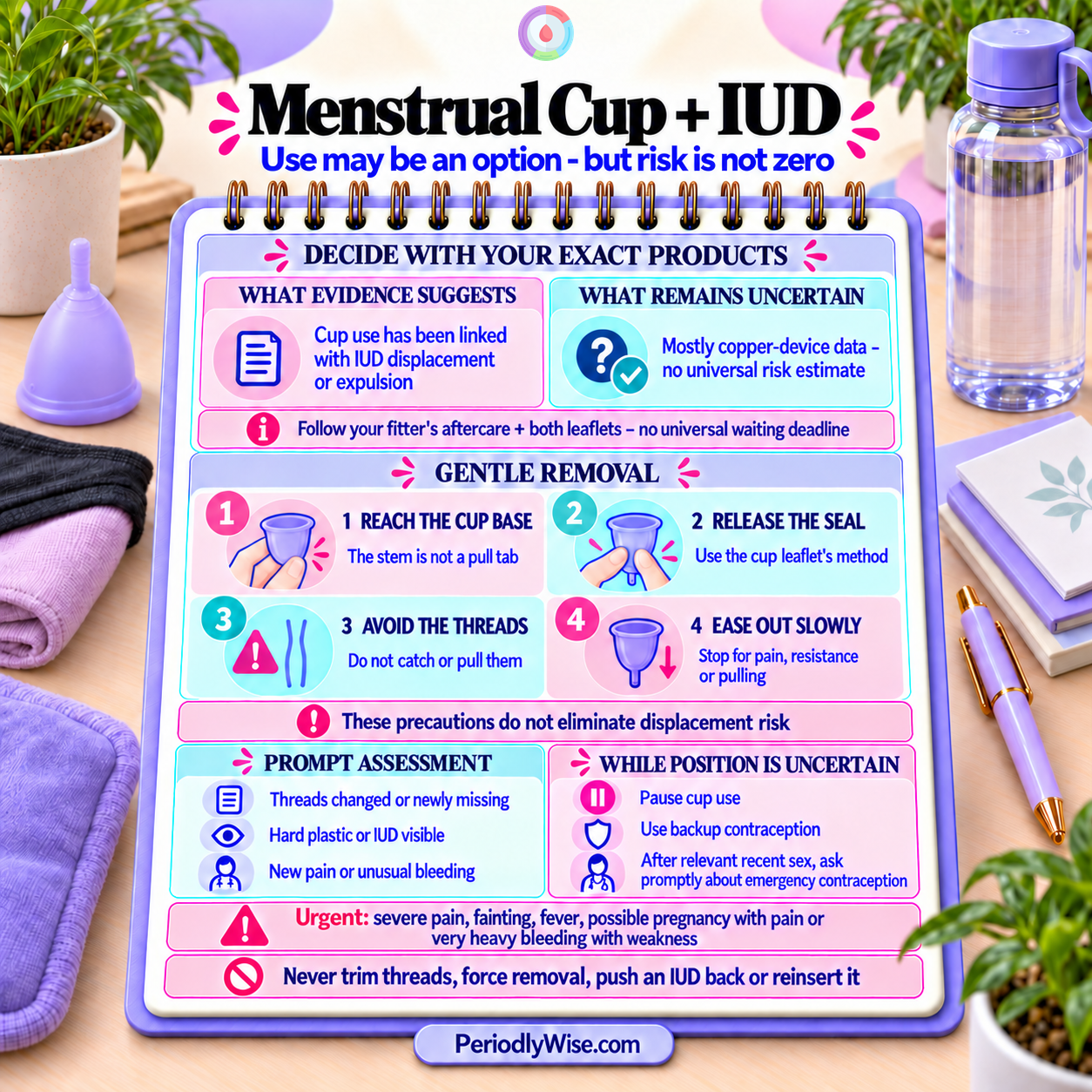
These are general precautions for someone whose clinician and product instructions support cup use. They are not a guarantee against displacement. For a concrete manufacturer example, Saalt's instructions say to release the seal by pinching the base and not pull the stem alone. Your own product may specify additional steps.
Do not keep testing the seal by tugging or pull harder because the cup is nearly full. The stem is a locating aid, not a handle for extracting a sealed cup. Avoid sweeping for threads or pinching tissue or anything string-like with the cup. If you cannot tell what you are holding, stop rather than guessing.
- Wash and rinse your hands. Choose a stable, comfortable position and allow yourself time to relax.
- Locate the cup base as directed by its manufacturer. Do not start by pulling downward on the stem.
- Release the seal using the product's recommended method, usually gently pinching the base. Avoid catching or pulling the IUD threads.
- Only once the seal is released, ease the cup out slowly while maintaining a comfortable grip. Stop for resistance, sharp pain or a pulling sensation.
- Empty and clean the cup according to its leaflet. Note concerning pain, thread changes or any visible IUD material; do not reinsert the cup while investigating a suspected problem.
- Seek clinical help if removal remains difficult or you suspect displacement. Never use tweezers, scissors or other tools inside the vagina.
Thread checks: useful, but not a home placement test
Ask the fitter to teach you what is normal for your device and how often to check. The NHS thread-check guidance describes checks after fitting and regularly thereafter. You are gently feeling for threads, not pulling them, fishing for them repeatedly or trying to feel the IUD's frame.
Threads that seem much longer, shorter or newly absent deserve assessment. Missing threads can have more than one explanation, including retraction; they do not prove expulsion. Conversely, being able to feel threads does not rule out every placement problem. A professional can decide whether an examination, pregnancy testing or ultrasound is needed.
Never cut or shorten IUD threads yourself. Do not copy advice to trim them flush with the cervix as a general cup solution. A clinician should weigh any adjustment and its implications for future removal. The cup's silicone stem and the IUD's threads are entirely different things; even cup-stem trimming should only follow its leaflet with the cup outside your body.
If you think the IUD moved: what to do next
Pause cup use and contact a sexual-health service, your fitter or another appropriate clinician promptly. Use condoms or avoid intercourse until the device and contraceptive plan have been checked. Do not pull the threads, push hard plastic back through the cervix, or reinsert an IUD that has come out. If the device falls out, keep it for the clinician if practical.
If you have had sex that could lead to pregnancy since a possible displacement, ask promptly about emergency contraception; do not wait for your next period or a home test. Timing, the device and any remaining hormone exposure can affect the choice. The NHS emergency-contraception guide explains why early advice matters. A pharmacist or clinician should help choose the appropriate option.
| What you notice | What it may mean | Next step |
|---|---|---|
| What you noticeNewly missing or clearly changed threads; hard plastic felt | What it may meanPossible position change, but threads alone cannot diagnose it. | Next stepPause internal products, use backup contraception and arrange prompt assessment. |
| What you noticeIUD visible in the cup or fully outside the body | What it may meanComplete expulsion or accidental removal; do not rely on it for contraception. | Next stepDo not reinsert it. Contact a clinician and ask about emergency contraception if recent sex is relevant. |
| What you noticePossible pregnancy with pelvic pain or unusual bleeding | What it may meanPregnancy complications need assessment, even without a positive home test. | Next stepSeek urgent medical advice; do not wait for an app prediction or another period. |
| What you noticeSevere or one-sided pain, shoulder-tip pain, fainting, collapse or very heavy bleeding with weakness | What it may meanPotential emergency, particularly if pregnancy is possible. | Next stepSeek emergency medical care now. |
| What you noticeFever, worsening pelvic pain or unusual/smelly discharge | What it may meanInfection or another problem may need treatment. | Next stepSeek urgent assessment and explain that you have an IUD and used a cup. |
What if the cup feels stuck?
A cup cannot travel freely into the abdomen through the cervix, but it can sit higher than is comfortable to reach. Stop repeated pulling. If you feel well, have no concerning symptoms and can comfortably reach it, a brief pause, relaxed position and the leaflet's gentle seal-release method may help. Do not use force or persist through pain.
If you still cannot remove it, contact a clinician promptly for help, especially when an IUD is present. Do not wait beyond the product's wear limit, and do not wait for that limit if you are unwell. Tell the service what product is in place, how long it has been there, whether you have pain and whether threads or plastic seem different.
Severe pain, faintness, fever or serious illness makes this an urgent problem, not a routine manufacturer-email query. Do not ask someone to pull the stem forcefully or use household tools. Clinical removal of a difficult cup does not automatically require removing the IUD; the professional can assess both separately.
Are menstrual discs, tampons or external products safer alternatives?
A menstrual disc sits differently and does not require the same suction seal as a cup. That does not prove it cannot interact with IUD threads or that it is risk-free. Cup studies cannot automatically establish disc safety. Discuss the exact disc and its removal method rather than swapping products on the assumption that no suction means no concern.
Tampons are not subject to a universal lifelong ban with IUDs, but follow your fitter's aftercare and tampon instructions, including its wear limit. Avoid catching threads during any internal-product removal. A tampon, cup or disc does not protect against pregnancy or sexually transmitted infections; the presence of one does not restore protection from a displaced IUD.
Pads and period underwear do not require vaginal insertion or removal around the threads. They can be useful while aftercare advice is unclear, symptoms are being checked or you decide how much uncertainty you are comfortable accepting. Choose products that suit your flow, comfort, budget and access; there is no obligation to use an internal reusable product.
Hygiene, wear limits and toxic shock symptoms
Follow the exact cup's cleaning, sanitizing, storage and replacement instructions. Wash your hands before handling it, keep any air holes clear as directed, and replace a damaged cup. Do not share it or use harsh cleaners that conflict with the leaflet. More aggressive cleaning is not automatically better for vaginal comfort or the product material.
Do not apply a universal 12-hour rule to every cup. The allowed maximum can differ by product and market; heavier flow may require emptying sooner. A listed maximum is not a target to reach despite discomfort, leakage or illness. Do not use a cup for postnatal bleeding unless your clinician and product guidance specifically support the situation.
Toxic shock syndrome is rare but can be life-threatening. Sudden fever, rash, vomiting or diarrhea, dizziness, confusion or rapidly feeling very unwell during internal-product use needs urgent medical help. Remove the product if you can do so without force, but do not delay care because removal is difficult. Severe symptoms, breathing difficulty, confusion or collapse require emergency help.
Does leaking, cramping or a full cup mean expulsion?
Not necessarily. Leakage can reflect a full cup, an incomplete seal or a fit issue; cramping and bleeding can have several causes. Copper and hormonal IUDs also affect bleeding differently. The important distinction is between a familiar manageable pattern and a new, persistent or severe change, especially one that begins during removal or accompanies changed threads.
Do not respond to new pain by forcing the cup higher, trying repeated hard pulls or selecting a stronger seal. Switch to an external product while seeking advice. Very heavy bleeding, worsening pain, fever, unusual discharge or pregnancy concerns deserve clinical attention even if you cannot identify a thread change.
Cup measurements can be useful context, but a partially spilled cup is not an exact blood-loss test, and reaching its capacity is not a diagnosis. Describe how often you need to empty or change protection, whether bleeding is affecting daily life, and any dizziness or weakness. You do not need to produce an exact milliliter total before asking for help.
What to track and take to an appointment
Keep a short factual record: IUD type and insertion date, cup model, when symptoms started, whether they occurred during removal, bleeding pattern and any noticeable thread change. Bring the product leaflet or device card if available. If contraceptive failure is possible, tell the clinician privately about relevant recent sex and medicines so time-sensitive options can be assessed.
A period tracker can organize dates and changes, but it cannot locate an IUD, confirm contraception, diagnose expulsion or rule out pregnancy. A predicted fertile window is not a backup method while placement is uncertain. Avoid recording more sensitive information than you need, and do not upload intimate photographs to try to prove a thread problem.
If pregnancy testing is advised, follow the appropriate timing and repeat-testing plan; the NHS pregnancy-test guide explains why timing matters. A negative test taken too early does not exclude a recent pregnancy and is not a reason to postpone emergency-contraception advice or urgent care for concerning symptoms.
Frequently asked questions
Can I use a menstrual cup with a copper IUD?
It may be an option after an informed discussion, but copper-device studies have found increased expulsion or displacement risk in some settings. The result depends on the device and study, not just whether it contains copper. Follow both leaflets and your fitter's advice; gentle seal release is a precaution, not a guarantee.
Is a cup safe with Mirena or another hormonal IUD?
Do not interpret limited hormonal-IUD evidence as proof of no risk. Hormonal devices also have threads and can move or be expelled. Discuss the exact model, insertion timing, symptoms and cup instructions with your clinician rather than assuming all hormonal devices share one verified risk estimate.
Does breaking the suction prevent IUD expulsion?
Releasing the seal before removal and avoiding the threads are important precautions, but neither is proven to eliminate expulsion or displacement. Do not pull a sealed cup down by its stem. If removal resists or hurts, stop and seek help rather than adding force.
Can I start using a cup six weeks after fitting?
Some services advise a six-week pause, but there is no universal evidence-proven deadline after which cup-associated risk disappears. Follow your own fitter's aftercare and both products' instructions. Ask for clarification if the advice conflicts, or if pain, bleeding or thread changes are present.
Should I trim my IUD threads to make cup use safer?
Never trim IUD threads yourself. There is no established thread length that guarantees safe cup use, and changing threads can affect later removal. Discuss any adjustment with a trained clinician. The cup's silicone stem is a separate part and must never be cut while inside your body.
What if my IUD comes out in the cup?
Do not reinsert it or rely on it for contraception. Use condoms or avoid intercourse and contact a clinician promptly. If recent sex could lead to pregnancy, ask immediately about emergency contraception rather than waiting for a test or period. Keep the device for assessment if practical.
Is a menstrual disc automatically safer with an IUD?
No. A disc does not use the same suction seal, but that difference does not establish zero expulsion risk or exclude contact with threads. Evidence about cups cannot be treated as proof about discs. Follow the exact product and clinician advice; an external product avoids internal removal around threads.
Can PeriodlyWise tell me whether my IUD has moved?
No. It can help organize period dates and changes, but it cannot verify device position, diagnose a complication or confirm contraceptive protection. New thread changes, hard plastic, concerning pain, bleeding or possible pregnancy require clinical assessment regardless of what the calendar predicts.
Use PeriodlyWise to organize actual period dates and changes you want to discuss with a clinician. Keep a separate note of your device and product instructions. Calendar estimates cannot verify IUD placement or replace contraception, pregnancy testing or urgent care.
Open the period trackerThe bottom line
A cup with an IUD is an individual decision involving a real, incompletely quantified risk. Identify the exact products, follow your fitting aftercare, release the seal before gentle removal and never pull or trim the threads yourself. No cup brand, waiting interval or technique guarantees against displacement.
If threads change, you feel hard plastic, the device comes out or symptoms concern you, pause cup use and get advice. Use backup contraception while placement is uncertain and ask promptly about emergency contraception when relevant. Severe symptoms or possible pregnancy with pain need timely medical care, not further tracking.