You can sleep with a tampon in only if the total time that specific tampon remains inserted stays within its label directions and never exceeds eight hours. Under FDA guidance, that usually means putting in a fresh tampon immediately before bed and removing it as soon as you wake. Time already worn before getting into bed counts toward the total.
That is not a universal permission for every night or every country. Health Canada advises not using tampons overnight, and an individual product may give stricter instructions. If your sleep could last longer than eight hours, you tend to snooze through alarms, or you are unsure when the tampon was inserted, an external pad or period underwear is the simpler option.
The concern is not that sleep itself changes the tampon. The issue is continuous wear time, absorbency, hygiene, and recognizing unusual symptoms. Toxic shock syndrome, or TSS, is rare, but it can progress quickly and requires urgent treatment.
Is an overnight tampon appropriate tonight?
| Situation | Safer decision | Why |
|---|---|---|
| You expect fewer than eight total hours from insertion to removal, and the label allows it | A fresh tampon may be used; remove it immediately on waking. | This stays within the FDA maximum, provided local guidance does not advise against overnight use. |
| You may sleep eight hours or longer | Use a pad or period underwear. | There is no safety buffer for falling asleep late, snoozing, or forgetting the insertion time. |
| The tampon was inserted hours before bed | Change it before sleep or switch to an external product. | Earlier wear time still counts. A bedtime alarm does not restart the clock. |
| Your flow is light and removal usually feels dry | Choose lower absorbency or external protection. | FDA guidance says to use the lowest absorbency needed; excessive absorbency can increase dryness and discomfort. |
| Your flow is very heavy and a tampon saturates before eight hours | Change it sooner and use backup protection; assess repeated heavy bleeding. | Eight hours is a maximum, not a target. Flow may require much earlier changes. |
| You live where official advice says no overnight tampon use, or the label says not to | Follow that instruction and use an external option. | Local regulators and the exact product label take priority over general online advice. |
| You cannot remember when it was inserted | Remove it now and use a fresh product only if you can track the next interval. | An unknown start time makes the total wear time unknown. |
| You feel feverish, dizzy, faint, confused, or suddenly very unwell | Remove it and seek urgent medical care. | These can be warning signs of TSS or another serious illness; do not wait for the eight-hour mark. |
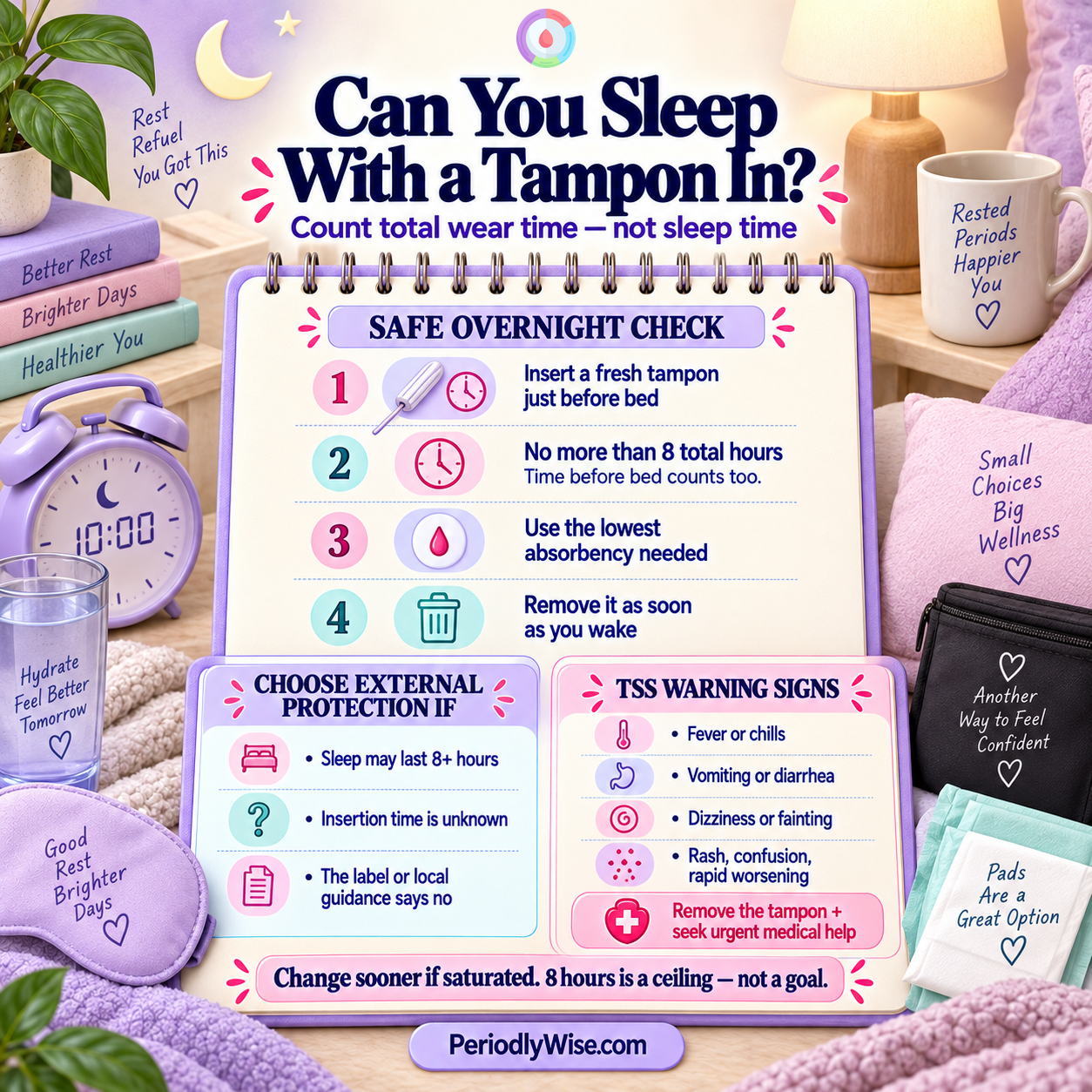
A practical bedtime routine
A simple sequence reduces guesswork. The package instructions remain the controlling directions for the exact product in your hand.
- Check the clock before insertion. Work out when eight total hours will end. If your realistic wake time is later, choose a pad or period underwear instead.
- Wash and dry your hands. Use a new, single-use tampon only during menstrual bleeding. Do not use a tampon for discharge or as a precaution before a period starts.
- Select the lowest absorbency that manages the current flow. Do not choose super absorbency merely because you are going to bed. Heavy flow may need earlier changing, not higher absorbency for longer wear.
- Insert it immediately before sleep. Note the insertion time in your phone or period record if timing is easy to forget.
- Use external backup if leaks are likely. Backup underwear or a pad can protect bedding, but it does not make a tampon safe beyond its time limit.
- Remove the tampon as soon as you wake. Wash your hands, dispose of it as directed, and do not flush it unless the manufacturer explicitly says the local system permits this.
- Reassess symptoms and flow. Pain, unusual discharge, strong odor, fever, dizziness, rash, or feeling seriously unwell needs attention rather than another tampon.
Why eight hours is a ceiling, not a goal
The FDA tells tampon users to change each tampon every four to eight hours and never wear one for more than eight hours. The interval depends on flow and product instructions: a saturated tampon should be changed earlier. There is no benefit to stretching a lightly used tampon to the maximum.
Use the lowest absorbency that works. If one tampon routinely lasts the full eight hours without needing a change, the FDA notes that its absorbency may be too high. A tampon that is too absorbent for the flow can feel dry or painful to remove and may irritate tissue.
The eight-hour limit is not a promise that every use below eight hours carries zero risk, nor does crossing eight hours mean TSS will automatically occur. It is a risk-reduction boundary. Do not treat nine or ten hours as an interchangeable routine because previous over-wear caused no symptoms.
- Count all continuous wear time, including reading, watching television, intimacy, and time spent awake before or after sleep.
- Change sooner when the tampon is saturated, leaks, feels uncomfortable, or the label gives a shorter interval.
- Do not insert a second tampon without removing the first; this can lead to a retained tampon.
- Do not reuse tampons. The FDA has not authorized reusable tampons.
- Alternate with external products when that makes timing, dryness, or comfort easier to manage.
What if you slept longer than eight hours or forgot a tampon?
Remove the tampon as soon as you realize it is still in. Wash your hands first, pull gently, and do not douche or put soap, disinfectant, or another object inside the vagina. If you feel well, an accidental over-wear does not by itself mean you have TSS or require emergency treatment. Record the approximate interval and pay attention to symptoms.
Contact a healthcare professional if you develop pain, fever, unusual or foul-smelling discharge, a rash, pelvic discomfort, or other unexpected symptoms. Seek emergency care immediately for the TSS warning pattern described below. Tell the clinician that a tampon was in place and for approximately how long.
If you are unsure whether a tampon is still inside, check calmly with clean fingers. A tampon cannot travel through the cervix into the abdomen, but it can sit high in the vagina or become compressed. Do not keep inserting new tampons while uncertain.
Toxic shock syndrome: rare, serious, and time-sensitive
TSS is a rare, life-threatening illness caused by toxins made by certain bacteria. It can occur in people who do not use tampons, but tampon use is a recognized context. Risk-reduction measures include following the label, clean hands, lowest effective absorbency, use only during a period, and never exceeding the wear limit.
Symptoms can develop quickly and may resemble a severe flu or stomach illness. You do not need to have every symptom, and a rash may look different or be harder to see on darker skin. If TSS is possible, remove the tampon and seek immediate medical help; do not drive yourself if you are faint or confused.
| Possible warning sign | What it may look like | What to do |
|---|---|---|
| Sudden fever or chills | A high temperature, feeling very hot, cold, or shivery, often with rapid worsening. | Remove the tampon and seek urgent medical care. |
| Vomiting or diarrhea | Abrupt gastrointestinal illness, especially with weakness or fever. | Treat the combination as urgent rather than assuming food poisoning. |
| Dizziness, fainting, or very low blood pressure | Feeling faint on standing, collapse, unusual weakness, or inability to remain upright. | Call emergency services; do not wait to see whether rest helps. |
| Widespread rash | A sunburn-like or rough, sandpaper-feeling rash; redness may be less visible on darker skin. | Seek immediate assessment, particularly with fever or illness. |
| Confusion or rapidly worsening illness | Not making sense, severe muscle aches, breathing difficulty, or feeling dangerously unwell. | This is an emergency even if wear time was under eight hours. |
Situations that need a different plan
Tampons are for menstrual blood, not for everyday discharge, spotting before a period, or postpartum lochia. After birth, miscarriage, abortion, pelvic surgery, or a gynecologic procedure, follow the care team's instructions about when anything may be inserted into the vagina. Internal products may be restricted while tissue heals or infection risk is higher.
People of any age who menstruate may use tampons if they can insert, wear, and remove them comfortably and follow the timing instructions. Using a tampon does not determine virginity, and the appearance of the hymen is not a valid test of sexual activity. A first-time user may prefer a slim, low-absorbency product while awake so removal and timing can be practiced without sleep pressure.
If you have had TSS before, ask a clinician whether to avoid tampons and other internal products. NHS guidance notes that the chance is higher after a previous episode. Recurrent infections, unexplained pelvic pain, difficulty removing products, or significant vaginal or vulvar irritation also deserve individualized advice.
- Use only during actual menstrual flow and only one tampon at a time.
- Stop if insertion or wear causes persistent pain; a correctly placed tampon should not be sharply painful.
- Never use sleep medicines, exhaustion, shift work, or an unpredictable alarm schedule as reasons to exceed the product limit.
- Ask a clinician about internal products after childbirth, pregnancy loss, surgery, procedures, or a previous TSS episode.
- Caregivers should teach adolescents both removal timing and emergency symptoms, without using fear or shame.
Overnight alternatives
The best overnight product is one that matches your flow, skin comfort, mobility, sleep length, local guidance, and ability to change it safely. Every product still requires its own instructions.
| Option | Why it may suit sleep | Important limit |
|---|---|---|
| External pad | No inserted product and easy to check on waking; overnight shapes may give more rear coverage. | Change when saturated and on waking; fragrance, heat, moisture, or adhesive may irritate some skin. |
| Period underwear | External protection with broad coverage and no tampon clock. | Capacity varies. Follow washing instructions and change sooner for saturation, leaks, or discomfort. |
| Tampon plus external backup | Can reduce bedding leaks when total tampon wear remains within instructions. | Backup does not extend the tampon's maximum wear time. |
| Menstrual cup or disc | Some products have different manufacturer wear limits and collect rather than absorb flow. | They are still internal products with their own fit, cleaning, removal, and TSS precautions; never assume a generic 12-hour rule. |
Common overnight tampon myths
Myth: Eight hours of sleep always means eight hours of tampon wear. Insertion before getting ready for bed and removal after checking messages or showering can make the real interval longer. Count clock time from insertion to removal.
Myth: A super tampon is safer overnight because it prevents leaks. Higher absorbency is not a license for longer wear. Use the lowest absorbency needed and change sooner when flow requires it.
Myth: If a tampon was left in too long, TSS is inevitable. TSS remains rare. Remove the tampon, avoid internal cleaning, and watch for symptoms. Emergency care is driven by warning signs, not panic alone.
Myth: A tampon can get lost inside the body. It cannot pass through the cervix into the abdomen, but it can be retained high in the vagina. Prompt clinical removal is appropriate when you cannot retrieve it safely.
Myth: Organic tampons remove TSS risk. Material or marketing terms do not replace wear-time, absorbency, hygiene, and symptom precautions. Follow the label for every tampon.
When to contact a healthcare professional
Arrange medical advice for a retained tampon, repeated difficulty with insertion or removal, persistent pain, unusual discharge or odor, vaginal sores, rash or swelling, fever, or symptoms that began while using a tampon. Also discuss periods that repeatedly soak a tampon every hour, last more than seven days, cause large clots, or bring dizziness, fatigue, breathlessness, or faintness.
A tampon does not cause every symptom that happens during a period. Pelvic infection, skin irritation, heavy menstrual bleeding, pregnancy-related bleeding, gastrointestinal illness, and other conditions can overlap. The product timeline is useful context, not a diagnosis.
Frequently asked questions
Can I sleep with a tampon in for seven hours?
Under FDA guidance, seven total hours may fit the four-to-eight-hour interval if the exact label allows it, you insert a fresh tampon just before bed, use the lowest absorbency needed, and remove it on waking. Follow stricter local advice; Health Canada says not to use tampons overnight.
What if I sleep for exactly eight hours?
Preparation and waking time can push actual wear beyond eight hours, leaving no buffer. An external pad or period underwear is more reliable when sleep itself may last eight hours.
Is nine hours with a tampon dangerous?
Nine hours exceeds FDA guidance, but it does not mean TSS will automatically occur. Remove it promptly, do not douche, and seek immediate care for fever, vomiting, diarrhea, dizziness, fainting, rash, confusion, or rapid deterioration.
Should I set an alarm to change a tampon overnight?
It is usually more practical to use external protection if safe timing would require interrupting sleep. An alarm can fail and does not change the wear limit.
Can I use a super tampon overnight?
Only when that is the lowest absorbency needed for your flow, total wear follows the label and stays at or below eight hours, and local guidance permits overnight use. Higher absorbency does not allow longer wear.
Can a teenager sleep with a tampon in?
Age alone is not the deciding factor. The user must be able to insert and remove it comfortably, track the total time, follow the label, and recognize TSS symptoms. Practicing while awake first may be easier.
Can I sleep with a tampon after giving birth?
Do not use tampons for postpartum lochia unless your maternity clinician has specifically said internal products are appropriate. Follow individualized guidance after birth, pregnancy loss, surgery, or a procedure.
Record period dates, flow, product changes, leaks, pain, and unusual symptoms so overnight choices are based on your real pattern rather than memory alone.
Open the Period TrackerThe bottom line
Sleeping with a tampon is conditional, not automatically safe or automatically dangerous. Under FDA guidance, the same tampon must never remain in for more than eight total hours, and shorter wear may be needed for flow, comfort, or the product label. Insert a fresh, lowest-effective-absorbency tampon immediately before bed and remove it on waking only when that schedule is reliably within the limit.
Use an external pad or period underwear when sleep may run long, timing is uncertain, the tampon was inserted earlier, or local guidance advises against overnight use. Know the signs of TSS, remove the product, and seek urgent care when sudden systemic symptoms appear.