The first period after giving birth does not follow one universal calendar. The NHS says it may return as soon as 5 to 6 weeks after birth if you bottle feed or combine bottle and breastfeeding. With full breastfeeding, including at night, periods may stay away until feeding becomes less frequent. Contraception, individual hormone recovery, and whether bleeding has truly stopped also shape what you see.
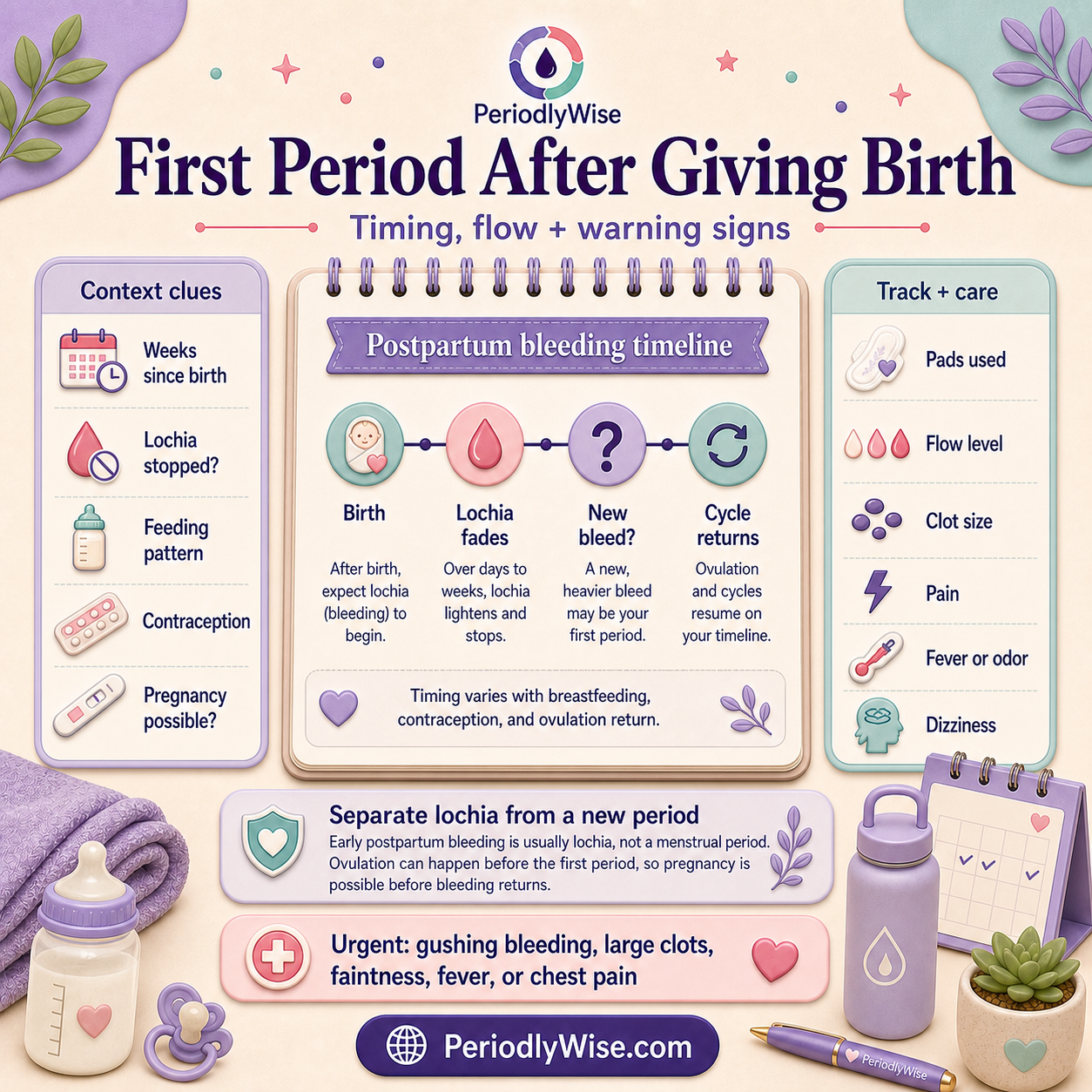
Before deciding that bleeding is a period, separate it from lochia, the normal blood and discharge that follow childbirth. Lochia is often heavy and red at first, then generally becomes lighter, browner or pinker, and eventually fades over several weeks. A fresh episode after a clear gap may be a period, but heavy or worsening postpartum bleeding should not be labeled a period without considering recovery complications.
This guide helps you build a safer timeline. It covers return timing, breastfeeding, contraception, flow changes, pregnancy risk, and warning signs. Your maternity team knows the details of your delivery, placenta, tears, surgery, anemia, and medications, so their instructions take priority over any general timetable.
Is it a period or postpartum lochia?
Lochia begins after birth because the uterus is shedding blood, mucus, and tissue as the placental site heals. It is not controlled by the menstrual cycle. It may be red and relatively heavy in the first days, become temporarily redder with breastfeeding or activity, and then gradually reduce and change color. The NHS advises using maternity or period pads rather than tampons until after the 6-week postnatal check.
A true menstrual period follows ovulation and usually appears after lochia has ended or clearly settled. It can be difficult to identify if postpartum discharge never fully stopped, if hormonal contraception is causing irregular bleeding, or if feeding patterns are changing. A calendar date alone cannot confirm which kind of bleeding it is.
Look at the whole pattern: days since birth, whether lochia had stopped, whether flow had been steadily fading, feeding frequency, contraception, pregnancy possibility, pain, fever, odor, and how quickly pads are filling. When in doubt during the first 12 weeks, contact your postpartum team rather than assuming a sudden heavy bleed is the first period.
Lochia and a returning period are not the same
| Clue | More consistent with lochia | More consistent with a period |
|---|---|---|
| Timing | Starts immediately after birth and continues for days to weeks. | Starts after ovulation, often after lochia has stopped or clearly settled. |
| Direction of change | Generally trends from heavier red bleeding toward lighter brown, pink, then pale discharge. | Usually forms a new episode of menstrual-type flow. |
| Breastfeeding effect | May look redder or heavier during feeds because the uterus contracts. | Frequent full breastfeeding may delay the cycle's return. |
| Contraception | Not caused by a monthly cycle. | Hormonal methods or an IUD can alter timing and flow. |
| Safety | Sudden heavy or worsening bleeding can be a postpartum emergency. | Heavy menstrual bleeding still deserves care, but early postpartum thresholds require extra caution. |
When can the first postpartum period return?
The timing mainly reflects when ovulation restarts, but it varies widely. The NHS states that bottle feeding or mixed feeding may be followed by a period as early as 5 to 6 weeks. Full breastfeeding, including night feeds and no bottles, can delay periods until breastfeeding is reduced. Some people resume earlier or later than these broad examples.
Breastfeeding is not an all-or-nothing switch. Longer gaps between feeds, stopping night feeds, adding formula or solids, and reducing overall frequency can allow fertility to return. Expressing milk may not have exactly the same contraceptive effect as direct frequent feeding. ACOG notes that ovulation can be delayed during breastfeeding but typically returns by about 6 months, while individual timing varies.
Postpartum contraception can change the bleeding pattern independently. Progestin-only pills, injections, implants, and hormonal IUDs can cause irregular, lighter, or absent bleeding; a copper IUD can make periods heavier or more painful. The date of a bleed therefore does not reveal fertility or recovery on its own.
Factors that can shift the timeline
- Feeding pattern: full day-and-night breastfeeding commonly delays ovulation more than bottle or mixed feeding.
- Changes in feeding: longer intervals, fewer night feeds, formula, or solids can coincide with cycle return.
- Contraception: postpartum hormonal methods and IUDs can change or suppress bleeding.
- Individual hormone recovery: bodies do not restart ovulation on the same schedule after pregnancy.
- Pregnancy: ovulation can happen before the first period, so a new pregnancy is possible without a previous bleed.
- Medical recovery: retained placental tissue, infection, thyroid changes, anemia, or another condition can affect bleeding and wellbeing.
What might the first period be like?
The first bleed may be heavier, lighter, longer, shorter, more crampy, or simply unfamiliar compared with your pre-pregnancy pattern. A single changed cycle does not establish a new normal. Sleep disruption, lactation, weight change, stress, contraception, and the gradual return of ovulation can all add variability.
Avoid promising yourself that every postpartum period should be heavier or that delivery permanently fixes cramps. Some people notice change and others return to a familiar pattern. What matters is the amount of bleeding, how you feel, whether it improves, and whether the pattern repeats over several cycles.
If bleeding is very heavy, do not rely on the label first period. ACOG warns that postpartum hemorrhage can occur up to 12 weeks after birth. Heavy or gushing blood, large clots, faintness, weakness, rapid heartbeat, pallor, or worsening pain needs urgent assessment.
What to notice during the first cycles
| Track | Why it matters | When to ask for help |
|---|---|---|
| Start and end dates | Shows whether bleeding is a new episode after lochia. | Bleeding that never settles, restarts heavily, or continues unusually long. |
| Pads used and flooding | A practical record is more useful than words like normal or heavy. | Soaking pads rapidly, gushing blood, or bleeding that limits basic activity. |
| Clot size | Small clots can occur, but size and repetition matter postpartum. | Clots as large as an egg, repeated large clots, or clots with heavy flow. |
| Pain | Mild cramps can accompany a period or uterine contraction. | Severe, worsening, one-sided, or persistent abdominal or pelvic pain. |
| Temperature and odor | Fever or foul-smelling discharge can suggest infection. | Temperature of 100.4 F / 38 C or higher, chills, tenderness, or bad odor. |
| Feeding and contraception | Both can explain delayed or irregular cycles. | Unclear pregnancy risk, troublesome side effects, or a method that does not fit your needs. |
How to track the first period safely
Keep the record simple enough to use while caring for a newborn, but specific enough to show a concerning change.
- Keep lochia in a separate record. Note the birth date, daily color and flow trend, clots, pain, temperature, and the date discharge fully stopped.
- Start a new period entry only for a new bleeding episode. If you are unsure, label it uncertain postpartum bleeding rather than forcing it into a cycle calculation.
- Record feeding context. Note full breastfeeding, mixed feeding, formula, night feeds, pumping, and major reductions in frequency.
- Add contraception and sex dates privately. Ovulation can precede the first period, so these details matter for pregnancy testing and contraceptive advice.
- Measure flow practically. Record pad changes, flooding, clots, cramps, dizziness, shortness of breath, and whether you can manage normal basic activity.
- Bring the timeline to postpartum care. Ask about bleeding, anemia, contraception, pelvic pain, breastfeeding, mood, and when your personal recovery history needs a different plan.
When postpartum bleeding needs prompt or urgent care
Seek emergency help for heavy or gushing bleeding, fainting, severe dizziness, confusion, chest pain, trouble breathing, a fast heartbeat with weakness, or severe abdominal pain. ACOG describes postpartum hemorrhage as much heavier-than-usual bleeding and notes it can happen up to 12 weeks after delivery.
Call your maternity team or clinician promptly for fever of 100.4 F / 38 C or higher, chills, worsening abdominal or uterine tenderness, foul-smelling discharge, increasing rather than decreasing bleeding, large clots, severe headache, vision changes, or pain and swelling in one leg. These can point to infection, hemorrhage, postpartum preeclampsia, or a blood clot.
For later cycles, arrange a non-emergency review if periods remain very heavy, last more than 7 days, cause fatigue or breathlessness, are repeatedly very painful, or your pattern worries you. Ask whether a blood count, pregnancy test, thyroid testing, contraception review, or other evaluation fits your history.
Separate lochia from a new bleed, then add feeding pattern, contraception, flow, clots, pain, temperature, and symptoms. Treat early estimates as provisional until several cycles return.
Open the period trackerFrequently asked questions
Can my first period come 5 weeks after giving birth?
It can, especially with bottle or mixed feeding, but bleeding at 5 weeks may still be lochia or a postpartum complication. Look at whether lochia had stopped, the flow pattern, symptoms, feeding, and your clinician's advice.
When will my period return if I am breastfeeding?
There is no exact date. Full frequent breastfeeding, including at night, often delays periods until feeds reduce. Mixed feeding, longer gaps, formula, solids, or fewer night feeds may allow an earlier return.
Can I get pregnant before my first postpartum period?
Yes. Ovulation happens before the period, and the NHS says pregnancy can occur from about 3 weeks after birth. Use contraception if you do not want another pregnancy.
Is the first period after birth usually heavy?
It may differ from your previous pattern, but not everyone has a heavy first period. Very heavy or gushing bleeding, large clots, faintness, fever, foul odor, or worsening pain should not be dismissed as normal.
Should I use tampons for my first postpartum period?
Follow your postpartum team's advice. The NHS recommends avoiding tampons until after the 6-week postnatal check because healing tissue and the placental site can increase infection risk.
The bottom line
The first period after birth can return within weeks or stay away for months, especially during full breastfeeding. The date alone is less important than separating lochia from a new menstrual episode and recording feeding, contraception, flow, clots, pain, fever, and odor.
Remember that fertility can return before bleeding does. Use contraception when pregnancy prevention matters, keep postpartum warning signs visible, and contact your maternity team whenever the pattern is heavy, worsening, painful, or simply does not feel right for your recovery.